Most airports want you to forget them. They are places you pass through, all the same gray carpet and the same coffee, deliberately unmemorable. Denver International Airport is the opposite. It has a nickname theorists use — "the New World Order headquarters" — an animatronic gargoyle that talks to travelers, and gift-shop merchandise that jokes about lizard people. It is arguably the only airport on Earth with its own body of folklore, thick enough to fill books and documentaries. And the strangest thing about that folklore is how much of it starts from things that are completely, verifiably real.
This is a Conspiracy Files entry, so we will do what these theories dislike most: separate the documented facts from the invented mythology, and look carefully at exactly where the line runs. Because the Denver airport is a near-perfect specimen of how a conspiracy theory is built. Almost every "clue" points at something that genuinely exists — an over-budget construction, buried buildings, an apocalyptic mural, a demon-eyed horse, a Masonic cornerstone. The facts are real. What gets invented is the thread that ties them into a single sinister plan.
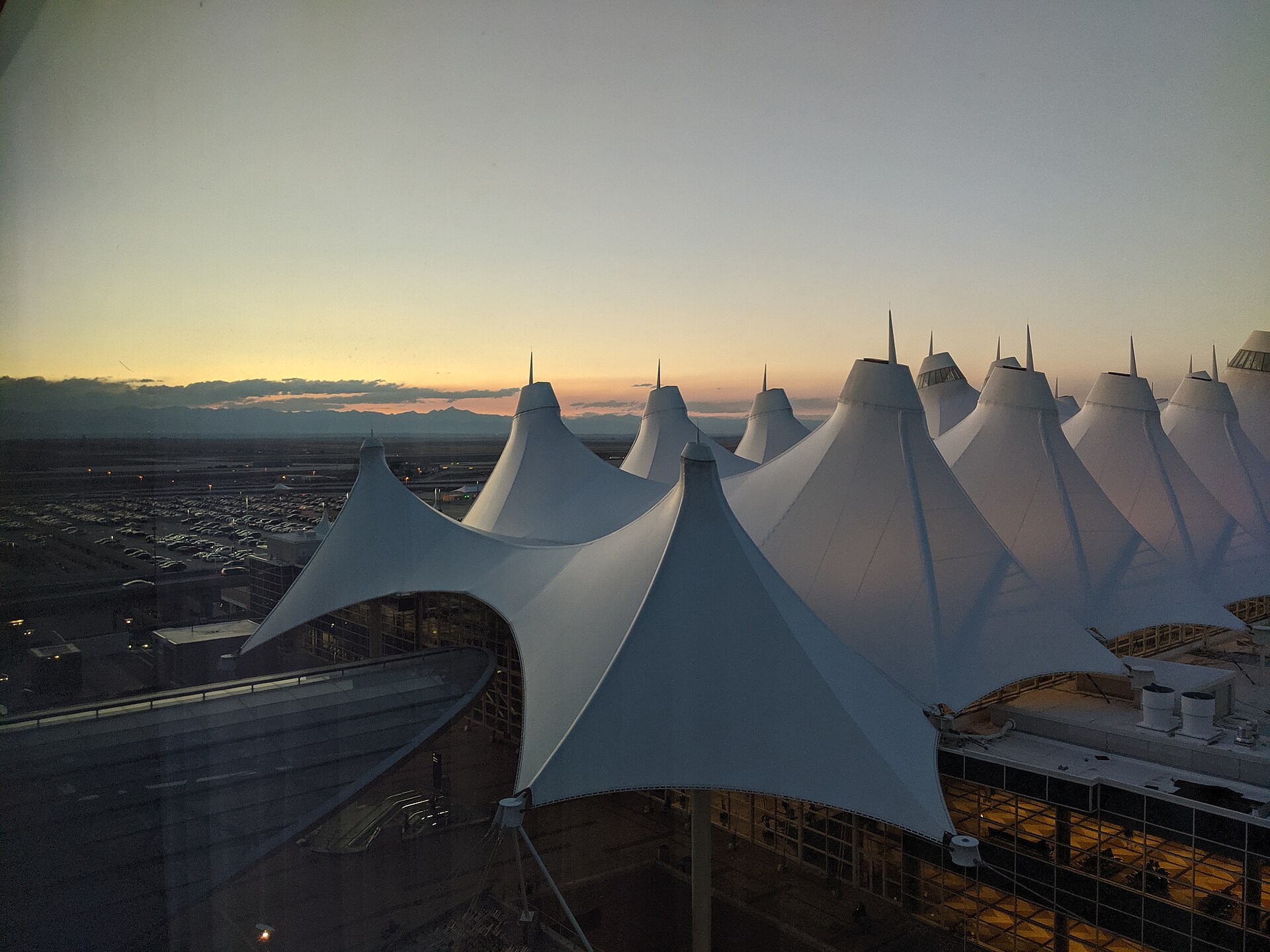
Photo: Wikimedia Commons, CC BY-SA 4.0
Denver sits in my archive under a heading I use for very few files: cases where the debunking is more disturbing than the theory. I started assembling it expecting an easy afternoon of corrections, and I spent most of that afternoon on the New World Airport Commission instead — a body whose papers sit in boxes at a public library, entirely findable, which for twenty years everyone repeated could not be found. Nobody had to hide anything. It was enough that nobody checked.
The Airport That Cost Too Much and Came Too Late
Start with the origin story, because even the boring facts are unusual.
Denver International Airport — DEN to airlines, "DIA" to locals — opened on February 28, 1995, replacing the city's old Stapleton airport. It opened sixteen months behind schedule. And it came in around two billion dollars over budget: originally projected at roughly 1.7 billion dollars, it ultimately cost about 4.8 billion. It sprawls across some fifty-three square miles, making it one of the largest airports by land area in the world — bigger than the island of Manhattan, larger than several small cities.
Now put yourself in the mid-1990s. A brand-new airport, colossal in scale, wildly over budget, opening far from the city on an enormous plot of empty prairie, more than a year late. To an ordinary observer that reads as bureaucratic dysfunction — the utterly normal way that huge public-works projects blow past their budgets and deadlines. But to a certain cast of mind, it reads differently. Why so much money? Why so much land? Why so far out of town? Why the delays? The gap between the official story ("a big project ran late and over budget, as big projects do") and the suspicious imagination ("something else was being built out here") is exactly the space where the Denver airport legend grows. Every fact in this file lives in that gap.
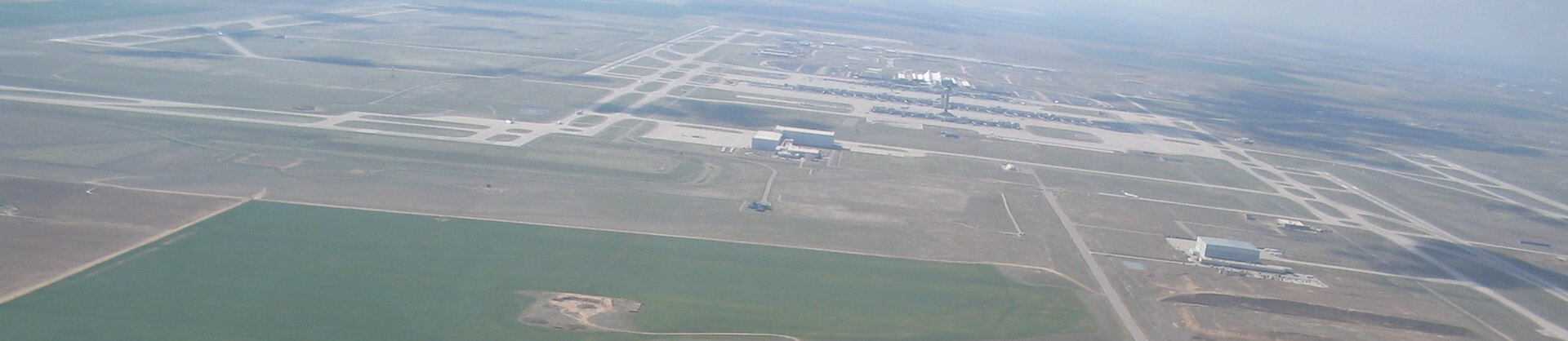
Photo: Wikimedia Commons, CC BY-SA 3.0
The Five Buried Buildings
Here is one of the theory's foundation stones, and it is true.
Beneath Denver International Airport there really are buried buildings — by the common count, five of them. During construction, structures were erected and then, rather than being demolished, were buried, with the airport built on top of them. To a conspiracy theorist this is a gift: entire buildings, sealed underground, out of sight. What are they for? A base? A bunker? A facility for something the public is never meant to see?
The official explanation is far more mundane, and it is the kind of thing anyone who has managed a large construction project will recognize instantly. During a build this size, structures get erected that turn out to be flawed, mispositioned, or simply not fit for the final design. Demolishing a large concrete structure and hauling away the rubble is expensive and slow. Often it is cheaper and easier to bury the mistake — to fill it in and build over it — than to tear it out. The buried buildings are, in this reading, construction errors and construction spoil, entombed because burying was the practical choice, not because they hide a secret.
Both things are true at once, and that is the whole point. The buildings really are down there. And the reason they are down there is almost certainly boring. The theory keeps the first fact and quietly discards the second, because "five buildings buried under an airport" is a far better story than "a contractor decided burying was cheaper than demolition."
Blucifer: The Horse That Killed Its Maker
If the airport has a single icon, it is the horse — and this one needs no exaggeration to be unsettling.
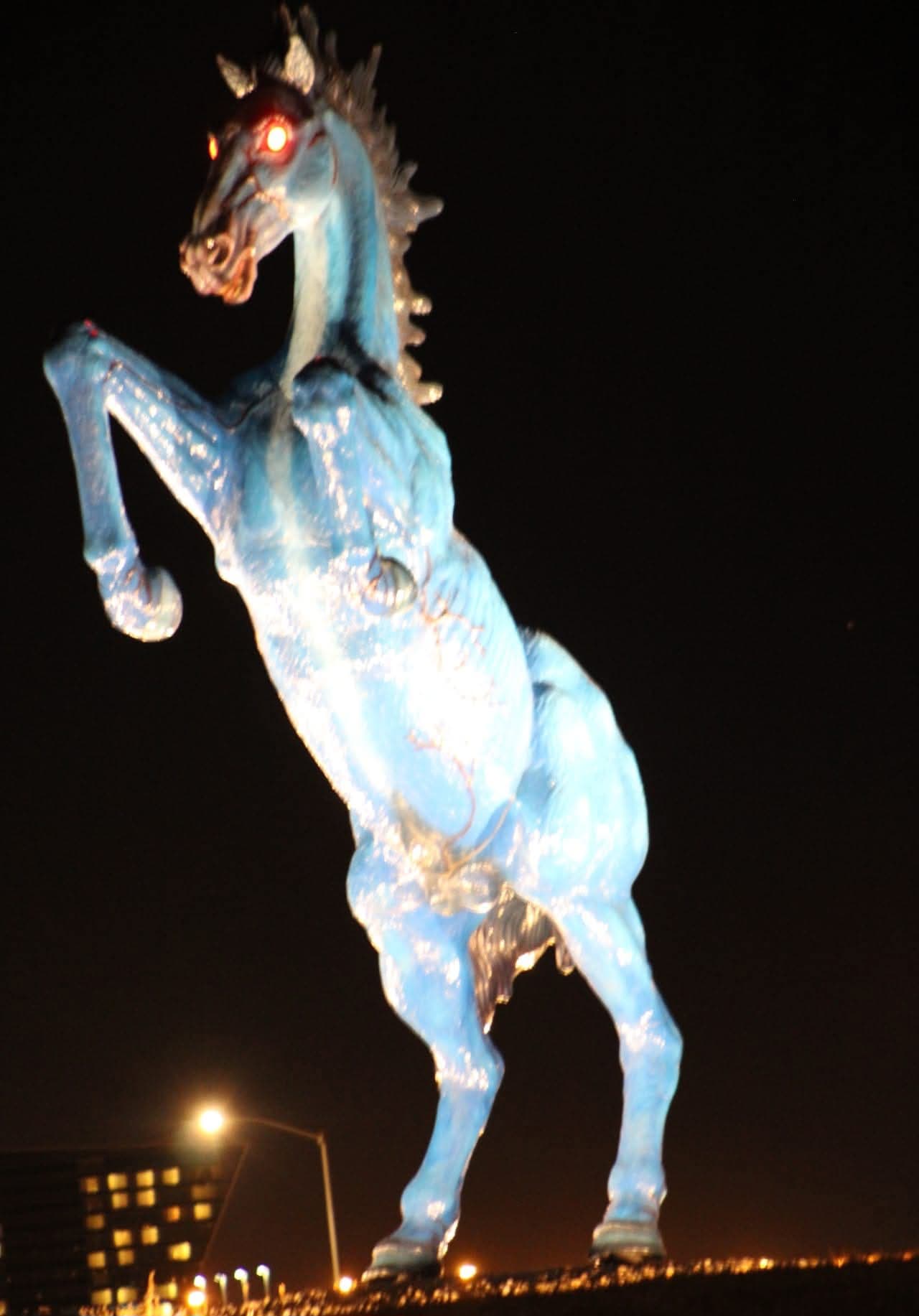
Standing near the entrance to the airport is a thirty-two-foot-tall sculpture of a rearing mustang, cast in fiberglass, painted a violent electric blue, its veins bulging, its eyes glowing red. Officially it is titled Blue Mustang. Almost no one calls it that. To travelers and locals it is Blucifer — a blend of "blue" and "Lucifer" — and it has also earned nicknames like "Satan's Steed" and the "Demon Horse." At night, with its red LED eyes burning against the dark, it looks less like public art than like something guarding a gate to somewhere you do not want to go.
And then there is the fact that turns the joke cold. The sculpture killed the man who made it. The artist was Luis Jiménez, a celebrated Mexican-American sculptor. In 2006, while he was working on the piece in his New Mexico studio, a section of the enormous horse came loose from a hoist and fell on him, severing an artery in his leg. He bled to death before he could reach a hospital. The mustang was completed by his family and studio and installed at the Denver airport in 2008. So the demon-eyed horse standing sentinel at the airport did, in the most literal and tragic sense, take the life of its creator.
This is where the theory is at its most honest and its most misleading simultaneously. Every disturbing detail is real: the glowing red eyes, the demonic nickname, the death of the sculptor. Nothing is invented. What the theory adds is meaning — the implication that a horse this ominous, that killed its own maker, must be a deliberate symbol, perhaps the pale horse of the apocalypse from the Book of Revelation, placed here as a warning or a signal. The truth is that a gifted artist chose bold, wild imagery, painted it a striking color, gave it glowing eyes for drama, and then died in a horrific studio accident. It is a genuine tragedy. It is not evidence of a plan. But a red-eyed horse that kills its creator is such a perfect horror image that the mind refuses to leave it at "accident."
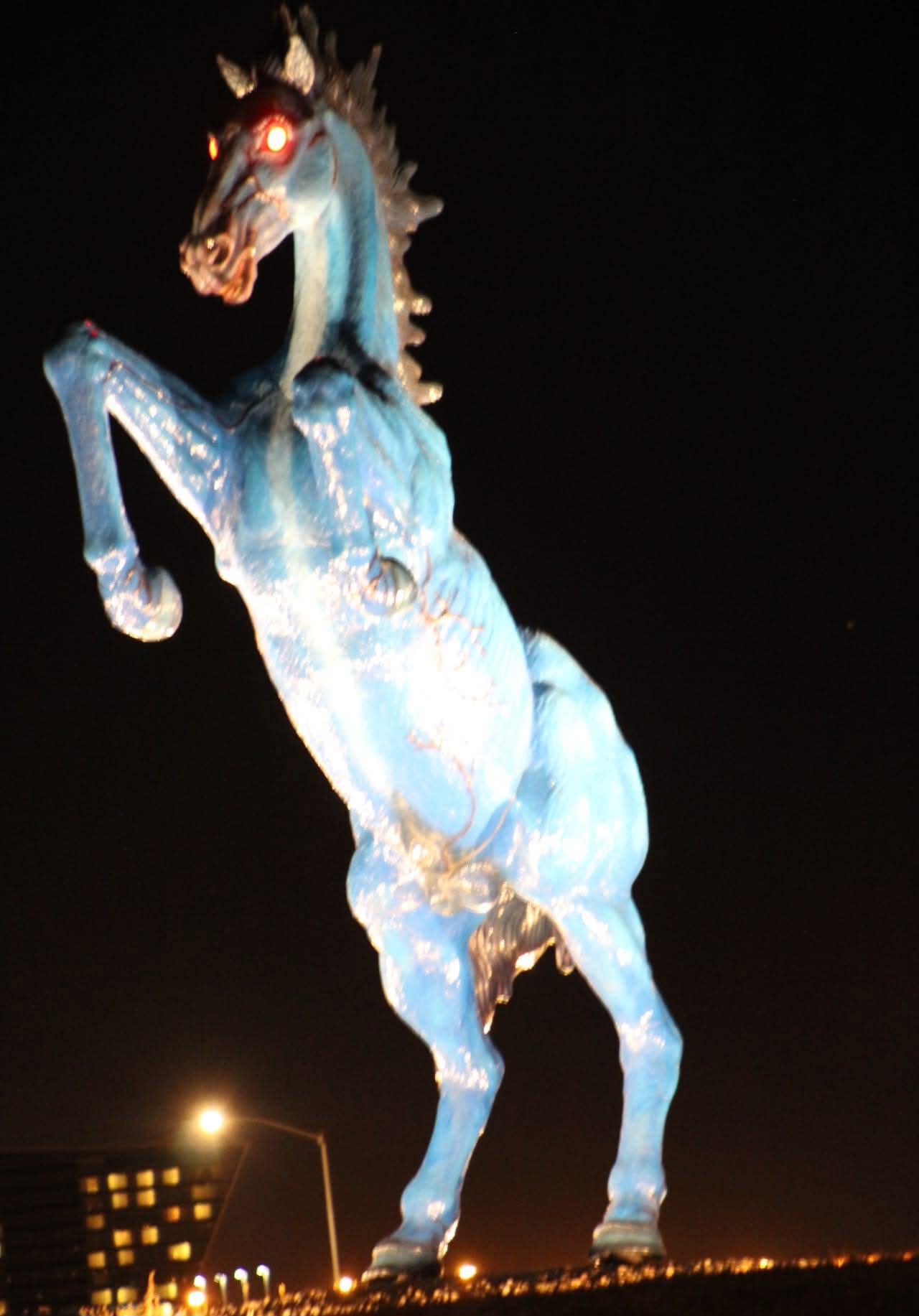
Photo: Wikimedia Commons, CC BY 4.0
The Apocalyptic Murals
Walk inside, and the theory finds its next anchor on the walls.
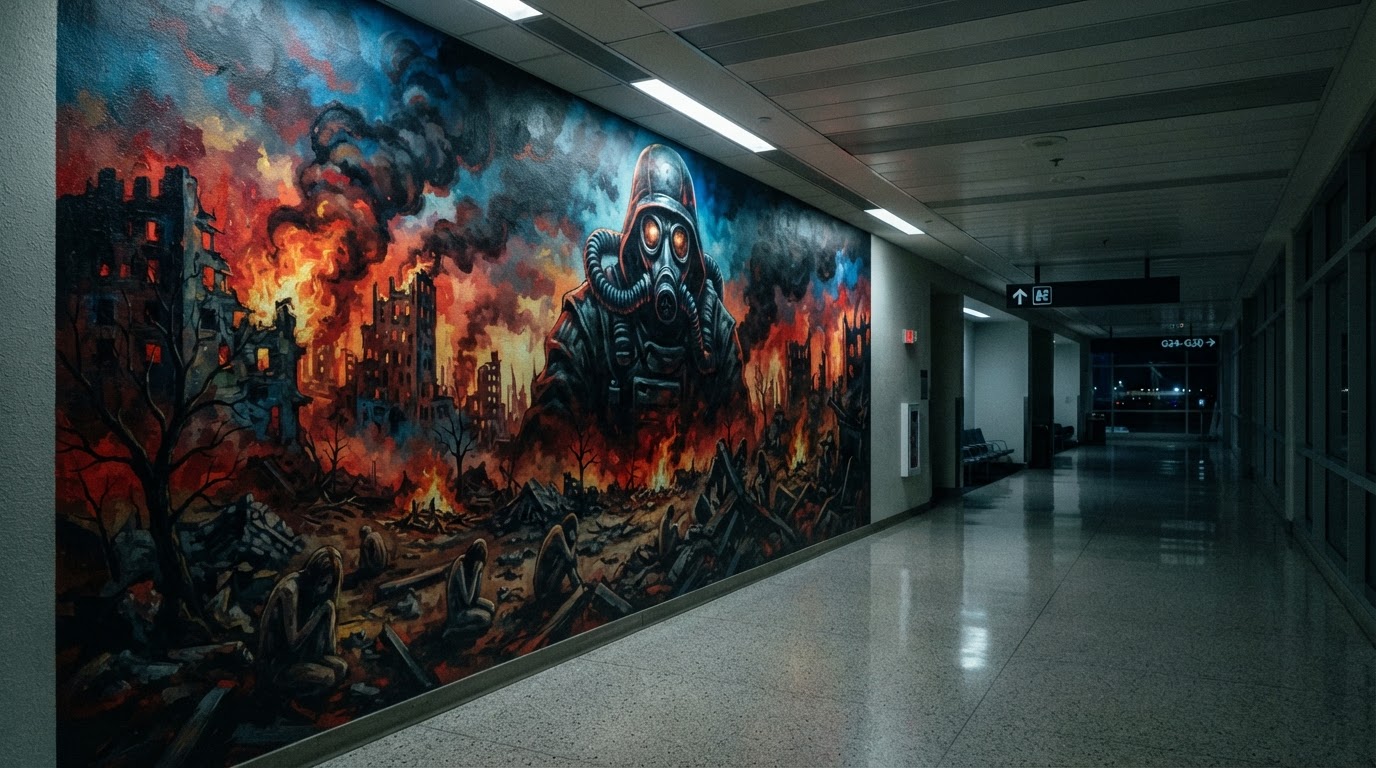
The airport commissioned large murals from the artist Leo Tanguma, and two in particular have become famous far beyond Denver: In Peace and Harmony with Nature and Children of the World Dream of Peace. Look at only one half of them and you can see exactly why theorists lost their minds. One panel shows a towering soldier in a gas mask, gripping a sword and a rifle, advancing over a devastated landscape — a burning city behind him, dead women lying in a coffin, weeping refugee children, animals sealed in glass cages, a dead forest. It is genuinely apocalyptic imagery, painted in vivid color on the wall of an airport, and to a suspicious eye it looks like a prophecy: war, genocide, environmental collapse, all foretold in the terminal of the "New World Order airport."
But that reading depends entirely on stopping halfway. Tanguma's murals are two-part narratives, and they are meant to be read as a journey from darkness into light. The gas-masked soldier, the burning city, the grief — that is the before. The other panels resolve the story: the children of the world gather, the soldier's sword is beaten down and laid aside, weapons are surrendered beneath a rainbow, the dead forest is replaced by flourishing nature, and humanity comes together in peace. Tanguma, a Chicano muralist whose work has always centered on social justice, has said plainly that his subject is the tragedy of war and environmental destruction — and the hope of overcoming both. The murals are anti-war and pro-environment. Their whole message is that the horror in the first panel gets defeated in the second.
The theory works by amputation. It crops the hopeful half out of the frame, keeps the nightmare half, and presents a work whose stated meaning is "war is a tragedy we can end" as if it were "here is the coming genocide, announced in advance." The imagery on the wall is real and it is disturbing on purpose — that is what political art does. What is invented is the claim that its purpose is prophecy rather than protest.
The Masonic Cornerstone and the Commission That "Never Existed"
Now we reach the detail that feels, more than any other, like a genuine smoking gun — and it rewards careful reading.
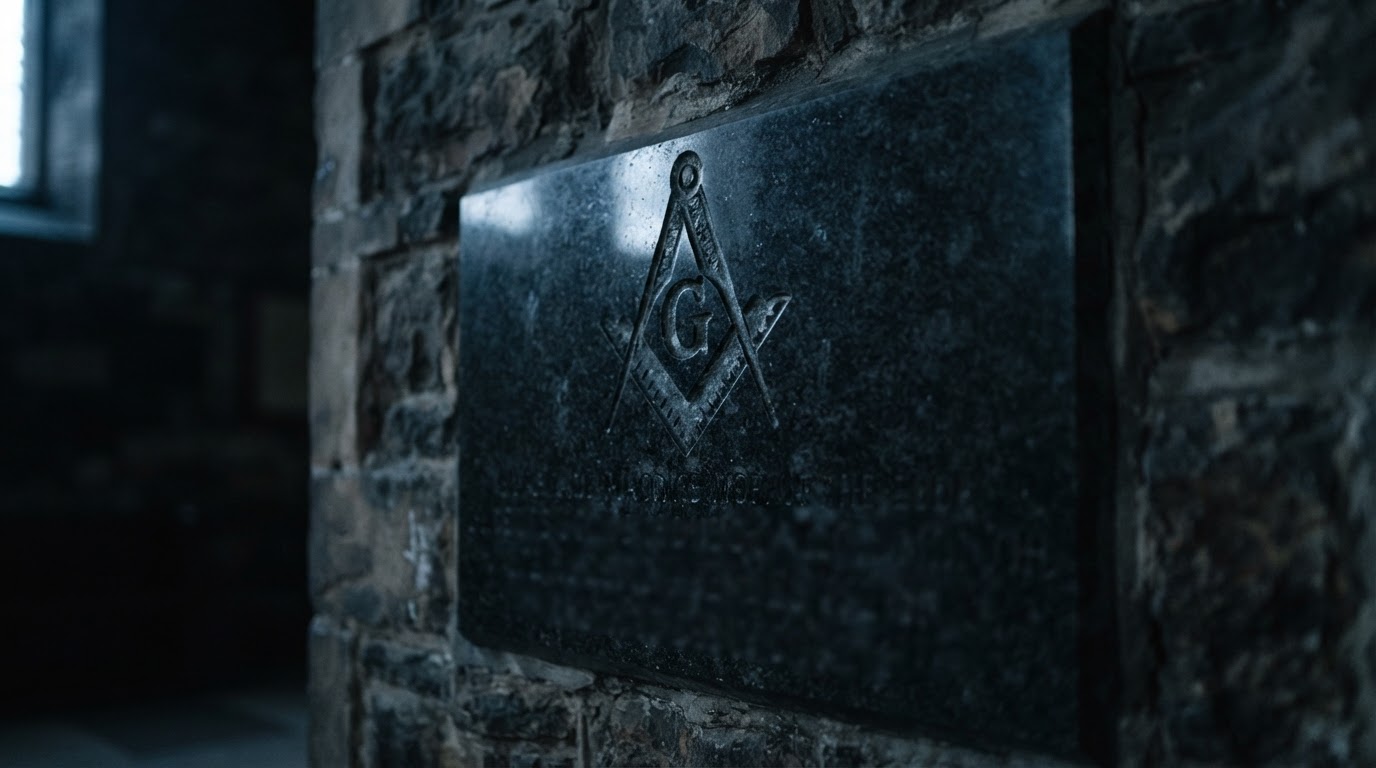
Set into the airport is a dedication capstone, a marker over a time capsule. Carved into it is the square-and-compasses emblem of the Freemasons, along with the names of two Masonic grand lodges and their grand masters. That much is straightforwardly documented: Freemasons were involved in the dedication ceremony, as they have been at cornerstone-layings for major American buildings since the founding of the country — George Washington himself laid the U.S. Capitol cornerstone in a Masonic ceremony in 1793. The Masonic symbol on the Denver capstone is real.
But the capstone also bears a line that sends theorists into orbit. It credits the airport's dedication to something called the "New World Airport Commission." And when people went looking for this organization, they reportedly could not find it. An official-sounding commission, carved in stone, that seemed not to exist anywhere on paper — combined with the phrase New World, so close to New World Order — looked like proof that the airport was quite literally a monument built by a shadow authority.
Here is the resolution, and it is well documented. The New World Airport Commission was a real, if temporary, body. It was formed to promote and organize the festivities around the airport's grand opening — a booster and event-planning group, not a secret government. It was disbanded shortly after the airport opened, which is precisely why later searchers, looking years afterward, struggled to find a standing organization: there was nothing left to find, because it had done its job and dissolved. Its archive genuinely exists; boxes of the commission's documents are held at the Denver Public Library, available to anyone who asks. And the name almost certainly nods to Antonín Dvořák's famous New World Symphony — a fitting, grand-sounding reference for opening a "new world" gateway to the city, not a coded announcement of global government.
So the smoking gun dissolves on inspection. The Masonic symbol is real but ceremonial and ordinary. The mysterious commission is real, but it was a party-planning committee that closed up shop, not a hidden ruling council. The word "New World" is real but points to a symphony, not a world order. Every brick is genuine; the wall built from them is imaginary.
The Tunnels, the Baggage System, and the Bunker for the Elites
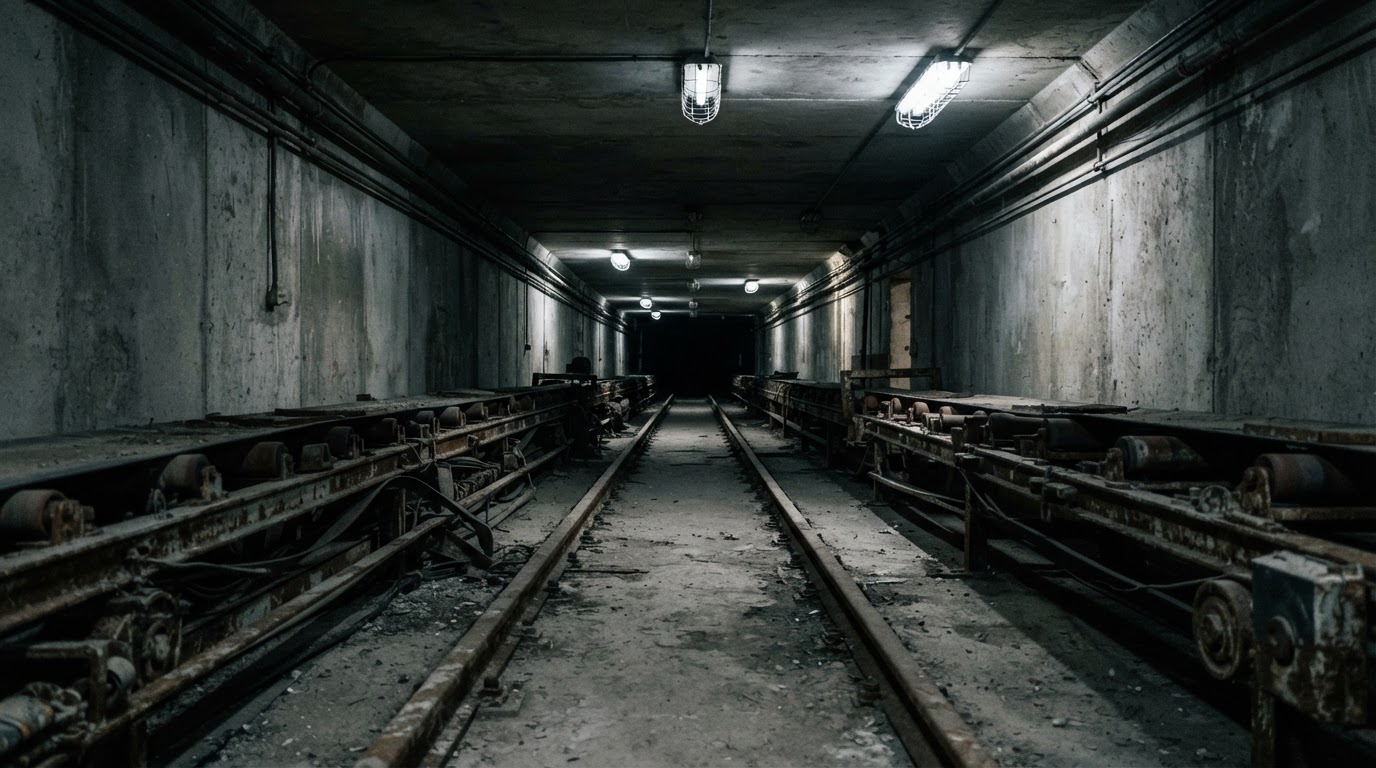
Beneath the airport runs a network of tunnels, and this too is real — hundreds of thousands of square feet of underground passages, traveled daily by staff, threaded with plumbing and electrical cabling. To theorists, tunnels this extensive can only mean one thing: an underground complex, a bunker where the world's elite will shelter when the apocalypse comes, connected to the buried buildings, sealed off from the ordinary travelers walking overhead.
The real explanation for those tunnels is one of the great engineering embarrassments of the 1990s. Denver was built to house one of the most ambitious automated baggage systems ever attempted — a vast, computer-controlled network of tracks and carts meant to whisk luggage across the sprawling airport with no human hands. It was a disaster. The system mangled bags, misrouted them, and jammed. Its failures were a major reason the airport opened sixteen months late and so far over budget. Engineers fought it for years, and it never worked as intended. In September 2005, it was finally scrapped entirely, and the airport went back to conventional baggage handling with human workers. What is left underground is the skeleton of a famous technological failure: tunnels and rails built for robot luggage carts that could never be made to work. Not a doomsday bunker — the abandoned plumbing of an over-ambitious dream.
That single fact quietly explains several of the airport's mysteries at once. Why the enormous cost overrun? Partly the baggage system. Why the sixteen-month delay? Largely the baggage system. Why the extensive, eerie, underused tunnels beneath the terminals? Built for a baggage system that failed. The "bunker for the elites" and the ruins of a broken luggage robot are the same tunnels, seen through two very different lenses.
Why the Airport Started Telling the Jokes Itself
Here is the twist that makes Denver unique among conspiracy magnets: the target got in on the joke.
For years the airport ignored the theories. Then, around a major renovation of its Great Hall, its marketing team made a decision almost no institution accused of housing the Illuminati would dare: they leaned all the way in. In 2018, the airport wrapped its construction barriers in a campaign that openly referenced the legends — signs pointing to "Illuminati Headquarters," jokes about "the lizard people's lair," images of Blucifer firing red lasers from his eyes, winking nods to aliens and Freemasons. The campaign was a viral sensation, generating hundreds of millions of media impressions worth millions of dollars, all without buying paid advertising. In 2019, for the airport's anniversary, they installed a talking animatronic gargoyle that greets travelers with lines like "Welcome to Illuminati Headquarters... I mean, Denver International Airport."
You can read this move two ways, and both are worth stating. The skeptic's reading: this is exactly what a smart institution does with an absurd myth it cannot kill — it defuses the fear by turning it into a punchline, because you cannot be frightened of a place that is laughing at itself. The theorist's reading, of course, is the mirror image: hiding in plain sight is the oldest trick there is, and mocking the truth is the most effective way to make people dismiss it. The very same gargoyle is either a clever PR joke or a taunt. This is the unfalsifiable engine at the heart of every conspiracy theory: any fact, and its exact opposite, can both be folded in as confirmation. The airport denies the theories — cover-up. The airport jokes about the theories — hiding in plain sight. There is no move the airport can make that the theory cannot absorb.
What's Real, and What Isn't
Let us lay the two columns side by side, because with the Denver airport the exercise is unusually clean.
What is real: the airport opened in 1995, sixteen months late and about two billion dollars over budget. There really are buried buildings beneath it. There really is a demon-eyed blue horse, and it really did kill its sculptor, Luis Jiménez, in 2006. The murals really do contain apocalyptic imagery — a gas-masked soldier, a burning city, dead children. There really is a Masonic capstone naming a "New World Airport Commission." There really is an extensive network of tunnels below the terminals. Every one of these is a verifiable fact, and that density of genuinely strange, genuinely true details is why this particular theory is so much stickier than most.
What is invented is the connective tissue. The buried buildings are construction spoil, not a secret base. The horse is a bold artwork and a studio accident, not the pale rider of Revelation. The murals are a two-part anti-war narrative that ends in peace, cropped by theorists to keep only the nightmare. The New World Airport Commission was a temporary opening-festivities group that disbanded and left its papers in a public library, its name a nod to a symphony. The tunnels are the wreckage of a failed automated baggage system, not a bunker for the elite. Each fact, restored to its context, becomes ordinary. Only when you strip the context away and lay the naked facts in a row does the sinister pattern appear.
There is one item in this file I have never managed to file cleanly, and it is Luis Jiménez. Everything else here resolves once you restore the context. His does not. A man spent years building a horse, the horse came off the hoist and cut the artery in his leg, and now it stands at the gate of the airport with its red eyes on and gift shops sell jokes about it. I have gone back over that sequence more than once looking for the place where it becomes a coincidence like any other, and I have not found it.
That is the whole architecture of the Denver airport conspiracy, and of a great many others besides. It does not need to lie, mostly. It needs only to select — to keep the unsettling half of each true thing and discard the explanation, then arrange the fragments until they seem to point the same direction. The airport is genuinely one of the strangest public buildings in America. The demon horse is genuinely there, and a man genuinely died making it. And the truth, examined honestly, is stranger and sadder and more human than the myth: a wildly over-budget megaproject, a doomed luggage robot, an artist killed by his own creation, and a political mural about peace that half the world decided to read as a prophecy of doom.
---
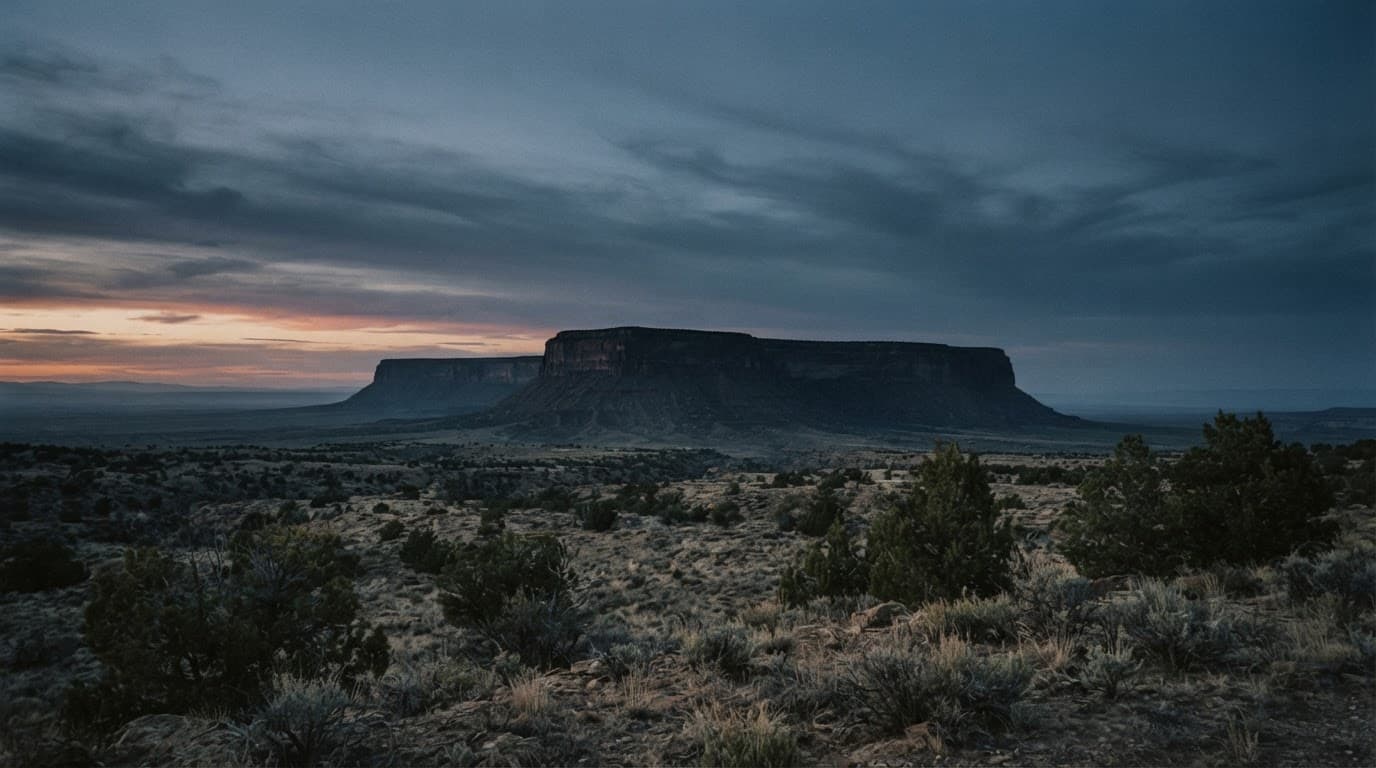
This article combines real photographs of Denver International Airport with AI-generated images and video produced to convey the mood of the story.
Comments
No comments yet — leave the first one.