There is something to say first.
This is a record of a case in which a real person lost their life.
We will not treat it sensationally, and will lay out only the confirmed facts and the questions that remain.
Even so, the reason this case has not been forgotten in fifteen years —
you will understand once you read it.
I have handled this file more carefully than almost anything else I keep.
What made me set it down and come back to it later was not the cross, but the blueprint — a drawing with the dimensions written in, made by a man who then wrote nothing else.
I have read the inventory of that scene more times than I can defend, and it is the ordinary items that stop me.
May 1, 2011 — Dundeoksan
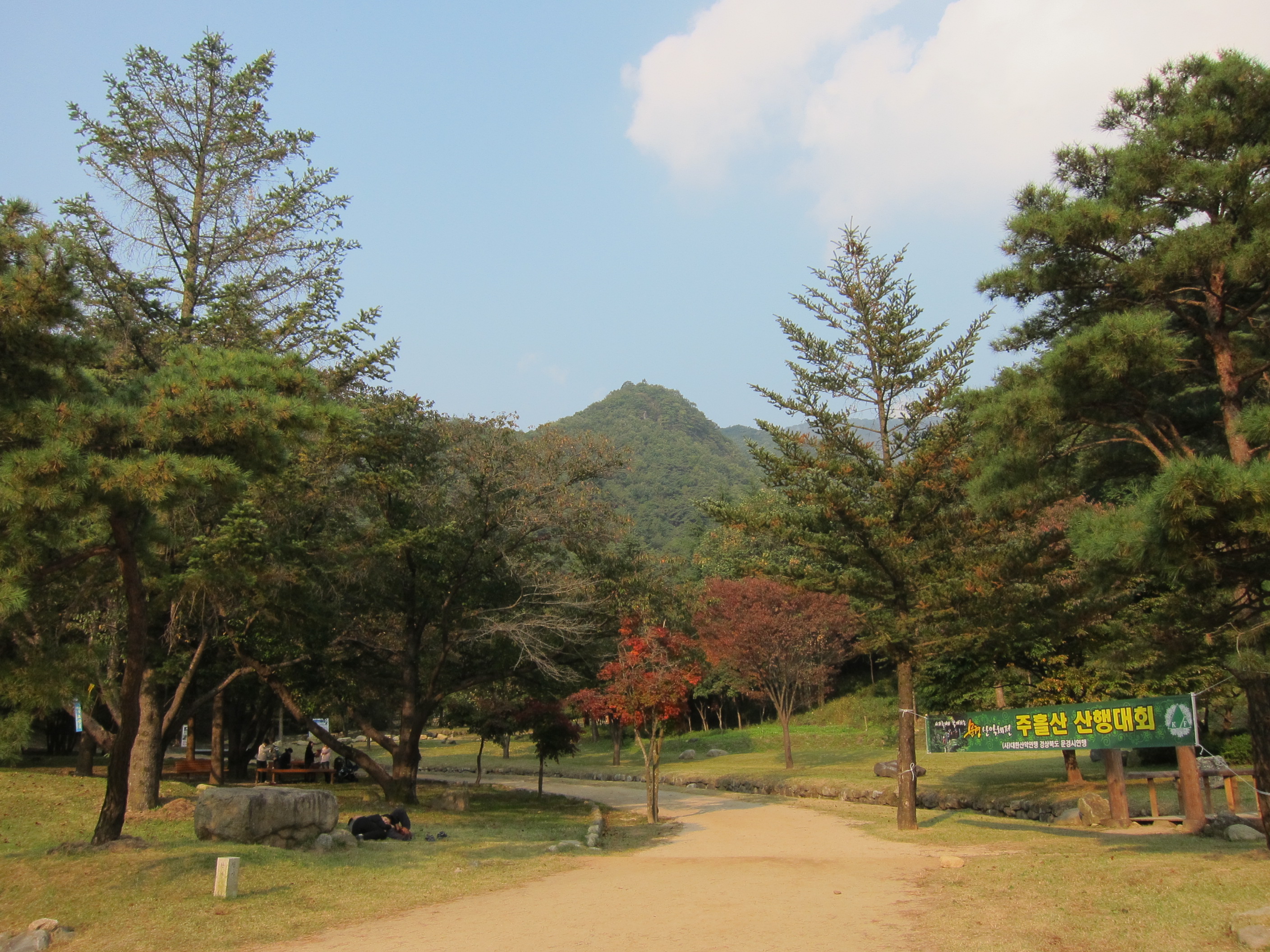
Gunggi-ri, Nongam-myeon, Mungyeong, North Gyeongsang Province.
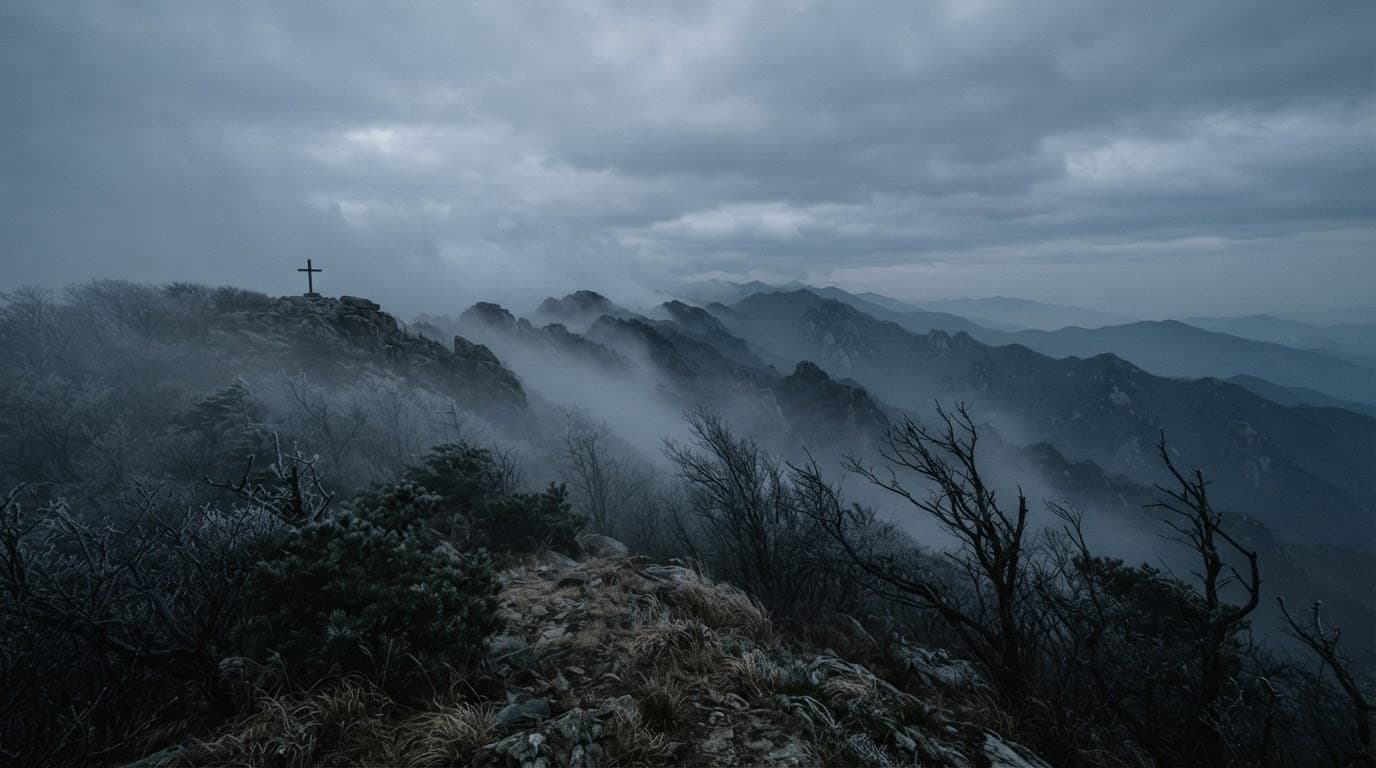
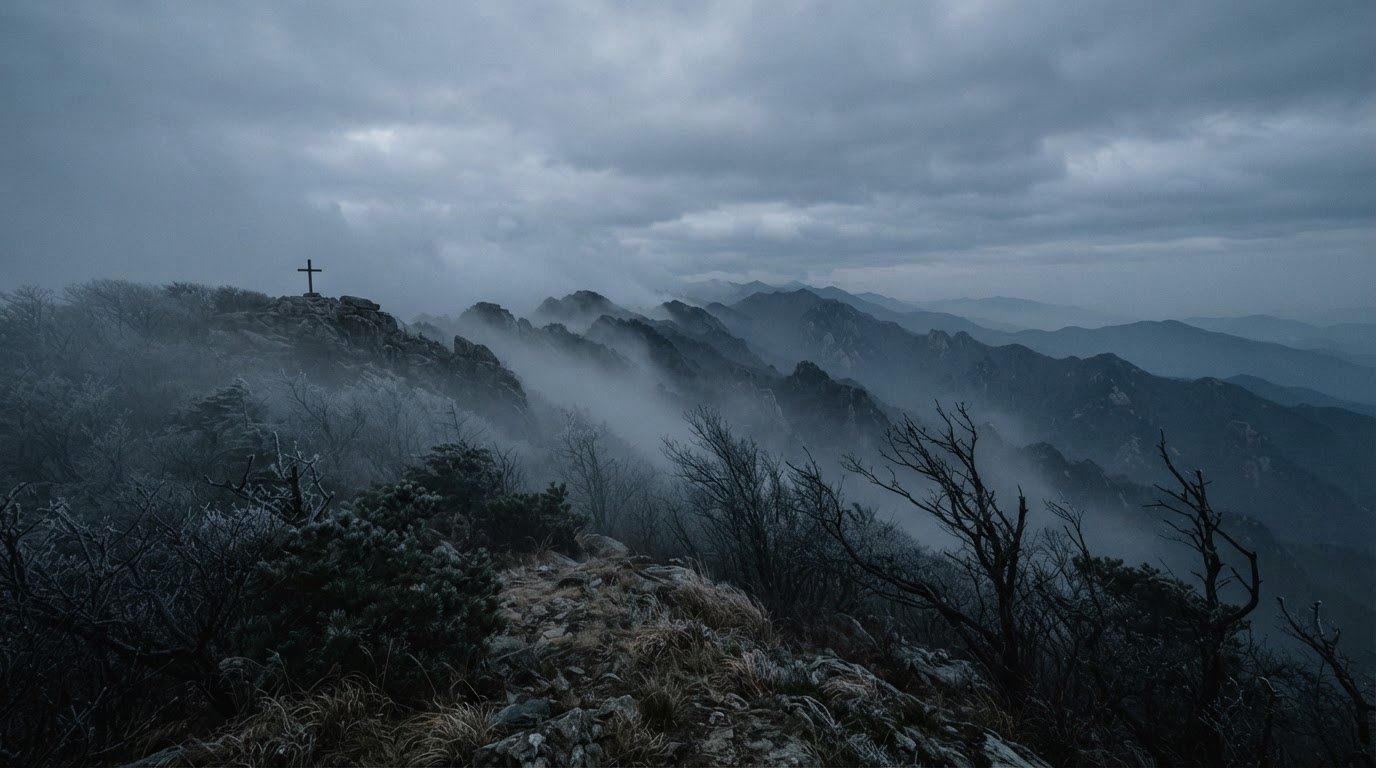
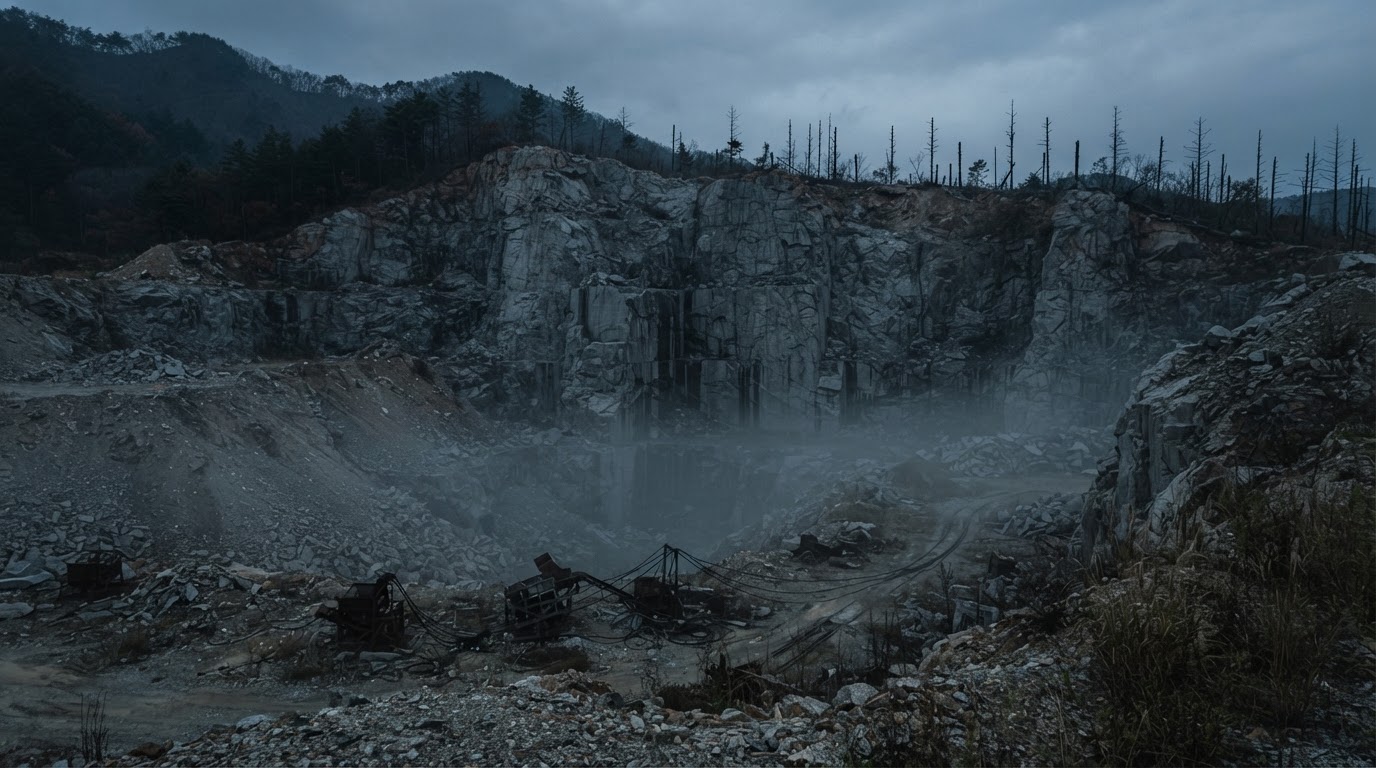
On a ridge of Dundeoksan, some 980 meters above sea level, there is an abandoned quarry.
Nothing but ash-gray cliffs half-cut for stone and loose gravel, a place off even the hiking trails.
That morning, a man in his fifties who kept bees nearby was passing through with his son to check on the hives —
and he found it.
A wooden cross, standing before a boulder.
And upon it, a person, nailed in place.
The scene
When the police arrived, the scene they found was stranger still than the report had said.
A handmade wooden cross, 187 centimeters wide, 180 centimeters tall.
The dead man, in white undergarments, hung from the cross with large nails driven through his hands and feet.
On his head, a crown woven from thornbush.
On the lower right of his abdomen, a wound more than ten centimeters long.
Around his neck, a cord.
And near the top of the cross, a wooden plaque had been fixed.
On it was inscribed a phrase meaning "Jesus of Nazareth, King of the Jews," written in Hebrew, Greek, and Latin — three languages.
The execution scene at Golgotha from two thousand years ago had been recreated, exactly as it was, in an abandoned quarry in North Gyeongsang.
The man
The dead man was a 58-year-old private taxi driver, Mr. Kim, who had come from Changwon, South Gyeongsang.
To those around him, he was known as an earnest, dependable man.
Once the investigation began, Mr. Kim's final months were reconstructed almost day by day.
That March and April, Mr. Kim sold the private taxi he had long driven.
He gave up the rented home where he had lived in Changwon.
He bought an SUV, and lumber to build the cross.
In early April, he bought a tent.
Then he went down to Mungyeong, spent several nights at an inn,
cancelled his phone and closed out his bank accounts.
The nine million won in his account he wired to his older brother,
and the last of it — the small change left in his wallet — he dropped into a charity donation box.
It was as if he were settling his accounts with the world, erasing them one by one.
Then he pitched a tent at the abandoned quarry and built the cross.
In his home and his vehicle, investigators found a cross blueprint he had drawn himself.
A blueprint marked precisely, down to the dimensions.
There was also a memo listing the order of steps for raising the cross.
But one thing, nowhere to be found.
A suicide note.
The objects at the scene
The objects recovered from the scene and its surroundings made the case stranger still.
A hand drill lay beside the cross; an electric drill was in the tent a little way off.
A mirror, thought to be for checking the position of his own body.
A whip, apparently handmade — cord twisted and wrapped in duct tape, a sign that he had tried to recreate the scourging Jesus endured.
About a hundred meters from the scene stood his SUV.
Inside were a hammer, a saw, a knife, wire, a week's worth of food and water, and twenty Choco Pies.
The supplies of a man who had prepared to hold out for days.
And one more thing few people know.
There was not only the one large cross, but two smaller crosses flanking it — the three crosses of Golgotha, set down exactly as they were.
From the arrangement of these objects and the marks of their use, the police built a single scenario.
A scenario in which all of it, Mr. Kim had done alone.
The Forensic Service's conclusion
The autopsy found the cause of death to be a combination of hemorrhaging from the abdominal wound and asphyxiation from the cord around his neck.
No poison was found in his body.
Traces of a heart medication and a sedative were detected, but nothing that would have paralyzed him.
Which meant he had done all this fully conscious.
The National Forensic Service even carried out a reenactment at the scene.
The reconstructed method: he set the nails into the cross first, drilled holes through his own hands, then fitted those holes onto the waiting nails.
With one hand already fixed in place, could a person deal with the other?
The conclusion of the experiment was: "It is possible."
On every piece of evidence at the scene only Mr. Kim's own DNA was found,
and handwriting analysis, too, turned up no trace of a third party.
On May 17, 2011, the police made their official announcement.
Suicide, acting alone.
The case was closed sixteen days after the body was found.
And yet, the questions that remain
The case was closed, but the questions were not.
This case reached the foreign press. It was reported around the world under headlines like "Easter Crucifixion," and it survives as its own entry in the English Wikipedia.
The questions people still ask tend to run like this.
To drive nails through both hands, one hand must necessarily come last. With a hand already nailed, could he handle a drill and nails?
The Forensic Service said it was possible. But "possible" and "he did it" are not the same thing.
Why is there no suicide note? From a man who left a blueprint and a memo of his steps.
And the twenty Choco Pies that lay in that place — what were they for?
That there might have been an accomplice, that someone of the same faith might have been watching over him — these are the theories that kept surfacing.
At one point, suspicion even fell on the man who first reported the scene.
He was a former associate pastor of a heterodox church, had been acquainted with Mr. Kim some years before, and after calmly photographing the scene, posted a detailed account of it online.
But the police investigation found that he had had no contact with Mr. Kim since long before, and that none of the evidence at the scene carried any trace of him.
In the end, he was ruled out.
Beyond that, the police investigation found no trace of any accomplice in the end.
Why that place
Over Mr. Kim's life lay a heavy shadow of religion.
It is said he had once done pastoral work, and that he later fell deeply into a faith of his own, outside the mainstream denominations.
There are also accounts of a sorrow in his family history, though nothing has been confirmed.
What is certain is the date he was found.
May 1, 2011.
A Sunday, just after Easter that year.
The cross, the crown of thorns, the wound in the side, the plaque in three languages.
What Mr. Kim recreated may not have been an execution but, perhaps, a resurrection rite of his own.
What he believed, and what he was waiting for on that mountain, no one can know now.
Before we close this file
The Mungyeong crucifixion case holds a peculiar place even among Korea's mystery cases.
It is not a case with a culprit. No one went missing.
Every piece of physical evidence points one way, and an official conclusion has been reached.
And yet the reason this case has not left people's memory in fifteen years,
is that why a human being made such a choice — the inside of that heart alone — is something no investigation can recreate.
An abandoned quarry, 980 meters up.
Through the months he spent hauling heavy lumber all the way up there and raising a cross to his own design,
what if there had been someone beside him who could have made him stop?
That may be the heaviest question this case has left behind.
When I close this folder I do not close it on the nails.
I close it on twenty Choco Pies and a week of food and water in a vehicle parked a hundred meters down the slope.
A man who had cancelled his phone, emptied his accounts, and given away the coins in his wallet still bought a week of food.
The official conclusion accounts for everything at that site except what he thought was going to happen next.
---
This article uses both genuine archival and on-site photographs and AI-generated images and video produced to convey the mood of the story.

Comments
No comments yet — leave the first one.