Early on the morning of June 30, 1908, the sky above a remote stretch of Siberian forest suddenly blazed like a second sun. High above the Tunguska River, an enormous object collided violently with the atmosphere and detonated in mid-air. The energy released is estimated at hundreds — by some measures as much as a thousand — times that of the atomic bomb dropped on Hiroshima. The blast wave flattened forest for tens of kilometers in every direction, shattered windows hundreds of kilometers away, and knocked people off their feet. And yet something was strange. An explosion of that magnitude should have punched a vast crater into the earth — but there was none. Nor were any large fragments of the object clearly recovered. It is the most powerful cosmic impact recorded in human history, and more than a hundred years on, the details of what caused it remain incompletely solved. This is the story of the Tunguska event.
1908, That Morning
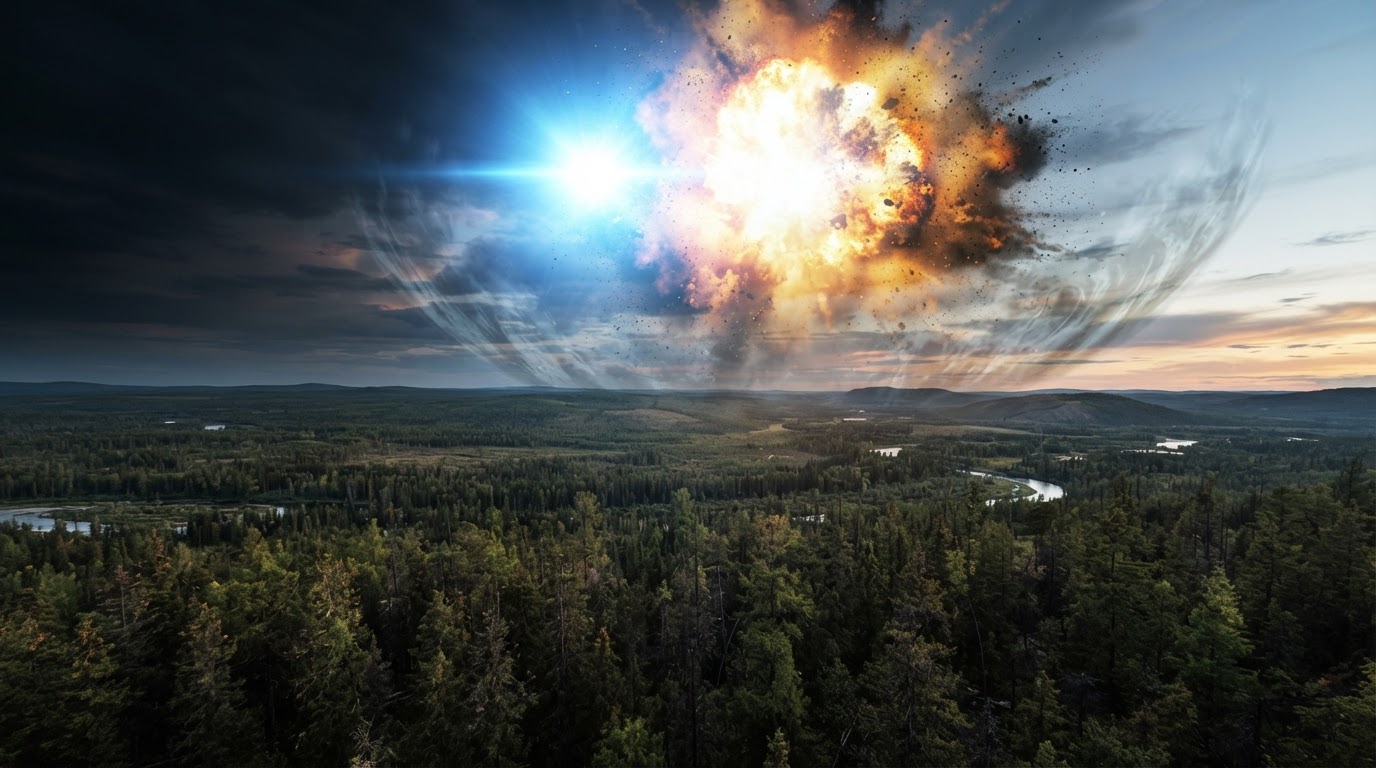
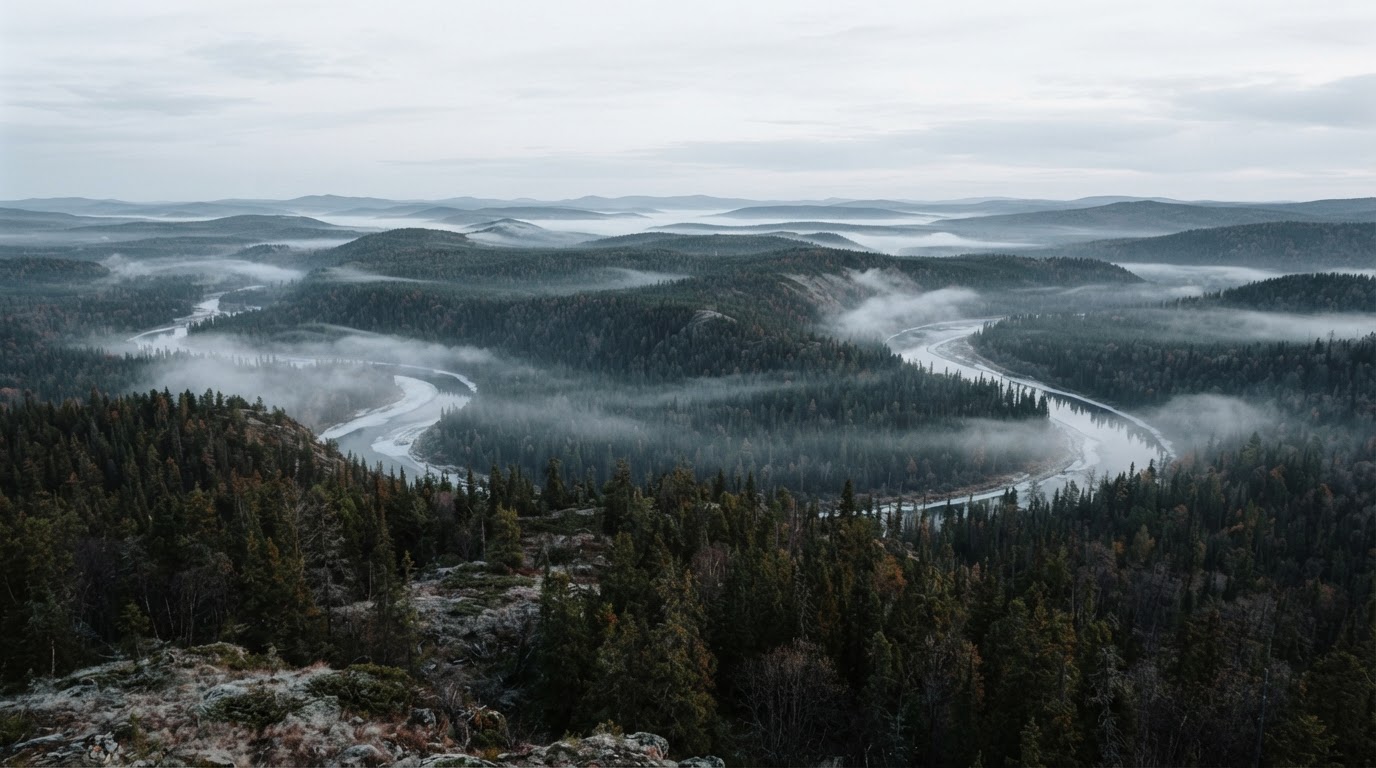
The event occurred in central Siberia, in the basin of the Tunguska River — more precisely, the Podkamennaya (Stony) Tunguska. It was primeval, sparsely populated taiga, home to a scattering of Indigenous reindeer herders and a few settlers. Shortly after seven o'clock local time, a colossal ball of bluish fire streaked across the sky. Witnesses said it was nearly as bright as the sun. It split the heavens and vanished beyond the horizon, followed by a sound like the sky tearing in two and a searing wind.
Semenov, a witness at a trading post roughly 65 km from the epicenter, said the sky seemed to catch fire and the heat felt as if it might set his shirt alight. The shock wave threw him from his seat. Closer to the blast, a man of the Evenki people (then called the Tungus) described repeated thunderclaps, trees falling with their branches ablaze, and what looked like a second sun in the sky. Seismographs thousands of kilometers away recorded the tremor, and the atmospheric pressure wave circled the globe twice, registering on barometers as far away as Europe.
The witness statements are what pulled me into this file, and they are what I keep returning to. Semenov, sixty-five kilometers out, describing heat that felt as though it would take his shirt. Nineteen years passed before anyone with instruments reached the site to ask him anything. I have compared the surviving transcriptions of those accounts against one another looking for the drift you always find in memory recorded that late, and the strange thing is how little there is. Men who could not have coordinated their stories described the same two-sunned morning, and by the time anyone was listening properly, most of them were old.
The Scale of the Fallen Forest
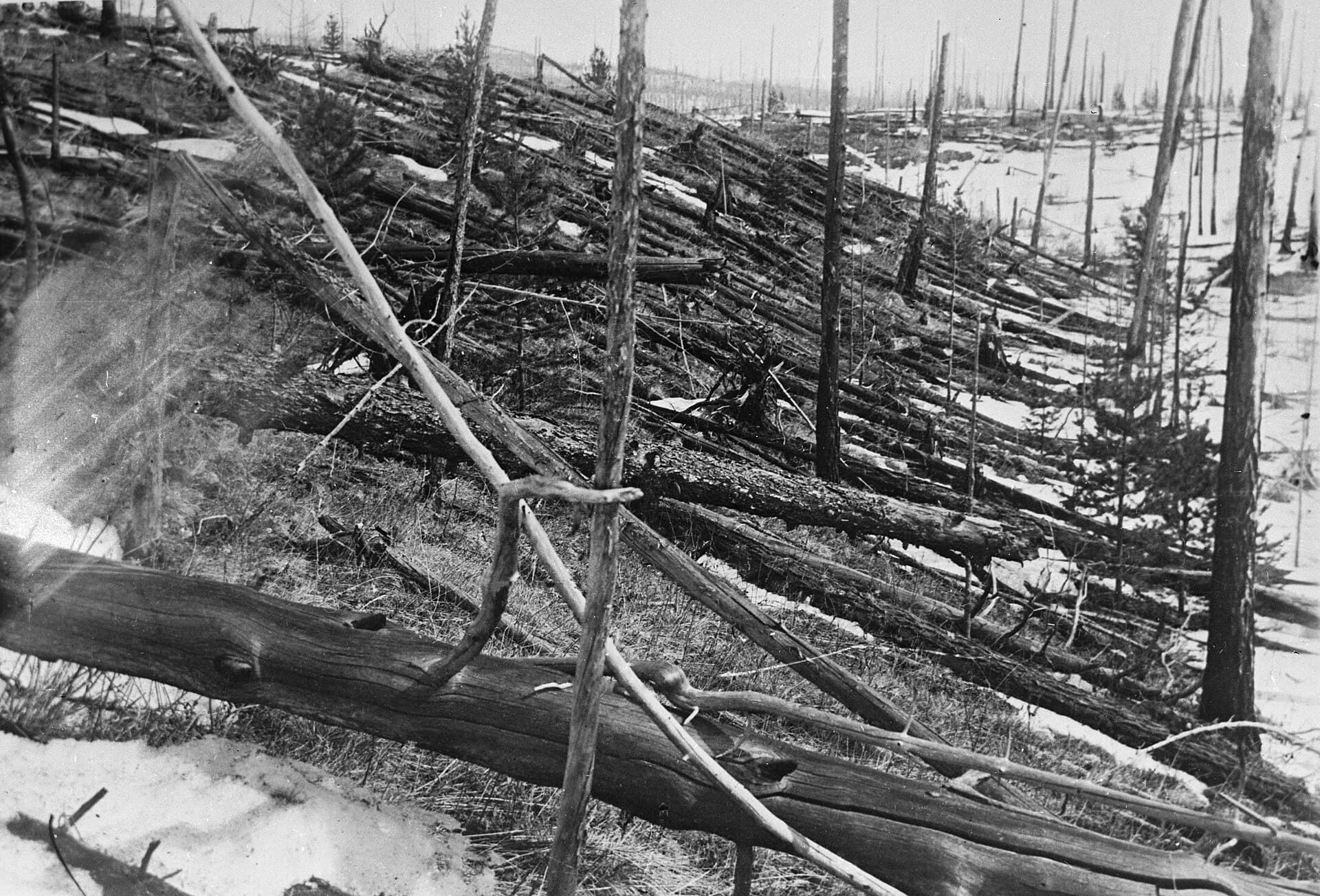
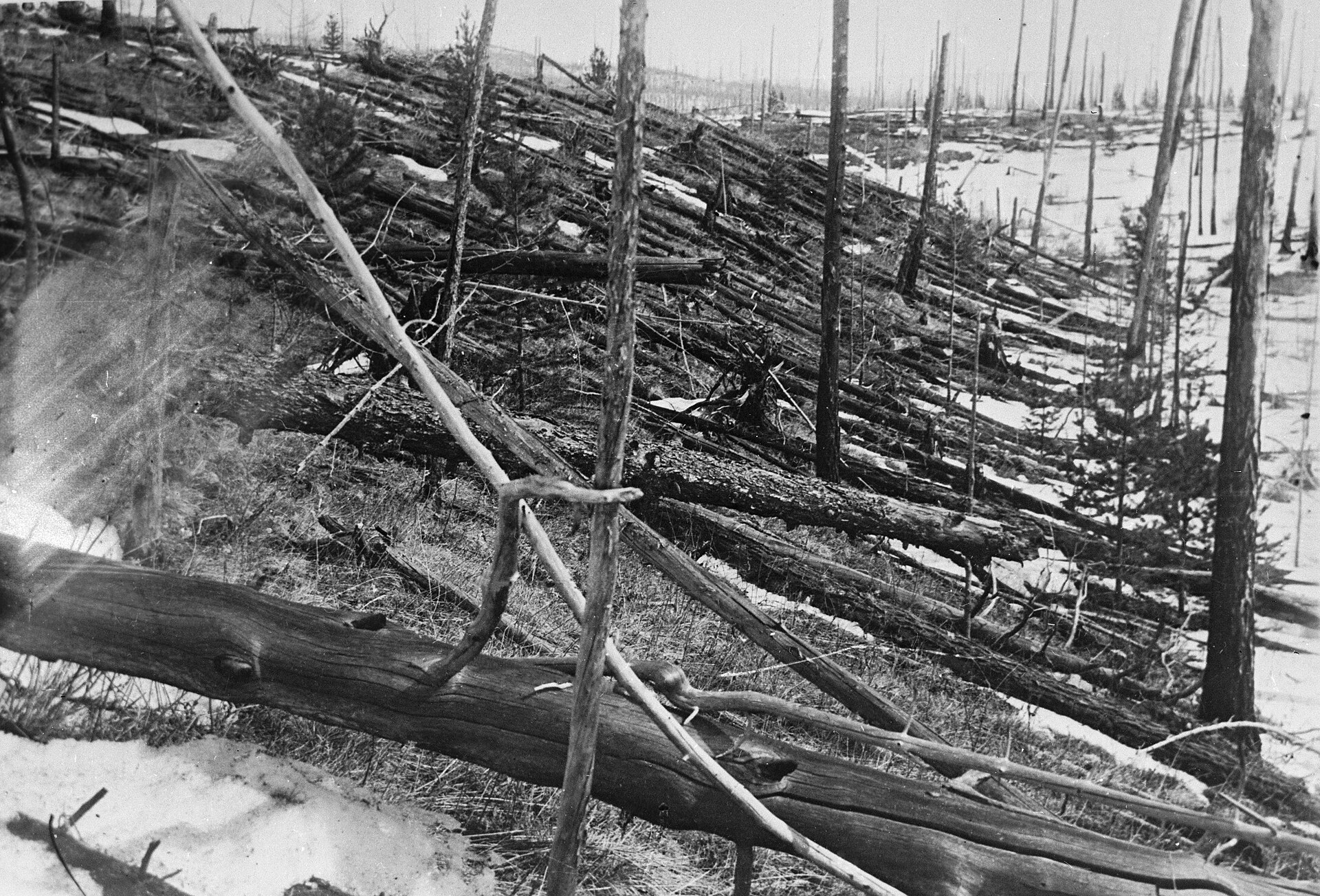
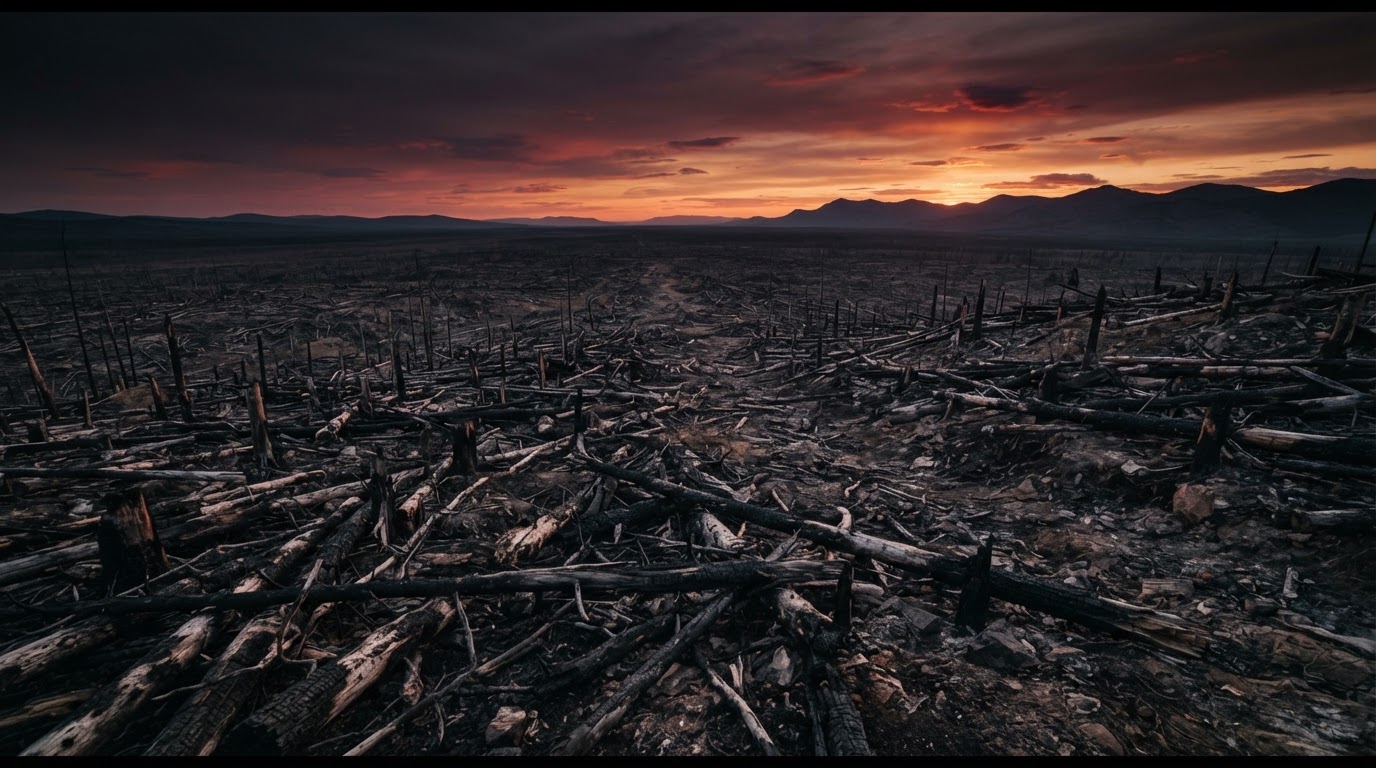
The scar the explosion left behind was almost impossible to imagine. Later surveys found that roughly 2,150 square kilometers of forest had been knocked flat by the blast — an area many times the size of a large city. The event is often described as felling some 80 million trees, though it is worth noting that this figure came from early estimates that appear to have overstated the true area of devastation. What is certain is that, across that enormous zone, millions of trees were thrown down in a single direction.
The most striking thing was the pattern in which they fell. Centered on the point below the blast, the trees lay in a radial, butterfly-shaped arrangement, splayed outward in every direction — exactly as one would expect from a shock wave spreading from a single point overhead. Stranger still was ground zero itself. The trees closest to the center were not toppled at all; they stood upright like a forest of poles, stripped of their branches and bark. This meant the explosion did not happen on the ground but high in the air, with the shock wave slamming down almost vertically. This clue — that it was an "airburst" — would later become the key to unlocking the mystery.
Twenty Years Later: The First Expedition and the Missing Crater
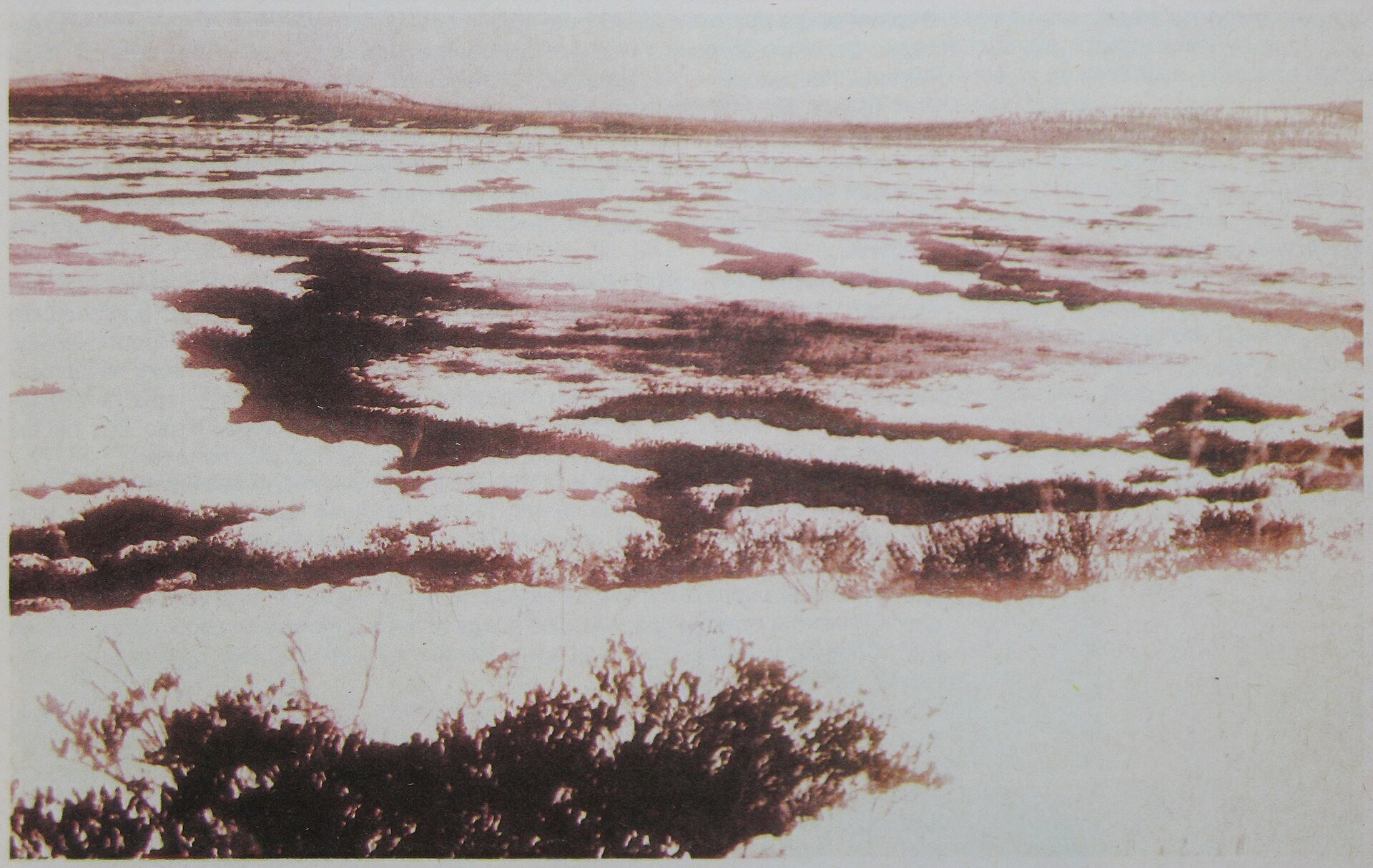
Because the blast struck such a remote region — and because Russia was soon consumed by revolution and war — serious scientific investigation came only much later. The Soviet mineralogist Leonid Kulik first set out to survey the area in 1921, but the harsh terrain stopped him well short of the blast center. He did not finally reach the heart of the explosion until 1927, nearly twenty years after it happened.
Kulik entered the site expecting to find a deep crater gouged out by a giant meteorite buried in the ground. Instead, what met him was an ocean of dead trees stretching to the horizon, all felled in one direction. The crater he expected simply was not there. He drained several boggy pits near the center, suspecting them to be meteorite holes — but at the bottom of one he found an old tree stump, proof it was no impact crater. Despite repeated expeditions, no massive meteorite lodged in the earth and no crater it had made were ever found. That very absence is the starting point of the Tunguska mystery.
What Exploded — The Mainstream Airburst-Asteroid Explanation
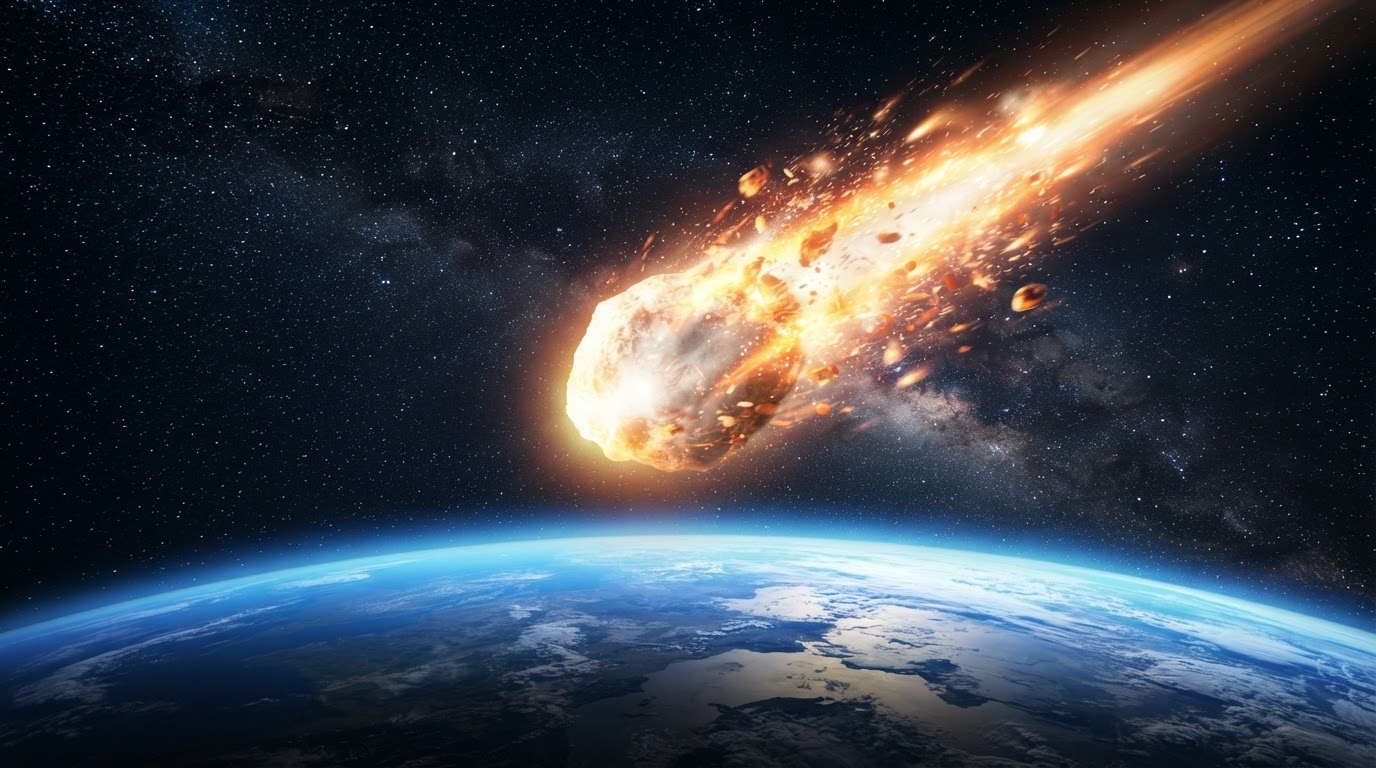
How could destruction on this scale occur with no crater and no large meteorite? The answer favored by scientists today is an "air burst." A stony asteroid, estimated at roughly 50 to 80 meters across, tore into Earth's atmosphere at tens of kilometers per second. Unable to withstand the violent friction and pressure, it exploded and shattered entirely at an altitude of about 5 to 10 kilometers, before ever reaching the ground.
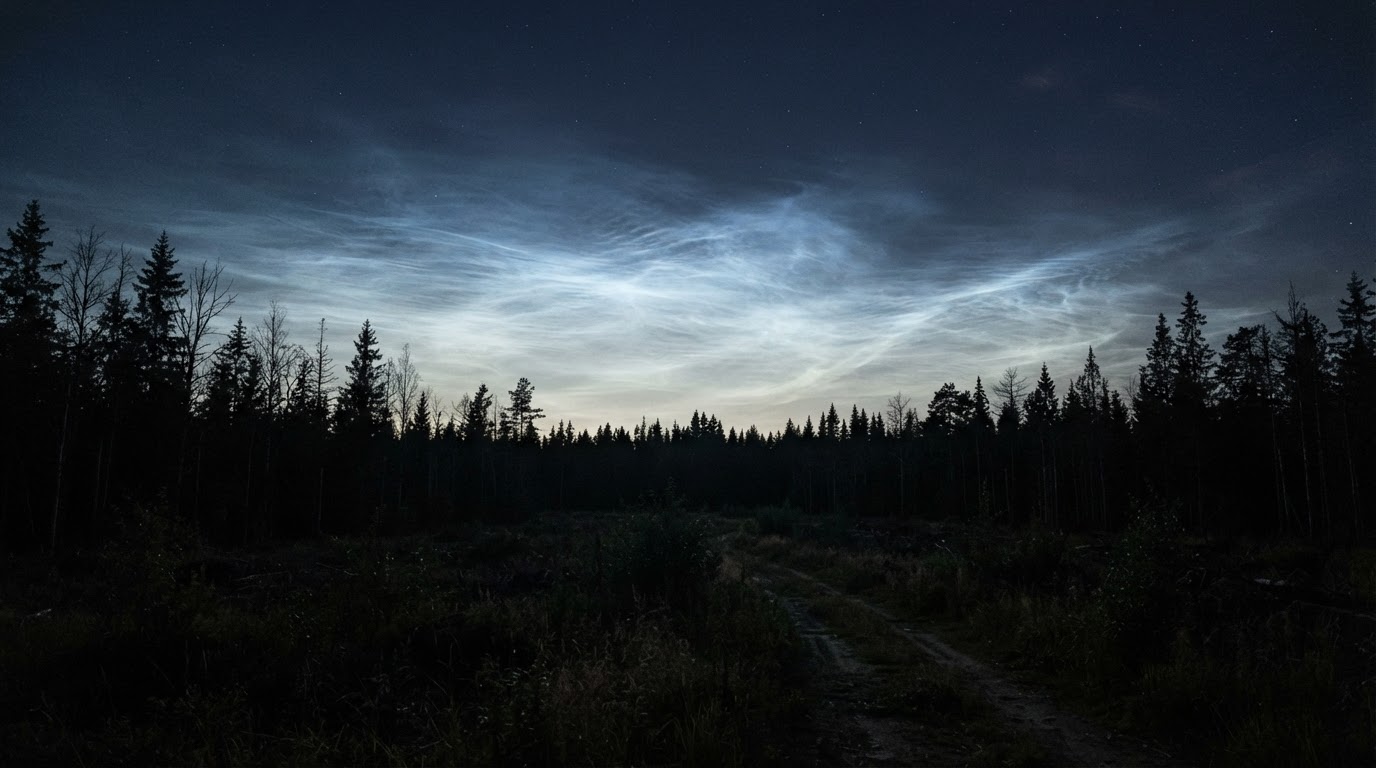
This explanation resolves several puzzles at once. Because the object detonated in the air before touching down, no crater formed. The upright trees directly beneath the blast, ringed by the radial fall pattern, follow naturally from a shock wave driving down from above. The lack of large fragments fits too, if the body of the asteroid mostly vaporized and disintegrated under enormous heat and pressure. In fact, later expeditions detected microscopic particles in the soil and in tree resin — nickel-rich grains and silicate spheres — that appear to be of extraterrestrial origin, though there is still debate over whether these can be conclusively tied to the 1908 blast. Some researchers argue the object was not an asteroid but an icy fragment of a comet, pointing to the eerie brightness of European night skies in the days afterward, possibly caused by water-vapor clouds from a comet. The asteroid-versus-comet question remains open, but the broad framework — that this was an airburst rather than a ground impact — is firm scientific consensus.
The Fringe Theories — Antimatter, Black Holes, and UFOs
The "empty space" left by the missing crater and fragments invited all manner of speculation. Some claimed the thing that exploded was not an asteroid at all but a tiny black hole passing through the Earth, or a lump of antimatter that annihilates and releases immense energy on contact with matter — attempts to explain the absence of fragments by saying there were never any fragments to leave. A 1946 short story by a Russian science-fiction writer even popularized the notion, widely spread through popular culture, that a crashing alien spacecraft (a UFO) had caused the blast. The idea that inventor Nikola Tesla's experiments were responsible has also circulated, mostly online.
One point must be made clear. The antimatter, black-hole, UFO, and Tesla theories are all fringe hypotheses with no support in the scientific community. A black hole passing through the Earth or an antimatter annihilation would have left traces entirely unlike those actually observed; they do not match the evidence. The UFO and Tesla ideas originated in fiction and popular imagination and have no physical evidence behind them whatsoever. These stories endure because the event itself is so dramatic, and because the lack of a decisive fragment — a "visible" piece of physical proof — left room for the imagination to run. The answer science points to is, from beginning to end, the natural airburst of a celestial body.
What If It Had Been Over a City
The truly chilling thing about Tunguska is the sheer luck that it happened over an empty stretch of Siberian wilderness. Had the Earth's rotation been off by only a few hours, or the object's path shifted slightly, the same explosion could have detonated above a major city in Europe or Asia. With enough force to erase an entire city, it would have caused a catastrophe almost too terrible to picture had it struck a populated area.
The event is frightening for another reason too: the size of the object behind it. An asteroid a few dozen meters across is, on the scale of space, a "small" one. Such small bodies are extremely difficult to spot in advance — and in 2013, over Chelyabinsk in Russia, an object less than 20 meters across airburst and injured thousands of people. No one saw it coming that day either. Tunguska is not a curiosity from a century ago but a reminder of a present-day threat that could recur at any time. That is why nations today invest in watching for asteroids approaching Earth and charting their orbits in advance.
The Details That Remain a Mystery
Working through the material, I found the detail that unsettles me is not the missing crater. It is Chelyabinsk. Twenty meters across, 2013, over a city, and nobody saw it approaching — and that one was small. The Tunguska object was several times larger and arrived over the emptiest forest on the continent at seven in the morning. Every account I have filed treats that as the fortunate part of the story. It is also, read plainly, the only part that had nothing to do with us.
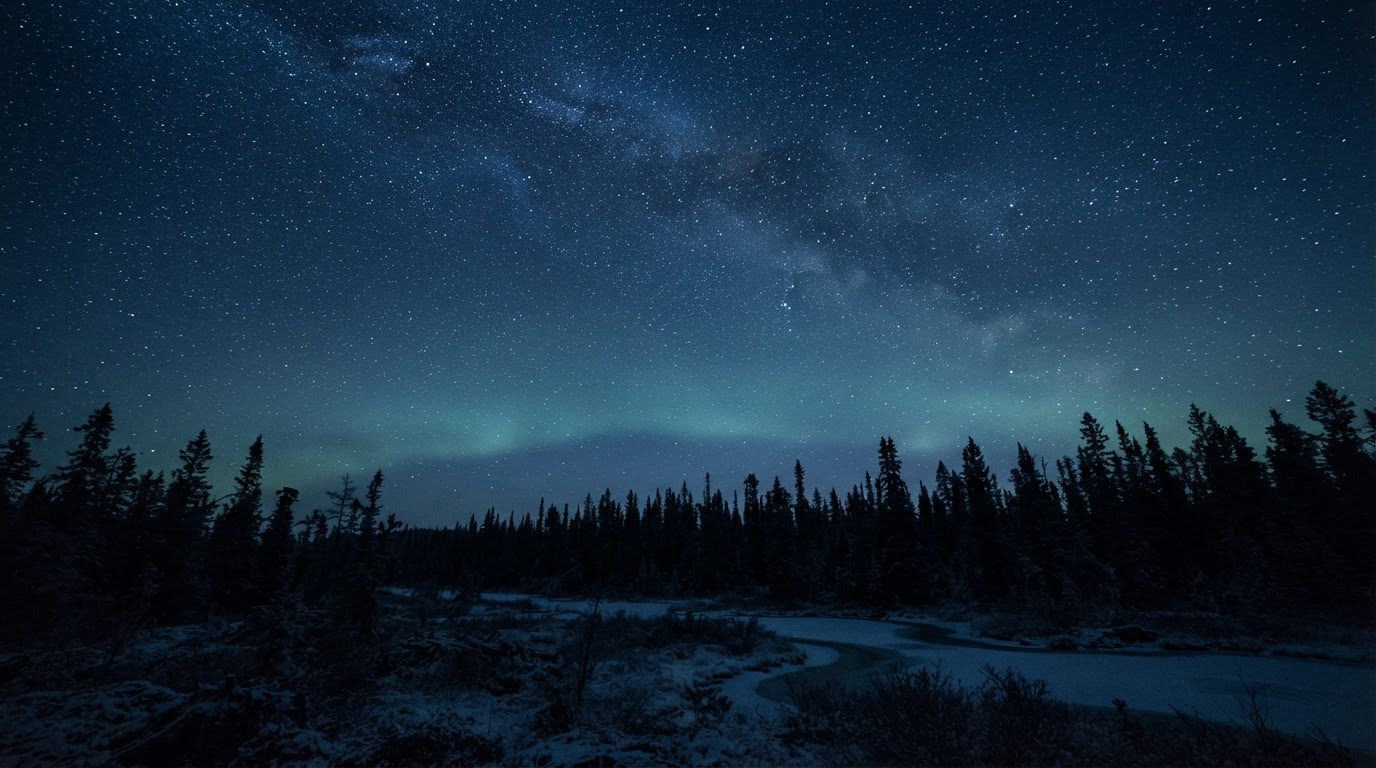
Here is what we can say with confidence today. On the morning of June 30, 1908, an explosion far exceeding the Hiroshima bomb erupted above Siberia and flattened more than 2,000 square kilometers of forest in a radial pattern. Its cause, the scientific mainstream holds, was a natural celestial body — most likely a stony asteroid a few dozen meters wide — that detonated in the air before striking the ground. Stories of antimatter and UFOs are only fringe claims without evidence.
Even so, much remains open in the details. Researchers still differ over whether the object was precisely an asteroid or a comet fragment, over its exact size and the altitude of its explosion, and over why decisive fragments have been so hard to find. The expedition that came only twenty years later, the early records since lost, and a site slowly erased by nature and time left no conclusive physical proof. It was the largest sky-borne explosion ever witnessed in human history — yet the deepest layer of the question, exactly what exploded and how, still lies buried in the silence of Siberia.
---
This article uses both real archival and on-location photographs and AI-generated images created to convey the mood of the story.

Comments
No comments yet — leave the first one.