
Every horror story in the world has one thing in common: it can be told. That is what makes it a story. Someone knows how it goes, someone can set it down, someone can lean close in the dark and say and then, and then, and then. The fear lives inside the telling.
"Cow Head" is the one that cannot be told. And that is precisely what makes it the most frightening story of all.
There is, supposedly, a tale by this name — Ushi no Kubi, the Cow Head — that is so unbearably terrifying that anyone who hears it through to the end dies of fear within days, or loses their mind, or simply is never right again. Because of this, the story has erased itself. Everyone who ever knew the whole of it is gone. What remains is only the name, passed from mouth to mouth by people who all swear it exists, who all warn you never to seek it out, and not one of whom can tell you a single thing that happens inside it.
You are reading an article about a story with no contents. Sit with how strange that is. We can circle it, describe its shape, trace where it came from and why it works — but the thing at the center is a hole. And the hole is the monster.


Cataloguing is a simple job until you reach this one. Every other entry in my archive has a body of text to summarise, however thin — a rumour, a testimony, a wrong date. Here the folder holds only the wrapper: the bus, the foaming driver, the children slumped in their seats, and a title. I have gone looking, in the way one does, through variant collections and forum archives, and what I have accumulated over the years is not the story but an ever-larger pile of accounts of people not telling it. The folder gets thicker. It stays empty.
The Bus
There is one scene almost every telling of Cow Head shares, and it is where most people first meet the legend. It is worth telling in full, because it is the closest the story ever lets us get to its own edge.
A busload of schoolchildren is on a trip — a long ride through the countryside, the kind of dozing, restless afternoon when the excitement has worn off and there are still hours of road ahead. To pass the time, the teacher at the front picks up the microphone and offers to tell a scary story. The children cheer. He begins.
And almost at once, something is wrong.
He starts to tell a tale called "Cow Head." Only a few sentences in, the mood of the bus changes. The teacher's own voice alters — he seems to fall into the story, as though he cannot stop himself now that he has begun, as though the words are pulling him along faster than he chose to go. The children stop cheering. They begin to beg him to stop. Stop, sensei, please stop, we don't want to hear it. Some are crying. Some have their hands over their ears. And still the teacher goes on, pale, sweating, reciting a thing he does not seem able to put down.
When at last he comes back to himself — when the spell breaks and he lowers the microphone — the bus is silent. Too silent. He looks up, and the whole bus has gone off the road; the driver is slumped, foaming at the mouth, his hands still locked white-knuckled on the wheel, the vehicle stopped at a crazy angle against the guardrail. And in the seats, every single child has fainted dead away, collapsed where they sat, unconscious.
The teacher has no memory of what he said. He only knows he was telling "Cow Head," and that he must never, ever tell it again.
That is the frame. Notice what it does. It gives you the effect of the story in overwhelming, physical detail — the foaming driver, the fainted children, the teacher who blacked out mid-sentence — and it gives you exactly none of the content. You have watched the story detonate and seen the crater. You still have no idea what the bomb was.


The Rule of the Empty Center
Every famous urban legend has a rule at its heart. Kunekune's rule is don't look too closely — we've written about that one here. Cow Head's rule is stranger and more total: no one may know how the story goes, because to finish hearing it is to be destroyed by it.
This produces a legend that is, logically, a sealed box. Follow the chain: the story kills or breaks everyone who hears it all the way through. Therefore no survivor carries the full text. Therefore the full text cannot be transmitted. Therefore what travels from person to person is not the story at all — it is only the report of the story, the rumor of its existence, the warning wrapped around a vacancy. Everyone who "knows" Cow Head knows only that it must not be known.
And here is the beautiful, awful trick: this makes the legend unfalsifiable and self-protecting. You cannot debunk a story by reading it and finding it dull, because you are never allowed to read it. You cannot catch anyone lying about its contents, because no one ever claims to give you its contents. The legend has arranged things so that its emptiness can never be exposed — because the emptiness is the legend. There is no man behind the curtain, only the curtain, and the curtain is enough.
Komatsu Sakyo's Joke
If you trace the modern legend back as far as it will go with any confidence, you arrive at a writer's desk — and at a joke.
Komatsu Sakyo was one of the giants of Japanese science fiction, a mind that thought in vast scales and long ironies. In 1965 he published a very short piece titled, simply, "Gozu" — "Cow Head." And what he wrote is one of the most elegant metafictional pranks in the language.
His story is about the Cow Head story. In it, the narrator keeps encountering people who speak of a legendary tale called "Cow Head," the most frightening story ever told — and every one of them behaves as though of course they know it, of course everyone knows it, it is famous, it is terrible, you must have heard of it. But when the narrator tries to actually learn what happens in "Cow Head," he finds he cannot. No one will tell him. No one, on inspection, actually knows. Each person is only performing familiarity, nodding along to a title, ashamed to admit that the celebrated horror at the center is, for them too, a blank.
In other words, Komatsu did not write the terrifying story. He wrote a story about a terrifying story that does not exist — and about the very human tendency to pretend we know a thing that everyone else seems to know, rather than confess our ignorance. The horror he was really describing was social: the void that opens when a whole crowd agrees to believe in a thing that none of them can actually produce.
And then the joke completed itself in a way Komatsu could scarcely have improved on. His fictional device — a story so scary no one dares repeat it, whose contents no one really knows — escaped the page and became true. People began speaking of "Cow Head" as a real cursed tale. The metafiction folded into fact. Komatsu wrote a satire about a legend that did not exist, and the satire went out into the world and manufactured the legend, until "Cow Head" now circulates exactly as his narrator described it: universally known, universally feared, and never once actually told. The trick ate its own tail and became the thing it mocked.

Older Trails: The Cow Head Before the Bus
Komatsu gave the legend its modern shape, but he did not invent the name from nothing. He was, characteristically, playing with older material — and the trails run backward into darker ground.
Rumors of a "Cow Head" tale drift through Edo-period gossip, referenced in the way people reference a thing everyone has half-heard and no one can source. The phrase carried a whiff of the forbidden long before any bus full of schoolchildren. It sat in the folk imagination as one of those titles that seems to arrive already ancient, already warning you off.
The nearer folkloric cousin is the Kudan — a prophecy-beast said to be born from a cow, with a human face and a cow's body (or the reverse). The Kudan appears, speaks a single true prophecy of coming disaster or plague, and then dies, all within days of its birth. It is a creature made entirely of dreadful knowledge that arrives with an expiration date, a thing whose whole purpose is to tell you something terrible and then be gone. You can feel how easily that imagination — the cow's head, the fatal utterance, the knowledge that kills — flows toward a story called "Cow Head" that speaks itself once and destroys its listeners.
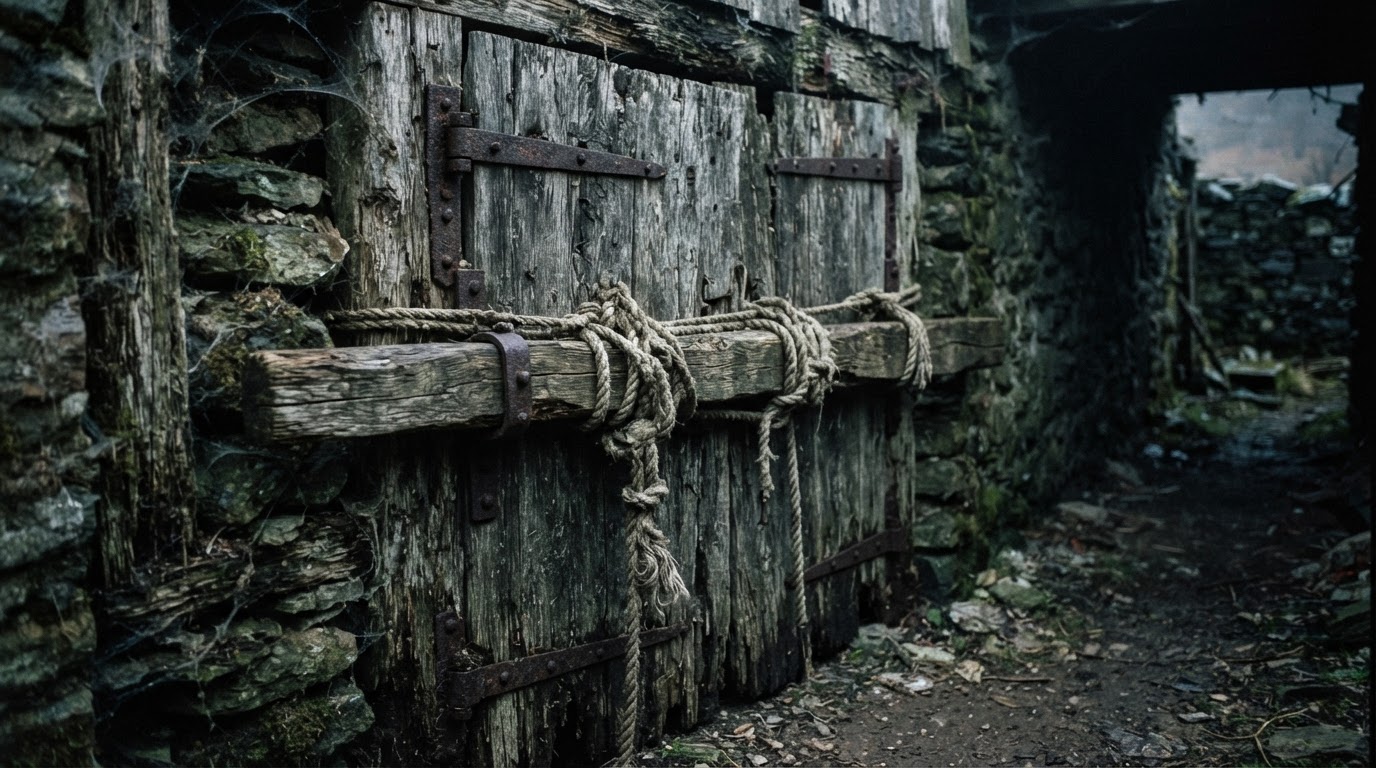
And there is a grimmer, older trail still, which the legend touches only at its edges. In some readings, "Ushi no Kubi" is tied to the buried folk-memory of famine — to villages in the far past that suffered the unspeakable during years when the harvest failed and the snow would not stop, and to a horror so shaming and so total that the people who survived it could not, would not, speak of what had happened. In this reading the "story too terrible to tell" is not supernatural at all. It is a real thing that real people did in the worst of times, sealed away behind a name precisely because naming it plainly was unbearable. We handle this thread gently and leave it where the villages left it — behind the storehouse door, unopened. But it is worth knowing that beneath the playful modern legend there may lie a much older and more human silence: the true kind of story that a community agrees, forever, not to finish.

Why the Untold Story Is the Scariest One
Cow Head works because of a principle every good horror writer eventually learns and most learn too late: the imagination outperforms description, every time.
When you describe a monster fully — its teeth, its height, the color of its eyes — you have given the audience something finite. It can be measured, and anything measured can be managed. But when you refuse to describe it, when you leave a labeled absence where the monster should be, the audience does the work themselves, and they will build something far worse than anything you could have written, because they will build it out of their own private fears, fitted exactly to the shape of what frightens them most. You cannot out-write a reader's own nightmare. Cow Head understood this and took it to the absolute limit: it does not withhold the monster's face; it withholds the entire story, and lets your mind pour into the void.
This is the Lovecraft principle stated in its purest form. H. P. Lovecraft built a whole literature on the idea that the truly cosmic horror is the thing that cannot be described, that breaks the mind precisely because it exceeds what the mind can hold — the knowledge that unmakes the knower. Cow Head is that principle turned into a folk legend and stripped of even Lovecraft's hints. There is no glimpse, no adjective, no "non-Euclidean angle" to hold onto. There is only the report that the knowledge exists and that it is fatal.
And it draws on a deeper cognitive unease too — the peculiar torment of the unfinishable. A story you cannot complete lodges in the mind and will not settle. Human beings are pattern-closers; we ache for the end of the sentence, the resolution of the chord, the last word of the tale. Cow Head denies you closure permanently and by design. You will never hear how it ends. And some part of you will keep leaning toward that missing ending for the rest of your life, which is exactly where the legend wants you: forever curved toward a door you must never open.


The Legend as a Mirror
Here is the sharpest point of the whole thing, the observation that turns Cow Head from a creepy campfire tale into something genuinely uncomfortable to think about.
Everyone who claims to have heard Cow Head is lying.
They must be. By the legend's own rule, to hear it through is to die or to break. So anyone standing in front of you, alive and sane, insisting they know the real Cow Head, telling you they heard it once and it was the most frightening thing — that person, necessarily, did not hear the real thing. They are performing knowledge they do not have. And that is not a flaw in the legend. That is the legend. Cow Head is, at bottom, a story about the way people pretend to know what they do not know, about the social contagion of asserted familiarity, about how an entire culture can agree to be haunted by a thing that no single member of it can actually produce.
Hold it up and it becomes a mirror. It reflects the times we have nodded along to a reference we didn't catch, claimed a book we hadn't read, laughed at a joke we didn't understand, agreed that yes, of course, everyone knows that — rather than raise a hand and admit the blank. Komatsu saw this clearly in 1965 and built his whole prank around it. The horror of Cow Head is not a monster. It is the moment you realize that the confident consensus around you may be built on nothing at all, that the crowd is only performing a knowledge no one possesses, and that you have been performing it too.

Chain Letters, Creepypasta, and the Internet Age
A legend about a self-erasing, fatal-to-hear story was always going to thrive on the internet, and Cow Head did. The digital age gave it perfect new bodies to wear.
It became a natural chain letter: this is Cow Head — do not read to the end — forward this or the curse falls on you. The old ghost-story mechanics of contagion and warning slid frictionlessly into the mechanics of the forwarded email and the copied-and-pasted post. It crossed into the English-speaking creepypasta world in translation, where it sits comfortably among internet horror's other self-referential curses — the video that kills you a week after you watch it, the file you must not open, the page you must not scroll to the bottom of. Cow Head is the ancestor of all of them: the original cursed content, the media that harms you simply by completing.
The name has surfaced in other places too, borrowed for its aura more than its (nonexistent) plot. The filmmaker Miike Takashi made a strange, surreal film in 2003 titled Gozu — "Cow Head" — that has essentially nothing to do with the legend's schoolbus terror, but which reaches for the name because the name itself has become a signal, a two-syllable promise of dread. That is what Cow Head has ultimately produced: not a story, but a brand of fear, a title that means the worst thing, the thing beyond telling, available to anyone who wants to invoke the feeling without ever having to deliver the goods — because there are no goods to deliver, and never were.
Forbidden Knowledge, the World Over
Cow Head belongs to one of humanity's oldest story-families: the tale of the knowledge you must not acquire, the thing whose only safety lies in never learning it. Once you see the pattern you find it everywhere.
There is The King in Yellow, Robert W. Chambers's fictional play that drives mad anyone who reads its forbidden second act — a cursed text whose contents are hinted at but never fully given, precisely because the withholding is the horror. There is the folklore of the "brown note," the mythical sound frequency supposed to incapacitate anyone who hears it — a curse delivered, like Cow Head, purely through the act of reception. There is Bluebeard's forbidden door and the apple in Eden and every myth that says you may have everything but this one knowing. Cow Head sits squarely in that lineage: the sealed room of the mind, the one thing the story will not let you have.
And then there is the joke that stands the whole tradition on its head — deliberately, gloriously. Monty Python's "the funniest joke in the world," a sketch about a gag so hilarious that anyone who reads it dies laughing, so that it has to be handled one word at a time by translators who each render a single fragment and none of whom may know the whole. It is Cow Head's exact twin, built to the same blueprint — a piece of language too potent to survive contact with a full human mind — and pointed in the opposite direction. Fear and laughter, the two involuntary full-body responses, are structurally the same trick: an input the nervous system cannot refuse. Cow Head kills you with the one; the killing joke kills you with the other. Both understand that the deadliest content is the content you cannot un-receive.

The Story That Tells Itself in Your Head
So there is no story. That is the ending, and it was the beginning too. There is a title, "Cow Head," and around it a bus of fainted children and a foaming driver and a teacher who blacked out mid-sentence, and behind all of that a hole where the words should be — a hole that has been there since Komatsu made his joke, and perhaps since some frozen village sealed a door on something it could not say.
But notice what has happened while you read this. You now carry Cow Head. Not the story — there is no story — but the shape of it, the labeled absence, the certainty that somewhere there is a thing too frightening to be told. And your imagination, which cannot leave a blank alone any more than the boy with the binoculars could leave the distance alone, has already begun, quietly, to fill it. You will find yourself, later, wondering what could possibly be that terrible. You will try to picture the unpicturable. You will lean, just slightly, toward the door.
One thing in the Edo-period trail has never sat right with me, and I raise it knowing I cannot resolve it. Komatsu published in 1965, and the satire explains everything after that date beautifully. It does not explain what he was satirising. The name was already drifting through older gossip, already carrying its warning, already a thing people half-remembered hearing of — which means the empty centre predates the joke about the empty centre. Somebody was refusing to finish this story long before there was a writer around to make a point of it.
That is the only place Cow Head has ever lived. Not on the bus, not in the storehouse, not in Komatsu's clever pages — but in the reader's own head, in the space where a story should be and isn't, which the mind fills with the worst thing it privately owns. The scariest story in the world was never written down because it does not need to be. You finish it yourself, every time you think of it, out of your own material. And you will never reach the end.
Better, as another ruined man once said of another thing at the edge of a field, not to know.
---
The images and video in this article are AI-generated works produced to convey the mood of the story, and are not photographs of any actual person or event.



Comments
No comments yet — leave the first one.