
It is past midnight, and the last train has long since gone.
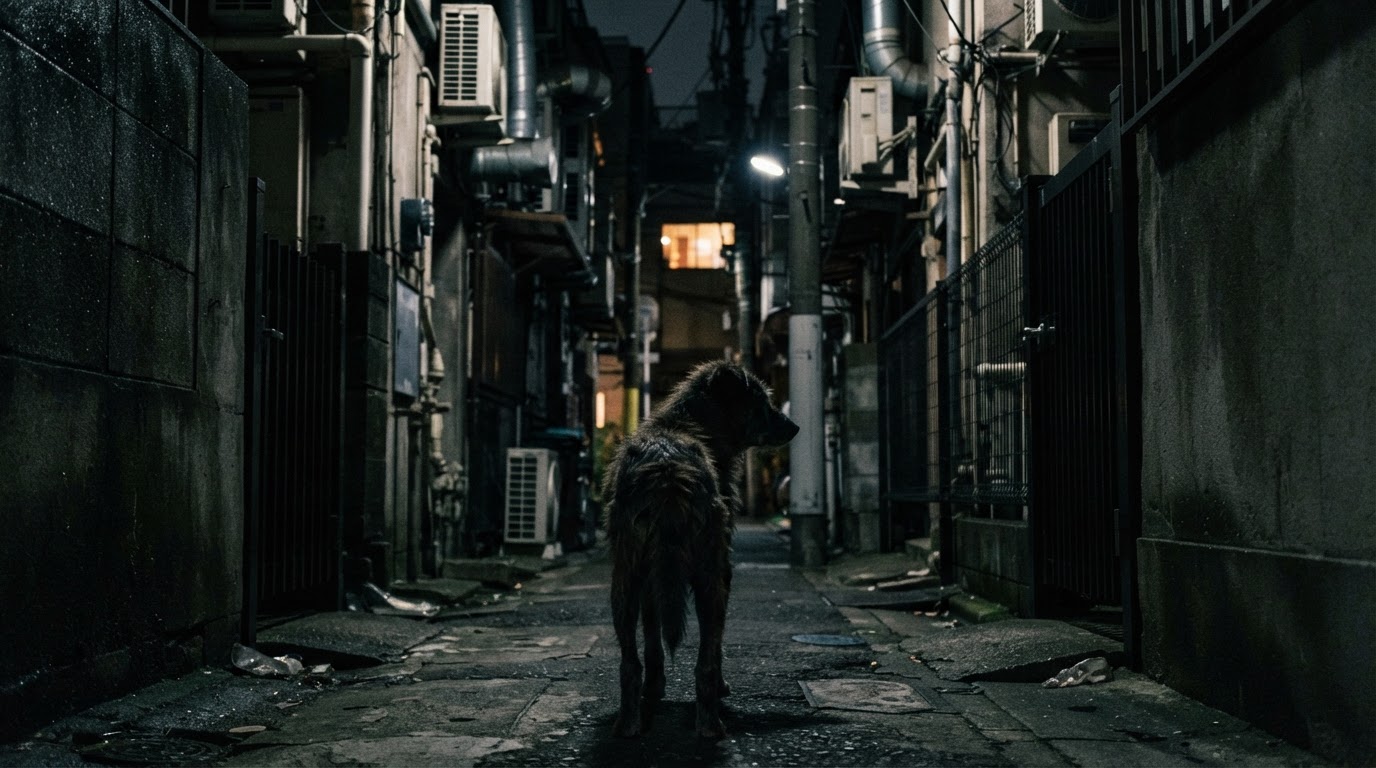
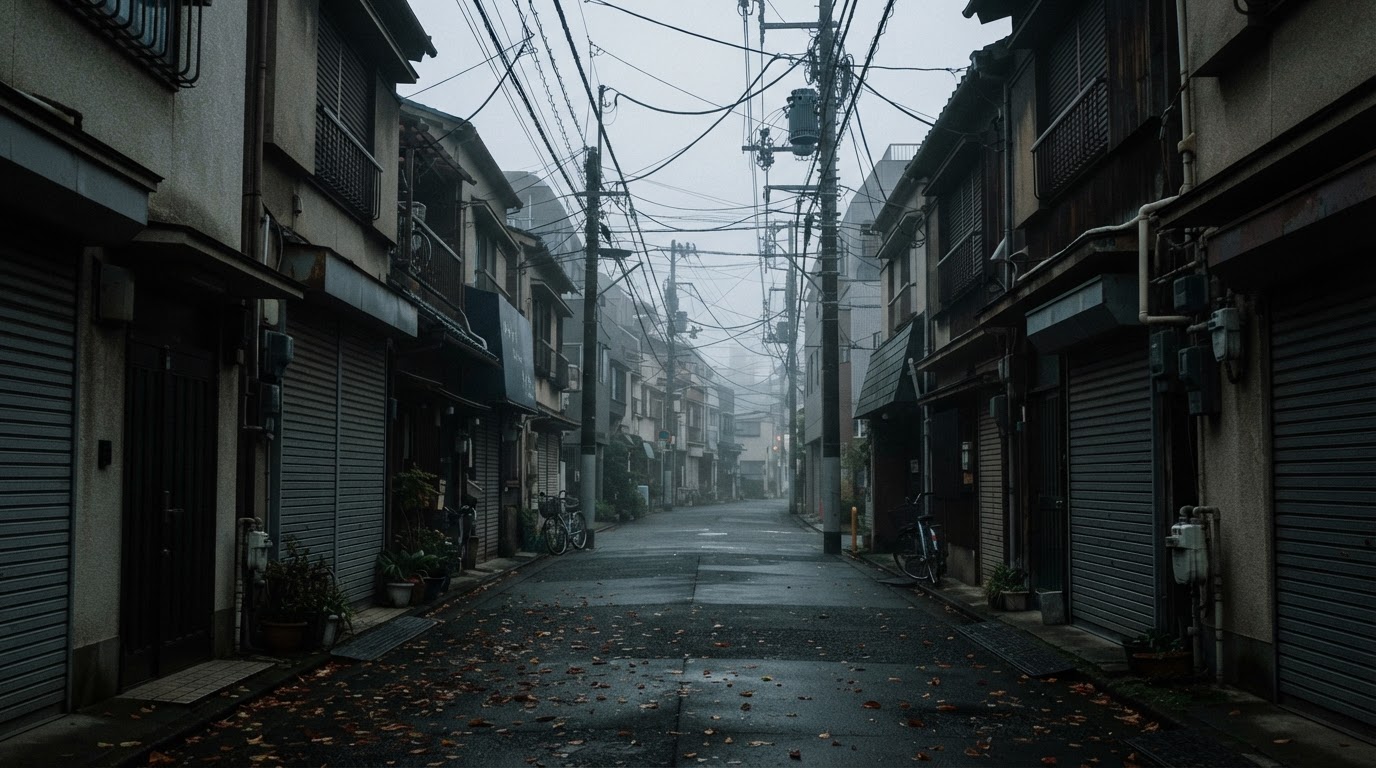
The alley runs behind a station in the back streets of Tokyo, the kind of narrow service lane that only exists to hold the things a city would rather not look at — the stacked garbage bags, the grease traps, the coiled hoses, the dripping air-conditioning units. A single vending machine hums against the far wall, throwing a cold rectangle of light onto wet asphalt. And in that light, half in shadow, a dog is going through the trash.
You have seen a hundred strays do exactly this. But you slow down anyway, because something in the silhouette is off. The body is a dog's body, lean and low. The head, though — the head sits wrong on the neck, and it is turned just enough that you cannot quite see it, and you do not, in the end, want to. Because as your footsteps scuff the asphalt, the shape goes very still. And without lifting its head from the bags, in a voice that is unmistakably human — a low, flat, exhausted voice, the voice of a man in his fifties who has had a very long day and would like, more than anything, for it to end — it speaks.
Hottoite kure. Leave me alone.


I did not go looking for this one. It surfaced while I was sorting a box of scanned tabloid clippings from 1989 and 1990, filed under something else entirely, and the phrase hottoite kure kept recurring in the margins of accounts that otherwise had nothing to do with one another. That is what made me open a file for it. Most of the material I handle describes creatures that want something from the witness. This one, in every version I have transcribed, wants the witness gone — and I have never worked out how to catalogue a monster by its indifference.
The Monster That Doesn't Want Anything From You
Nearly every monster in the world wants something. It wants to eat you, or curse you, or drag you into the water, or take your child, or make you look too closely at the thing in the field. Desire is the engine of horror — the creature reaches toward you, and the story is the story of that reach.
The Jinmenken is built the other way around. It wants, above all else, for you to go away.
This is what makes it the strangest entry in Japan's crowded catalogue of the uncanny. A dog with a human face — usually described as the tired, jowly, unremarkable face of a middle-aged man — is discovered somewhere it should not be: in an alley, under a parked car, along a dark stretch of expressway. It is not lunging. It is not baring teeth. Most often it is doing something almost unbearably ordinary: picking through garbage, resting in the dark, trying to get on with a small miserable existence. And when a human being notices it — when you stop, and stare, and let it see that you have seen — it speaks. Wearily. Irritably. The way anyone might speak to a stranger who has caught them at a low moment and will not stop looking.
Leave me alone. Don't look at me. Go away.
That is the whole encounter. There is no chase in most tellings, no attack, no gore. The Jinmenken does not hurt the people who bother it — or rather, the harm it brings is quieter and more diffuse than a bite. In the fuller versions of the legend, to cross paths with a human-faced dog, to disturb it, to make it speak, is to invite a run of bad luck: small misfortunes, a sour mood that lingers, a sense that something has gone subtly wrong with your days. The creature is not a predator. It is closer to an omen with feelings — a walking piece of misfortune that would honestly prefer you didn't step in it.
What It Looks Like — and Why You Never Quite See It
Descriptions of the Jinmenken are consistent in their outline and vague in their center, which is exactly how the best urban legends work.
The body is a dog's, and usually an unremarkable one — a medium stray, dark or brown, the kind that slips between parked cars and disappears down side streets. It is the face that stops the heart. Set where a muzzle should be is the face of a person: most often a middle-aged man, sometimes described as tired, sagging, faintly sad, with the loose skin and heavy eyes of someone worn down by years of work and disappointment. Not a demon's face. Not a beautiful face. An ordinary, forgettable, human face — the face of a man you might pass a thousand times on a commuter platform and never once remember.
And that ordinariness is precisely what makes it unbearable. A monster with fangs and burning eyes announces itself as other; you can file it under "nightmare" and keep your distance. But a dog wearing the tired face of a salaryman is a category error you cannot resolve. It is too human to run from and too wrong to approach. Your mind reaches for a box to put it in and finds none.
Crucially, the legend almost never lets you see the face cleanly. In the telling, it is glimpsed — under a car, in the swing of headlights, at the far end of an alley, turned half away. The narrator sees enough to know, and never enough to describe in full, and neither do you. The horror lives in that half-look, in the certainty of a human face where no human face should be, arriving before the details do. To see it plainly would almost be a relief. The Jinmenken never gives you the relief.
The Highway That Runs at a Hundred Kilometers an Hour
There is a second Jinmenken, and it lives not in the alley but on the open road.
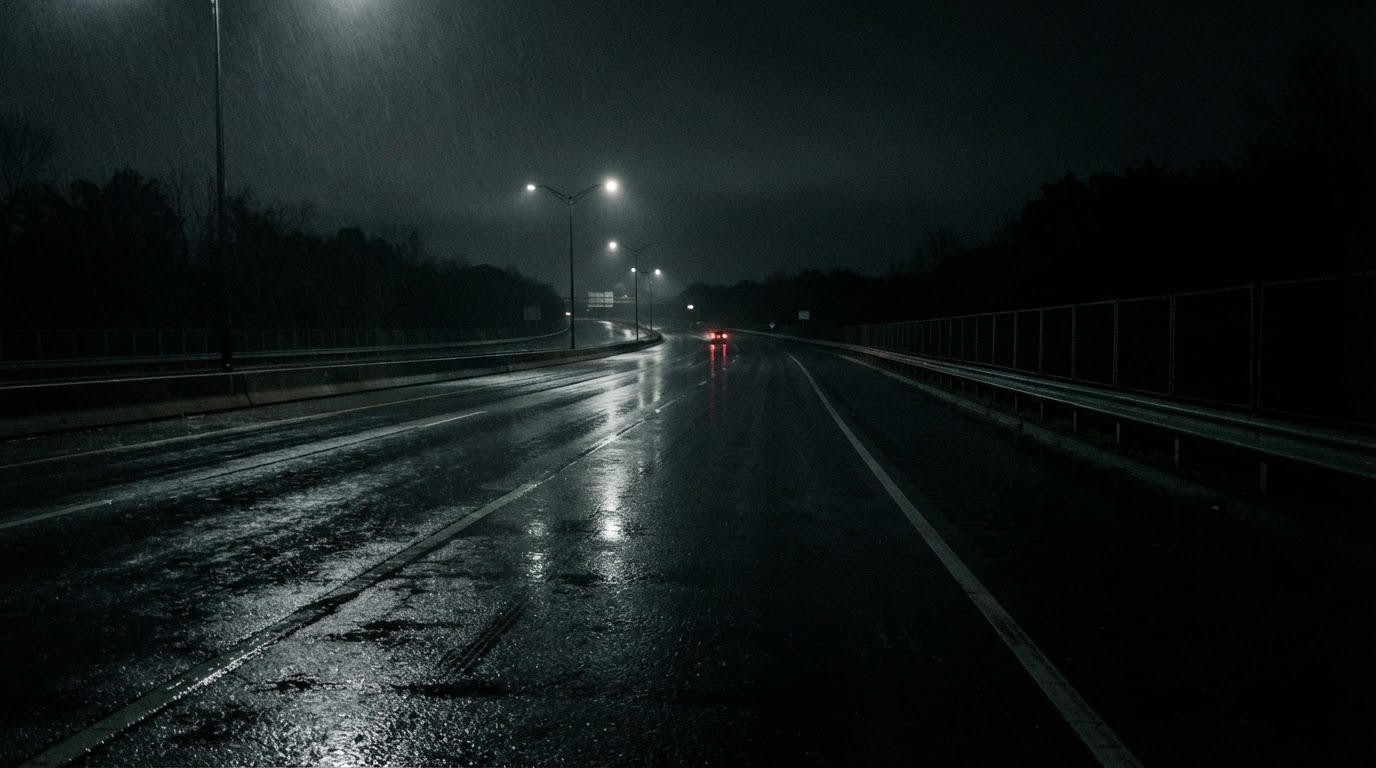
In this darker, faster version, the human-faced dog is seen on the expressway at night — and it is keeping pace with the cars. A driver, cutting through the dark at a hundred kilometers an hour, glances into the side mirror or out the window and sees, running alongside the vehicle, low to the road and impossibly fast, a dog. Its legs move like any dog's. Its speed is nothing any dog could manage. And when the driver looks — really looks — the thing turns its head, and the face is a man's.
The rule attached to this version is grimmer than the alley rule, and it is worth stating plainly and then leaving where it lies. In the highway legend, the Jinmenken is not merely a nuisance. It is a portent. To be overtaken by it — to see it pull ahead of your speeding car and vanish into the dark road in front of you — is said to be an omen of a coming accident. The creature that outran you is a warning you were not meant to receive and cannot now un-see.
This is where the Jinmenken quietly touches Japan's deep, uneasy relationship with the night road. The country's expressways and mountain passes are threaded with their own folklore — vanishing hitchhikers, phantom tunnels, stretches of asphalt where the same accident seems to repeat. The human-faced dog running flat-out beside a midnight car belongs to that tradition: the road at night as a thin place, a corridor where the ordinary rules of speed and distance and living things come loose. You do not stop for it. You do not race it. You grip the wheel, keep your eyes forward, and hope it stays behind you — because in this telling, the worst thing the Jinmenken can do is win.

The Boom: How a Talking Dog Swept the Schools of Japan
The Jinmenken as most people know it is not, in truth, an ancient thing. It is the child of a very specific moment — the turn from the 1980s into the 1990s, the last years of the Shōwa era bleeding into the first of the Heisei — and for two or three years around 1989 and 1990 it was, briefly, everywhere.
To understand how completely it took over, you have to understand the machine that spread it. This was Japan before the internet: a country wired instead by school playgrounds, weekly magazines, and late-night variety television. The Jinmenken traveled first as a schoolyard rumor, passed child to child in the electric currency of "I heard that—" and "my friend's brother saw—." Someone always knew someone who had seen it, in an alley two towns over, on an expressway a cousin drove. The story mutated with every telling, which only made it feel more real; a legend that arrives in one fixed form smells invented, but one that shifts and contradicts itself and multiplies has the texture of something loose in the world.
Then the machine amplified it. Weekly magazines — the Friday-and-Focus photo-scandal press that specialized in the sensational — ran breathless items on the human-faced dog. Variety and tabloid TV shows, forever hungry for the eerie and the strange, gave it airtime, re-enactments, "eyewitness" interviews. The rumor and the media fed each other in a loop: the shows covered it because the children were talking about it, and the children talked about it more because it was on the shows. By 1990 the Jinmenken had crossed from playground whisper into genuine mass phenomenon — a piece of national weather, a thing that "everyone" had heard of, discussed on television and traded in classrooms across the whole of the country.

The Precedent: Kuchisake-onna and the Panic of 1979
Japan had done this before, and everyone old enough remembered it. Ten years earlier, in 1979, the slit-mouthed woman — Kuchisake-onna — had swept the nation's schools in a rumor-panic so intense that in some places children were escorted home in groups and police fielded calls about a masked woman with a razor. That earlier hysteria was the template. It proved that a purely spoken legend, carried entirely by children and amplified by a hungry press, could become real enough to change how a country behaved for a season.
The Jinmenken rode the same rails a decade on. It was, in a sense, the tamer sequel — the slit-mouthed woman wanted to cut you; the human-faced dog just wanted you to go away — but the mechanism was identical. A whispered figure, a schoolyard network, a media amplifier, and a national appetite for the uncanny, all converging into a boom. The two legends bracket a golden age of Japanese urban legend, the years when the country's collective imagination ran hottest and its monsters — the slit-mouthed woman, the crawling Teke-Teke, the toilet-stall spirit of Aka Manto, and the human-faced dog among them — walked, briefly, in daylight.

The Older Roots: Sideshows and Prophecy-Beasts
The 1990 boom made the Jinmenken famous, but it did not invent the idea. The image of a beast with a human face is far older than the Heisei era, and it reaches back into the strange visual culture of Edo-period Japan.
In the great cities of the Edo period, the misemono — the sideshow, the spectacle tent — was a popular entertainment, and among its attractions were human-faced animals: creatures, real or fabricated, displayed as marvels of nature for a paying crowd. Records and prints from the era describe human-faced dogs and other man-faced beasts shown off as curiosities. Whether these were deformed animals, clever fakes, or pure rumor made flesh in a barker's patter, they planted the image deep: the animal body wearing the human face, staged in the flickering lamplight of a tent, a thing to be gawked at and shuddered over.
Older and stranger still is the kudan — the human-faced calf. In Japanese folk belief, the kudan is a prophecy-beast: a cow that is born with the face of a human, speaks a true prophecy, and then, having spoken, dies within days. The very character for kudan (件) is written as "person" beside "cow," and to say something is kudan no gotoshi — "as certain as the kudan" — was once to swear that it was absolutely true, because the kudan could not lie. Here the human-faced animal is not a nuisance but an oracle, a creature whose wrongness is precisely the source of its authority. The Jinmenken inherits that lineage: the man-faced beast as a thing that speaks, whose voice carries weight precisely because it should not have one.

The Theories: What Was Really in the Alley
Part of what keeps the Jinmenken alive is that it invites explanation and then slips out from under every one. Each theory is sensible. None of them quite closes the door.
The escaped experiment
The most lurid rumor, and the one that traveled fastest in the boom years, was that the Jinmenken was a laboratory accident — an animal from some secret genetic experiment, a splice of human and dog that had escaped confinement and now roamed the night, half-made and miserable. This theory says almost nothing about biology and everything about its moment. It is a very modern anxiety wearing an ancient face: the fear that science, meddling in the boundary between human and animal, would produce something that could no longer be sorted into either box. The tired-eyed dog in the alley became, in this reading, a fugitive from our own hubris — which is perhaps why it seemed so unhappy to exist.
The animal in the dark
The most deflating explanation is also the most persuasive. A Japanese macaque — a monkey — has a flat, forward-set, oddly human face, and by day no one would mistake it for anything else. But by night, glimpsed for half a second in the swing of headlights or the throw of a streetlamp, a monkey crouched low over garbage, or a stray dog with a mange-flattened muzzle, or any animal caught at the wrong angle in bad light, can present the eye with a smear of features the panicking brain finishes into a face. Humans are exquisitely, helplessly tuned to see faces — in clouds, in wall stains, in the fronts of cars — and never more so than when frightened in the dark. The Jinmenken, in this reading, is not a creature at all. It is a mistake the visual system is built to make, given a name and a voice and set loose to breed.
The tired man who just wants to be left alone
And then there is the reading that has nothing to do with what was in the alley and everything to do with who was walking past it. The Jinmenken boomed at the absolute peak of Japan's bubble economy, in the exhausted heart of its salaryman culture — a world of impossible working hours, packed last trains, and men in grey suits worked to the bone by a system that measured them only by their output. Look again at the creature everyone was suddenly describing: a middle-aged man's face, weary and sagging, on a body reduced to something less than human, picking through garbage in the small hours, asking only to be left alone. It is almost too neat. The Jinmenken reads like a ghost dreamed up by an overworked nation — the salaryman as stray, the tired provider stripped of everything but his exhaustion and his wish for a moment's peace. The monster that just wants you to go away is, on this reading, a portrait of a whole generation that felt the same. Its horror is real, but underneath it runs a current of something sadder: recognition.


How It Spread Before the Internet
It is worth pausing on the sheer strangeness of how the Jinmenken traveled, because it belongs to a world that has since vanished.
There was no message board, no forum, no viral clip — the human-faced dog did all its spreading by mouth and by print. The schoolyard was the network: a self-sustaining rumor engine of children, each one a node passing the story on with embellishments, each retelling a small act of authorship. Onto that base the analog media stacked their amplifiers — the weekly photo magazines that would print almost anything strange, the late-night variety shows that turned rumor into segment. There was no single canonical version and no way to trace the story back to a first teller, because it had no first teller; it condensed out of the collective air the way weather does.
This is the mirror image of how a legend like Kunekune or Hachishakusama would be born a decade later, on the anonymous message boards of the early internet. The medium changed — from playground and print to text box and thread — but the shape of the thing is the same: an authorless story, mutating as it travels, believed because no one can find the person who made it up. The Jinmenken is the pre-internet version of a phenomenon the internet would later industrialize. It is what a viral legend looked like when the virus moved at the speed of gossip.

Decline, Nostalgia, and the Second Life
Booms end. By the mid-1990s the Jinmenken had cooled from national phenomenon to familiar reference — no longer a live terror that emptied playgrounds, just a thing "everyone knew about," filed away with the other furniture of a decade's imagination. The bubble economy that had produced its salaryman melancholy collapsed, the media moved to fresh sensations, and the human-faced dog padded quietly off into the archive.
But it did not die, because legends this strange rarely do — they only wait. In the 2000s and after, as the generation that had traded the rumor as children grew up, the Jinmenken came back as nostalgia: a fond, faintly ridiculous, genuinely creepy artifact of a specific childhood, remembered with the warmth reserved for the fears you have safely outgrown. It became a fixture of Japanese pop culture, turning up across games, manga, and anime — most beloved, perhaps, as a recurring yokai in the Yo-kai Watch franchise, where the tired talking dog is reimagined for a new generation of children who never lived through the panic that made it famous. The creature that once frightened a nation's schoolchildren now amuses their own.
There is something fitting in that softening. The Jinmenken was never really a hunter, never really wanted anything but to be left in peace. It is easy, in the end, to be fond of a monster whose only crime was existing when it would rather not have, and asking, tiredly, from the shadows, to be let alone.
The Voice in the Dark
Every culture has its talking-animal omens, and they almost always arrive to warn. The raven that speaks a prophecy, the horse that finds its voice at a moment of crisis, the beast that breaks the barrier between animal silence and human speech precisely because something momentous is about to happen — across the world, an animal that talks is a rupture in the order of things, and a rupture that important is never small. Japan's own kudan, the prophecy-calf, is exactly this: the human-faced beast whose words you must heed because they cannot be false.
Set against that ancient company, the Jinmenken is quietly heartbreaking. The great talking beasts of legend speak to you — they carry a message, a warning, a prophecy meant for human ears. The human-faced dog speaks only to make you stop. It has no prophecy. It has no message. It has nothing it wants to tell you at all. It wears the most human of faces and possesses the most human of wishes, and the single thing it uses its impossible voice to say is the thing an exhausted person says at the end of a bad day when a stranger's eyes will not leave them: leave me alone.
So the legend lingers the way it does, long after the boom that made it, because it never quite behaved like a monster. Somewhere in a back alley behind a Tokyo station, in the cold light of a vending machine, a shape that is almost a dog goes through the garbage and asks, in a tired man's voice, only to be left in peace. You could stop, and stare, and make it speak. Or you could do the one kindness it has ever asked of anyone — keep walking, keep your eyes ahead, and let the poor tired thing be. The Jinmenken never wanted to be your monster. It only wanted the night, the garbage, the quiet, and to be, at last, unnoticed.
There is one thing in the file I keep returning to, and it is not the alley and not the expressway. It is the kudan — the calf born with a man's face that speaks once, truthfully, and dies. Set the two records side by side, as I have done more times than the work required, and the arrangement starts to feel deliberate. The old beast is granted a voice and spends it on a prophecy. The new one is granted the same impossible voice and spends it asking to be ignored. I have catalogued the sightings, dated the boom, traced the sideshow prints. What I cannot file anywhere is the possibility that the tired dog behind the vending machine also had something true to say, and simply decided we were not worth telling.
---
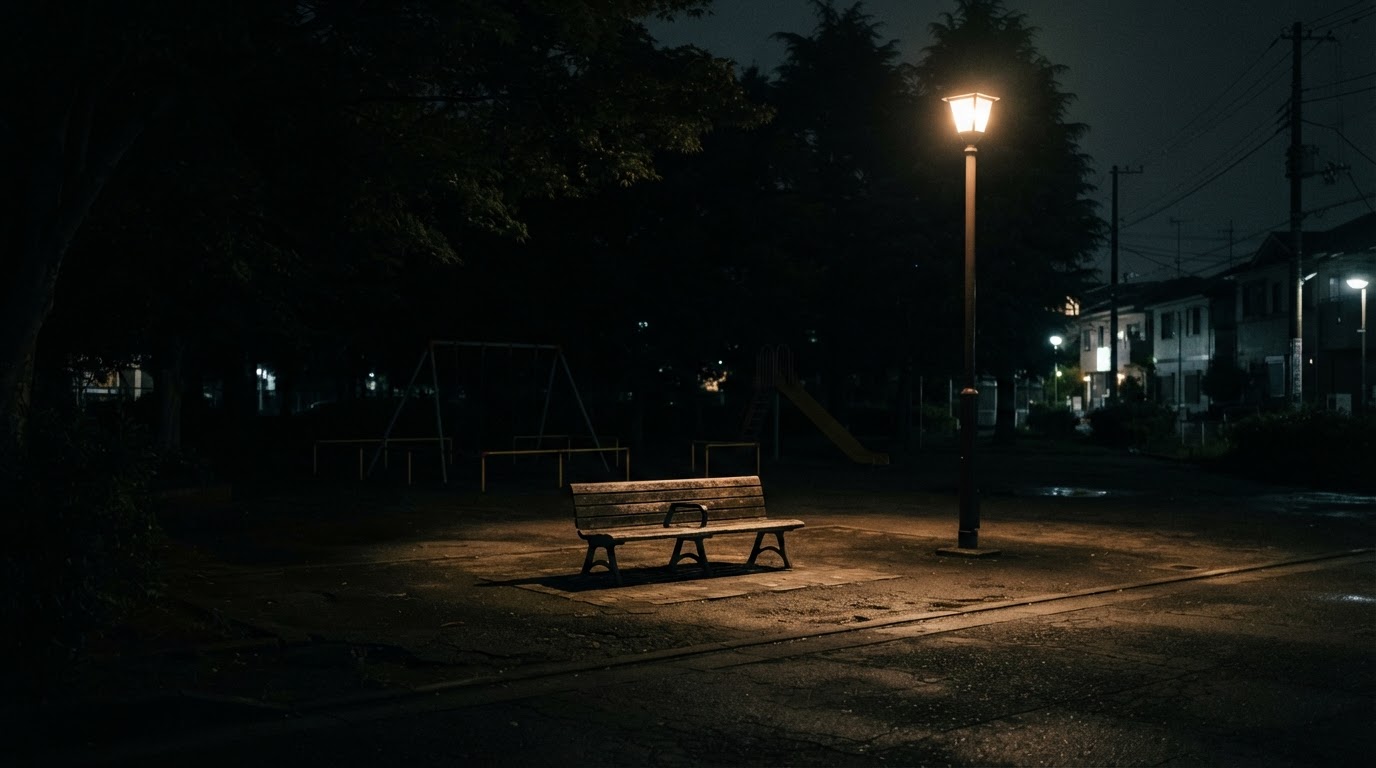
The images and video in this article are AI-generated works produced to convey the mood of the story, and are not photographs of any actual person or event.


Comments
No comments yet — leave the first one.