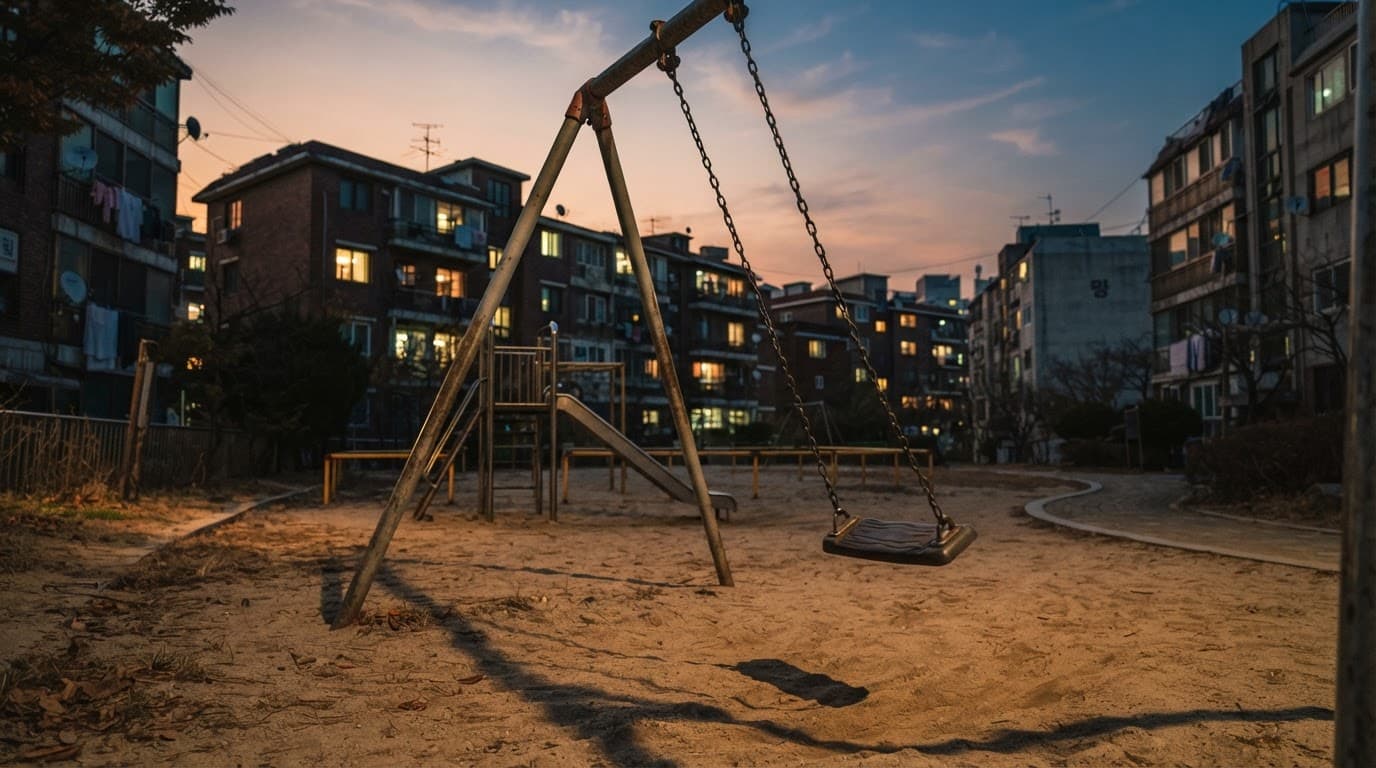
This is a heartbreaking case in which the victim was a young child.
We will not describe anything cruel — only the perpetrator who is still at large and the clues that remain.
We write this in the hope that it might stir someone's memory.
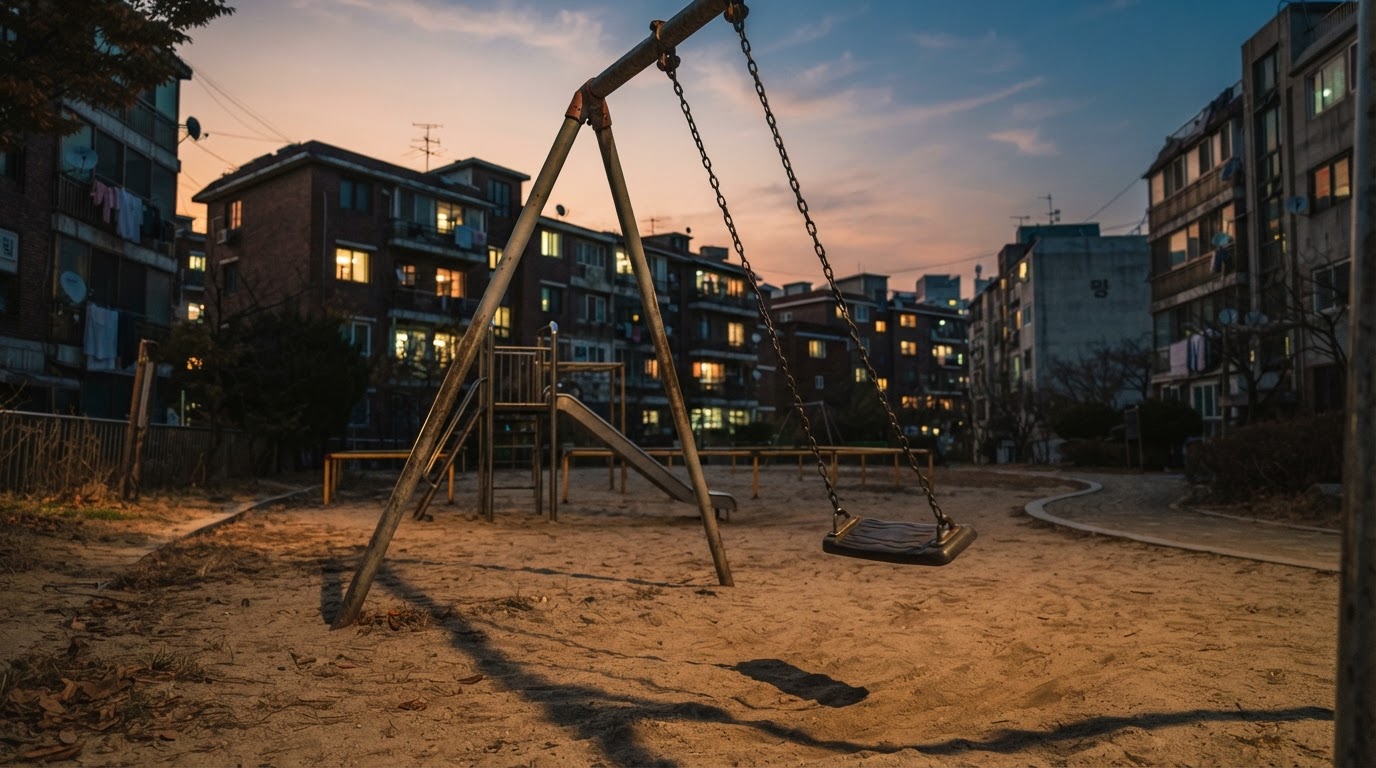
The evening of August 5, 2000
A playground beside an apartment complex in Jakjeon-dong, Gyeyang-gu, Incheon.
On a summer evening, a few children were playing at the playground.
It was around 8:15 p.m.
The sun had only just gone down, and people were still out on the streets.
A strange man approached and asked them:
"Kids, which way do I go to get to the Hyundai Department Store?"
An utterly ordinary question.
But later, investigators would fix on those few words.
The place people in that neighborhood called "Hyundai Department Store" was not an actual department store — it was a local shopping arcade, known by that name only to the locals.
That he used the name so naturally was a small clue that he might be someone who knew the area.
Without a trace of suspicion, the children moved to point him the way.
A seven-year-old girl had just stepped forward to lead him when, in the next moment, the man turned.
She was found collapsed barely ten meters from where the children had been playing.
There was no sign of robbery, no sign of any other motive.
A crime committed in an instant, its purpose unknown.
The man vanished at once into the dark.
My name is K. Woo, and I keep the records this file was built from.
The detail I could not put down was the name of the shopping arcade.
Not a department store at all — a name only people who lived there used.
I went back through the neighborhood references to be sure of it, and I was.
He asked in the local dialect of a place. Which means, on the evening of August 5, 2000, he was not lost.
The face the children saw
This case had witnesses.
Three children who had been playing with her.
But they were all young, and the shock of what they had seen made their accounts diverge.
The face one child remembered and the face another remembered were not quite the same.
The memory of small children was that easily shaken.
Their statements alone were not enough to identify the man.
Still, the children remembered his features clearly.
Police gathered their accounts and produced a composite sketch.
Five thousand copies were distributed across the country.
That September, the case was featured on a televised most-wanted program.
Tips came in from all over the country.
Police worked through some 1,200 people who came under suspicion — from drug offenders to those with histories of mental illness to vagrants — questioning them one by one.
But not one of them pointed to the man.
There was no CCTV at the scene.
It was before surveillance cameras had spread across the country, and not a single shadow remained of anyone who had passed the playground that evening.
Three months earlier, the same neighborhood
There was a reason police took this case so gravely.
Just three months before, on May 31 that year, in the very same Jakjeon-dong, a similar case had occurred.
At a flowerbed by an apartment in the same neighborhood, while a girl was watering the flowers with her mother, in the ten-odd minutes the mother had stepped up to their fifth-floor home,
a young girl was stabbed several times and taken from her family.
It happened to be raining that day.
As the rain washed the traces from the scene, the investigation struggled from the very start.
There was no sign of robbery, no sign of any other motive.
A crime committed in moments, with no discernible purpose.
The two cases were far too alike in method.
A stranger approaching a young girl, for no reason at all, in an instant.
Police believed it was highly likely the work of the same person.
One neighborhood. Three months apart. The same person, twice.
A case past its deadline
Time passed.
Under the law at the time, the statute of limitations for murder was fifteen years.
August 5, 2015.
On the day that marked exactly fifteen years since the crime, the statute of limitations on this case was set to expire.
Once it lapsed, even catching the man would make punishment impossible.
The case files would go into a cabinet, and the case would close forever.
For those who had carried the girl's death in memory, that was a second loss.
And then, at that very moment, the law changed.
"Tae-wan's Law."
Named for another young victim, a boy who died in an acid attack, this law abolished the statute of limitations for murder altogether.
It passed the National Assembly in late July 2015 and took effect at once.
And it applied retroactively to any case whose deadline had not yet passed.
The Jakjeon-dong case, with expiration only days away, came dramatically under this law.
Had it come even a few days later, the case would have been closed for good.
The deadline vanished.
Which means:
if that man is caught now, he will be punished.
Before we close this file
The Incheon Jakjeon-dong case is not over.
The Incheon police cold-case unit is still looking into it today.
The playground and the apartment from that day were later torn down in redevelopment.
The spot where the children once played has since become a different scene entirely.
But the case files remain, and the search for that face goes on.
The man who asked for directions at the playground that evening 25 years ago may be living somewhere now, an ordinary life.
The children who saw him then are grown adults now.
And the face in that composite sketch is still, even now, waiting for someone to recognize it.
There is one thing in my notes I keep circling back to.
The law changed in late July 2015. The deadline would have fallen on August 5.
I have checked those two dates more times than the checking warrants, because a margin that thin is not really a rescue.
It only means the file stayed open by a matter of days, while he has had twenty-five years.
If this face brings to mind someone you know,
then even if it was 25 years ago, it is not too late.
The deadline is gone, and the case is open.
A single small memory could protect one child's name.
---
The images and video in this article are AI-generated works produced to convey the mood of the story, and are not photographs of any actual person or event.
Comments
No comments yet — leave the first one.