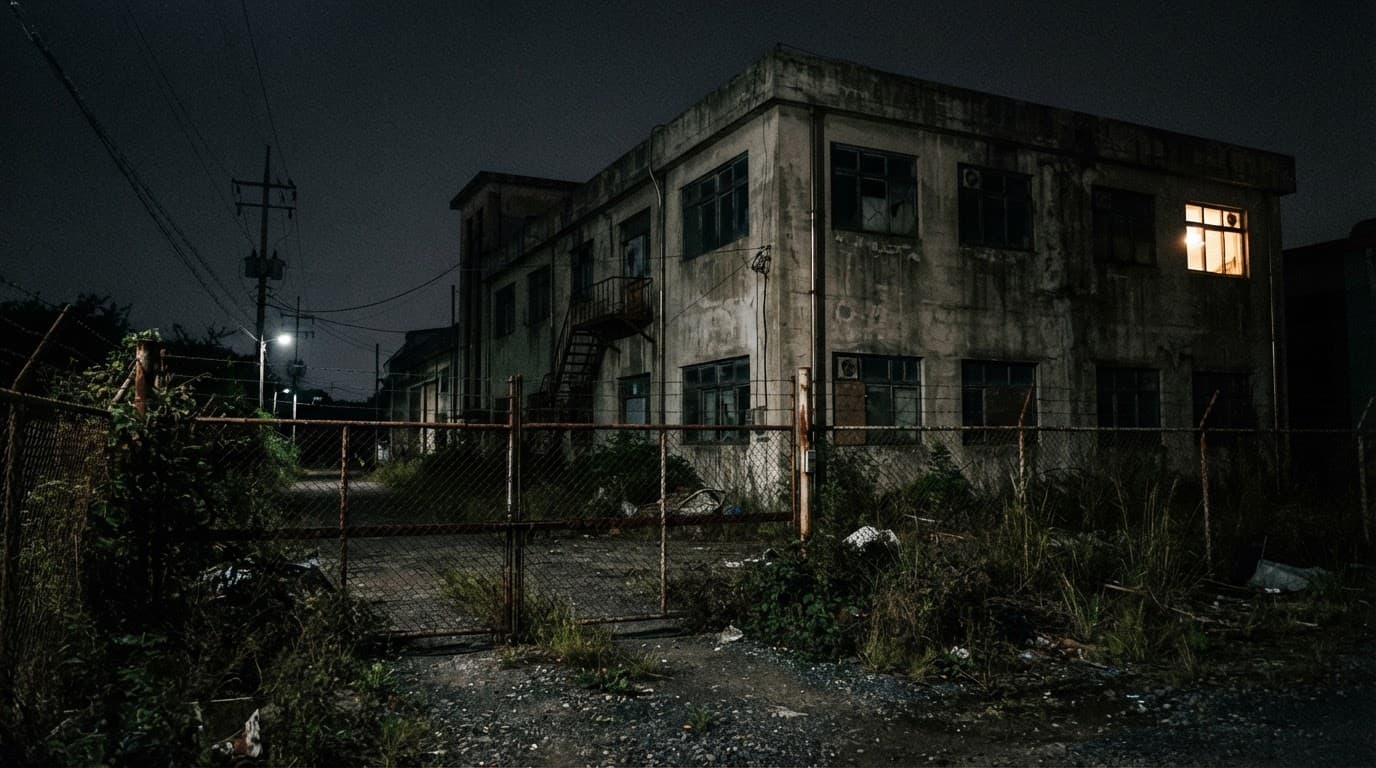
August 29, 1987.
A craft company in Namsa-myeon, Yongin, Gyeonggi Province — Odaeyang.
An employee who came to the factory that day opened the loft leading to the cafeteria ceiling —
and froze on the spot.
Inside that narrow ceiling space, thirty-two people lay dead.
Not one or two.
Thirty-two.
Men and women, young and old, all together — and among them, young children.
It was the beginning of the strangest mass death in modern Korean history.
There is a shelf in this archive for the files nobody has managed to finish.
My name is K. Woo. Odaeyang has sat there a long time.
This one came to me as a number and stayed as a ratio.
Twenty-eight women. Four men.
I have gone through the summaries three or four times now looking for anywhere that ratio is addressed directly, and it never is. It sits in every account as a line of description, never as a question. Whatever else the ceiling held, it held that proportion, and no investigation appears to have asked why.
Thirty-two people
The dead were the woman who led Odaeyang, her family — including her two sons —
and the people who followed her.
The head of this company was no ordinary businesswoman.
She stood at the center of her own faith, and a large number of the employees were her devotees as well.
In other words, this place was a factory and at the same time, a community.
Of the thirty-two, only four were men; the other twenty-eight were women.
An overwhelmingly female composition of death.
The autopsies found that most had died of asphyxiation by strangulation.
Their bodies showed traces of tranquilizers and motion-sickness medication.
It meant that, before death came, someone had given them the drugs in advance, or they had taken them themselves.
And perhaps for that very reason, there was something strange.
There were almost no signs that anyone had resisted.
As thirty-two people lost their breath one after another in that cramped space, scarcely a mark of struggle was left behind.
8.9 billion won
Behind these deaths lay an enormous debt.
Odaeyang carried private loans of roughly 8.9 billion won — an astronomical sum for the time.
On the surface it was a company that made handicrafts, but in truth it was a community running on private debt, perched atop a mountain of it.
The pressure to repay was relentless.
On one occasion, a creditor who had lent a large sum came to the factory himself, and was beaten by the devotees and pressured into signing a paper renouncing the debt.
When this reached the press, police opened a fraud investigation, and the pressure on the community grew heavier still.
A collapsing company, mounting debt, a tightening investigation, and people who followed her like a god.
Police weighed all of this and reached a conclusion.
Group suicide.
Driven to ruin, the leader had made an extreme choice together with those who followed her.
No indictment followed, and the case seemed to close.
Four years later, a confession
In 1991, as the case faded from memory.
Something shocking happened.
Six people connected to Odaeyang, who had disappeared until then, came forward to the prosecutors and turned themselves in.
Their statements brought a new fact to light.
Before the mass death of 1987, three people inside the community had already been killed and secretly buried — for supposedly breaking its rules.
They also spoke of times of "repentance" within the community — sessions in which members would corner one another and beat them as a group.
Behind the face of a faith community seen from the outside, there had been this darkness.
On the strength of this, the case entered a third investigation.
But the conclusion of the reinvestigation was the same as in 1987.
The thirty-two in the ceiling — group suicide.
The three secretly buried were a separate case, and those responsible were punished.
What was never resolved
The official conclusion was group suicide, but the questions never disappeared.
First, in that narrow ceiling space, could thirty-two people really lose their lives one after another, without resistance, truly of their own will?
Some of the experts who handled the autopsies even gave the opinion that some of the deaths should be seen not as suicide but as murder.
Second, why the ceiling of all places?
Was it to hide something, or was it a ritual all their own?
This case was also trailed, for a long time, by a rumor of involvement with a well-known religious group of the time.
But one thing must be made clear.
Across three investigations, prosecutors found no evidence that this religious group was behind the case,
and concluded that it was "unrelated."
Much later, in 2014, when prosecutors examined this question again, the conclusion did not change.
No connection had been established, still.
When the group's leader was criminally convicted, it, too, was not for this case but for a separate fraud charge.
The rumor of involvement is only a rumor, and officially the group is unrelated.
So that speculation does not harden into fact, this point must be remembered.
Before we close this file
The Odaeyang case is not a story of chasing a culprit.
Nor is it fully explained by the word "unsolved."
The official conclusion exists. Group suicide.
And yet the reason this case has stayed in memory for nearly forty years
is that no one has ever given a complete answer to the question of "why."
What led thirty-two people up into that cramped ceiling?
What stripped from them even the will to resist?
That one person's faith could take thirty-one others with it.
Perhaps that is a truth more chilling than any ghost story.
Nearly forty years have passed over the site of that factory in Yongin.
The whole of what happened above that ceiling was buried forever with the people who were there that day.
There is one detail I have never been able to file properly.
The tranquilizers, and the motion-sickness medication.
Tranquilizers I can account for. Motion-sickness medication I cannot.
Nobody in that ceiling was going anywhere. It is a drug you take before a journey, and it was in their bodies, and the record has never explained what journey anyone thought they were on.
I close this file the same way every time. Not on the question of who, or how — but on that one small pharmacy detail, sitting there for nearly forty years, waiting for a destination.
---
The images and video in this article are AI-generated works produced to convey the mood of the story, and are not photographs of any actual person or event.
Comments
No comments yet — leave the first one.