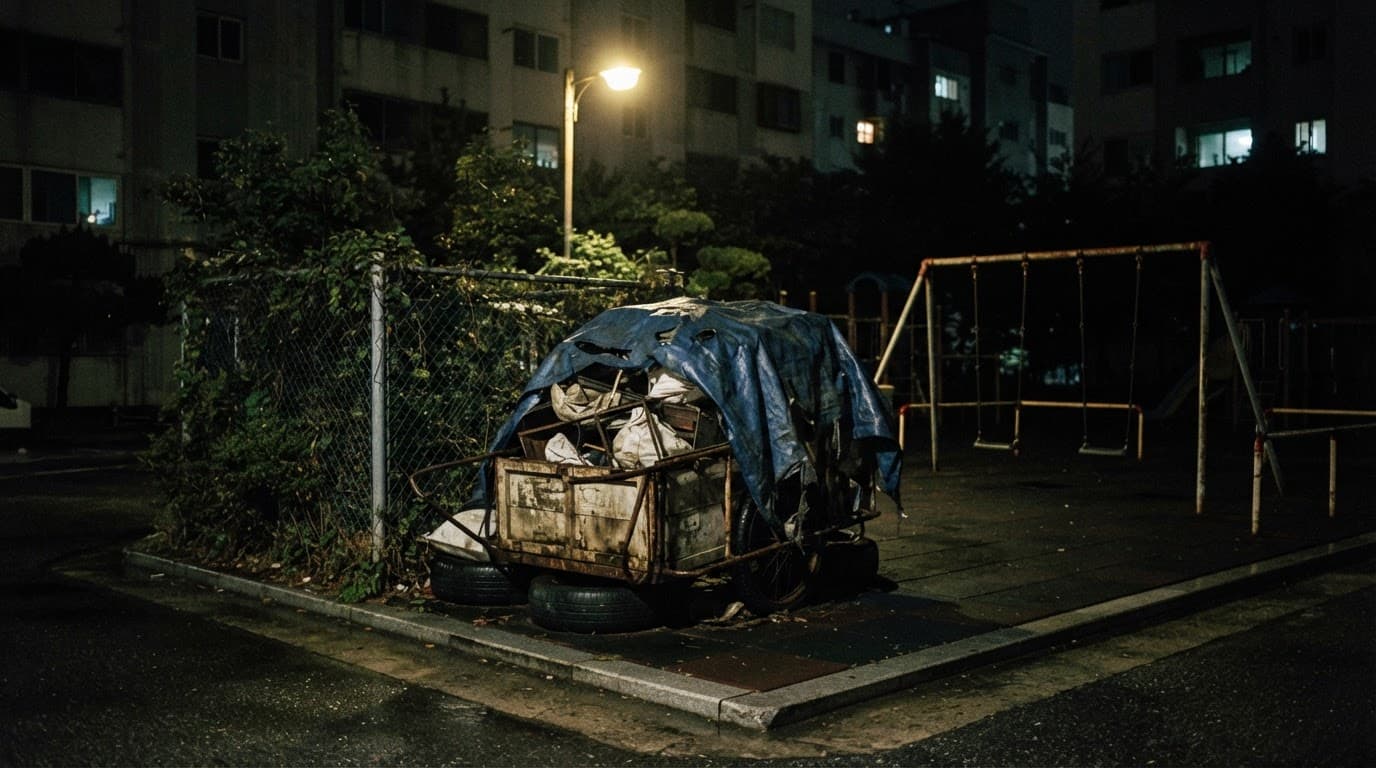
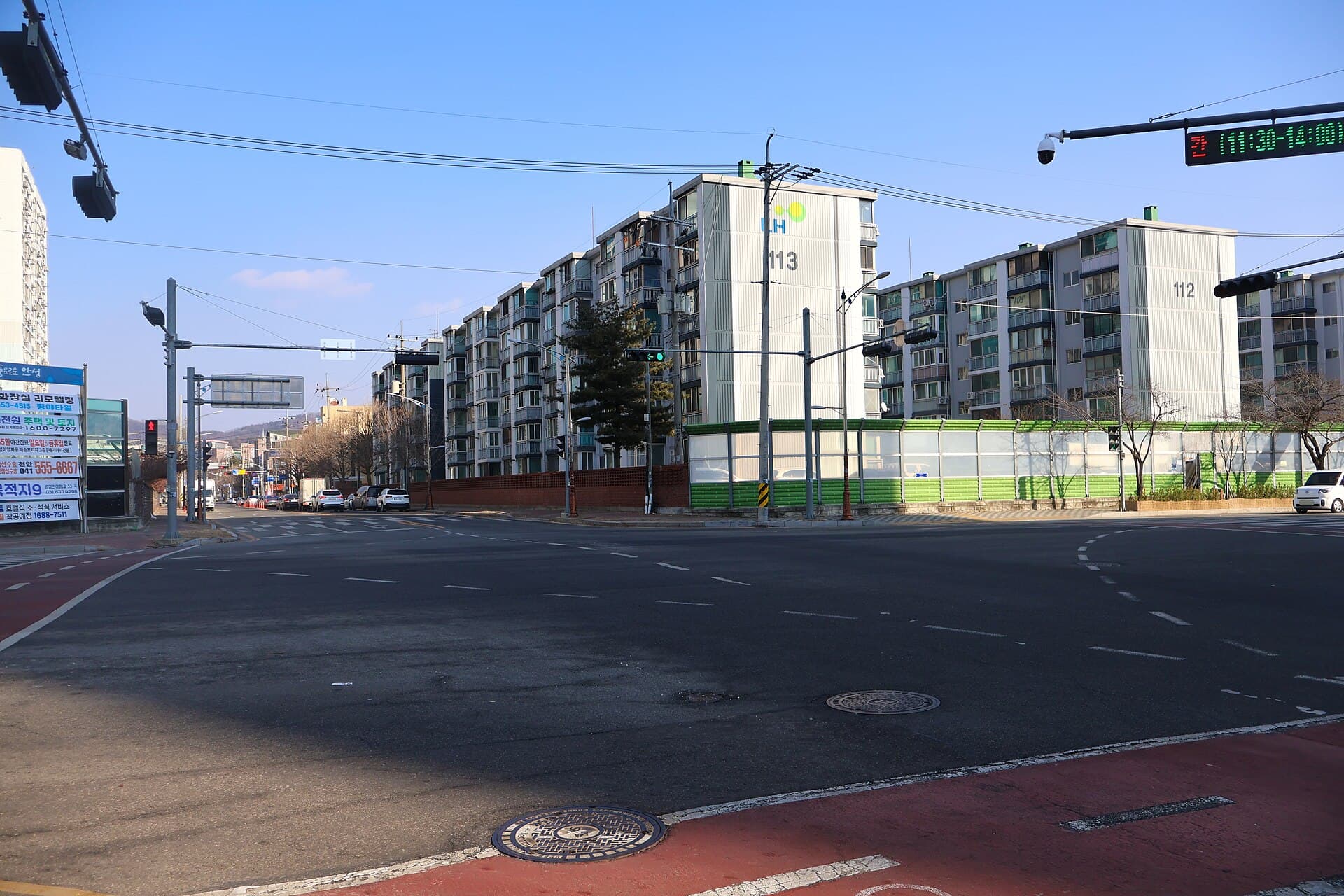
Choji-dong, Danwon-gu, in the city of Ansan, Gyeonggi Province.
An ordinary apartment complex.
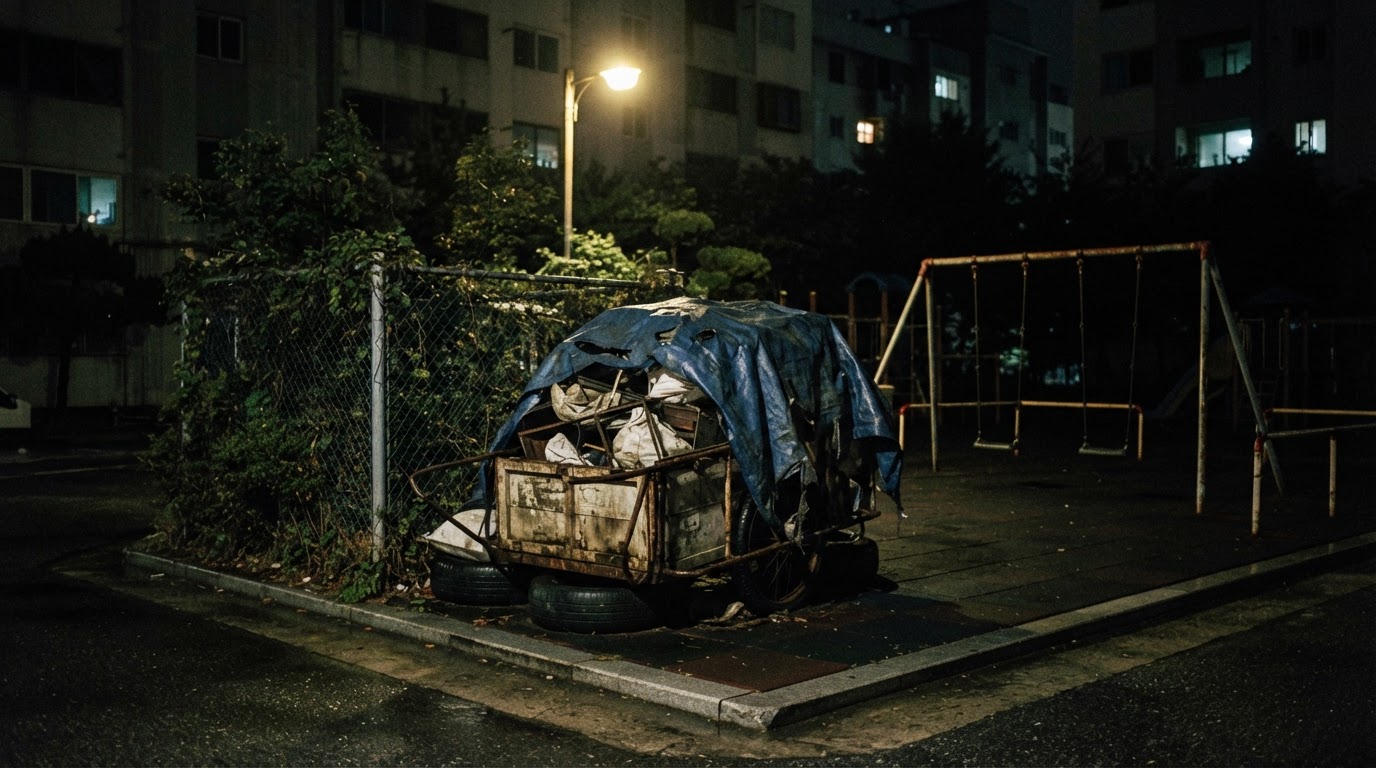
To one side of the complex playground stood an old handcart.
The kind you'd see collecting waste paper, its load draped in blue cloth — an ordinary pushcart.
Dried mud caked its wheels, and the cloth had faded in the sun.
Nothing about it stood out.
A cart someone had parked for a moment. Something that would soon be cleared away.
No one in the neighborhood gave it a second look.
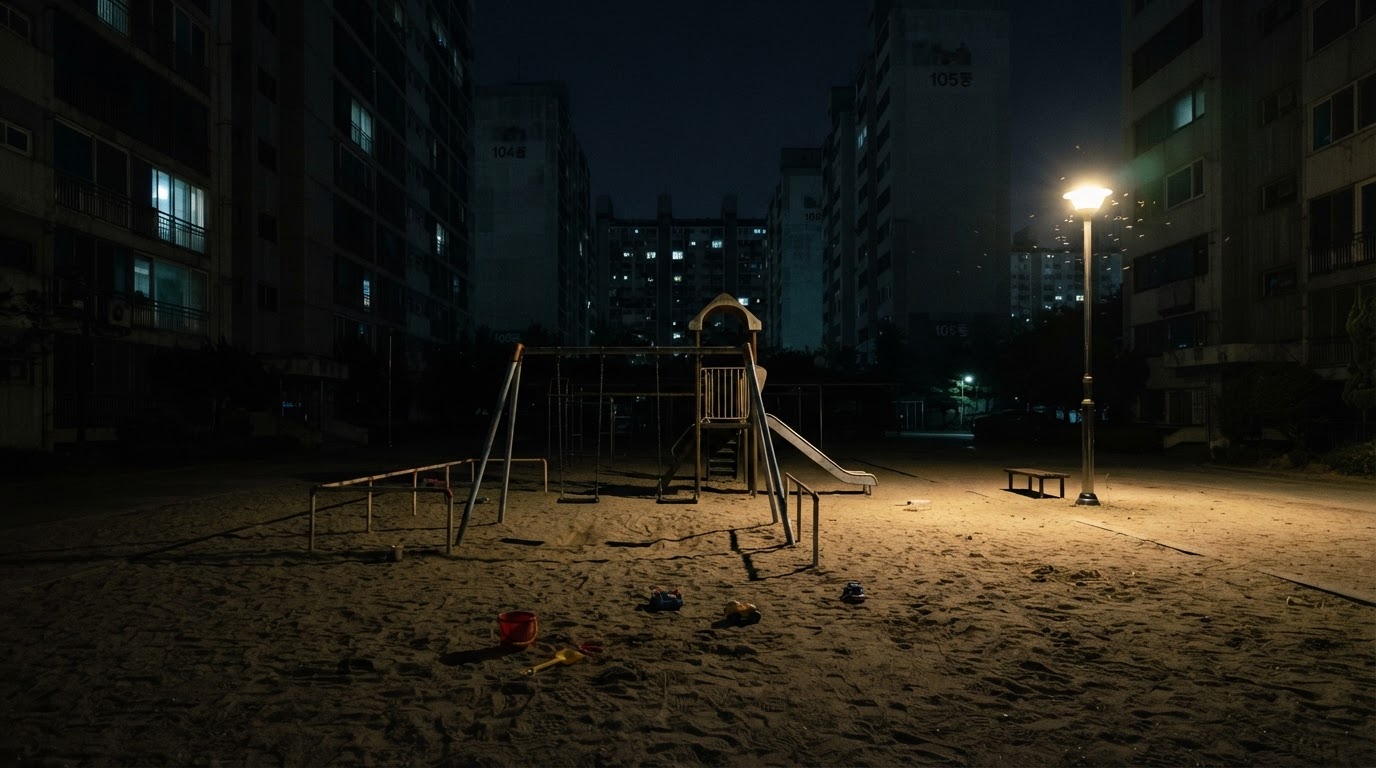
Every day the children played beside it, sliding down the slide, pushing one another on the swings.
Just how long that handcart had stood in that spot,
no one could remember exactly.
That no one could recall the day it appeared —
looking back, that alone was the first strange thing.
Most cold cases I sort through begin with a date.
This one begins with a hole where a date should be.
I went through what the residents told investigators and what the management office had on paper, looking for the day the cart arrived, and there is no such day — only 2008, approximately, reconstructed backwards.
I have kept files on stranger crimes. I have never kept one where the first missing fact was the beginning.
July 6, 2011
That day, a resident made a request to the management office.
"That handcart abandoned in the playground — the children are going to run into it and get hurt. Please clear it away."
Around 3:10 in the afternoon, a security guard went to move it.
When he pulled back the blue cloth covering the load, a cooler box appeared.
A cooler box in a summer playground is nothing unusual.
But there was one strange thing.
As he tried to lift it, the cooler was far too heavy.
Heavier than any empty box could ever be.
Without a second thought, the guard opened the lid.
Inside was a travel bag, wrapped in dozens of layers of white plastic.
A black liquid had pooled at the bottom, and an unbearable smell rose up.
And inside that bag, there was a woman.
The guard called it in, and the police came.
The most ordinary-looking playground had become, that day, a crime scene.
Three years
As the investigation began, the very first fact it uncovered left people frozen.
That handcart had been in the playground for about three years.
Three years.
Matching residents' memories against the management office's records, investigators traced the cart's arrival back to around 2008.
Across three springs that came and three summers that passed,
the children had played beside that handcart every single day.
No one knowing what was inside the cooler box.
Parents sent their children to that playground, and grandmothers rested on the bench beside it.
In summer they splashed in water beside it; in winter they built snowmen there.
Through all that time, no one ever suspected the cart.
It was so ordinary that, if anything, it had gone invisible.
The most ordinary neighborhood playground had, for three years, been the site of a dumped body.
That is why this case still sends a chill through people to this day.
The erased person
The victim was a woman in her forties with cerebral palsy.
One of her arms was impaired, and she had been getting by, day to day, on a disability allowance and basic livelihood assistance.
She was a resident of that very apartment complex.
When investigators traced the records, her trail had gone completely cold around 2006.
No hospital visits, no welfare consultations — nothing remained after that point.
Some years later her resident registration was struck from the rolls, and still no one had been looking for her.
There had not even been a missing-person report.
The body's neck and both thumbs had been severed.
It appeared to be an attempt to make identification impossible — her fingerprints and her face erased before she was packed into a bag and discarded.
A person had vanished from the world, and not even one soul had noticed she was gone.
She had not so much vanished as been erased.
The vanished suspect
The investigation snared one man.
He was the owner of that handcart — a Mr. Jeong, known to have been the victim's caretaker and live-in partner.
He had once handled her administrative affairs on her behalf.
There were several suspicious circumstances around him.
First, even after the victim disappeared, the disability allowance and government support issued in her name kept being withdrawn from her account.
The money of a person no longer in this world kept flowing out, by someone's hand.
What is more, he had a prior conviction for murdering his wife.
To the investigators, that combination was not something to pass over.
When police tried to question him, they hit a decisive wall.
He was no longer of this world.
In 2009, he had died of cancer.
In the three years the handcart stood there, the one person they needed to ask had already gone.
Before we close this file
The prime suspect was dead, there were virtually no CCTV cameras near the playground in 2011, and the victim's final few years lie buried in darkness.
Even the autopsy could not pin down the exact time or cause of death — the body was too far decomposed.
And so this case was left permanently unsolved.
Let one thing be clear: Mr. Jeong was named only as a prime suspect — the crime was never proven.
With him already dead, even the chance to test it in a courtroom was gone for good.
Now no one remains who could tell the truth.
There is just one thing to sit with.
The children who played beside that handcart for three years must be all grown up by now.
Not one of them ever knew what it was they had been laughing beside, every single day.
The most terrifying things in the world sometimes wear the most ordinary face, set down right beside us.
For three years, as if it were nothing.
The line I keep returning to is not the cooler box.
It is the allowance.
A woman's trail ends around 2006, and the money issued in her name keeps being drawn out, month after month, by a hand that knew she would not be reported missing.
On paper she was still alive for years after she had stopped being anywhere.
I have read that sequence more times than I should have, and each time I come away with the same useless question:
which of those years was she still counted as a person, and by whom.
---
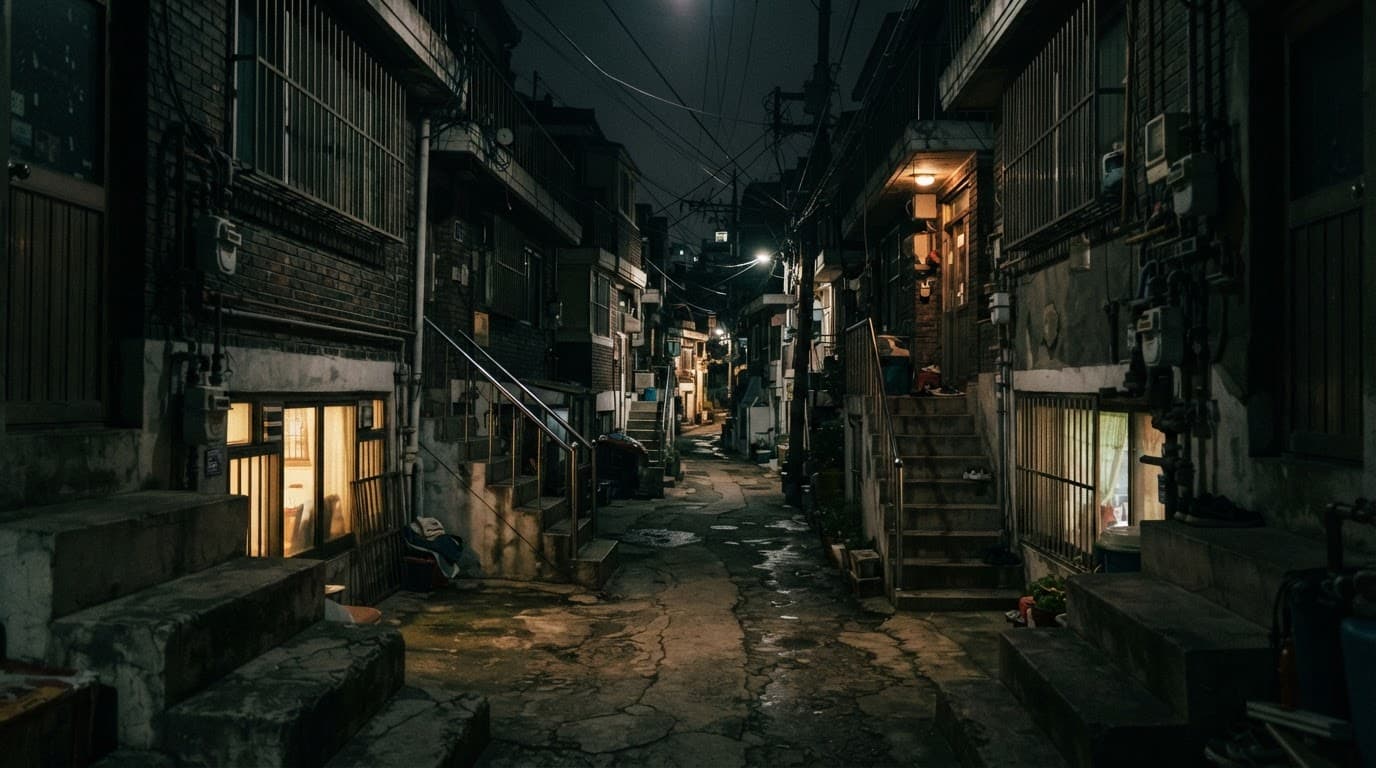
The images and video in this article are AI-generated works produced to convey the mood of the story, and are not photographs of any actual person or event.

Comments
No comments yet — leave the first one.