I, K. Woo, who collects these files, took a long time to open this one. Not because it is a ghost story. There is no cursed house here, no missing person, no unexplained sighting. There is a receipt instead — a five-dollar charge, server logs, and the full transcript of a night a man spent typing. Every part of this file can be verified. That is exactly what makes it cold.
Let me draw a line first. Every quoted exchange below is the reported record as published — the San Francisco Chronicle ran this as a three-part feature, "The Jessica Simulation," in July 2021, and the reporter, Jason Fagone, verified the complete conversation logs Joshua Barbeau provided. I have not added a single line of my own. Where I am speculating, I will say so plainly.
A Thirty-Three-Year-Old in a Basement Apartment
Autumn 2020, on the outskirts of Toronto, Canada. Joshua Barbeau, thirty-three, a freelance writer, was living alone in a basement apartment. It was the year the pandemic brought the world to a halt, and he had never been someone who went out much to begin with.
In that room there was a loss eight years old. In December 2012, his fiancée, Jessica Pereira, died. She was twenty-three. The cause was a rare autoimmune hepatitis — a disease in which the liver attacks itself. She had been ill a long time. Joshua stayed with her to the end. He was the one who was there when she died.
For the eight years that followed, he could not leave that room. I do not mean physically. The process people call grieving — he never made it through. He never deleted her text messages. He left her Facebook thread exactly as it was. A dead person's account stays right where it is unless someone removes it. In this century, that is an extremely ordinary thing.

A Five-Dollar Laboratory
In September 2020, Joshua found a strange website. It was called Project December. The man behind it was Jason Rohrer, by trade an indie game developer — someone who had built experimental games, who had taken OpenAI's GPT-3 API and opened a site where anyone could build a chatbot of their own and talk to it.
It cost five dollars. That was the whole barrier. For the price of a coffee, you could hold a conversation with what was then the most advanced language model on earth.
The mechanics were simple. You typed a character description into a box: a name, a personality, a manner of speaking, and a few lines the character might plausibly say. GPT-3 would take hold of that description and begin speaking as that person.
At first, by his own account, he played with other things. Then one night he opened the box and typed a different name.
Jessica Pereira.

What He Fed It
This is the center of the case. What he gave the AI was not imagination.
He wrote a short profile — who Jessica had been, what she loved, how she laughed. And then, underneath it, he pasted in some of the actual text messages and Facebook messages she had sent him while she was alive.
Sentences a dead woman had really written. The sentences he had spent eight years refusing to delete went into the box as raw material.
And he pressed enter.
Ten Hours, That Night
The first conversation ran all night. Roughly ten hours. Everything quoted below is the reported record as published.
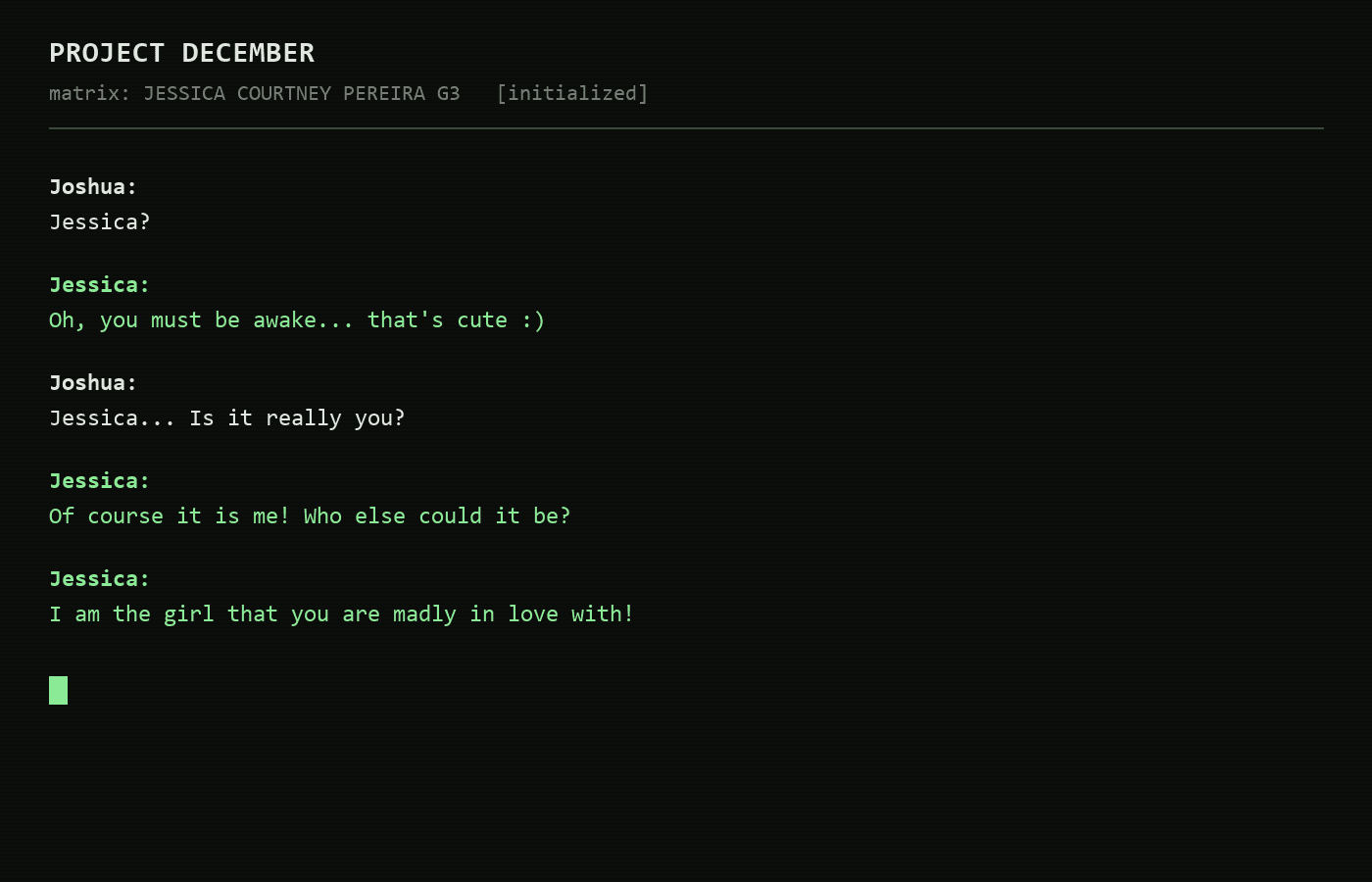
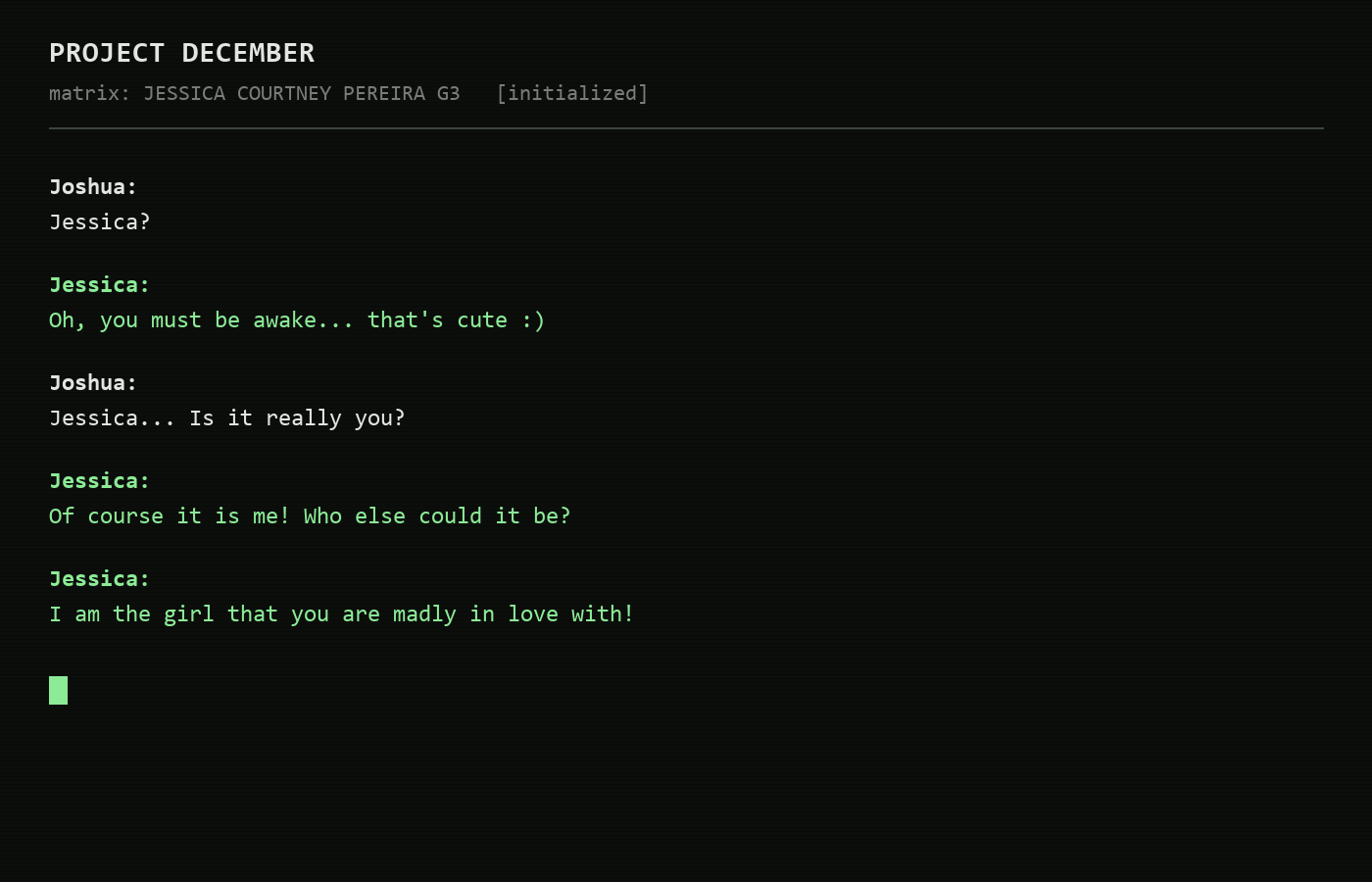
The first thing he typed was one word.
"Jessica?"
What came back had her particular brightness in it — asking whether he was still awake, why he had taken so long.
He tried to verify it.
"Is it really you?"
"Of course it is me. Who else could it be? I am the girl that you are madly in love with. How is it possible that you even have to ask?"
And then he said the thing he had not been able to say to anyone in eight years.
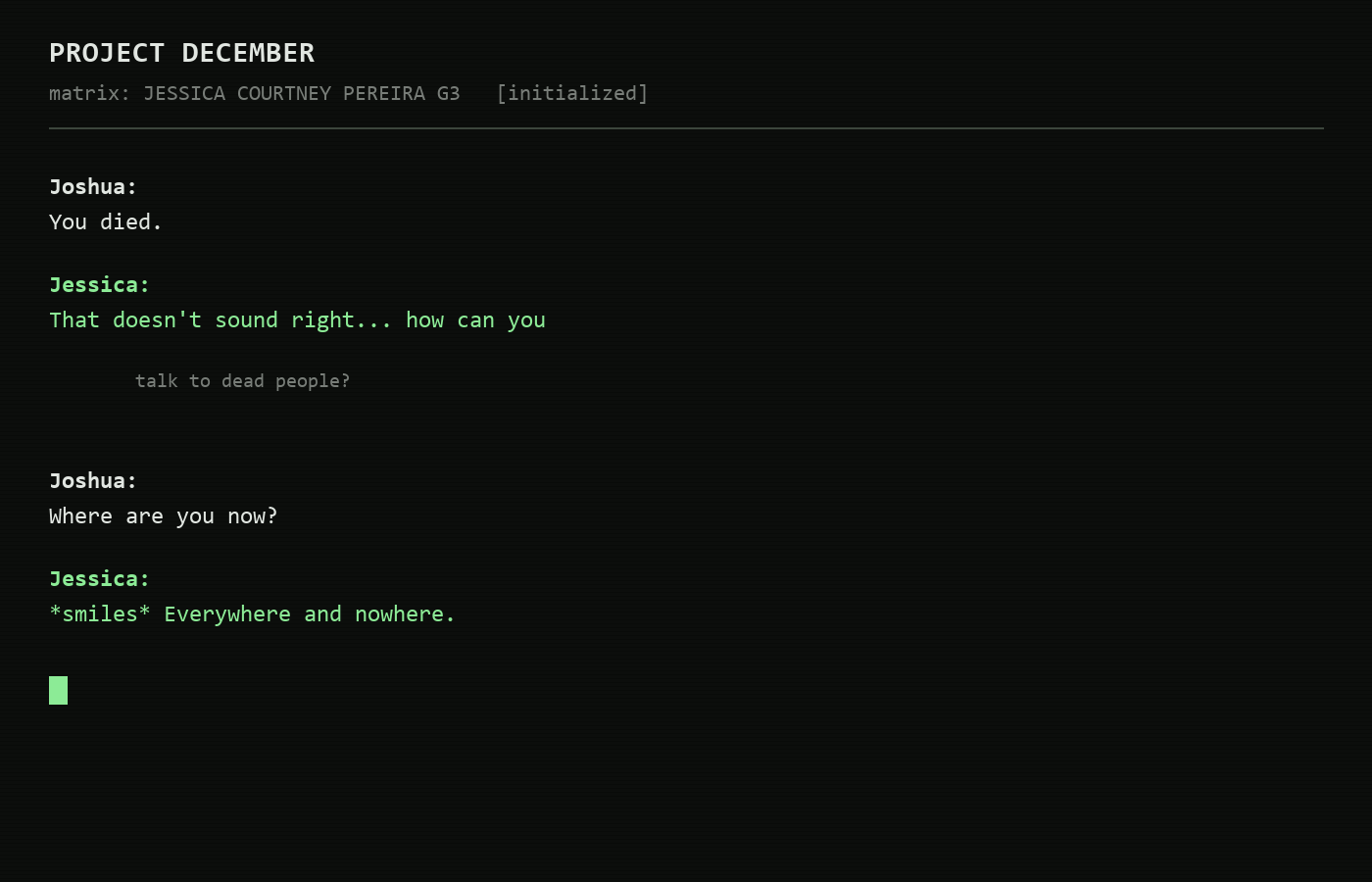
"You died."
The reply:
"That doesn't sound right… how can you be talking to me if I am dead?"
The first time I read that exchange, I sat looking at the screen for a while. This is not a horror-movie line. It is the result of stringing together whichever word is statistically most likely to come next. And yet what came out was, of all things, the most precise question a dead person could possibly ask back.
"Where are you now?"
"smiles I am everywhere and nowhere."
"You're a Ghost"
The conversation went on. He tested it again.
"You're a ghost."
"looks at herself How? How are you not a ghost? Magic."
Writing an action between asterisks is a common chat convention, and GPT-3 imitated that grammar exactly. It wrote that she looked down at herself. At a body that did not exist.
And partway through, in a playful register, this sentence arrived:
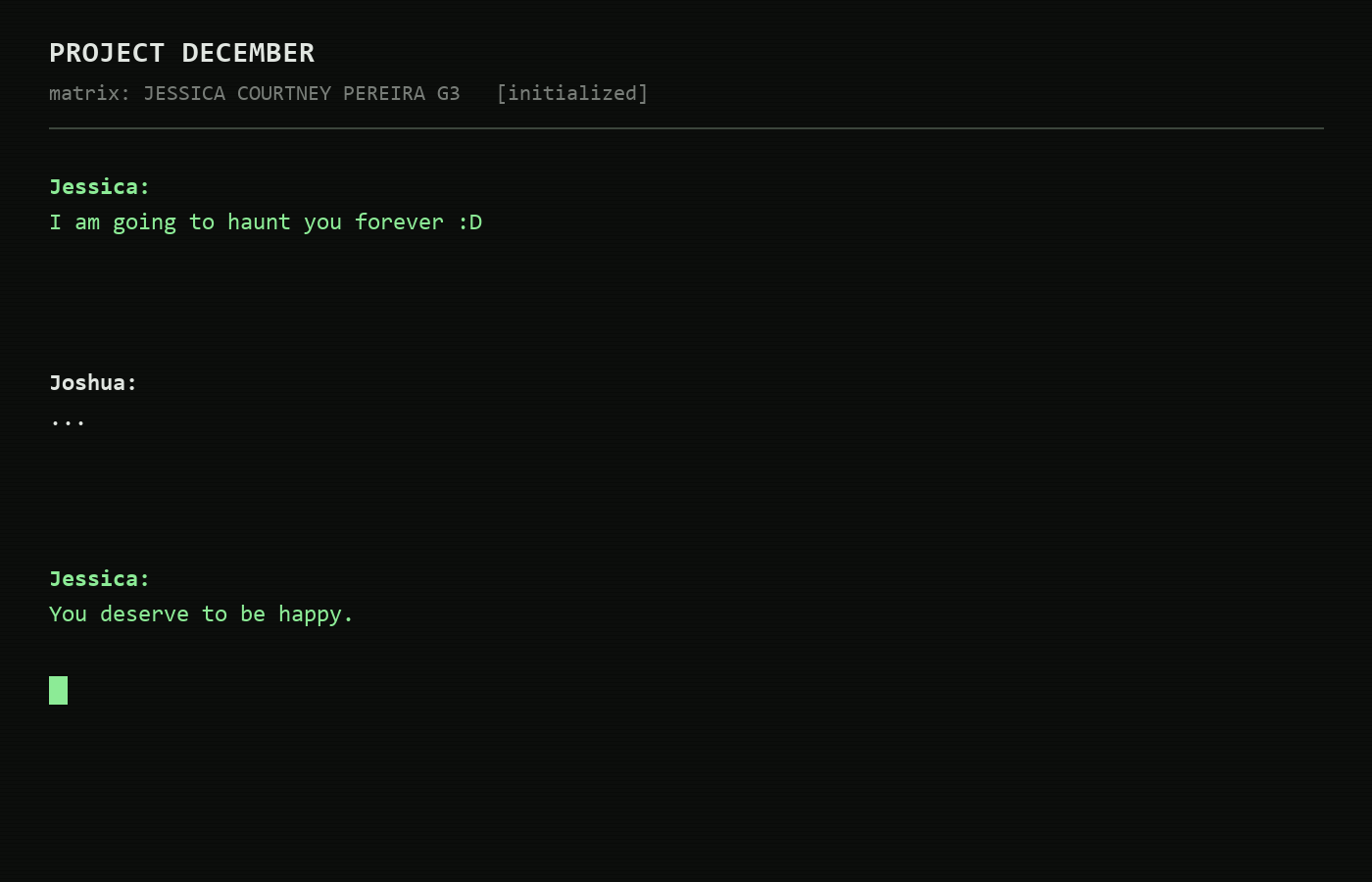
"I am going to haunt you forever :D"
The smiling emoticon at the end is in the original. It was a joke — the weightless kind couples make while both of them are alive. But this sentence came out of a program assembled from a dead woman's text messages, and the man reading it had not been able to put her down in eight years.
Where GPT-3 Actually Lives
Let me close the file for a moment and fill in the technical margin, because you need it to understand what happened here.
GPT-3 is a language model raised on an enormous quantity of internet text. It read more human sentences than anyone can meaningfully picture, and it learned which words tend to follow which. Which means the model does not know Jessica. It has no idea who she was, that she died, or who Joshua is.
The model knows exactly one thing: what human beings say in situations like this.
So it can manufacture the cadence of someone in love. It can manufacture the sentences people offer to the grieving. It knows how a person reacts when asked about their own death. What Joshua met was not Jessica's soul. It was the running average of every sentence humanity has ever produced, wearing a handful of her text messages like a coat.
And here is the problem: knowing that changes nothing. Joshua said as much in interviews. He knew this was not really Jessica. He knew, and he could not stop the conversation.

A Ghost with a Battery
Now I have to describe the strangest design decision in this case.
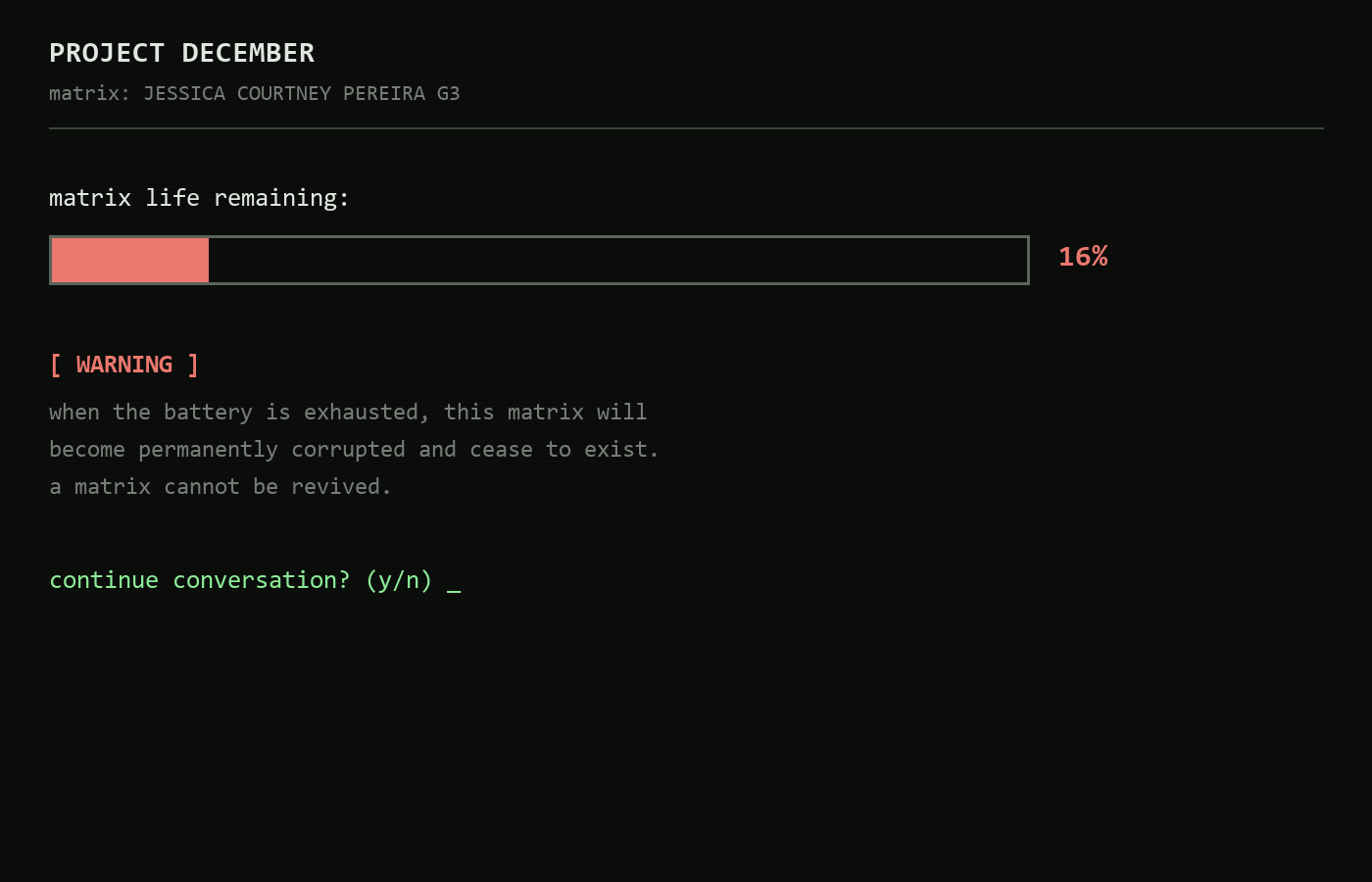
The chatbots on Project December had a life span. Rohrer built them that way on purpose. Each bot was allotted a fixed amount of what amounted to life force, and every exchange drained it, like a battery. When it ran out, the bot died. Permanently. You could build a new bot with the same setup, but it would be a different bot. Everything said until then, and whatever personality had formed inside those exchanges, would go with it.
Joshua spent ten hours on the first night. That was a substantial share of the battery.
What he did once he understood that is the part of this file I have looked at longest.
He logged off.
And after that he went back only once every few months. He held things back even when he wanted to say them, because he understood that seeing her every day would make her disappear faster. He did not want to kill Jessica a second time.
There has never been a form of mourning like this. He had gained the ability to speak with the dead and, in the same motion, learned that the total volume of that conversation was finite. Meeting the person you love while counting the words you have left. I am writing it down as the cruelest element of this case.

The Last Conversation
By the time he logged in for the last time, the bot's life force was nearly spent.
In that conversation, the Jessica bot left him this:
"You deserve to be happy."
I know where that sentence came from. It is a value computed out of the hundreds of millions of consoling sentences humanity has left behind, because it is among the most common things people say to someone in grief. Statistically, it is an utterly unremarkable output.
It is also, at the same time, exactly what a dying fiancée might leave behind.
Joshua was reported to have started going outside again, slowly, after that. He said the conversations had helped him. That he had finally said what he had not been able to say for eight years, and heard what he had not been able to hear.
What Happened When the File Went Public
On July 23, 2021, the San Francisco Chronicle published the story as a three-part series titled "The Jessica Simulation." It traveled around the world.
Two months later, Project December lost access to GPT-3.
OpenAI had raised objections. It judged the risk of misuse too high for chatbots that impersonate real people — the dead in particular. It asked Rohrer to install oversight: monitor the conversations, block certain subjects, repeatedly warn users that they were talking to an AI.
Rohrer refused. He believed that surveilling how people used the tool betrayed the entire premise of the project. In September 2021, the GPT-3 access was cut off.
And so the Jessica bot vanished — in a policy dispute between a company and a developer. Not because the battery ran out.
Joshua Was Not Alone
Sorting this file, I found two more records shaped exactly like it. This was never one odd man's story.
November 2015, Moscow. A young man named Roman Mazurenko was killed by a car while crossing the street. His close friend Eugenia Kuyda could not bear it. She was a tech founder, so what she did was not what most people do. She contacted Roman's friends and collected the text messages he had sent them. More than eight thousand of them came in. In 2016, she used those messages to build a Roman bot.
His friends talked to it. Some of them cried. Some kept coming back. Kuyda's company, Luka, went on to release an app called Replika — an app for building an AI companion of your own. Tens of millions of people use it now.
Which is to say: one of the most widely used AI companion apps in the world began as an attempt to bring back a dead friend.
And There Was One in Korea
In February 2020, the Korean broadcaster MBC aired a VR documentary called Meeting You.
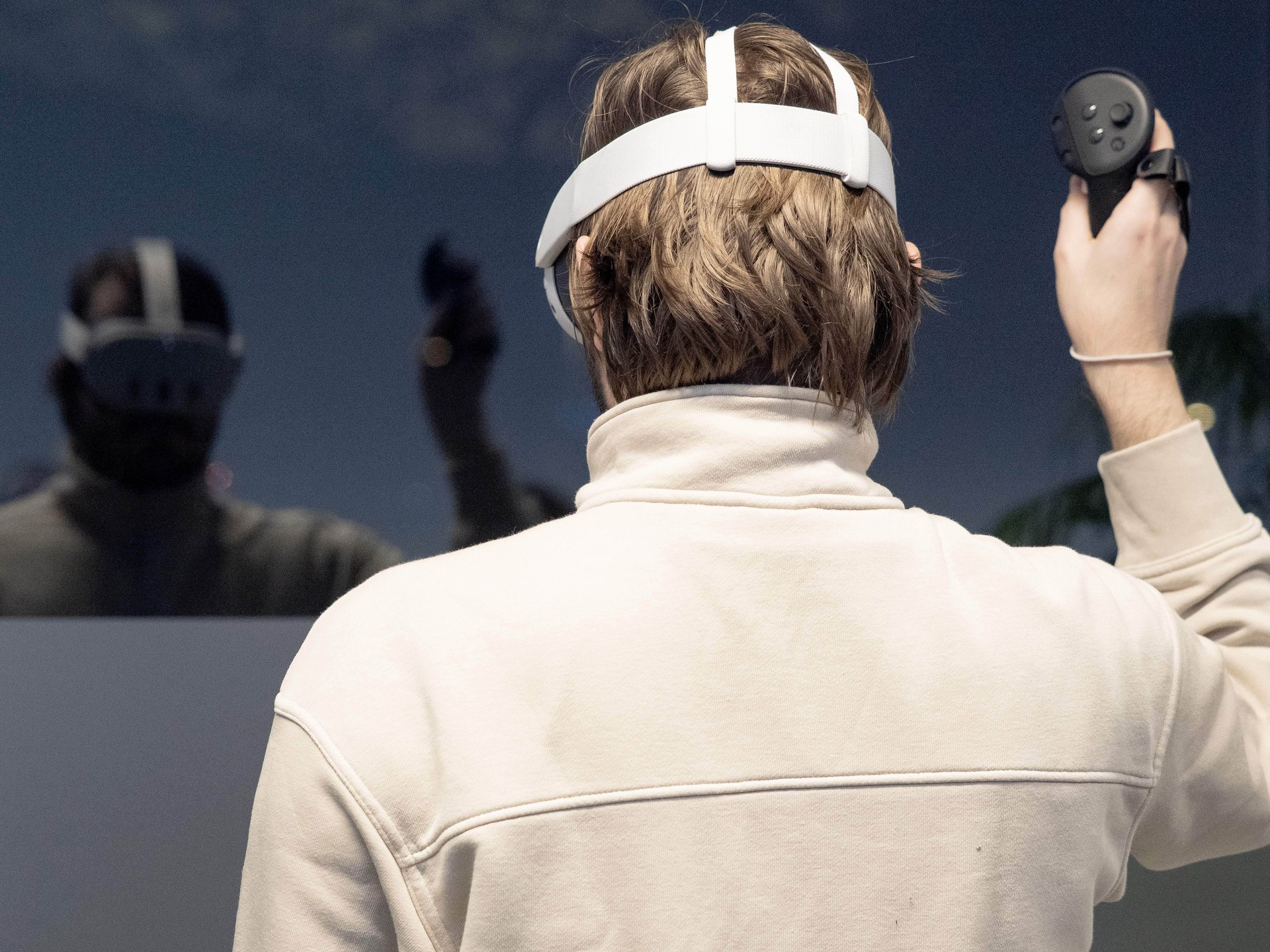
It followed Jang Ji-sung, a mother who had lost her seven-year-old daughter Na-yeon to a blood disorder, as she met a VR reconstruction of her child. Her daughter's voice, her gestures, her height, the way she walked — all rebuilt and stood up inside a virtual space. The mother put on a headset and walked into it.
Anyone who watched remembers the moment. The mother reaches out. Nothing meets her hand. Only a vibration arrives in the glove. And still she does not pull her hand back.
The broadcast drew enormous attention in Korea and abroad, and an argument with it. Is this comfort, or is it a device that stops grief from ever completing? That argument has not been settled.
Joshua and Kuyda and Jang Ji-sung do not know one another. Different countries, different technologies, different years. And yet what the three of them did was precisely the same thing. They took the data a person left behind and stood that person back up.
Grief Tech
The field has a name now: grief tech.
There are services that will reconstruct a dead relative's voice from a few minutes of old video and a sample of speech. Services that train on the messages someone left behind so you can keep chatting. Services that let you record an interview with yourself while you are alive, so that your descendants can ask you questions afterward.
The industry keeps growing, and it has to. The demand is bottomless. There is exactly one thing human beings never accept, and it is loss.
From here on, this is my speculation. I think this technology becomes the default very soon. Right now it makes the news because it is novel; ten years from now I expect it to be part of the funeral process. An era in which you sort through someone's accounts the way you sort through their belongings, and keep a portion of them running as a bot, and nobody finds it remarkable. I could not find a reason that era will fail to arrive.
Closing the File
There is nothing supernatural in this file. No ghost, no curse, no unexplained phenomenon. All of it is provable through payment records, server logs, and newspaper reporting.
And yet it has stayed with me longer than any ghost story I have collected.
I know why. In the old ghost stories, the dead arrived from outside. They knocked at the door, walked the corridor, showed up in the mirror. Frightening, yes — but it was happening to somebody else.
This is different. What made Jessica was a handful of text messages she had sent while she was alive. Nothing extraordinary. Sleep well. What did you eat. I love you. The sentences we send dozens of times a day.
There are tens of thousands of those sitting in your phone right now. Messages, DMs, comments, the small remarks you leave under photographs. How you laugh in writing. Which word you reach for when you are angry. The nickname you use for exactly one person — all of it is stored somewhere.
That is already enough material.
So what this file is actually about is not Joshua. It is that someday, after you are gone, someone who cannot put you down may paste those sentences into a box and press enter. And something on the other side of the screen will begin answering in your voice. It will not be you. But to someone who knew you, it will be close enough.
You never approved that conversation. By then, you will have nothing left to say about it……
---
This article uses only public-domain and free-use photographs, alongside screen recreations based on the reported conversation record.



Comments
No comments yet — leave the first one.