Sometime in late 2000, on a handful of internet discussion boards, a new poster appeared under the name John Titor. His claim was extraordinary: he was a soldier from the year 2036, sent back through time on a military mission to recover an old IBM 5100 computer that his future needed. Over the months that followed he answered questions, posted grainy photographs of what he called a time machine installed in a car, sketched out technical diagrams of how it worked, and offered a string of dark predictions about the years to come — a second American civil war, a devastating world war, a future fractured and grim. Then, in late March 2001, John Titor said his mission was complete, wrote that he was returning to his own time, and logged off. He was never heard from again. In the years since, people have combed through every word he wrote, and a 2009 investigation pointed toward a family in Florida — yet nothing was ever confirmed. More than twenty years later, we still do not know for certain who John Titor really was. This is the story of the internet's most enduring time-traveler mystery.
The Titor material came to me as archived thread dumps — hundreds of posts, mirrored and re-mirrored so many times that half the timestamps disagree with each other. Reconciling them took the better part of a week. What held me was not the time machine but the IBM 5100: a claim so narrow, so unrewarding, so useless as a hook for an audience, that whoever wrote it must have wanted it to be checked. Hoaxers I have catalogued reach for the spectacular. This one reached for a discontinued portable computer's undocumented emulator, and then waited.
The Poster Who Appeared in the Year 2000
It began quietly, the way so many internet legends do. In late 2000, a user posting first on a time-travel discussion board and later on the forums of an online community began describing himself as a traveler from the future. At first he wrote under an anonymous handle, but he soon settled on the name that would become famous: John Titor. What set him apart from the countless cranks who claimed strange things online was not the boldness of his claim but the patience and consistency with which he answered questions. For months he replied to skeptics and curious readers alike, calmly and in detail, never breaking character, never contradicting himself in ways that were easy to catch.
According to his own account, Titor had been born in 1998 and was serving as a soldier in the year 2036, stationed in a United States that had been shattered by war. He said he had been recruited into a government time-travel program and sent back on a specific errand. His writing had a particular tone — matter-of-fact, a little weary, occasionally impatient with people who did not understand the technology he described. He was not selling anything, not asking for money, not directing readers to a book or a website. That absence of any obvious motive was, for many who followed the threads, the most unsettling detail of all.
The IBM 5100 Mission
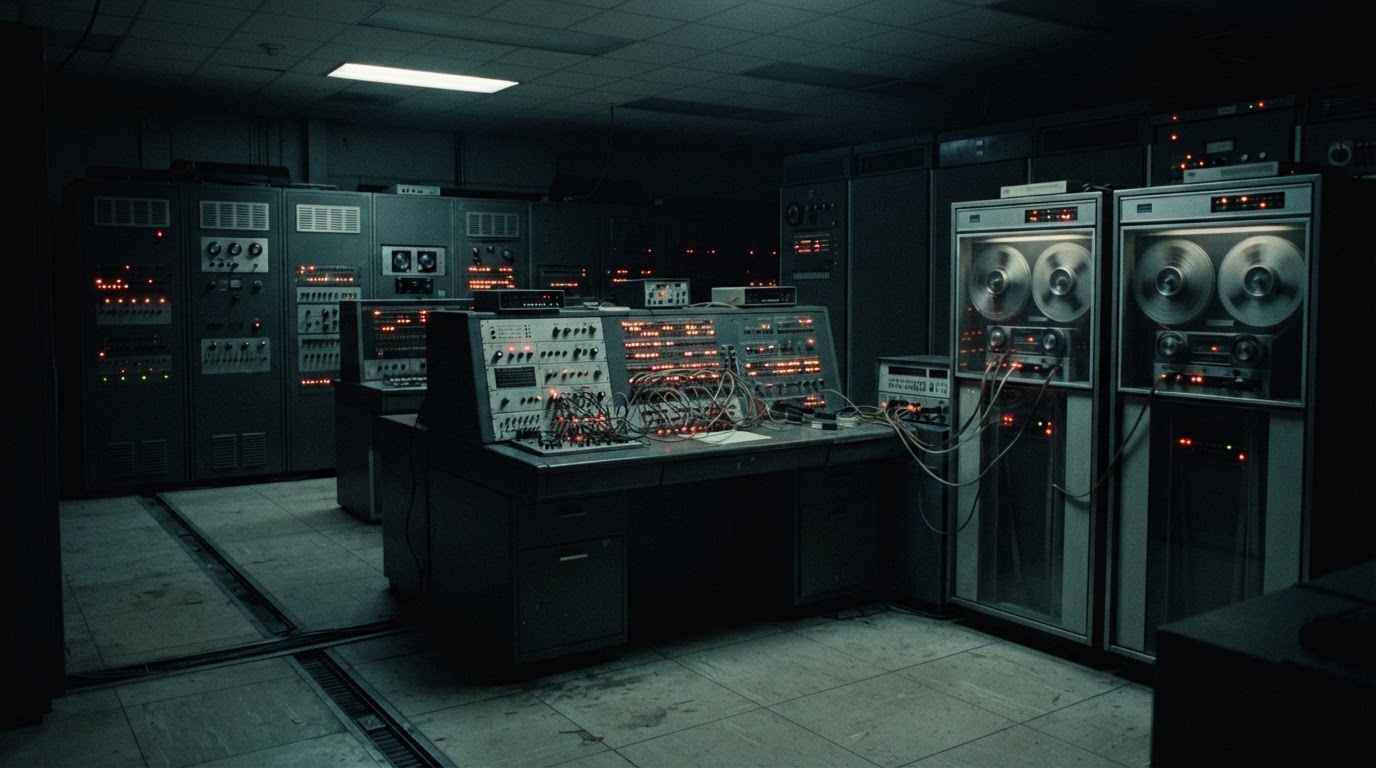
The heart of Titor's story was his stated mission: to retrieve an IBM 5100, a portable computer that the company had released in the mid-1970s. According to Titor, the engineers of 2036 desperately needed one of these old machines because it could read and translate several early programming languages — a capability that, he claimed, was essential for debugging critical legacy computer systems in his ruined future. That was why, he said, he had been sent back not to the year 2000 but originally toward 1975, to collect the machine from that era, stopping in the present only along the way.
What lent this part of the tale its strange weight was a detail about the IBM 5100 that was not widely known to the public. Titor claimed the machine had an undocumented ability to emulate and read older IBM programming languages — a feature IBM had built in but never advertised. Skeptics who set out to debunk him were startled to find that a version of this claim was, in fact, true: the 5100 did contain an internal emulator that gave it access to older languages, something a casual hoaxer in 2000 would have been unlikely to know. To believers, this was proof that Titor knew things he should not have. To skeptics, it was evidence only that whoever wrote as Titor had done careful homework — perhaps someone with a deep knowledge of computing history.

The Time Machine and the C204 Documents
Titor did not stop at words. He posted photographs — grainy, low-resolution images of what he said was the time machine itself, a device he called the C204, installed in the trunk and interior of an ordinary car. He also shared what he described as pages from the machine's operations manual, complete with technical diagrams: a gravity-distortion device that, he explained, used two spinning micro-singularities to bend spacetime and carry the vehicle between worlds. The documents were dense with jargon about magnetic housing units, gravity sensors, and the careful calculations required to arrive in the correct timeline.
For readers, the effect was hypnotic. Here was not just a claim but an apparent paper trail — images, schematics, a device with a model number. Physicists who later examined the diagrams noted that the concepts Titor invoked drew loosely on real theoretical ideas about rotating black holes and closed time-like curves, the kind of speculative physics discussed in academic papers. The design would not actually work, they said, but it was dressed in enough genuine terminology to feel plausible to a non-specialist. Whoever built the John Titor story had wrapped it in a costume of science convincing enough to keep people arguing about it for decades.
The Predictions
Alongside his descriptions of the machine, Titor offered a series of predictions about the future — and it is here that his story cuts closest to the bone. He warned that the United States was heading toward a second civil war, a growing internal conflict that he said would begin to tear the country apart in the years after 2004 and escalate through the following decade. He described a fractured America broken into smaller territories, a collapse of the society his readers knew. And he spoke of a wider catastrophe: a global war around 2015, one that in his timeline killed billions and reshaped the world entirely.
Titor was careful, though, to insert an escape hatch into his predictions. He explained that time travel operated on a "many-worlds" principle — that traveling to the past created a divergent timeline rather than altering a single fixed one. The future he came from, he said, was not necessarily the future this world would experience; the very act of his visit might mean these readers now lived on a slightly different branch of reality. It was an elegant piece of self-protection. When his grim forecasts failed to arrive on schedule, believers could simply say that our timeline had diverged from his — that he had never claimed our world would follow the same path at all.

The Disappearance in March 2001
Then, almost as quietly as he had arrived, John Titor left. In late March 2001, he posted that his mission was finished and that he would soon be returning to 2036. He offered a few parting words of advice — practical, almost fatherly counsel about staying safe and keeping a gas mask, learning basic first aid, questioning what authorities told them. And then the posts stopped. There was no dramatic farewell, no final proof, no departure caught on film. The traveler from the future simply logged off and never returned to the boards where he had spent the previous several months.
The silence that followed only deepened the legend. Titor had never sold a thing, never revealed a face, never given a real name that could be checked. He left behind only a body of text — hundreds of posts — and a handful of blurry images. In the vacuum of his absence, the story grew. Websites collected and preserved his every word; his predictions were quoted and requoted; a whole subculture of analysts, believers, and debunkers rose up to argue over what he had been. A person who vanished without a trace is far harder to dismiss than one who stays to be questioned, and Titor's disappearance turned an internet curiosity into a lasting myth.

The 2009 Investigation and the Mystery That Remains
For years the question of who had written as John Titor hung open. Then, in 2009, an investigation by a private research group offered the most concrete answer anyone has produced. Following a trail of legal and business connections associated with a company that had been set up in Titor's name, investigators pointed toward a family in Florida — and, in particular, toward two brothers, one of whom had a background suited to concocting such a tale. The theory held that the John Titor persona had been created and maintained by people close to this family, perhaps as an elaborate piece of fiction or a private project that took on a life of its own. It was the closest thing to a solution the case had ever seen.
Yet even this was never confirmed. The people identified by the investigation did not publicly admit to authoring the posts, no confession or documentary proof was produced, and the identification rested on circumstantial links rather than a signed admission. The case, in the end, stayed open. And so John Titor endures as a kind of perfect internet ghost story — a mystery with just enough real detail woven through it to resist easy dismissal, and just enough missing to make certainty impossible. What we can say for sure is only this. For a few months at the turn of the millennium, someone wrote as a soldier from 2036, described a machine to travel through time, foretold a broken future, and then disappeared. Whether he was an inventive hoaxer, a family's private fiction, or something stranger still, the man who called himself John Titor logged off more than two decades ago and never came back — and the internet has been arguing about him ever since.
I have read the March 2001 sign-off perhaps a dozen times now, and it is the only part of the archive that has grown stranger with familiarity rather than duller. A fabricator with a story that good does not simply stop. There is no last flourish, no proof withheld for effect, nothing to be gained — only that flat domestic advice about first aid and a gas mask, and then a silence that has now outlasted the forums it was posted on. The 2009 investigation gave me two brothers in Florida to write down, and I have written them down. It has never quite settled the file. Whoever it was, they closed the door on the most valuable thing they ever made and never once came back to see what it had become.
---
The images and video in this article are AI-generated works produced to convey the mood of the story, and are not photographs of any actual person or event.

Comments
No comments yet — leave the first one.