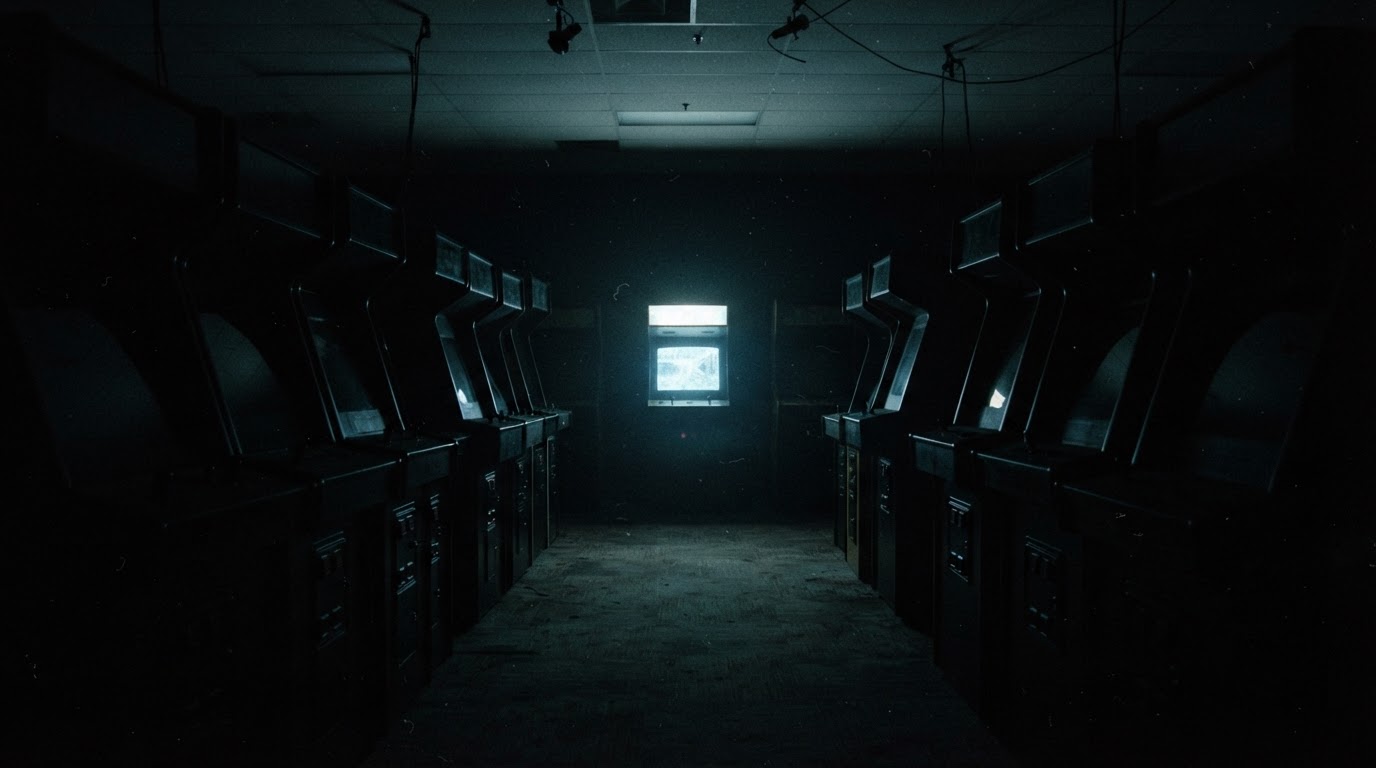
Sometime in 1981, the story goes, a new arcade cabinet appeared in a few game rooms around Portland, Oregon. It was plain and black, marked only with the word "Polybius," and it had no maker's name anywhere on it. The game was strange — fast, hypnotic, made of pulsing vector shapes and lights — and it drew crowds. But the players who fed it their quarters began to complain of headaches, nightmares, memory loss, and in a few tellings, seizures. Stranger still, men in dark suits are said to have visited the machines at night, opening them not to collect coins but to read out some kind of data. And then, within a month or two, every Polybius cabinet simply disappeared. No photograph of the game survives. No circuit board, no manual, no cabinet has ever been produced. To this day no one can prove that Polybius ever existed at all. This is the story of the most famous video game that may never have been real.
The Legend
The core of the Polybius legend is easy to tell, because it is short and it never quite changes shape. In 1981, in the suburbs of Portland, Oregon, a black arcade cabinet bearing the single word "Polybius" is said to have appeared in a handful of arcades. There was no manufacturer's logo, no copyright line, no clue as to who had built it. The gameplay is described as some kind of fast, abstract shooter or puzzle — a rush of vivid vector graphics, flashing geometry, and swirling color that players found strangely, compulsively addictive. Lines formed to play it.
Then, so the story goes, the players began to fall ill. Some suffered blinding headaches and could not sleep. Some had vivid nightmares and night terrors. A few reported amnesia — whole stretches of memory simply gone. In the most extreme versions, players collapsed with seizures in front of the screen. And through it all, the men in black kept coming. Figures in dark suits are said to have visited the arcades in the small hours, unlocking the Polybius cabinets and extracting data from them, paying no attention to the coin boxes at all. Then, as suddenly as they had come, the machines vanished — pulled from the floor, never seen again. That is the legend, whole and entire. Everything else is an argument about whether any of it is true.
Most entries in this archive begin with too much material. Polybius began with none, and that is why I kept it. I went looking for the ordinary paper an arcade game leaves behind — a distributor listing, a trade advertisement, a service bulletin, anything printed before 2000 — and the search returned nothing at all, over and over, until the nothing itself started to feel like the artefact. I have files here built on a single photograph. This is the only one I keep for the absence of one.
Where the Story Actually Comes From
Here is the part the legend leaves out: Polybius has no verifiable trace before the year 2000. However far back the story feels, it does not appear in any arcade magazine, newspaper, police report, or player memoir from 1981. The earliest documented mention of Polybius is an entry that appeared on the arcade database website coinop.org around February 2000 — nearly two decades after the events it describes. That entry laid out the now-familiar tale: the black cabinet, the sickened players, the men in black, the disappearance. From there, in the early days of internet forums and the emerging culture of shared online horror stories, the legend spread and grew.
In other words, the "1981 Portland arcade machine" reached the world for the first time as an internet post in 2000. It has all the hallmarks of an early creepypasta — a piece of collaborative online folklore, refined and re-told until it felt like history. The man who ran coinop.org, Kurt Koller, later acknowledged the site's role in popularizing the story and even offered a reward for genuine evidence of the cabinet; nothing credible ever came in. This does not, by itself, prove that nothing happened in Portland in 1981. But it means the chain of the story is inverted from how it feels: we do not have a 1981 event that was written up in 2000. We have a 2000 internet story that claims to describe 1981.

The Men in Black and the Government Theory
No part of the legend has done more to keep it alive than the men in black. In the story, they are the ones who turn a sick arcade game into a conspiracy: dark-suited figures who come at night, ignore the money, and take only data. From this single image, a whole theory grew. Polybius, in this telling, was never an ordinary game at all but a covert government experiment — a machine built to test the effects of flashing lights and hypnotic patterns on the human mind, perhaps a study in behavioral conditioning, subliminal messaging, or psychological warfare, deployed on unwitting teenagers in a suburban arcade. The men in black were the agents monitoring the results.
It is a story that fits its moment perfectly. It grew up alongside decades of real and rumored anxiety about secret government mind-control programs, and it borrows the visual language of UFO lore, where "men in black" have long been the faceless agents of a cover-up. Whether or not it is true, it is easy to see why it took hold. But it is worth being precise about what evidence exists: there is no document, no whistleblower, no declassified file, and no named agency connecting any government program to a Portland arcade cabinet. The men in black are the most vivid element of the legend and also the one with the least ground beneath it. They are the reason the story feels like a conspiracy — and the part for which not a shred of proof has ever been shown.
The Kernels of Truth
And yet the legend did not grow out of nothing. Researchers who have dug into it — including the coinop.org community itself — have turned up a few real, documented facts from around 1981 that map, unnervingly, onto pieces of the story. They do not prove Polybius was real. But they may well be the sand grains around which the pearl formed.
The first concerns arcade sickness. In late 1981, a handful of Portland-area teenagers really did fall ill at arcades. In one documented episode a boy collapsed with a migraine after a marathon session on the game Tempest — a real Atari title built, as it happens, from glowing vector graphics not unlike those the legend attributes to Polybius. Another player reportedly suffered stomach problems after long play on Asteroids. These were isolated incidents of over-exertion, photosensitivity, and exhaustion, widely enough noted at the time to leave a trace. The second concerns the raids. Also in 1981, real FBI and other agents did conduct raids on Portland arcades — not for mind control, but because some cabinets were being used for illegal gambling, and because operators were suspected of tampering with machines to alter the odds and skim money. Government men really did show up at Portland arcades and open up the cabinets. Layer the sick teenagers over the flashing vector graphics over the government raids, and you can watch, almost in real time, how a legend assembles itself out of true fragments.
Why No Cabinet Has Ever Been Found
If Polybius were a real, mass-produced arcade game — even a rare one — we would almost certainly have it by now. This is the argument that, for most researchers, settles the matter. The 1980s arcade scene has been documented, catalogued, and collected with obsessive thoroughness. Enthusiasts have preserved circuit boards, cabinets, marketing flyers, and service manuals for thousands of obscure and commercially failed games — titles that ran in a single region for a few weeks and vanished. The hardware of the era survives in basements, warehouses, and museums the world over.
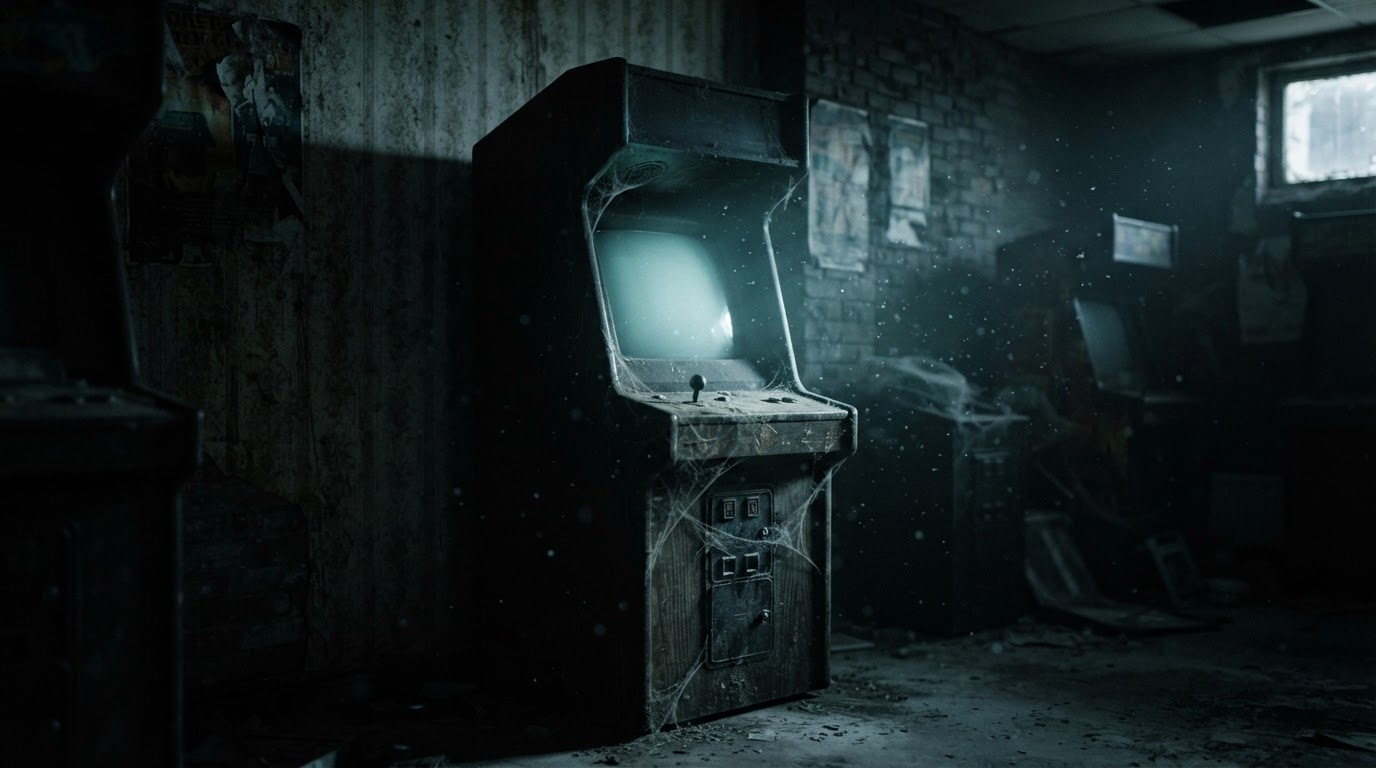
Against that backdrop, Polybius is a void. There is no surviving cabinet, no photograph taken at the time, no circuit board, no ROM dump, no printed flyer, no service manual, no manufacturing record, no shipping invoice, no operator who kept one, no distributor who sold one. For a machine said to have drawn crowds in multiple arcades, the total absence of any physical or documentary trace is not a small gap — it is the whole case. Homebrew "Polybius" cabinets and playable versions certainly exist today, but every one of them was built after the legend, as a tribute to it. None predates the year 2000. A real product leaves a wake; Polybius leaves only its own retelling. The simplest explanation for why no cabinet has ever been found is that there was never a cabinet to find.
The Game That May Never Have Existed
So what, in the end, was Polybius? The most honest answer is that it was almost certainly a story — one of the first true urban legends of the internet age, assembled around the year 2000 from real and haunting fragments of 1981. The sick teenagers at Portland arcades were real. The FBI raids on those arcades were real. The glowing vector graphics of games like Tempest were real. What the legend did was gather those true grains, fuse them with the older folklore of the men in black and secret government mind control, name the result "Polybius," and set it loose on the early web, where thousands of retellings hardened it into something that felt like remembered history.
The piece I cannot quite shelve is the 1981 raids. I went into those records expecting to find nothing, and instead found men from the federal government genuinely walking into Portland arcades at odd hours and opening up cabinets — for gambling skim, for rigged odds, for nothing stranger than money. It is the mundane version of the story's most frightening image, and it was real, and it was sitting in the record the whole time. I have read enough of these to know how rarely a legend gets to borrow something true and then outgrow it so completely that people stop believing the boring original.
That is why Polybius endures. It works not because the evidence is strong — the evidence, for the cabinet itself, is nonexistent — but because it sits on a perfect fault line where a few documented truths meet a bottomless absence of proof, and the human mind cannot help but rush in to fill the gap. Somewhere, the story insists, in a warehouse or a government vault, one black cabinet still waits. But four decades on, no such cabinet has ever surfaced, no photograph has ever emerged, and no record has ever been found. Polybius may be the most famous arcade game in the world. It may also be the one that never existed at all — a machine made entirely of the things we were afraid of, glowing quietly in an arcade that was never there.
---
The images and video in this article are AI-generated works produced to convey the mood of the story, and are not photographs of any actual person or event.


Comments
No comments yet — leave the first one.