Step in from the street and the daylight simply stops.
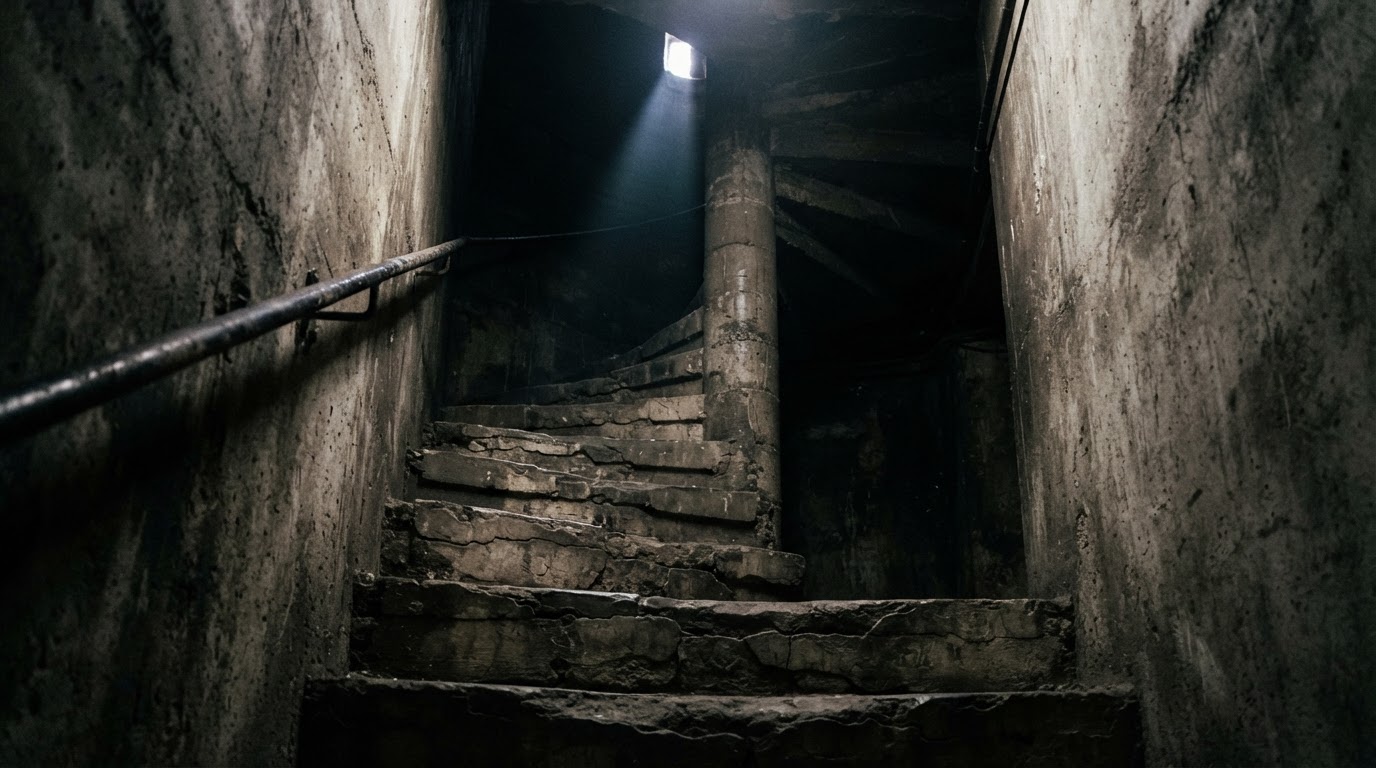
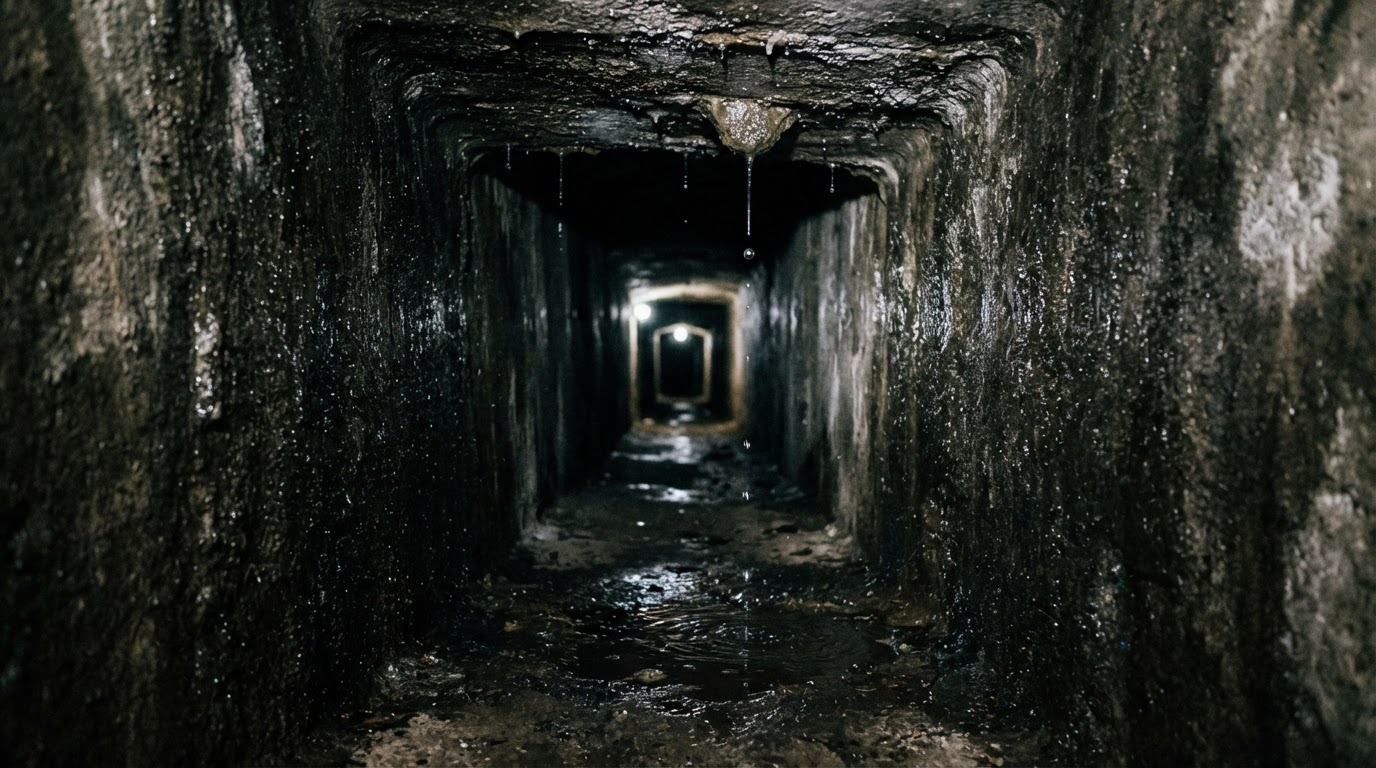
One moment you are in the bright, roaring chaos of Kowloon — hawkers, buses, the salt smell of the harbor. The next, you pass through a gap between buildings no wider than your shoulders, and the sun is gone. Not dimmed. Gone. Above you, floor after floor of concrete has grown together into a single mass, sealing off the sky. Water drips from pipes overhead onto a floor that never dries. A bare bulb burns somewhere ahead, then another, marking a path that twists deeper into a place where it is always, permanently, night.
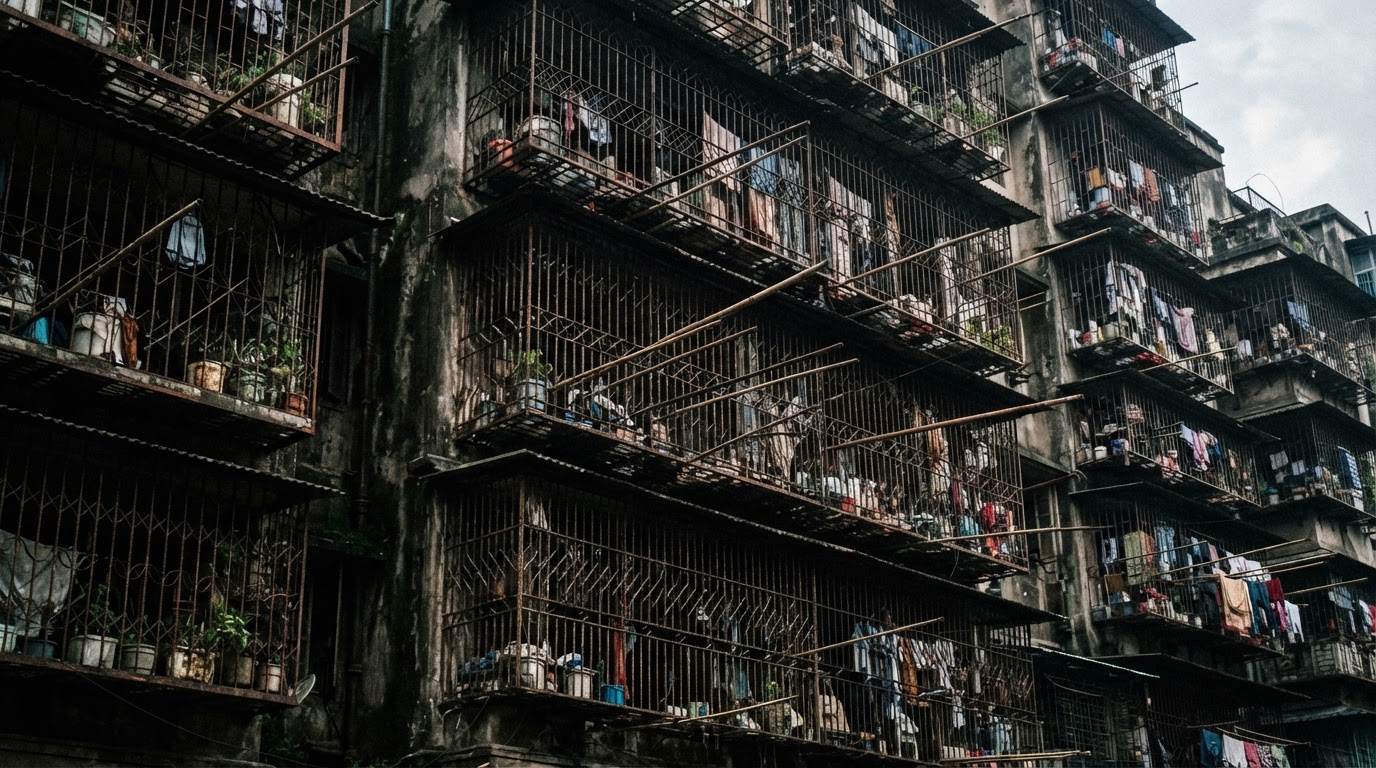
This was Kowloon Walled City — in Cantonese, Gau Lung Sing Zaai, 九龍城寨. For most of the twentieth century it was the most densely populated place on the face of the Earth, and one of the strangest. A city inside a city, ungoverned and unplanned, that grew like a coral reef until as many as fifty thousand people lived stacked in the space of a few football fields. The people who lived there called it, without irony, home. The world outside called it the City of Darkness.
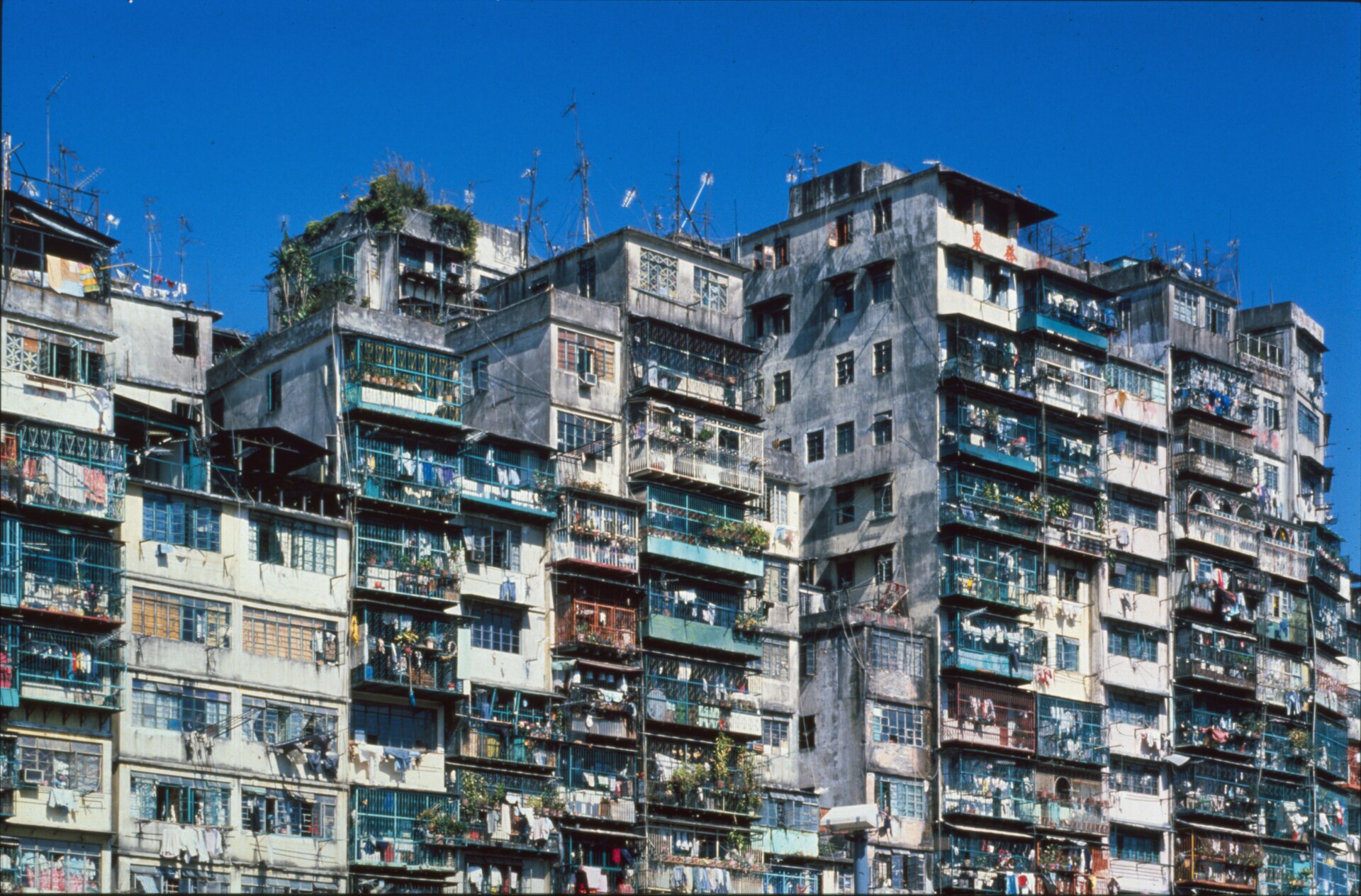
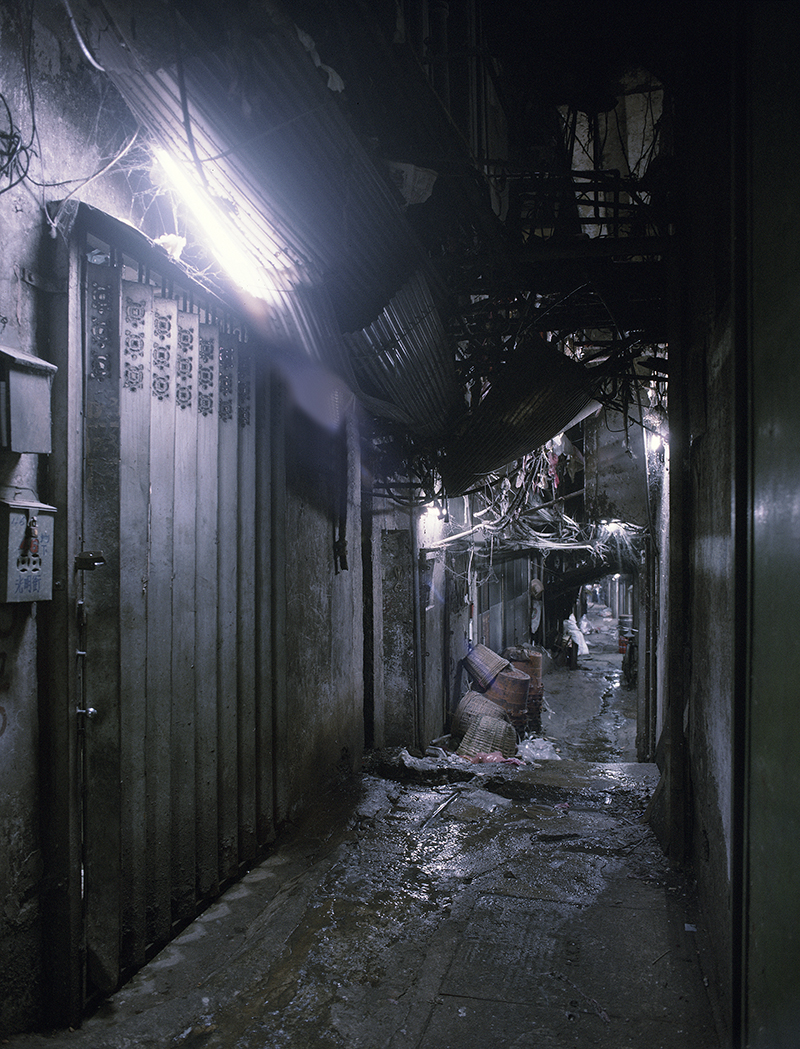
Photo: Wikimedia Commons, CC BY 4.0
This entry began as a note on a treaty clause, which is not where I expected to spend a month. The 1898 lease left one sentence about Chinese officials remaining in the enclave, Britain revoked it in practice the following year, and neither side ever cleaned up the paperwork. I have read a great many documents that produced consequences their authors did not intend. I have never read one where the consequence was a building — fourteen storeys of it, fifty thousand people, grown directly out of an unresolved paragraph and standing there for ninety years while the two governments that made it declined to look.
A Fort That Time Forgot
To understand how such a place could exist, you have to go back to a small stone fort.
Kowloon Walled City began, unremarkably, as a military outpost. From the Song dynasty onward, the site guarded the salt trade and the approaches to the Kowloon peninsula. In 1847, the Qing government fortified it in earnest, throwing up a granite wall, six watchtowers, and a garrison to keep an eye on the growing British presence across the harbor on Hong Kong Island. Inside sat a yamen — a magistrate's office — and a few hundred soldiers and residents. It was a proper, if minor, Chinese walled town.
Then came 1898, and a single line in a treaty that would haunt the place for a century.
Britain leased the New Territories from the Qing empire for ninety-nine years. But in the negotiations, China insisted on keeping a foothold: Chinese officials would remain in the Walled City, retaining jurisdiction there, so long as it did not interfere with British defense. The British agreed — then, almost immediately, changed their minds and drove the Qing officials out in 1899.
And there the matter froze. China never formally surrendered the enclave. Britain never formally absorbed it. Legally, Kowloon Walled City became an orphan: a scrap of Chinese soil marooned inside British Hong Kong, claimed by both and effectively governed by neither. For the next ninety years, it would fall through the cracks of the world — a place where the ordinary rules of two great powers simply did not reach.
The City That Grew in the Dark
For decades the old fort dozed. A handful of squatters drifted in. The Japanese occupation during the Second World War tore down the granite wall to build a nearby airport runway, erasing the "walled" from Walled City and leaving only the name.
The real transformation came after 1945. As refugees poured into Hong Kong — fleeing war, revolution, and famine on the mainland — they needed somewhere, anywhere, to live. And here was a patch of ground that no government dared to police. Squatters built shacks. The shacks became low buildings. And because the land was fixed but the demand for space was bottomless, there was only one direction left to grow: up.
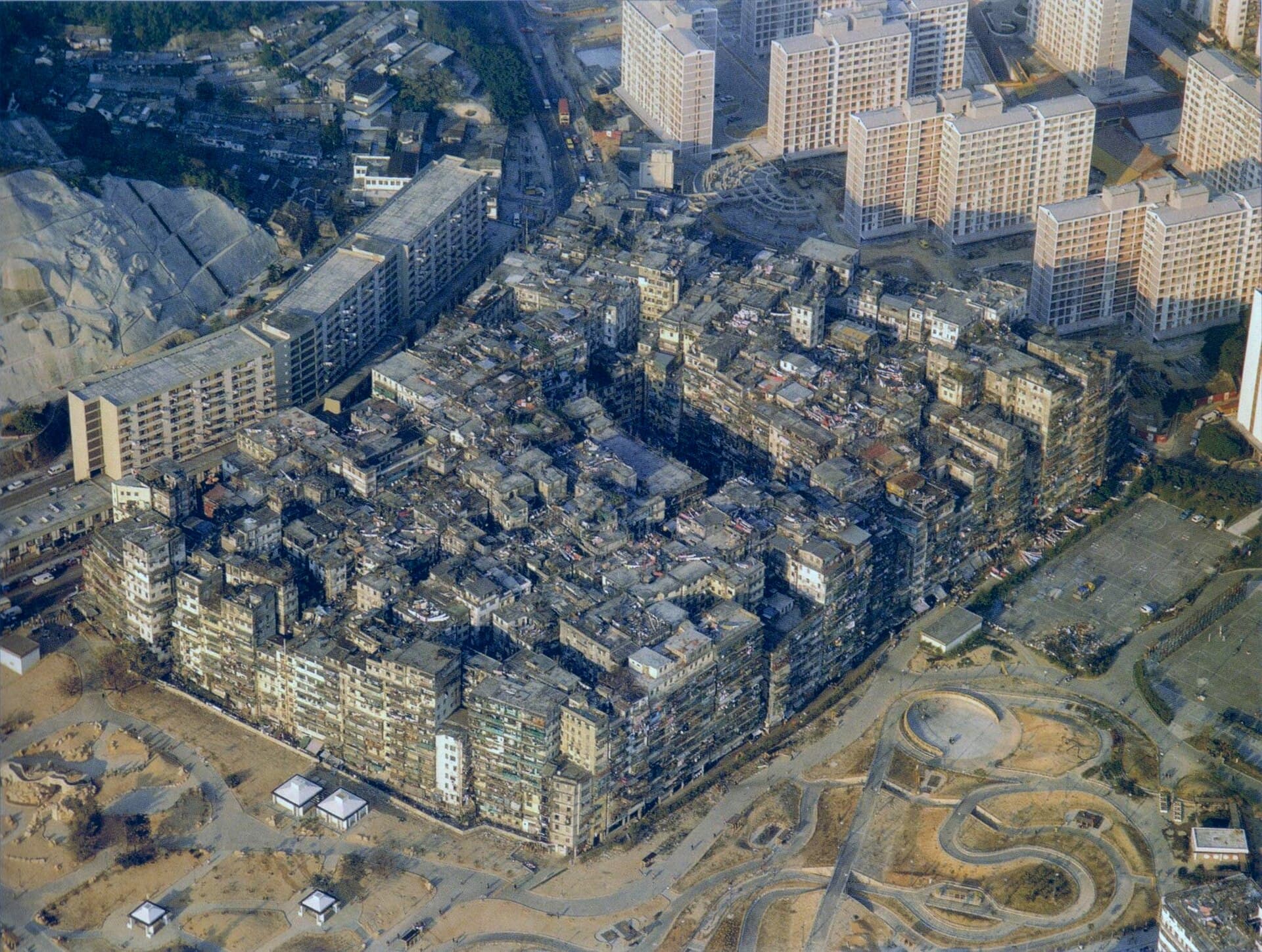
Through the 1960s and 1970s the buildings climbed and merged. Landlords and builders raised floor upon floor with no architect, no permit, no inspection — each new storey bolted onto the last, walls shared between buildings, stairwells threaded between apartments like veins. The whole enclave fused into a single, continuous structure, an accidental megastructure covering its entire footprint of roughly 2.6 hectares. It stopped growing taller only because it sat under the flight path of Kai Tak Airport; planes came in so low that buildings were capped, by rare mutual agreement, at around fourteen storeys.
By the 1980s the numbers had become almost unbelievable. Somewhere between 33,000 and 50,000 people lived inside those few blocks. The density worked out to around 1.2 to 1.9 million people per square kilometre — figures that make even the most crowded modern megacities look spacious. It was, by any honest measure, the most crowded place that human beings have ever built.
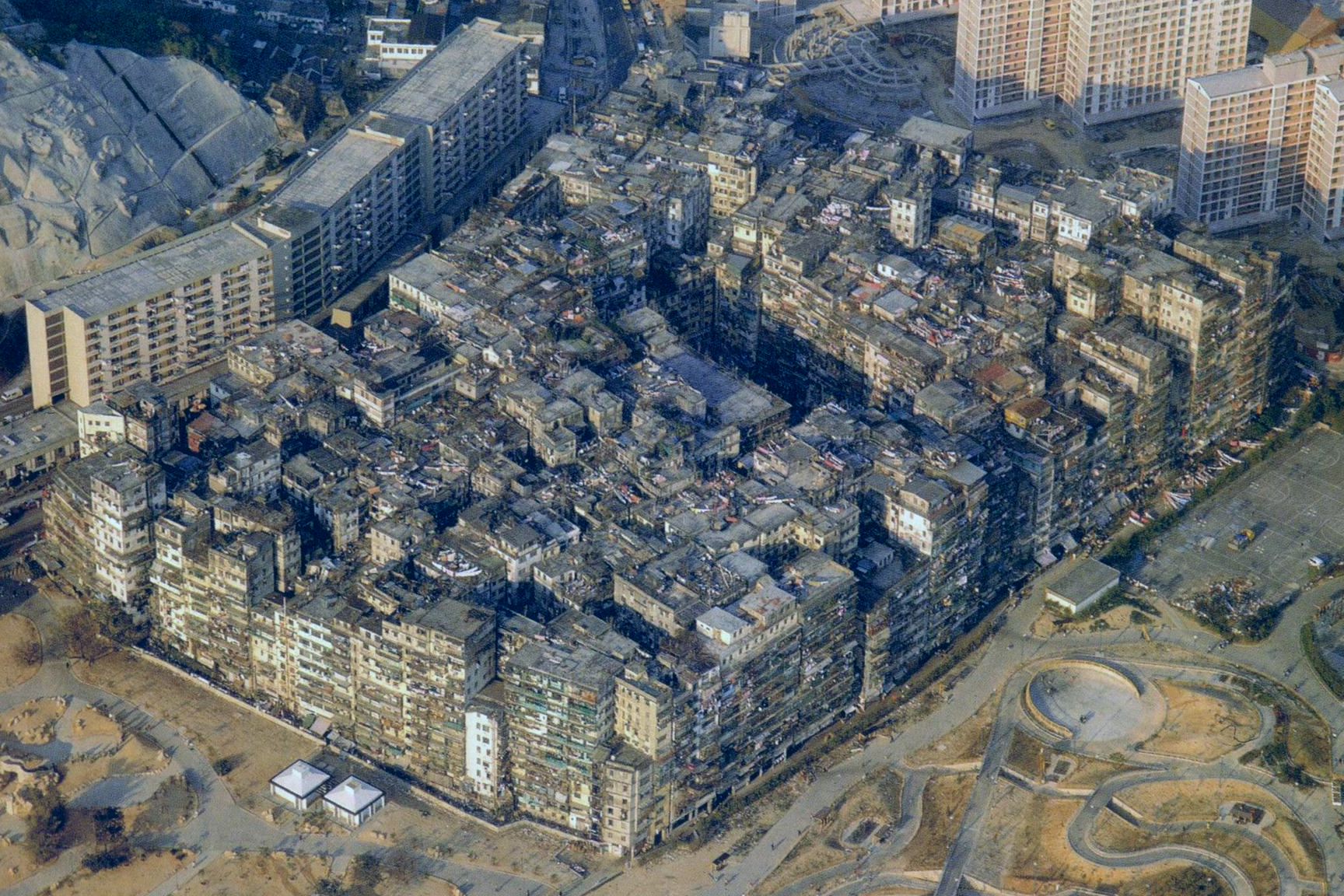
Photo: Wikimedia Commons, CC BY-SA 4.0
Life Inside the Hive
It is easy to describe Kowloon Walled City as a nightmare, and in its worst corners it was. But that image alone is a lie, because tens of thousands of ordinary people made lives here — and for many, they were good lives.
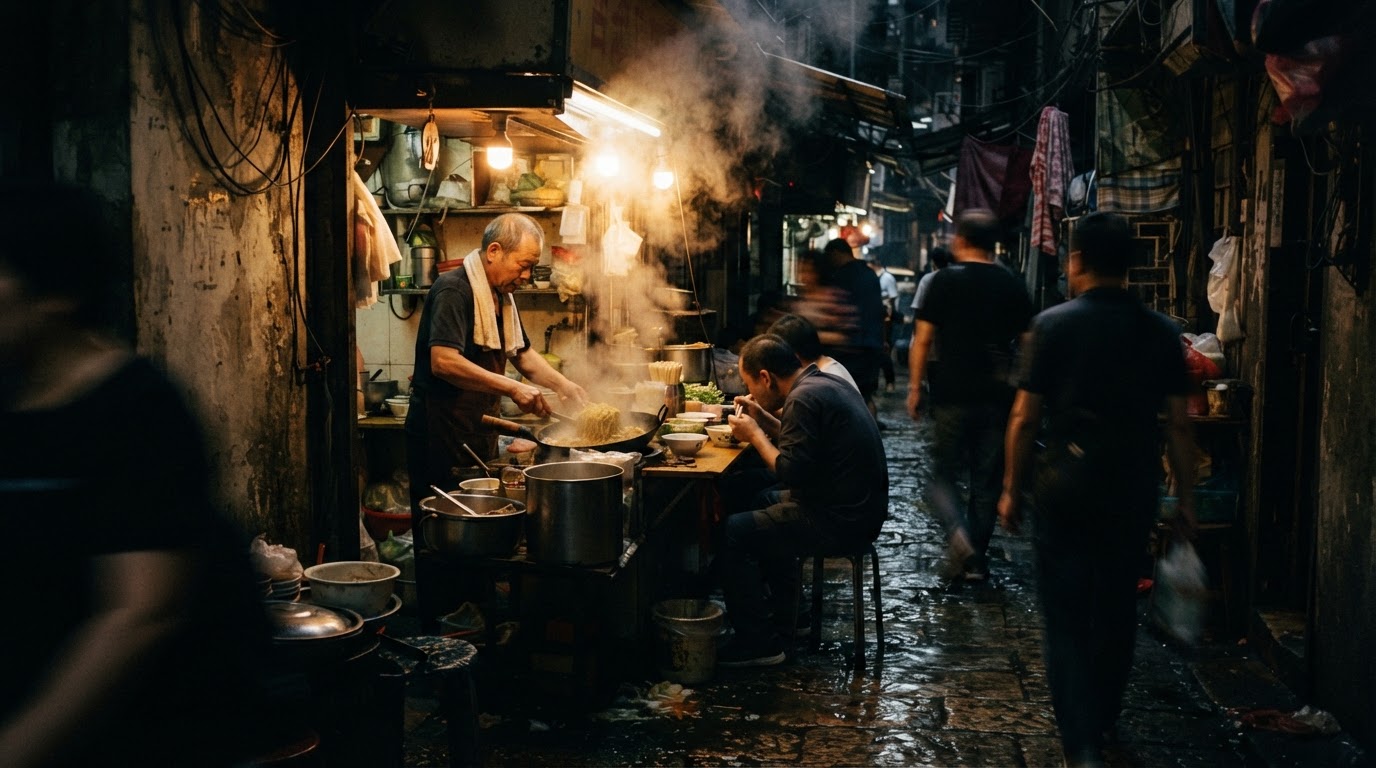
Behind the grim facade was a functioning, self-organized community. There were kindergartens and temples, grocers and metalworkers, family shops passed from parent to child. There were factories, too — small workshops turning out fish balls, noodles, and candy that fed a surprising slice of Hong Kong's food supply, precisely because no health inspector ever came to shut them down. Rent was cheap. Doors were often left open. Neighbors knew one another by name in a way the gleaming towers outside never allowed.
And there were the doctors and dentists — the enclave's most famous cottage industry. Because the Walled City lay beyond the reach of Hong Kong licensing law, mainland-trained physicians and dentists who could not get certified in the colony simply hung out a shingle here. Their prices were a fraction of the licensed clinics a few streets away, and their skills were often perfectly real. For decades, ordinary Hong Kongers crossed into the darkness for a cheap filling or an honest consultation, then walked back out into the light. The rows of dentists' signs at the edge of the city became one of its enduring images.
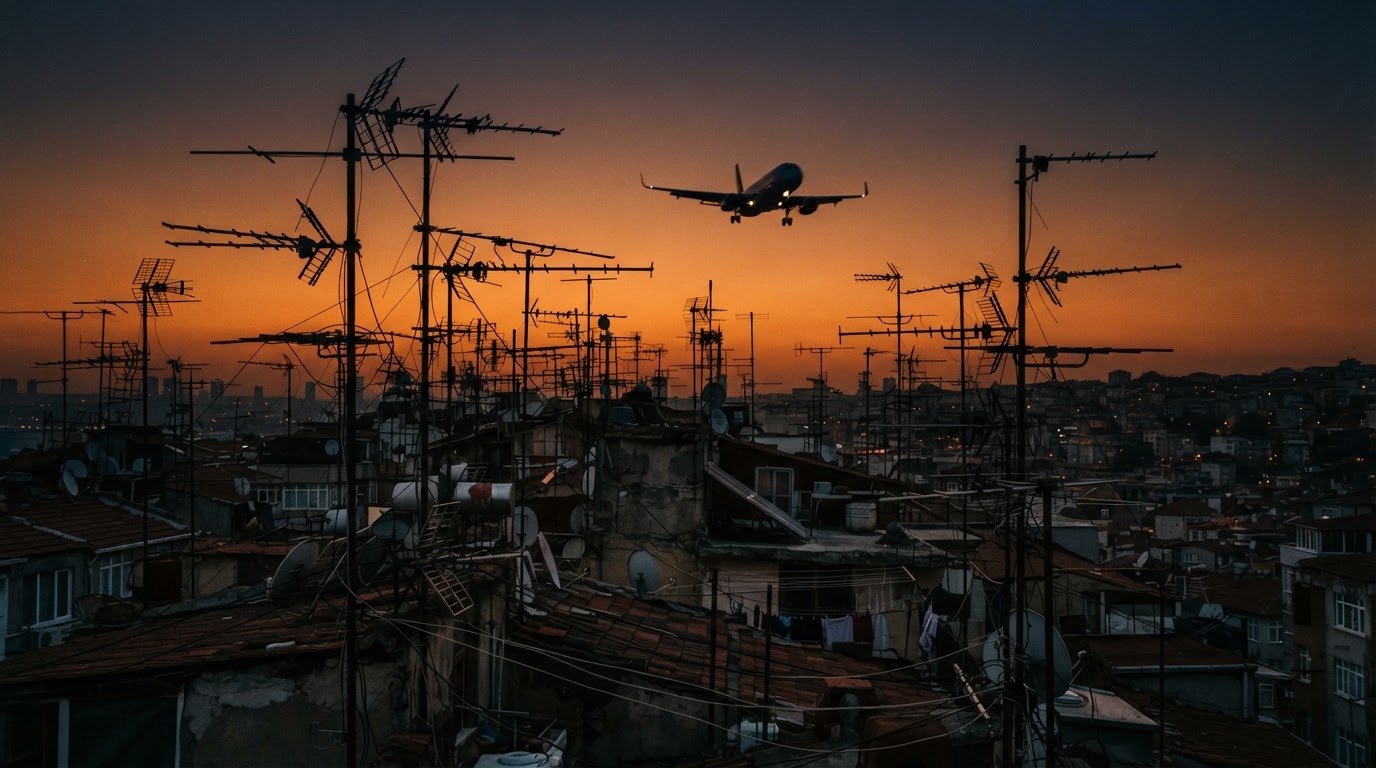
Life was vertical and intimate. Since the ground floor was a lightless maze, much of daily life migrated upward. Residents walked the upper floors, where the buildings' rooftops joined into a single sprawling terrace — a shared open sky, the only place inside where children could run and the elderly could sit in real sunlight, above the permanent night below.
The Darkness
Still, the shadow was real, and it must be told honestly.
For much of its history, Kowloon Walled City was a haven for the things a city hides. In the decades after the war, triad societies — the 14K and the Sun Yee On among them — treated the enclave as ungoverned turf. Opium dens, heroin divans, gambling parlors, and brothels operated openly along its ground-floor lanes, protected by the simple fact that Hong Kong police were reluctant to enter. Corruption did the rest; for years, officers who did venture in were as likely to collect a bribe as make an arrest.
That era peaked in the 1950s and 60s. The turning point came in 1973 and 1974, when a series of massive police raids — thousands of officers at a time — finally broke the triads' grip and cleared out the worst of the vice. After that, the Walled City became far more ordinary: still poor, still lawless on paper, but no longer the drug capital of legend. By the 1980s it was mostly what it looked like — a very crowded, very poor, oddly peaceful neighborhood.
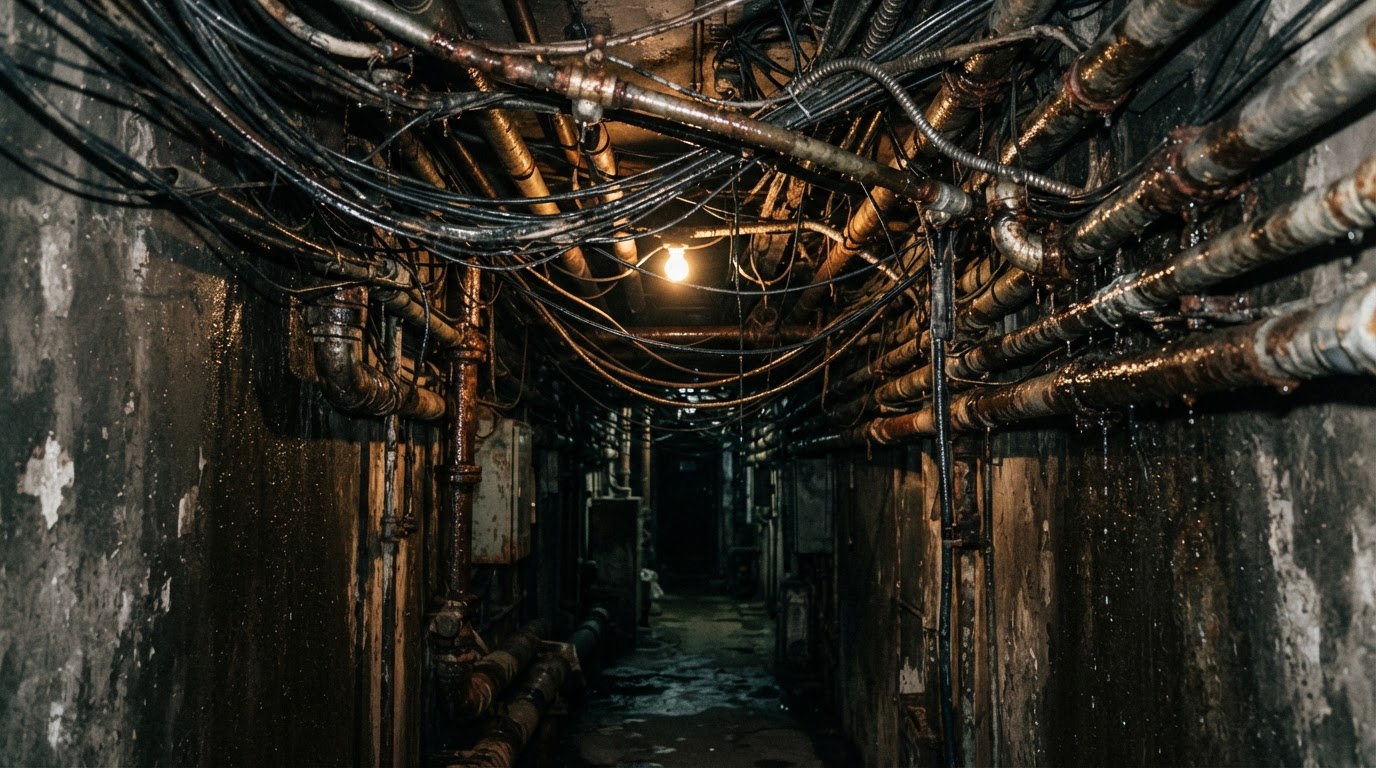
The sanitation, though, never had an answer. With no sewage system built for such density, waste and runoff pooled in the lower passages. There was no municipal water, so residents sank their own wells and pumped water up through a spidering network of pipes to rooftop tanks — those same dripping pipes that made the lower floors a permanent indoor rain. Electricity was spliced in illegally, a chaos of wiring so dense it blotted out what little ceiling could be seen, and fires were a constant terror. The lower alleys, where sunlight never came, stayed slick and dark and close, the air thick with the smell of damp concrete and cooking and rot. To walk them was to move through a place the daylight had abandoned.
The Ghosts of the Alleys
Where daylight cannot reach, stories grow. And Kowloon Walled City, a warren of the dead ends and drowned corridors, was fertile ground for them.
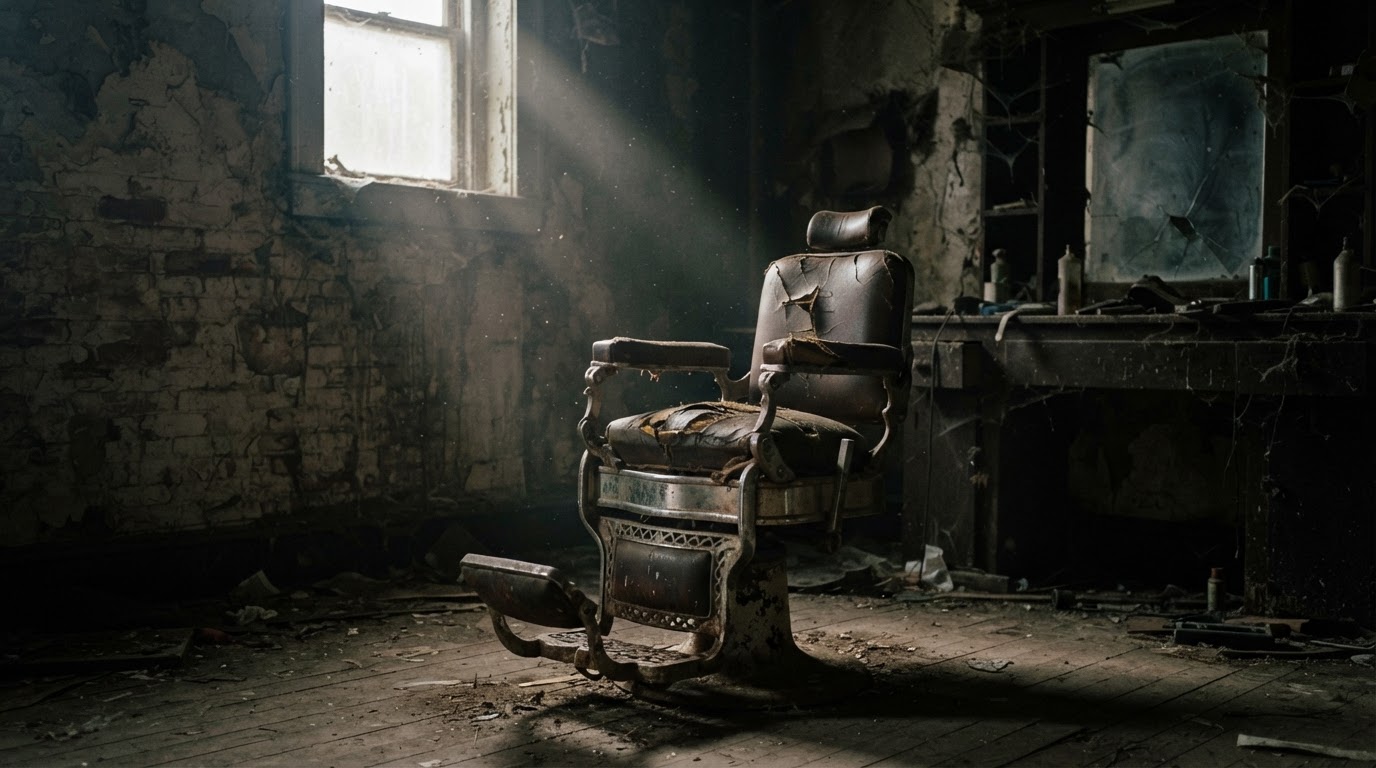
The residents themselves told them. In a place where thousands lived and died within a few blocks — where the old passed away in rooms their families had held for generations, where the desperate sometimes came to end their own lives in the anonymous dark — it was said that not everyone left when they died. People spoke of footsteps in stairwells known to be empty, of a tapping in the walls, of a figure glimpsed at the turn of a corridor that was gone when you reached it. Some told of a particular alley you learned not to walk alone after dark, though no one could say quite why.
These are folklore, and should be read as folklore. They are the shape that grief and fear take when they have nowhere else to go — the human mind's way of populating a darkness too total to look into directly. But they were told, and believed, and they were as much a part of the Walled City as its wires and wells.
The stories did not end with the city. After the demolition, when the ground was cleared and turned into a public park, a second wave of legends arose — of shapes seen among the new trees at dusk, of a chill on certain paths, of the sense, walking the tidy lawns, that the place beneath your feet had not entirely let go of what it once was. Whether one believes a word of it or not, the feeling those tellings capture is real enough: that fifty thousand lives cannot simply be erased with a wrecking ball, and that something of them lingers in the soil.
The Men Who Mapped It Before It Died
By the mid-1980s, both governments had finally agreed on the one thing they could agree on: the Walled City had to come down. The 1984 Sino-British Joint Declaration, which set Hong Kong's return to China for 1997, cleared the last diplomatic obstacle. In January 1987, the demolition was announced. The residents — some 33,000 of them — would be compensated and rehoused. The City of Darkness had a death sentence.
And here comes one of the story's most poignant chapters. Before the wrecking crews arrived, a small team of Japanese explorers and architects understood that something extraordinary and unrepeatable was about to vanish from the Earth forever — and resolved to record it.
Over several visits between 1988 and the early 1990s, this team walked the enclave's impossible interior with tape measures and notebooks, befriending residents, sketching apartments, tracing the paths of pipes and wires and stairwells. Working almost entirely by hand, they produced a series of astonishing cross-section drawings — cutaway illustrations that sliced the entire megastructure open like a doll's house, revealing thousands of individual rooms, shops, and lives layered one atop another. Their work, later published, remains the single most complete portrait of how the Walled City actually fit together. It is the closest thing we have to a blueprint of a building that had no blueprint — a map drawn, with great tenderness, of a place already condemned to die.
Demolition, and the Garden That Replaced It
The clearance took years. Rehousing 33,000 people is not quick, and some residents fought their compensation. The last holdouts left in 1992. In March 1993 the demolition began in earnest, and by April 1994 it was finished. The most crowded place on Earth was reduced to rubble and hauled away, floor by floor, until nothing stood where a city had been.
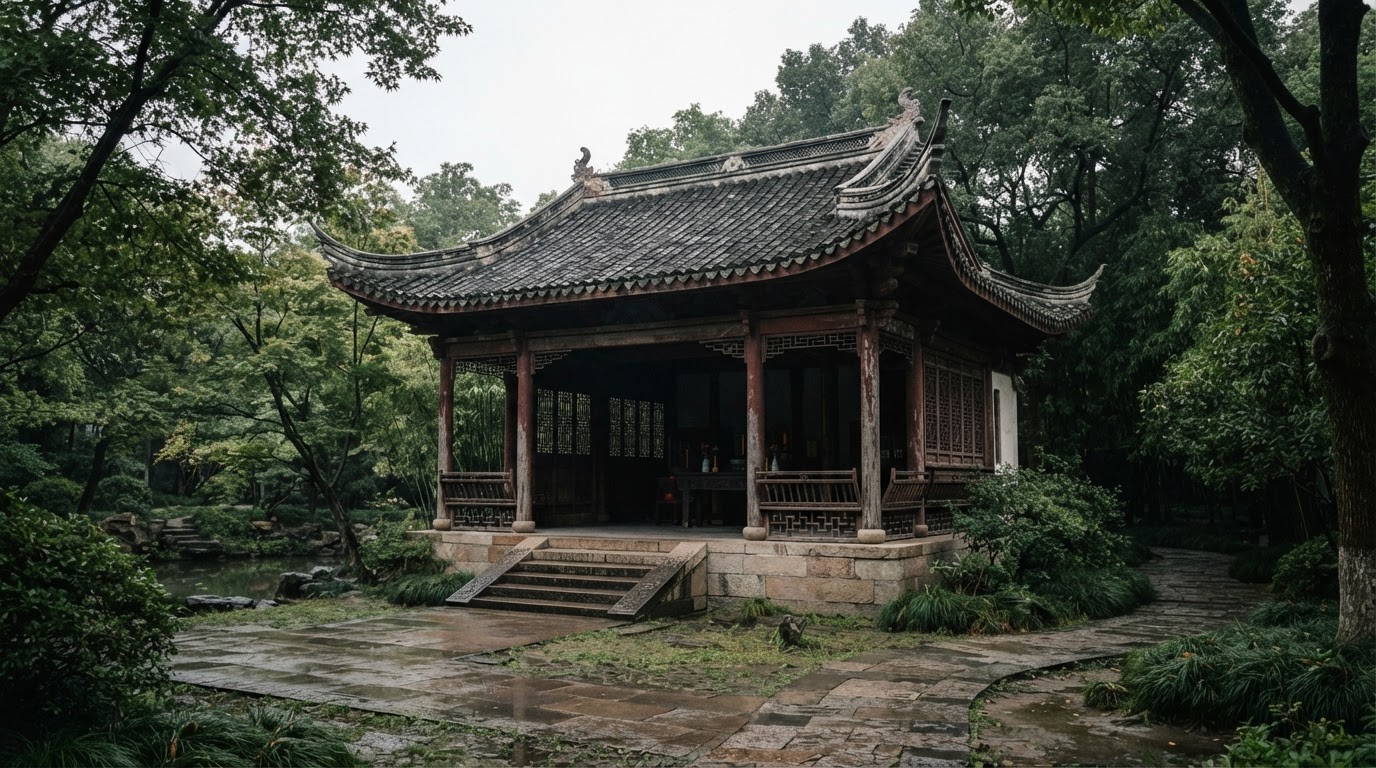
In its place, the Hong Kong government built Kowloon Walled City Park, opened in 1995. It is a deliberately serene thing — a formal garden in the Jiangnan style of the early Qing, with pavilions, ponds, and a chess garden, landscaped over the exact footprint of the vanished enclave. During the demolition, workers uncovered the foundations of the original fort, along with the old yamen building and two carved stone plaques reading "South Gate" and "Kowloon Walled City." These were preserved and now sit at the park's heart, the last authentic fragments of the fort that started it all.
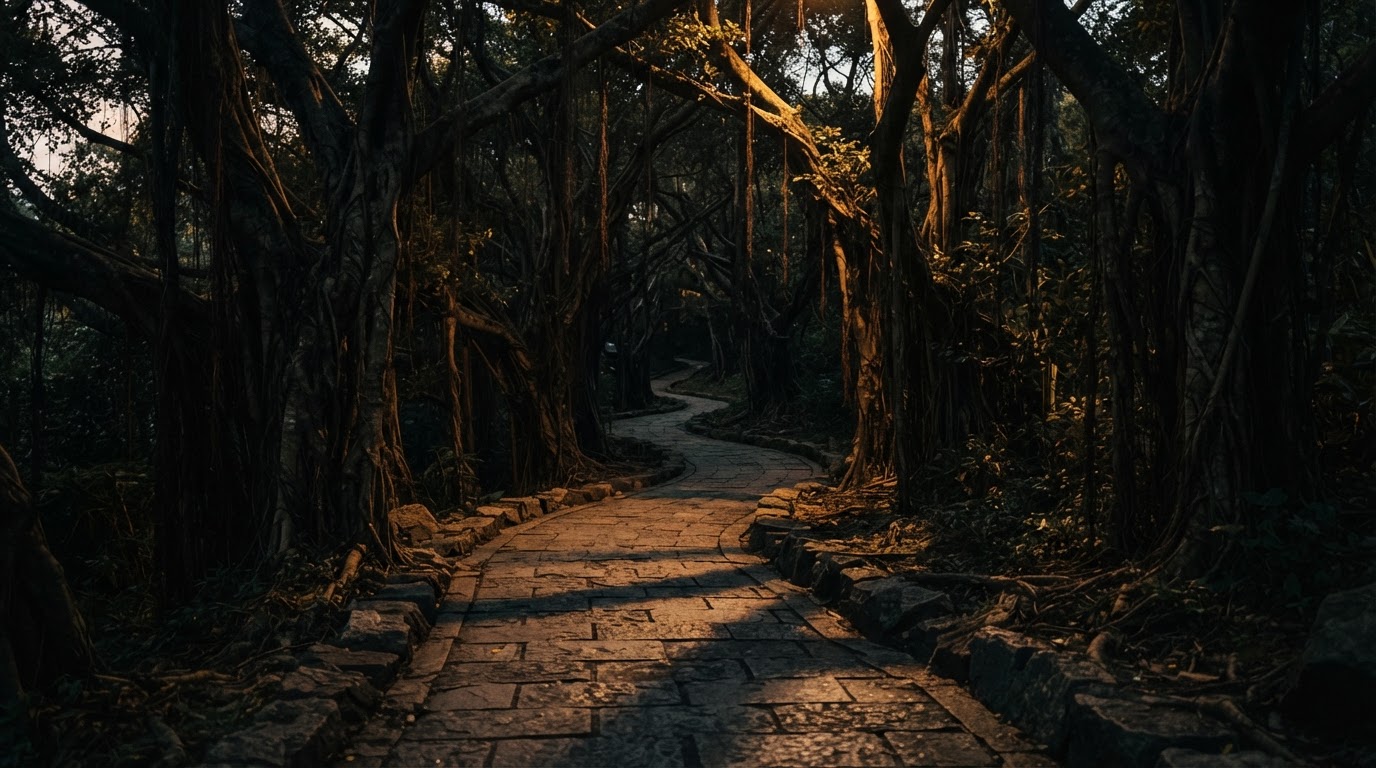
The park is beautiful, and the contrast is almost too neat: where fifty thousand people once lived in permanent darkness, banyan trees now shade an empty path, and the loudest sound is birdsong. Some visitors find it peaceful. Others find the very tidiness of it unnerving — a manicured silence laid, like a lid, over one of the most intense concentrations of human life the world has ever known.
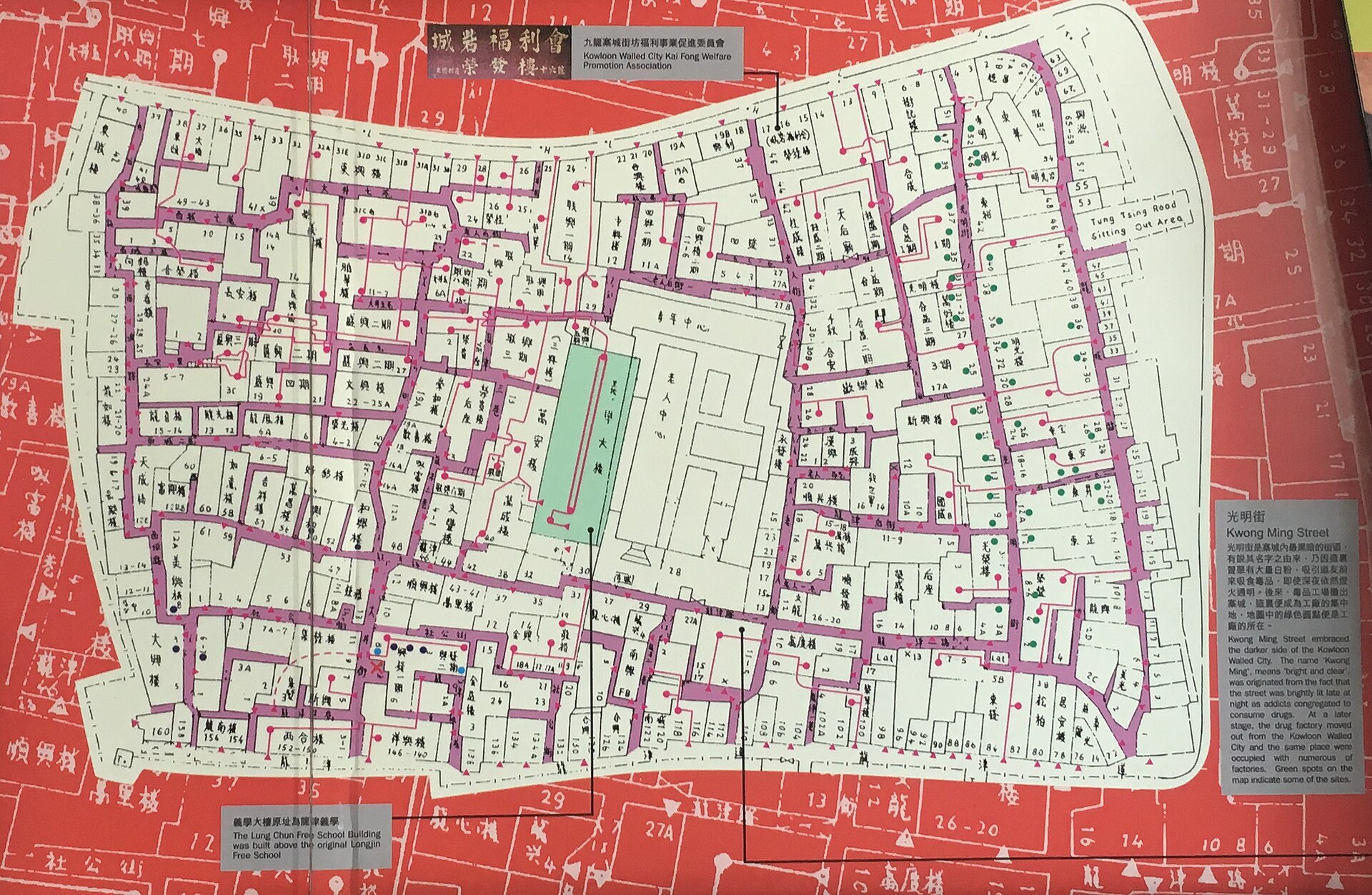
Photo: Wikimedia Commons, CC BY-SA 4.0
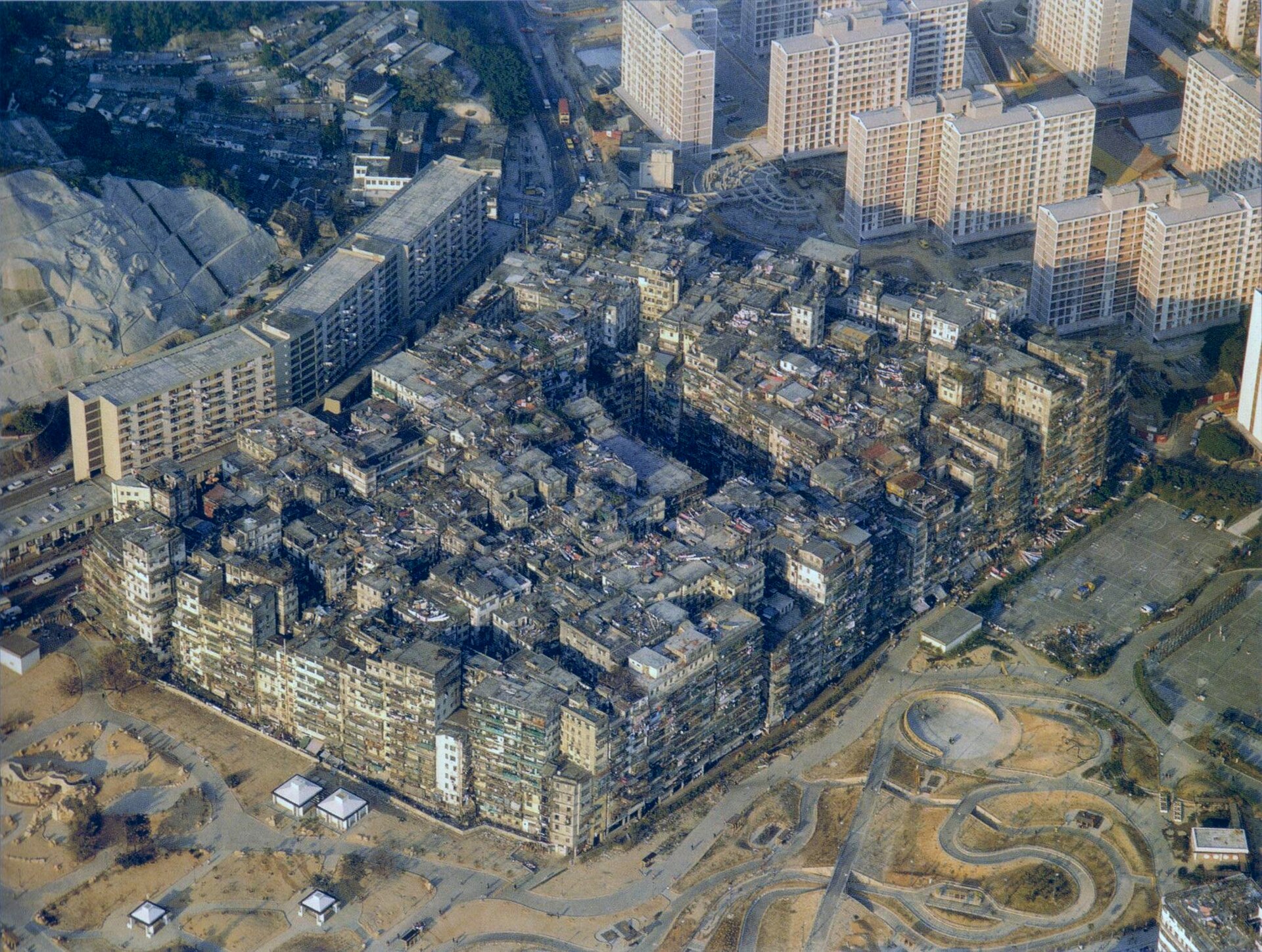
Photo: Wikimedia Commons, CC BY-SA 4.0
Why a Vanished City Still Haunts Us
Kowloon Walled City has been gone for thirty years. And yet it may be more alive now, in the imagination, than it ever was in concrete.
Part of that is the photographs. In the years before demolition, Canadian photographer Greg Girard and British architect Ian Lambot spent five years documenting the enclave from the inside, and their book City of Darkness — first published in 1993 — captured its cramped apartments, its wet lanes, its rooftop life, and above all its people, with a humanity that transformed the enclave's reputation from a den of vice into a lost human ecosystem. It is because of that work that we can still walk those corridors at all.
Then there is the aesthetic. The Walled City's tangled density — the wires, the neon, the stacked rooms, the rain-slicked dark cut by scraps of glowing light — became one of the founding visual grammars of cyberpunk. Its DNA runs through Blade Runner and Ghost in the Shell, through anime backdrops and video-game levels, through the fighting-game arena in Kowloon's Gate and the recreated set that stunned audiences in the 2024 Hong Kong film Twilight of the Warriors: Walled In. When a science-fiction artist wants to draw a future that is crowded, lawless, and alive, they are, knowingly or not, drawing Kowloon.
But the deepest reason it haunts us is harder to name. The Walled City was a place that should not have worked — no plan, no government, no light — and yet fifty thousand people made it work, built a functioning world in the one place the rules forgot. It stands as proof of something both frightening and strangely hopeful about human beings: that we will fill any space given to us, adapt to any darkness, and make a home even where the sun does not reach.
Perhaps that is why the legends refuse to fade. A place that intense does not simply become a garden. Walk the empty park path beneath the banyan trees at dusk, and you may feel it — a pressure in the quiet, a sense that the ground remembers. Fifty thousand lives lived and ended here, in a darkness the daylight never touched. The city is gone. The darkness, some say, is only sleeping.
The Japanese survey drawings are the finest documents in this part of my collection and I have gone through them more often than any research purpose required. Thousands of rooms opened up in cross-section, every stairwell and pipe run traced by hand. What unsettles me is a thing the draughtsmen could not have avoided: to draw a room, you must first stand in it and be let in. Every one of those cells was somebody's, and the survey was made in the certain knowledge that all of it was scheduled for the wrecking crews. So the most complete map ever produced of that place is also, page by page, a record of people permitting strangers to measure their homes on the way out. The park sits on the footprint now, laid out very neatly. The drawings are the only thing left that still knows where the corridors went.
---
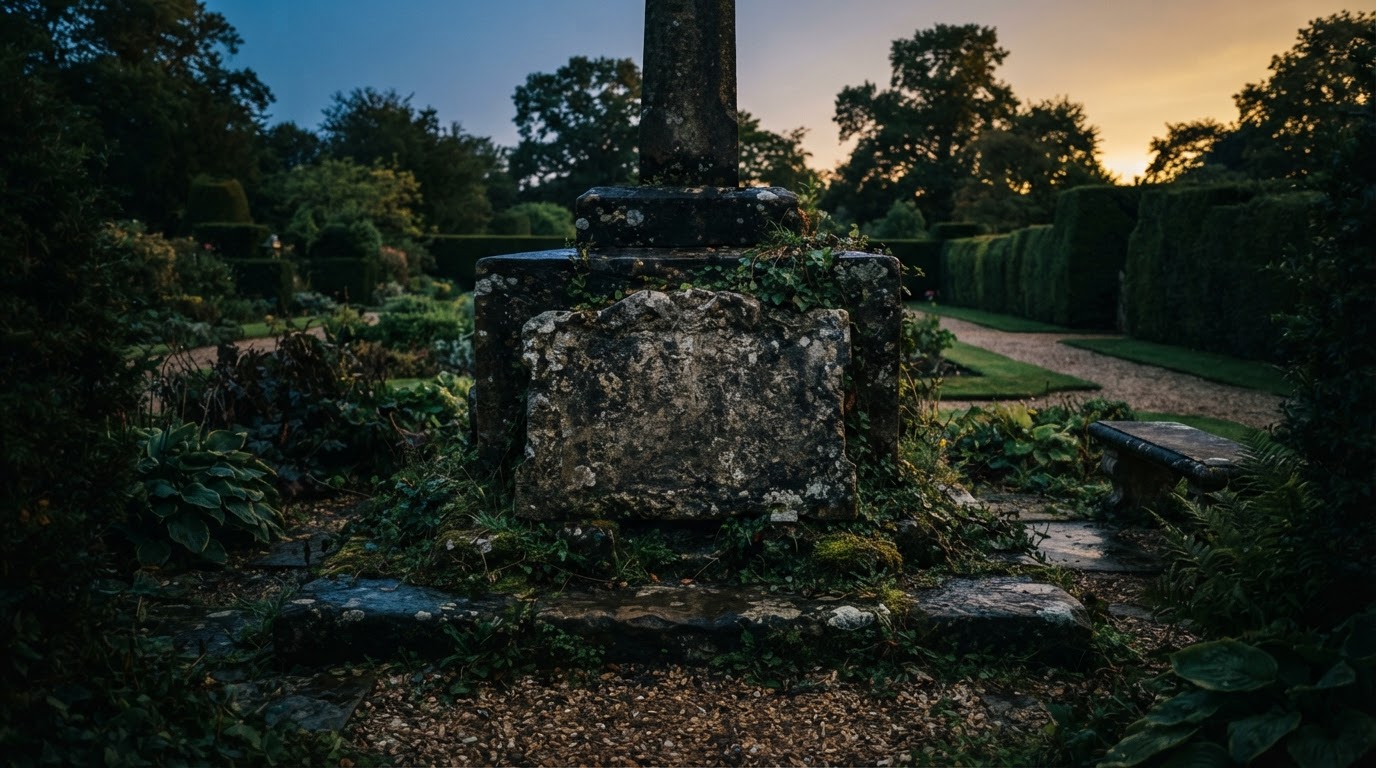
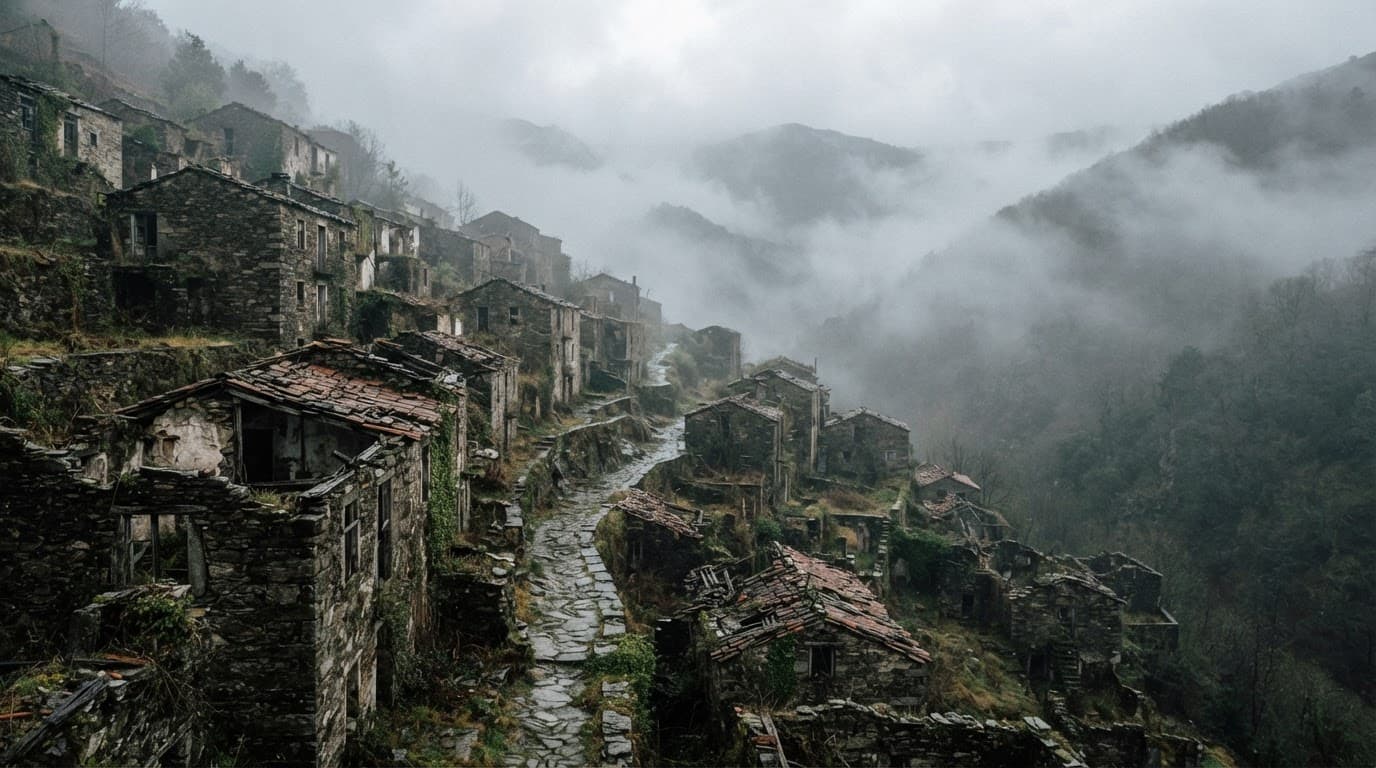
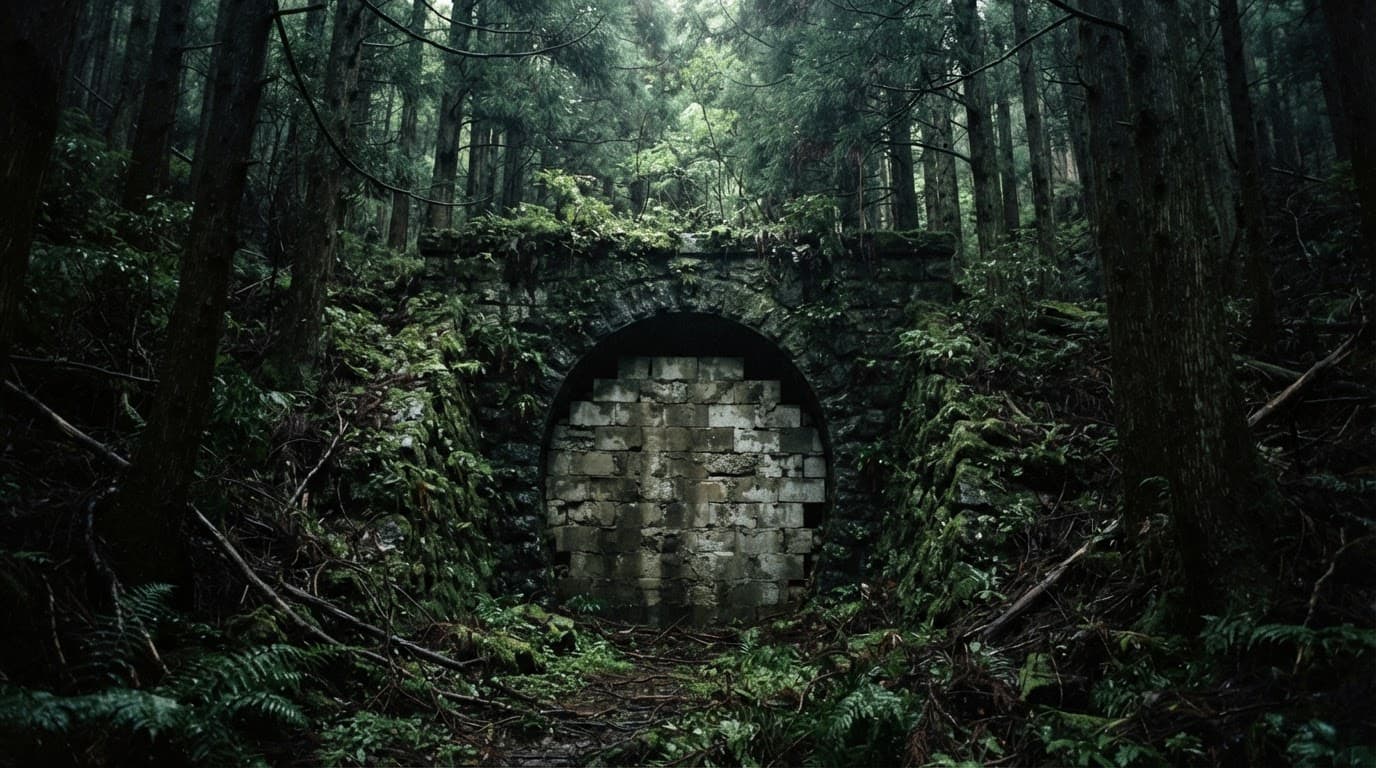
This article combines actual documentary photographs and records of the Kowloon Walled City with AI-generated images produced to convey the mood of the story.
Comments
No comments yet — leave the first one.