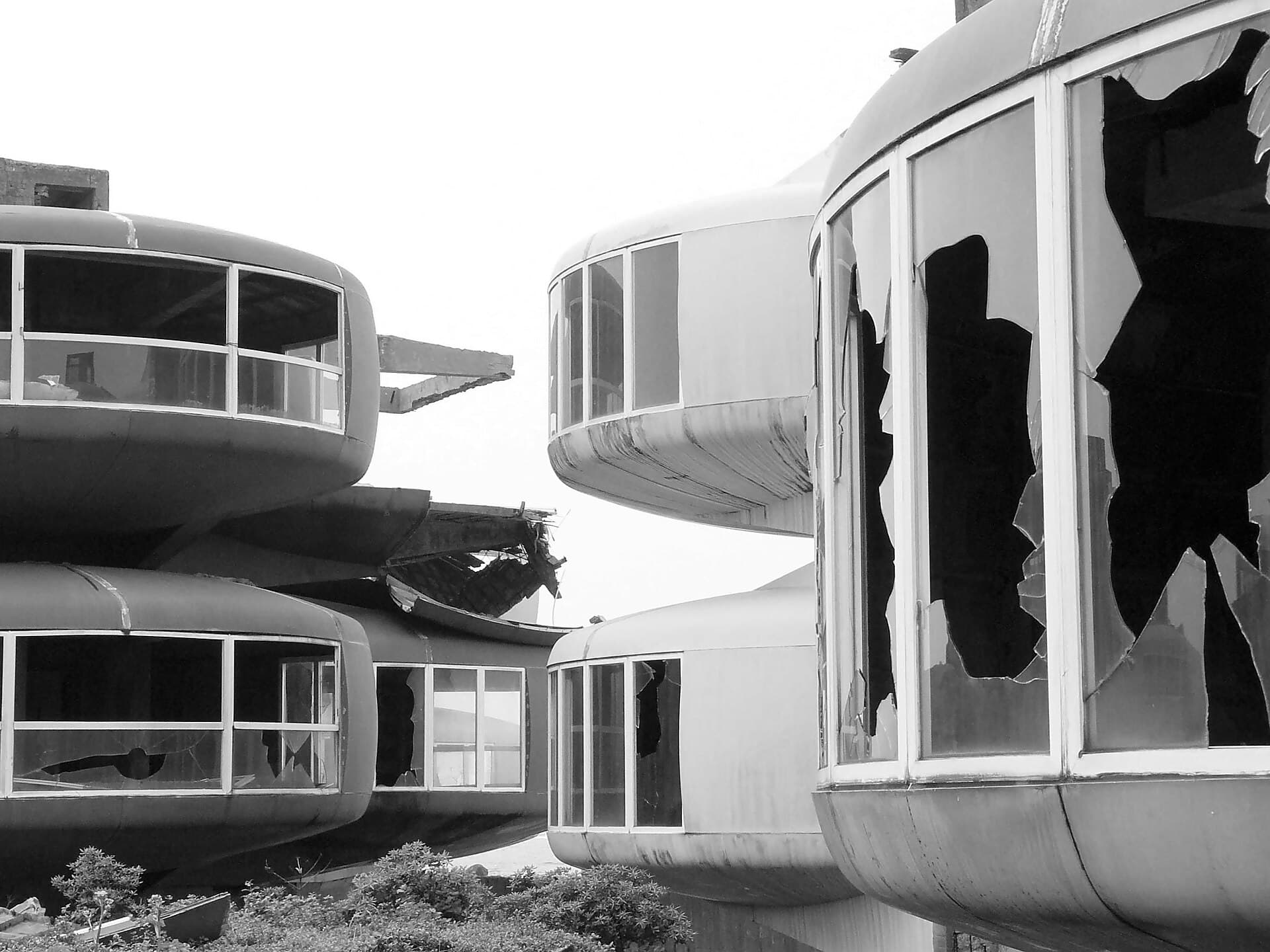
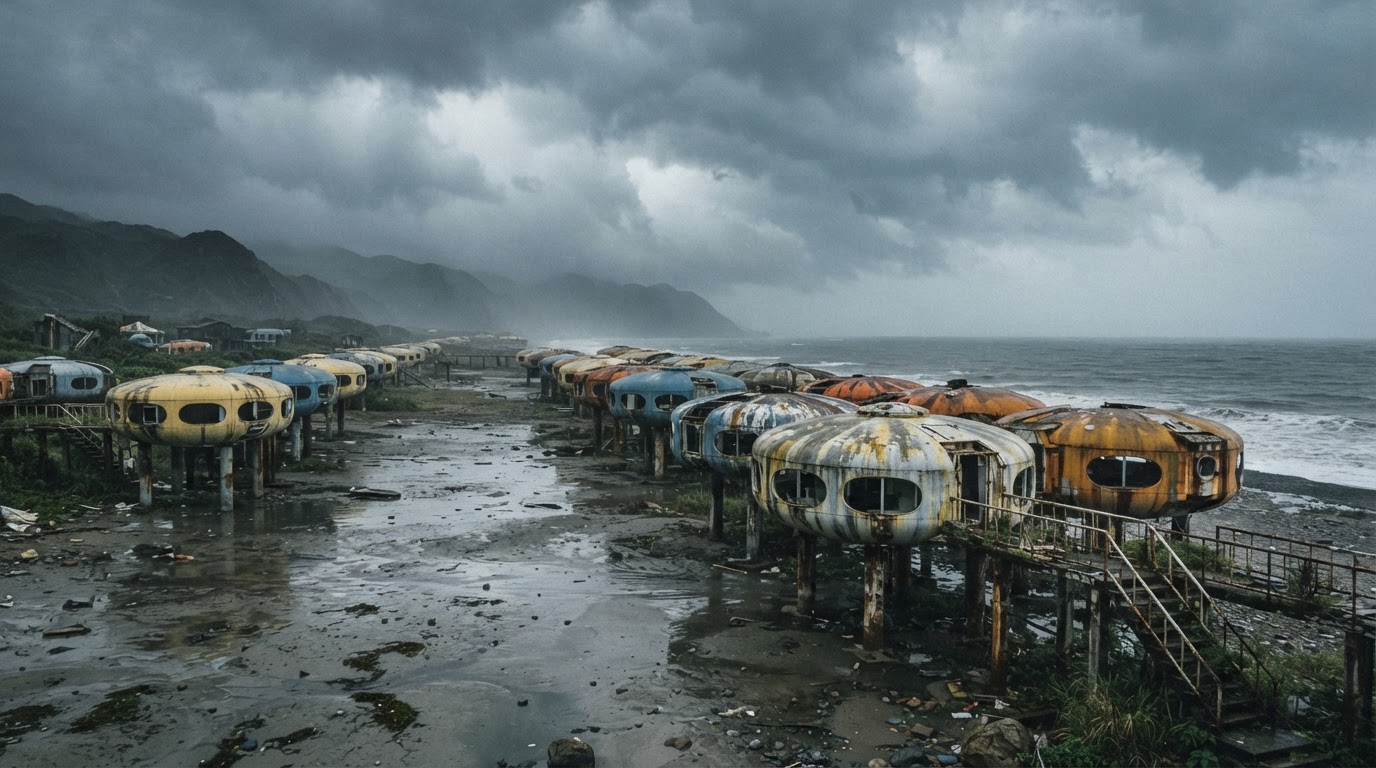
In northern Taiwan, if you follow the coast up from Taipei, you pass through Tamsui and reach a quiet seaside district called Sanzhi. From the 1980s onward, one utterly incongruous sight stood on this grey shore: rows of round, spaceship-shaped houses painted yellow, blue and orange, lined up across the tidal flats like a squadron of flying saucers that had settled out of the sky. People called the place the "Sanzhi flying saucer houses"; in the West it became known as the "Sanzhi UFO houses." Planned as an upmarket resort of the future, the complex was abandoned before it could be finished, and over its empty shell rumors piled up layer by layer — that many men had died during construction, that the whole project had been doomed by the curse of a dragon statue that was moved. And so the Sanzhi UFO houses became one of Asia's most famous "cursed ruins." They have since been demolished and are gone, but the strange story remains. This is the tale of an abandoned city of the future by the sea, and of the ghost stories that stuck to it like a name tag.
My folder on Sanzhi is mostly photographs, and it grew faster than the facts did. Sorting them by date, you can watch the colors go — the yellow capsules turning the shade of old teeth, the orange ones bleaching toward nothing — and somewhere in the middle of that sequence the captions change. The early ones say abandoned resort. The later ones say cursed. Nothing happened on the site between those two words except that more people photographed it.
A "Flying Saucer Village" That Settled by the Sea
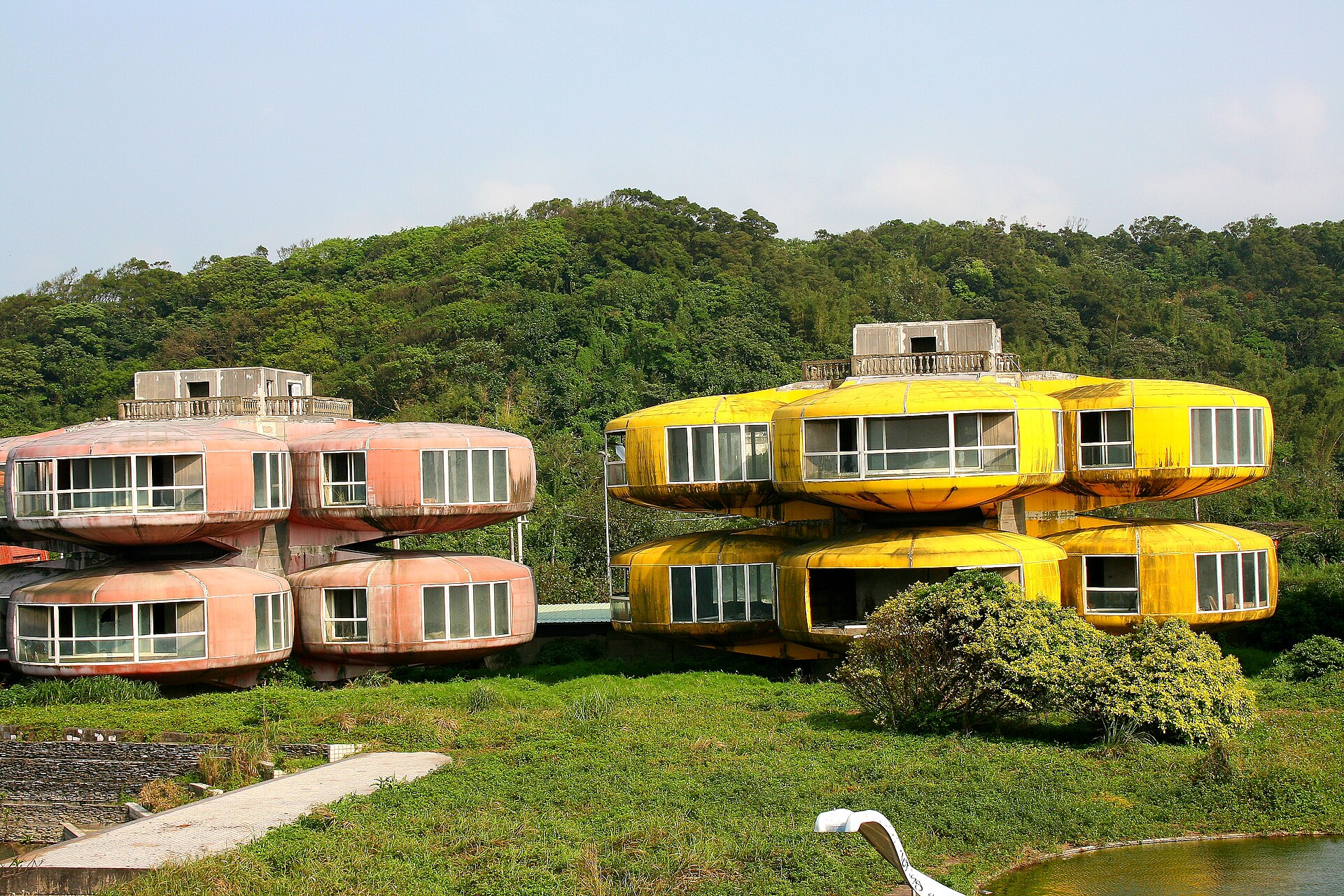
Construction of the Sanzhi UFO houses began around 1978. Taiwan was in a period of rapid economic growth at the time, and the coast at Sanzhi, not far from Taipei, drew attention as a site for villas and holiday homes for city dwellers. The developers decided to build a strikingly unconventional complex of prefabricated retreats there. Instead of pouring concrete on site, they set pre-made, round capsule-shaped units on top of pillars. Each finished house stood on four or five legs planted in the ground, looking for all the world like a brightly colored UFO.
There was a certain logic behind this unusual design. Prefabricated capsule units were thought to be quick and cheap to build, and mounting the houses on pillars kept them somewhat clear of the coast's damp and flooding. With views over the sea and an exterior that looked as if it had stepped out of a science-fiction film, the project might well have lived up to its billing as a "resort from the future" — if only the units had sold. Early on, it is said, they attracted considerable interest. But that interest did not last.
The Money Dried Up, and Work Stopped
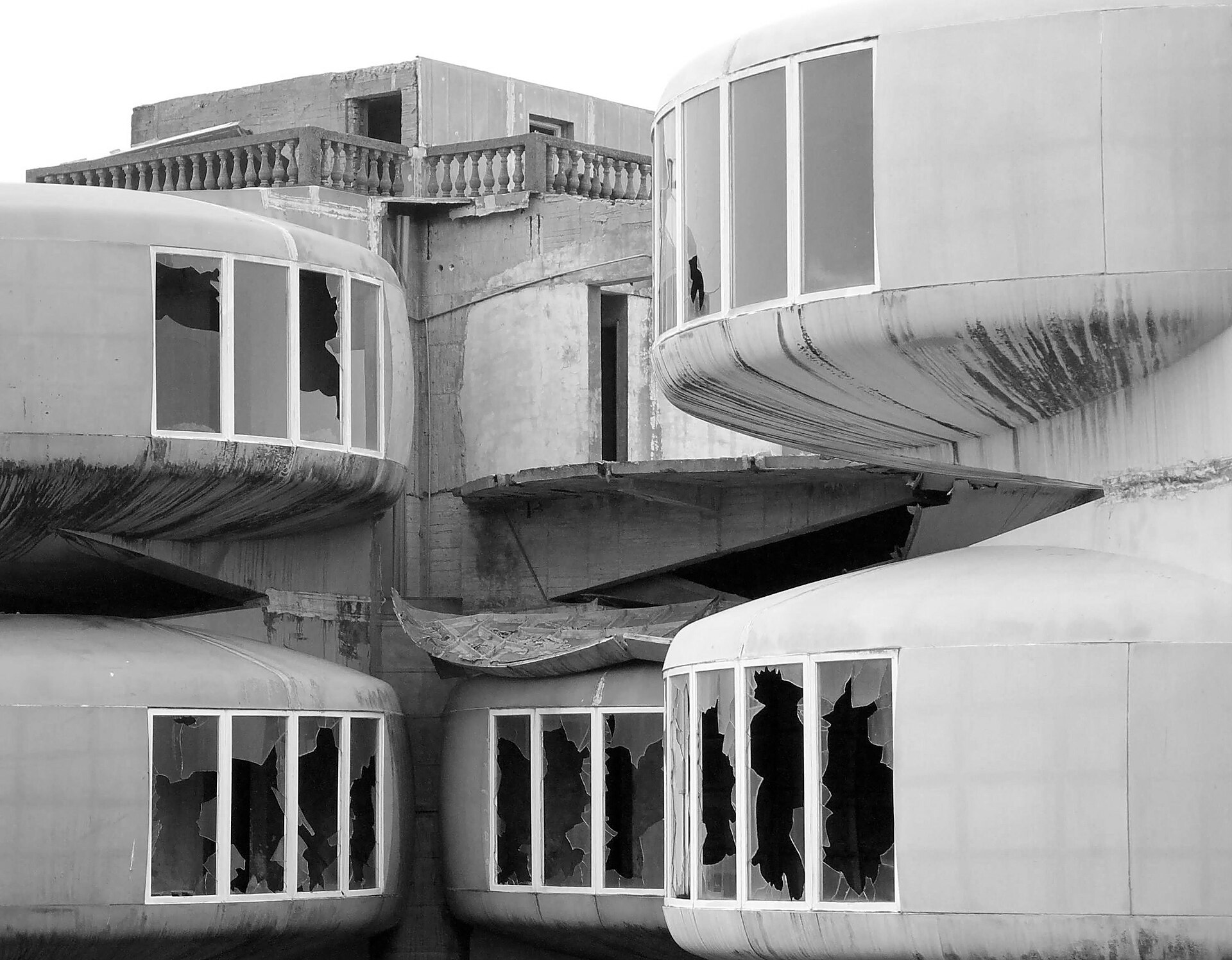
The clearest, most down-to-earth reason the Sanzhi project collapsed was money. Around 1980, the venture fell into serious financial trouble. Various accounts point to the financial ruin of the contractor or the backing investors, and to the oil shocks that shook the late 1970s and early 1980s, along with the economic slump they brought. Building costs climbed, sales fell short of expectations, and the capital ran out. In the end, work halted with a large share of the complex standing as little more than frames and outer walls.
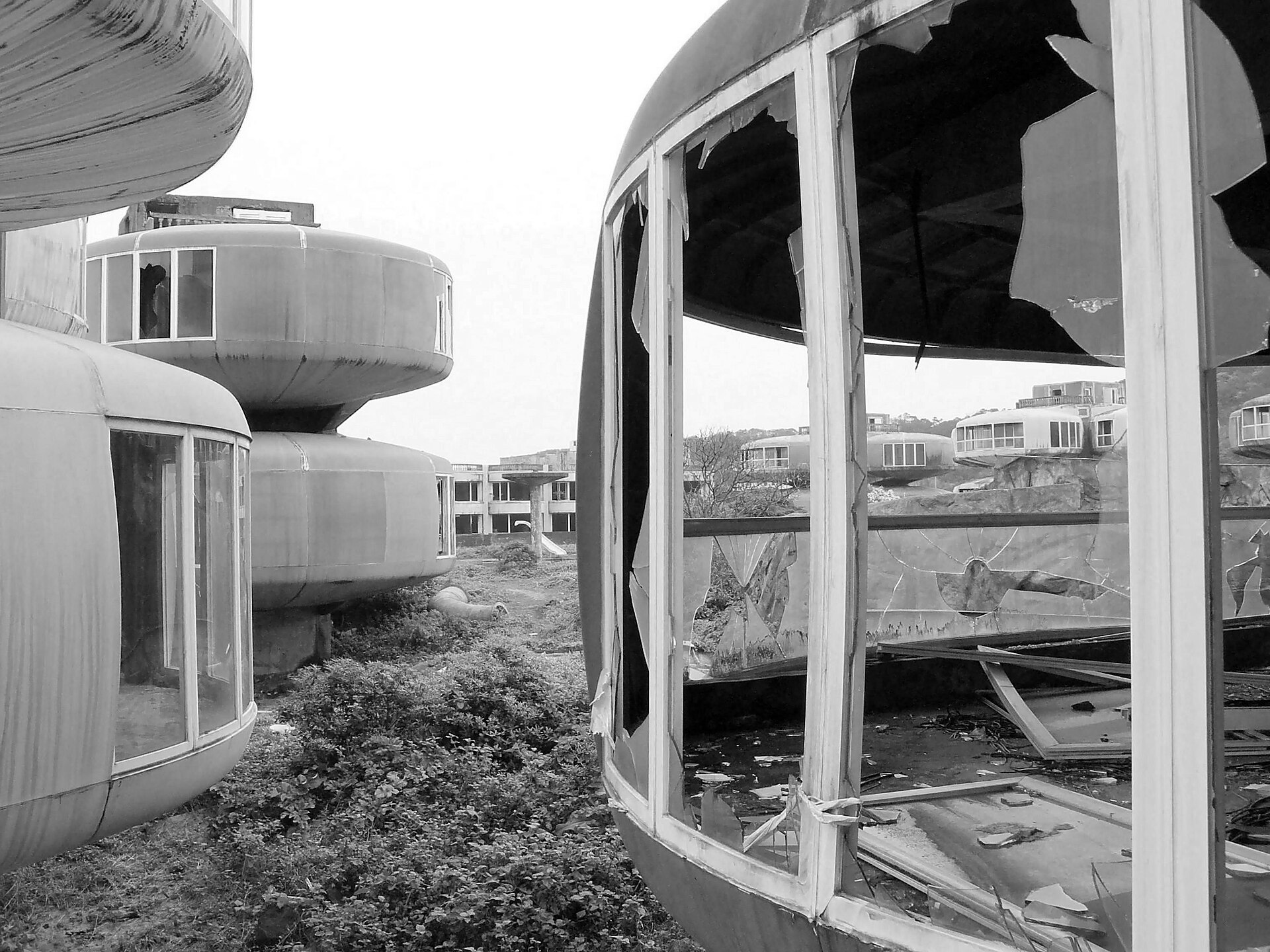
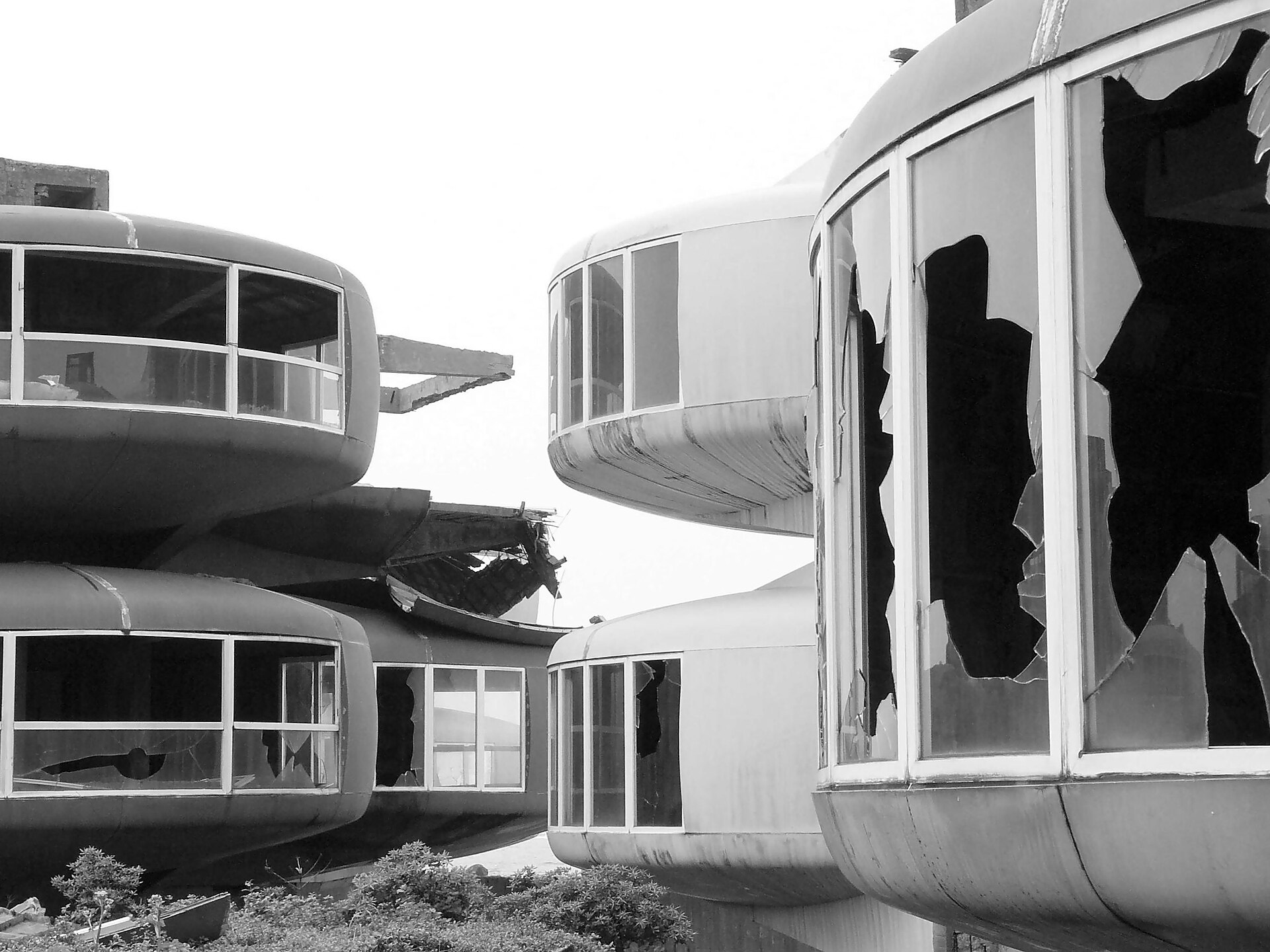
Once stopped, construction never resumed. The party that would have funded it disappeared, the rights and ownership tangled into a knot, and no one could agree on what to do with the structures already raised. Neither close to completion nor able to be torn down, the complex was left in limbo. Sea wind, salt, and the typhoons that swept in every summer battered the capsules year after year. The once-bright exteriors faded and peeled, the windows broke, and weeds and mold moved in. The "resort from the future" aged rapidly into a "ghost village by the sea."
A "Curse" Tag Gets Attached
Up to this point, it is really the kind of failed-property-development story you might find in any country. A build halted by lack of funds, an abandoned complex — in itself, nothing extraordinary. And yet the Sanzhi UFO houses attracted an unusually thick coat of ghost stories. The stranger and more beautiful a ruin is, the more people tend to reach for a supernatural answer to the question standing before it: why?
The most widely spread tale is the "curse of the dragon statue." According to it, there had originally been a Chinese-style dragon statue at the entrance to the site, and when the dragon was moved or destroyed to make way for construction, it disturbed the energy of the place — its feng shui — and so the entire complex was cursed and ruined. Another version held that the land itself had always been troubled: a place where many had died in some past war or disaster, or ground built over an old cemetery. And the most lurid rumor of all was this: "During construction, an unknown series of accidents killed several workers, and it was their vengeful spirits that kept anyone from ever finishing the place." There is no confirmed evidence for any of it, yet these stories crept into the silence of the ruin and spread as if they were fact.
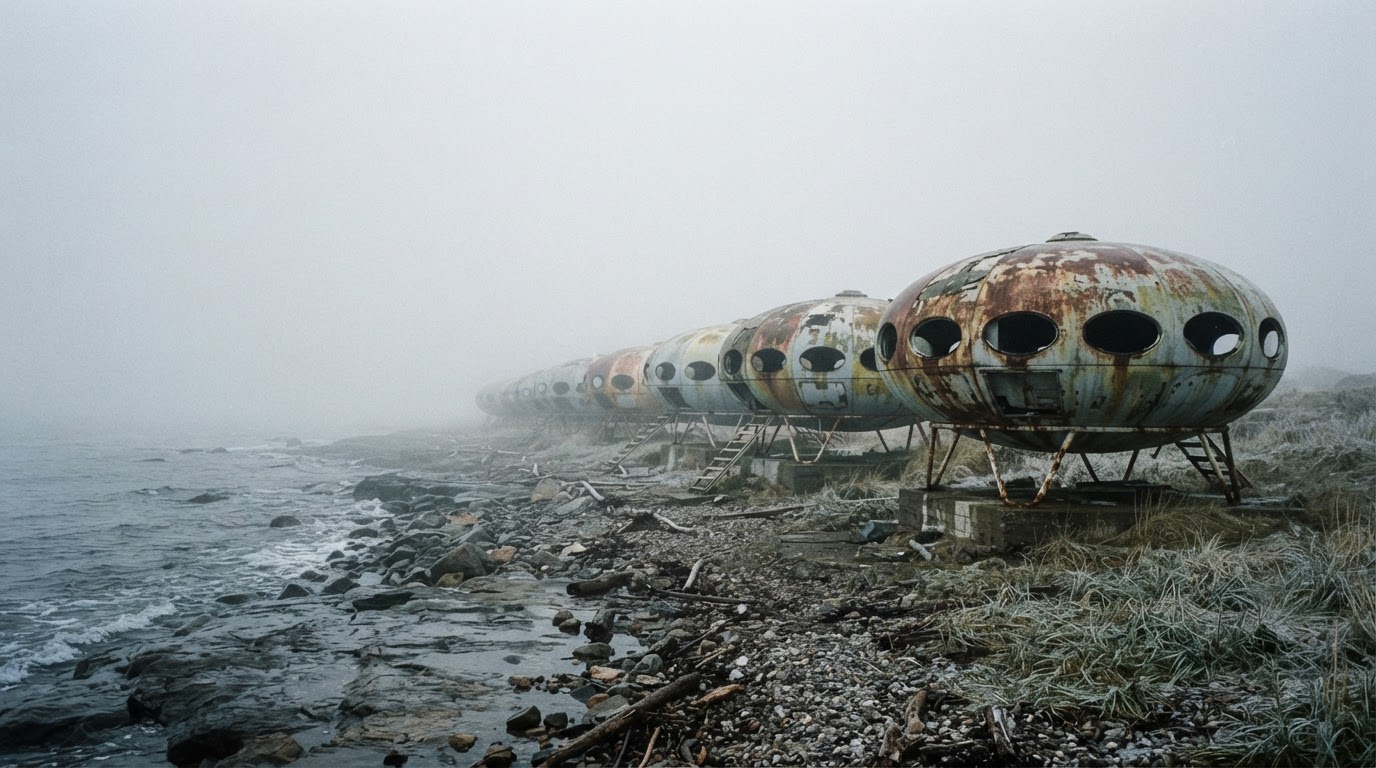
A pre-typhoon sky drifting slowly over the empty UFO villa complex
Why These Rumors "Stuck"
What is intriguing is why these ghost stories survived so tenaciously at Sanzhi in particular. Several reasons overlap here. The first is the look of the place itself. The very idea of a house shaped like a UFO is already a step outside reality. Buildings meant to be lived in that instead resemble alien craft — standing empty, no less, in rows along a grey shore — give you, the moment you see them, the sense of something not of this world. The form of the ruin has already written half the ghost story by itself.
The second is the "unexplained blank." Why would no one finish a complex that looks (or seems to look) perfectly sound? To most people, the dull truth — a tangle of financial trouble, ownership disputes, and economic recession — simply fails to satisfy. A one-line explanation, "because of a curse," is vivid and easy to remember instead. The third is photography and the internet. From the 2000s, photographers and urban explorers captured this brightly colored ruin and spread the images online, and the Sanzhi UFO houses became a world-famous "spooky spot." Wherever the photos circulated, the label "cursed place" followed without fail, and so the story swelled of its own accord. A single failed development project was reborn as one of the internet age's signature "ghost city" legends.
Demolition, and a Ruin That Vanished
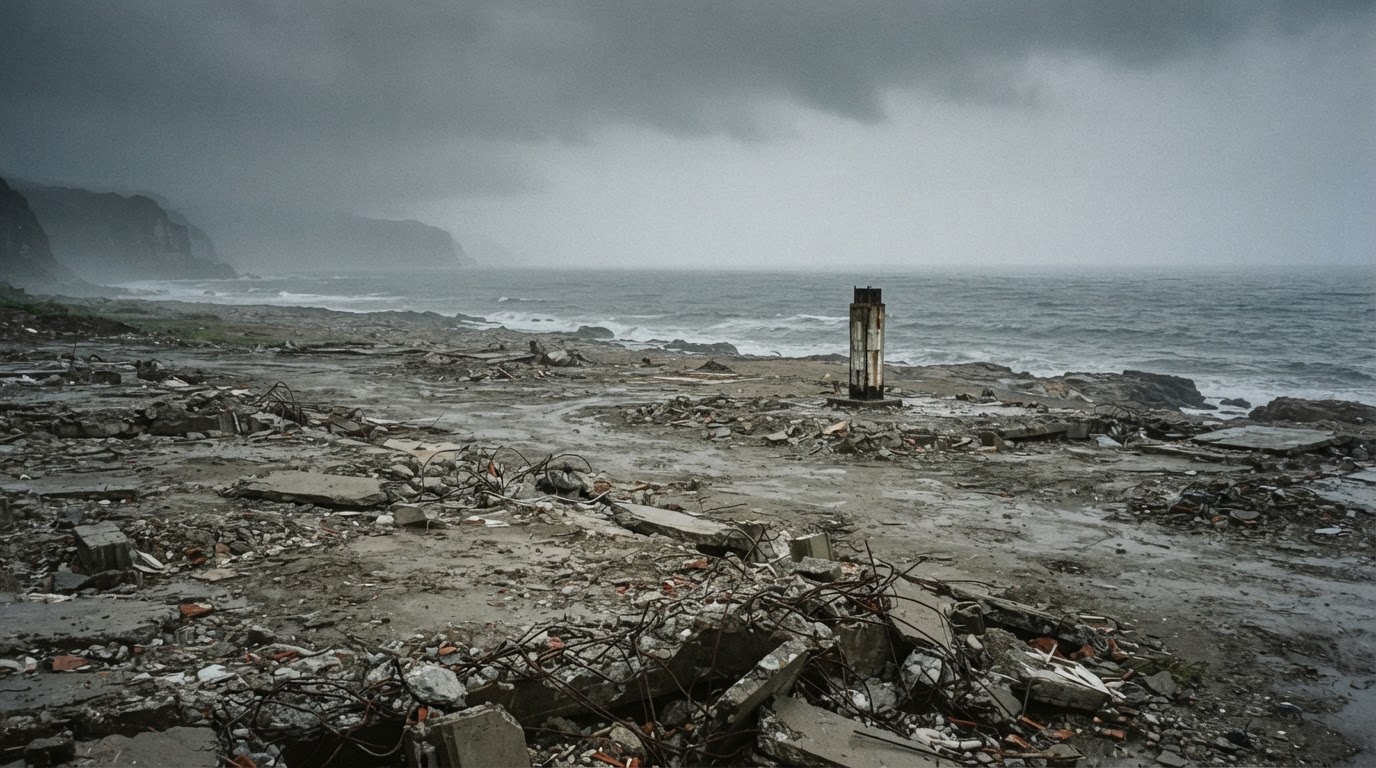
This strange village did not last forever. In the late 2000s, along with a push to redevelop the site, demolition was decided. Despite the regret of ruin-lovers, photographers, and some who wanted the place preserved, the Sanzhi UFO houses began to be torn down in stages from around 2008 and were mostly gone by about 2010. The spaceship-like capsules were broken apart one by one before the heavy machinery, and the "flying saucer village" that had guarded the coast for nearly thirty years was erased from the map.
Almost nothing remains on the spot today to recall the old UFO villas. Only the old photographs of that brightly colored ruin, and the ghost stories that drifted along with them, linger like fossils in a corner of the internet. Ironically, it was only after it had physically vanished altogether that the Sanzhi UFO houses settled more firmly into place as a "legend." It had become a place no one could go and check anymore. Once the people who could visit and say "it's really nothing special" were gone, only the mystery in the photographs remained, intact.
The Story That Remains
What we can say for certain about the Sanzhi UFO houses today is, surprisingly, quite plain. Around 1978, an ambitious complex of spaceship-shaped prefabricated villas broke ground on the coast at Sanzhi in Taiwan. But amid financial trouble and economic recession, work stopped around 1980, and the place was left unfinished and abandoned for decades. Then, between 2008 and 2010, it was demolished, and today it no longer exists. There is no solid record to support the stories of mass deaths among the workers or a dragon's curse.
Even so, the question this ruin leaves us with is still an interesting one. Why did we want to dress a single failed development project in the clothing of a "curse"? Perhaps the answer lies in the ruin itself. Spaceship-shaped houses raised in a dream of the future and then abandoned, never lived in — the wreckage of that unfinished dream suited the word "curse" better than any logical explanation. The UFOs of Sanzhi have now vanished from the coast, but the image of that ghost village, aging brightly under a grey sky, still drifts quietly somewhere in our imagination.
I went hunting for the dragon statue once, properly — construction filings, local gazetteers, anything that would put a stone dragon at that gate before 1978. I found the story everywhere and the statue nowhere. That should have settled it for me. Instead I noticed something worse: the demolition finished around 2010, which means every account written since has been checked against nothing but earlier accounts. The ruin is gone, the record is closed, and the curse is now the only part of the place that can still be visited.
---
This article uses both real archival and on-site photographs and AI-generated images and video produced to convey the mood of the story.
Comments
No comments yet — leave the first one.