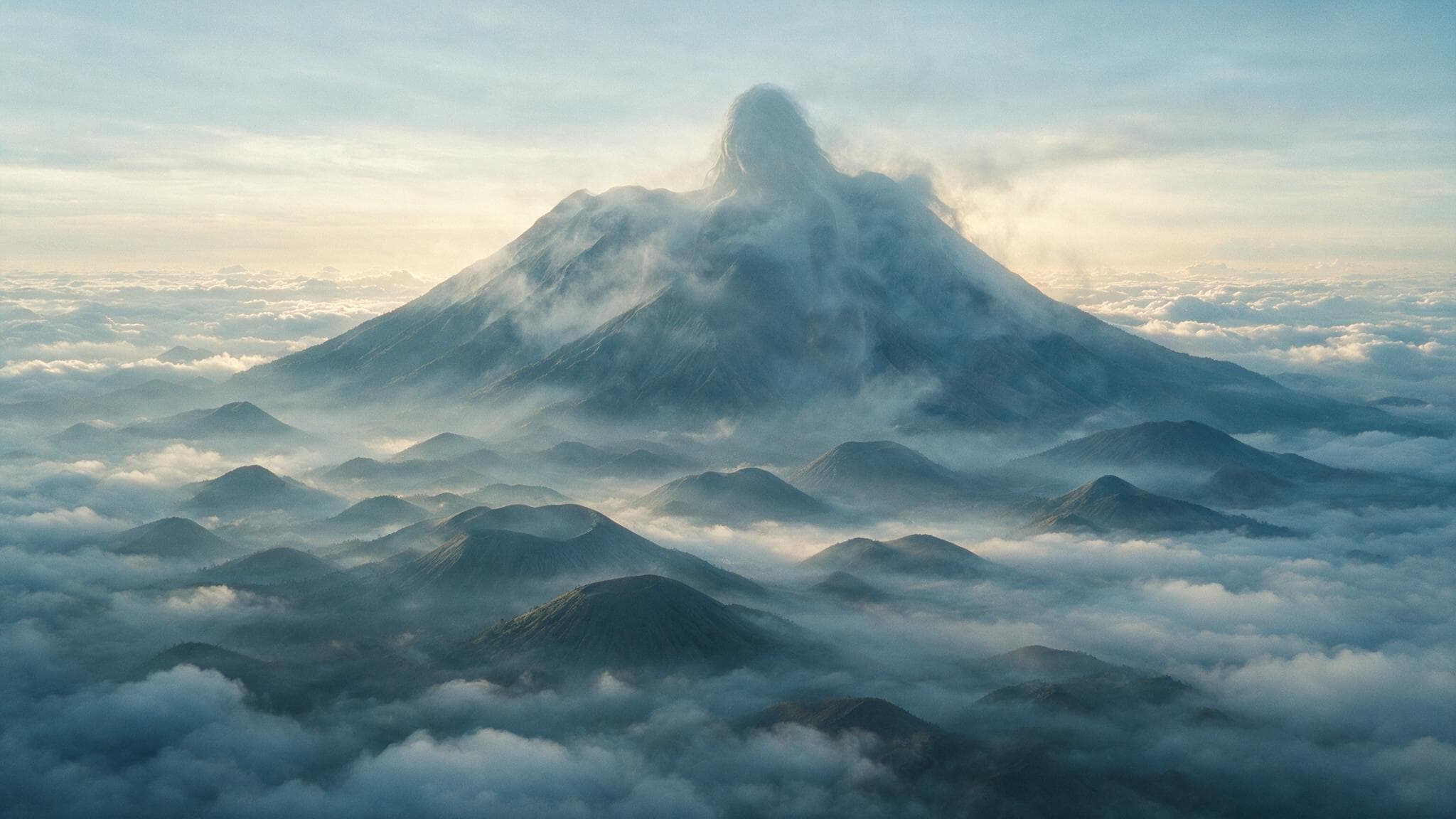
At the heart of Jeju Island rises Hallasan, and scattered across its slopes like ripples on water are hundreds of smaller peaks — too many to name. The people of Jeju call these hills oreum. This single island holds more than three hundred and sixty of them, and above them all stands Hallasan, and around it all lie the shores of black volcanic rock. For as long as anyone can remember, the people of Jeju have believed that the whole of this island was shaped by the hands of a single giant goddess. Her name is Seolmundae Halmang: a mother deity so immense that, so the story goes, when she lay down using Hallasan as her pillow, her feet stretched to a distant island across the sea. What we mean to tell today is the story of the goddess who shaped an entire island — and the ancient riddle of how so vast a being vanished, without a sound, into a small pond.

The Goddess Who Shaped an Island in Her Skirt
The story of Seolmundae Halmang always begins with her size. She was the largest being anyone could imagine. When she lay down with her head on Hallasan, her legs are said to have stretched all the way to Gwantalseom, an island far out in the sea. To do her washing, she would plant one foot on Hallasan and the other on Gwantalseom, dip her clothes in the seawater flowing between them, and scrub them with her feet. Hers is a scale no human measure can hold. And it was precisely that vastness that made her a goddess of creation.
The legend tells it this way. Long ago, in a time before the island of Jeju existed at all, Seolmundae Halmang scooped earth into the broad folds of her skirt and carried it out into the open sea. She poured the soil onto the water again and again, until land rose up above the waves and became, at last, the island of Jeju. And the earth that was left over she heaped high in a single place, and that became Hallasan, the mountain at the island's center. Hands that made an island, and raised a mountain upon it — the very shape of Jeju, in this telling, is the fruit of one goddess's labor.

How the 360 Hills Were Born
It is not Hallasan alone that makes Jeju what it is. The hundreds of hills that swell up across the island in soft, rounded curves are like the very skin of the land. So how did all these peaks come to be? Here the legend of Seolmundae Halmang offers one of its most beautiful passages.
According to the most widely told version, the skirt in which the goddess carried her earth was full of holes. As she moved the great skirtful of soil, a little slipped out here and there through the torn seams. With every step she took, a clump of earth fell through the gaps — a heap here, a heap there — and those scattered mounds of soil became the hills we know today. This, people said, is why Jeju has more than three hundred and sixty oreum. Each careless crumb of earth dropped by a giant goddess was, to human eyes, a mountain.
Other tellings hold that the goddess's own body shaped the land directly. Planting her feet on Hallasan and Gwantalseom, she relieved herself, and the waters she loosed carved out the surrounding sea — and in that same act, the small island of Udo, off the eastern coast of Jeju, was formed. Such stories sound strange to us, and at times comic, but within them lies a single, consistent way of seeing the world: a belief that Jeju's mountains and islands and seas were none of them accidents, but sprang from the body and the labor of one mother goddess. The impulse of the old people to read a divine hand into every curve of the natural world took shape, here, in the figure of this giant.

The Unfinished Bridge, and a Hundred Bolts of Silk
Between Seolmundae Halmang and the people of Jeju there is a tender, bittersweet promise. One day, the goddess is said to have made them an offer: if they would sew her a single undergarment, she would build a great bridge stretching from Jeju all the way to the mainland. To an island people hemmed in by the sea, what could be a more longed-for wish than a bridge to the land beyond?
But the trouble was the goddess's sheer size. To sew a single undergarment for so vast a being required no fewer than a hundred bolts of silk. The people of Jeju gathered every last length of silk on the island, yet however much they collected, they could reach no further than ninety-nine bolts. They fell short by exactly one. In the end the garment was never finished, and the goddess never built the bridge she had promised. And so, the story goes, Jeju remains to this day an island adrift in the sea, with no bridge to the mainland at all. This slightly forlorn ending, set at the close of a giant goddess's grand tale of creation, holds within it something quiet — the isolation, and the longing, of a life lived on an island.

<video controls muted loop playsinline poster="/media/seolmundae-1.jpg" style="width:100%;border-radius:8px;"> <source src="/media/seolmundae-clip.mp4" type="video/mp4" /> </video>
A short clip of mist drifting slowly over Hallasan and its ridge of hills sunk in a sea of clouds — a mood recreation, not real footage.
Where Did the Goddess Go? The Riddle of Mulchangori
Even a goddess who shaped a whole island had her end. But the story of that end shifts a little from place to place, and with each retelling from mouth to mouth, until the death of Seolmundae Halmang became a riddle in itself.
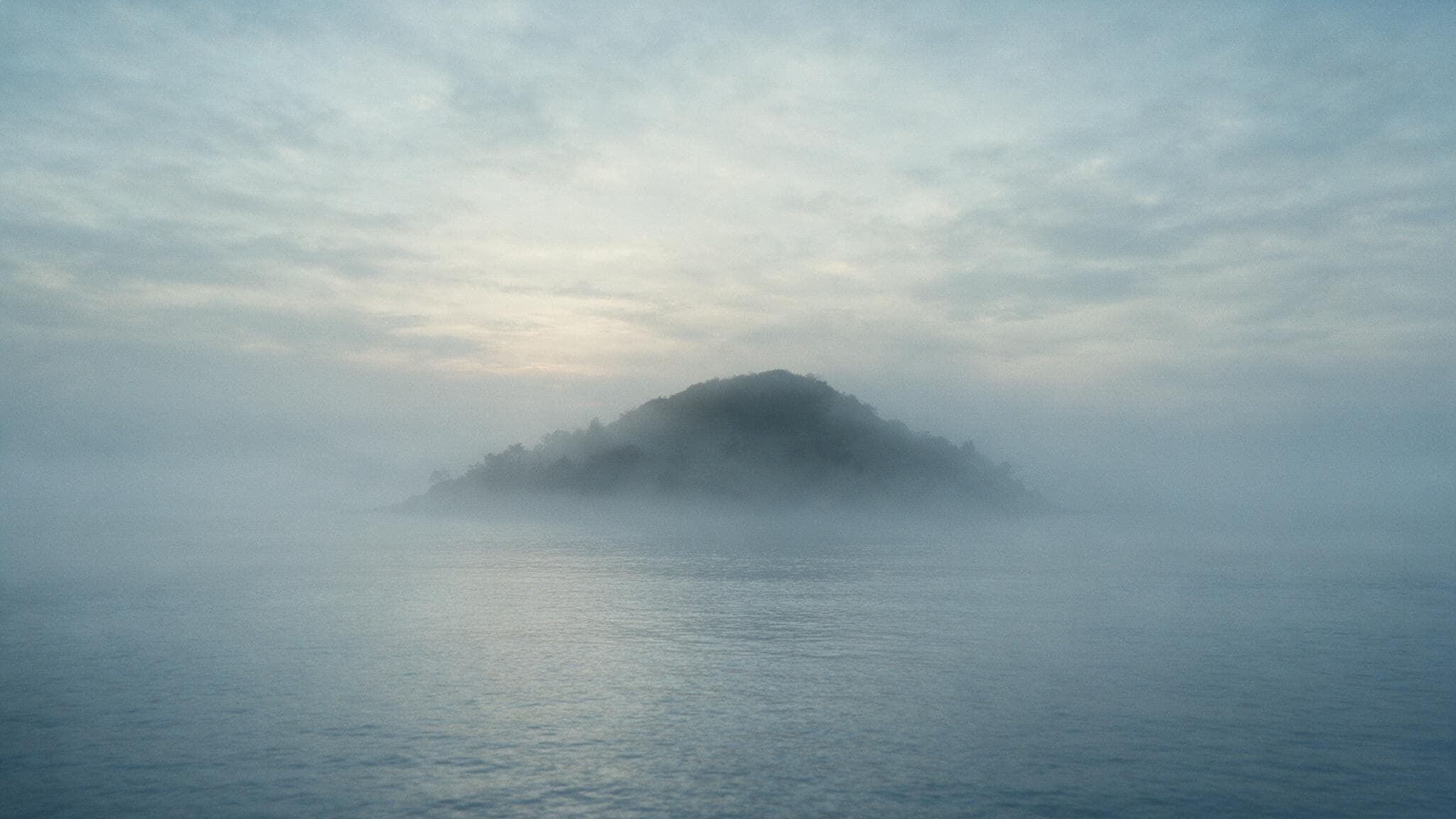
The best-known version turns on a place called Mulchangori. Mulchangori is an oreum on the slopes of Hallasan, cradling within its crater a round lake pooled high on the mountain. The legend says that Seolmundae Halmang had always taken pride in her own great height, certain that no body of water in the world could rise above her. So she went about measuring the depth of one pond after another with her feet — until, at last, she stepped into Mulchangori. To all appearances it seemed no different from any other mountain lake, yet its bottom, it is said, was pierced through and fell away to an unknowable depth. The giant goddess, who had believed nothing on earth could swallow her, sank into that bottomless water and never rose again. The hands that shaped an island, the body that lay down using Hallasan for a pillow — one small pond swallowed it all, without a sound.

The Five Hundred Generals, Another Ending
The Mulchangori tale is not the goddess's only ending. Jeju has kept alive, alongside it, an entirely different account of her death — and its setting is a valley called Yeongsil, on the southwestern flank of Hallasan.
At Yeongsil, hundreds of jagged rock spires rise toward the sky, arrayed like a folding screen. The people of Jeju have long called these rocks the Five Hundred Generals, or the Five Hundred Arhats. The legend bound to them runs like this. Seolmundae Halmang had five hundred sons, and one year, when famine struck and the whole family went hungry, the mother set a great cauldron of porridge to boil to feed them. But as she stirred the deep cauldron, she lost her footing and fell into the boiling porridge and died. Knowing nothing of this, her sons came home and ate the porridge with relish — until the youngest, arriving last, found traces of his mother at the bottom of the cauldron and understood the truth at last. Realizing they had eaten the porridge that had taken their mother, the sons wept, and where they stood they hardened into stone. Those hundreds of rocks at Yeongsil, the story says, are the five hundred brothers who wept for their lost mother until they turned to stone.
For one and the same goddess, some say she sank into Mulchangori, and others that she fell into her children's cauldron of porridge. What does this parting of endings tell us? It is not an error in the story, but the very way a living myth breathes. Seolmundae Halmang is not the invention of any single person, but a tale that grew for ages on the island of Jeju, passing through countless mouths. Each village, each hill, attached its own particulars and fashioned its own ending, and so a single goddess came to hold many different deaths. And those endings, split apart, remain for us today as one enthralling riddle instead.

The Mother the Island Remembers
No one can say for certain exactly when the story of Seolmundae Halmang first began to circulate on Jeju. Yet the traces of this goddess survive, under varying names, in old records such as the Tamnaji, a geographical text of the late Joseon period — and more than that, she lives on across the very land of Jeju itself, in real place names like Mulchangori and Yeongsil. Long before it was ever set down in writing, this story was carved into the island's own landscape, passed from mouth to mouth.
One thing is worth making plain here. This is not the record of an event that actually happened. There was no giant who carried an island in the folds of her skirt, and the oreum are natural landforms shaped by volcanic activity over vast stretches of time. Seolmundae Halmang is not history but myth. Yet to say that a myth is not fact is by no means to say that it is meaningless. If anything, this story is the deepest record of the heart — a record of how the people of Jeju looked upon their own land. By reading a mother's touch into every mountain and hill beneath their feet, and by telling how that immense mother finally faded into a small pond, they embraced the natural world not with fear but with tenderness.
Today Hallasan still stands wrapped in cloud, and across its slopes three hundred and sixty hills ripple outward. On a dawn when the mist drifts low along the ridgelines of the oreum, perhaps somewhere in that landscape the shadow of the giant goddess still flickers — still carrying earth in the folds of her skirt. She vanished, and yet she did not vanish. For this whole island she is said to have shaped is itself her body, and the oldest story ever told about her. The water of Mulchangori is still today, and the rocks of Yeongsil still stand facing the sky. The island, quietly, remembers the mother who shaped it.

Comments
No comments yet — leave the first one.