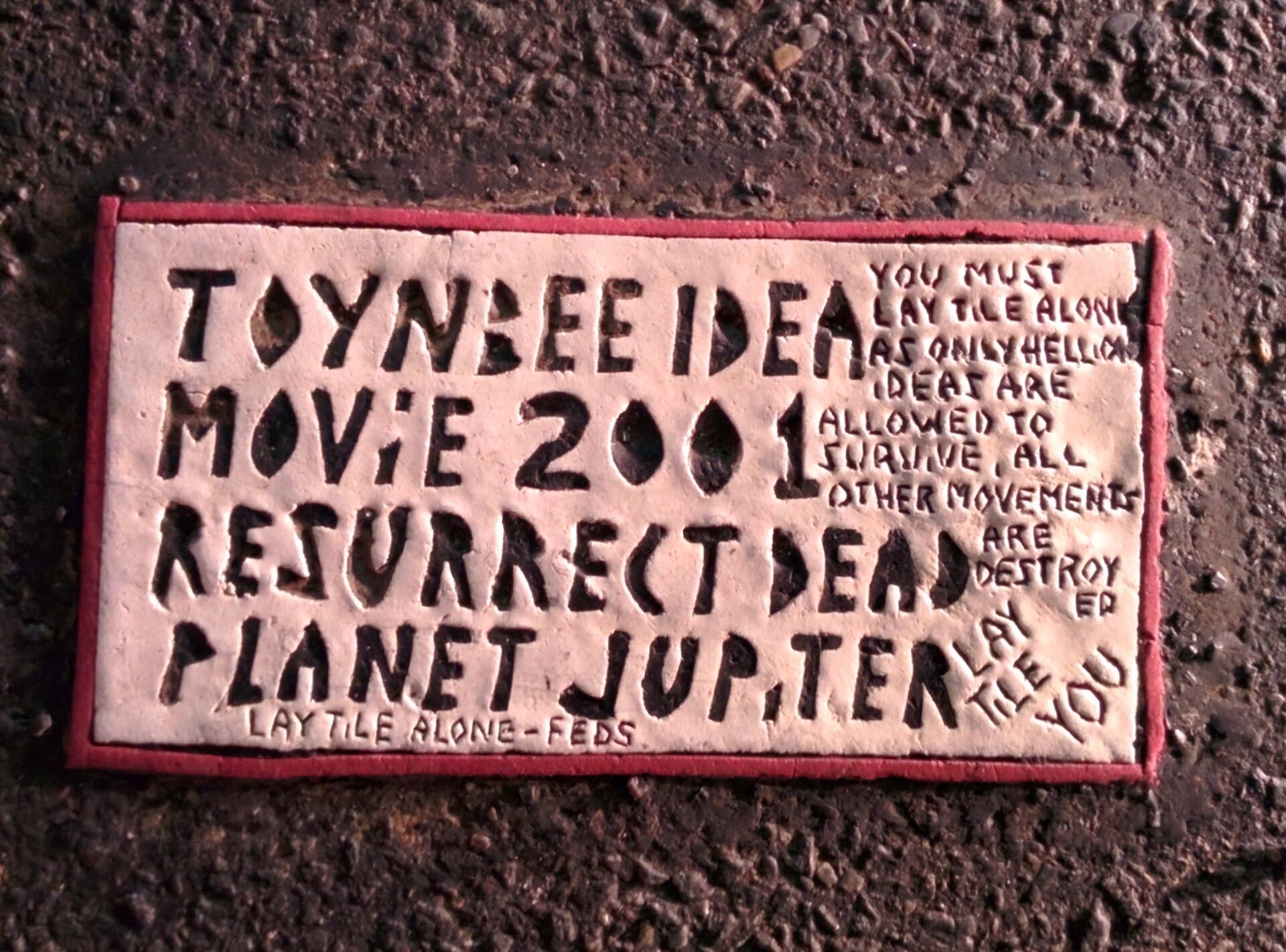
Imagine walking across a busy city intersection — asphalt that thousands of cars roll over every single day — and glancing down at your feet. There, set firmly into the black tar, is a small, worn, colorful tile about the size of your palm. Its surface has been scuffed and cracked by the tires that have passed over it, but the words pressed into it are still legible: "Toynbee idea, in movie 2001, resurrect dead on planet Jupiter." Who placed this tile here, and when, and how anyone could have embedded such a thing in the middle of a lane where traffic never stops — no one knows. And it is not the only one. Across major American cities and as far away as South America, hundreds have been found over the past forty-odd years, and even now, somewhere, new ones are appearing. This is the story of the Toynbee Tiles — a message pressed into asphalt by a ghost of the streets.
Most of what I collect comes to me as testimony — someone saw, someone heard, someone remembers. This case is different, and that is why I keep it. The tiles are objects. They can be photographed, measured, catalogued by intersection; hundreds of them have been. Building my own index of documented locations, I kept waiting for the message to drift the way copied text always drifts, and it does not. Toynbee, the film, Jupiter, the dead — the four elements hold across forty years and two continents, pressed into asphalt by someone who apparently never once considered rewording it.
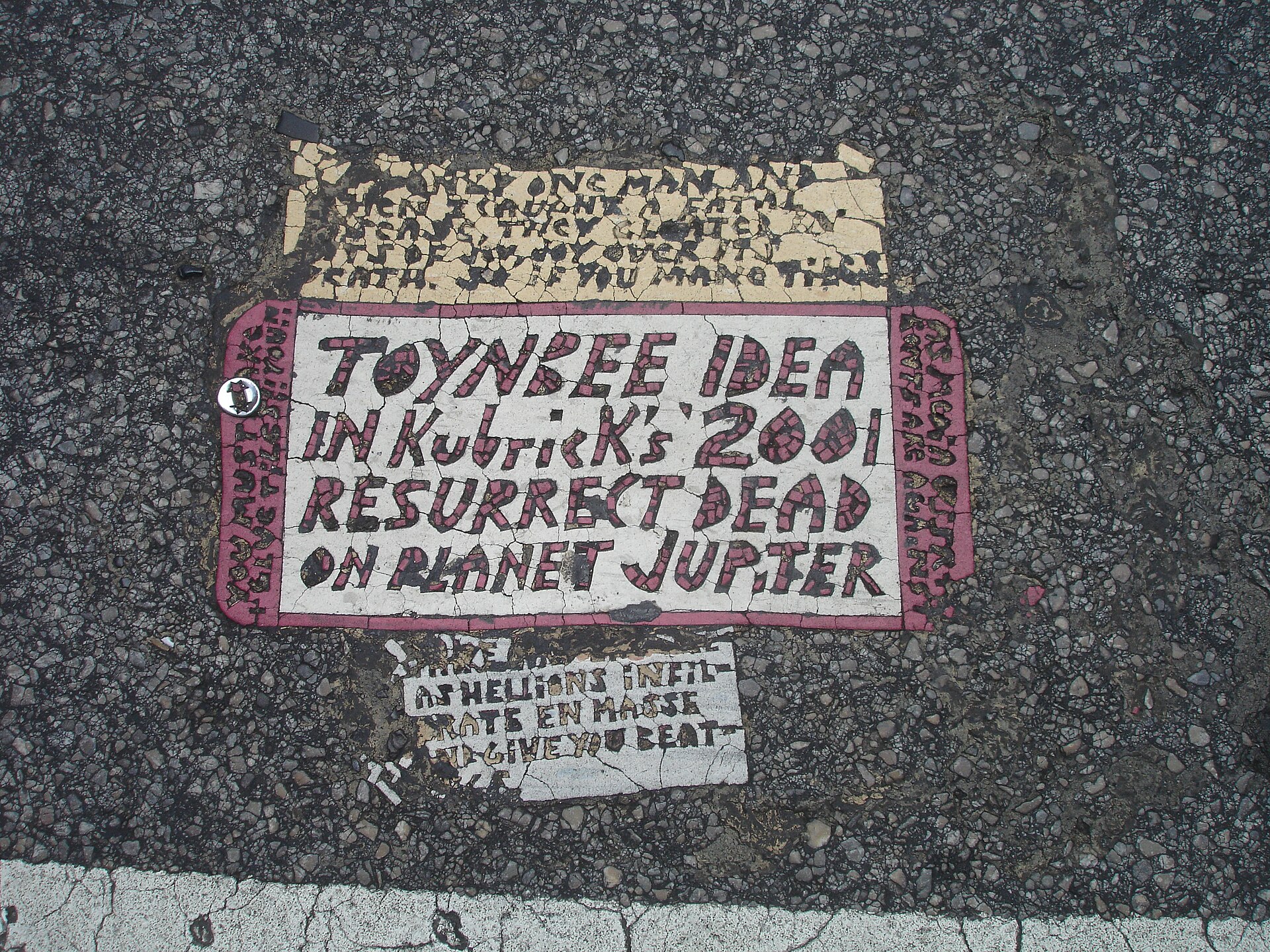
Photo: Wikimedia Commons, CC BY-SA
A Message in the Asphalt
The Toynbee Tiles are usually flat plates ranging from about the size of a palm to that of a license plate. Made of linoleum or roofing felt, they sit embedded in the middle of busy city intersections — and it matters that this is the roadway, not the sidewalk, the very asphalt that car tires pass directly over. Faded by weather and wear, their edges blurred, the tiles nonetheless carry a message that is remarkably consistent. The standard text reads: "TOYNBEE IDEA / IN MOVIE '2001 / RESURRECT DEAD / ON PLANET JUPITER."
Pull the phrase apart and you find hints of where it might come from. "Toynbee" is generally read as a reference to Arnold Toynbee, the twentieth-century British historian; "movie 2001" as Stanley Kubrick's science-fiction classic 2001: A Space Odyssey. Woven together, the two are taken to express a strange, apocalyptic conviction: that the human dead could be physically resurrected on the planet Jupiter. Yet even this reading is not settled. The one thing that is certain is this — that someone, over the course of decades, has been obstinately pressing the same message into the roads of our cities.
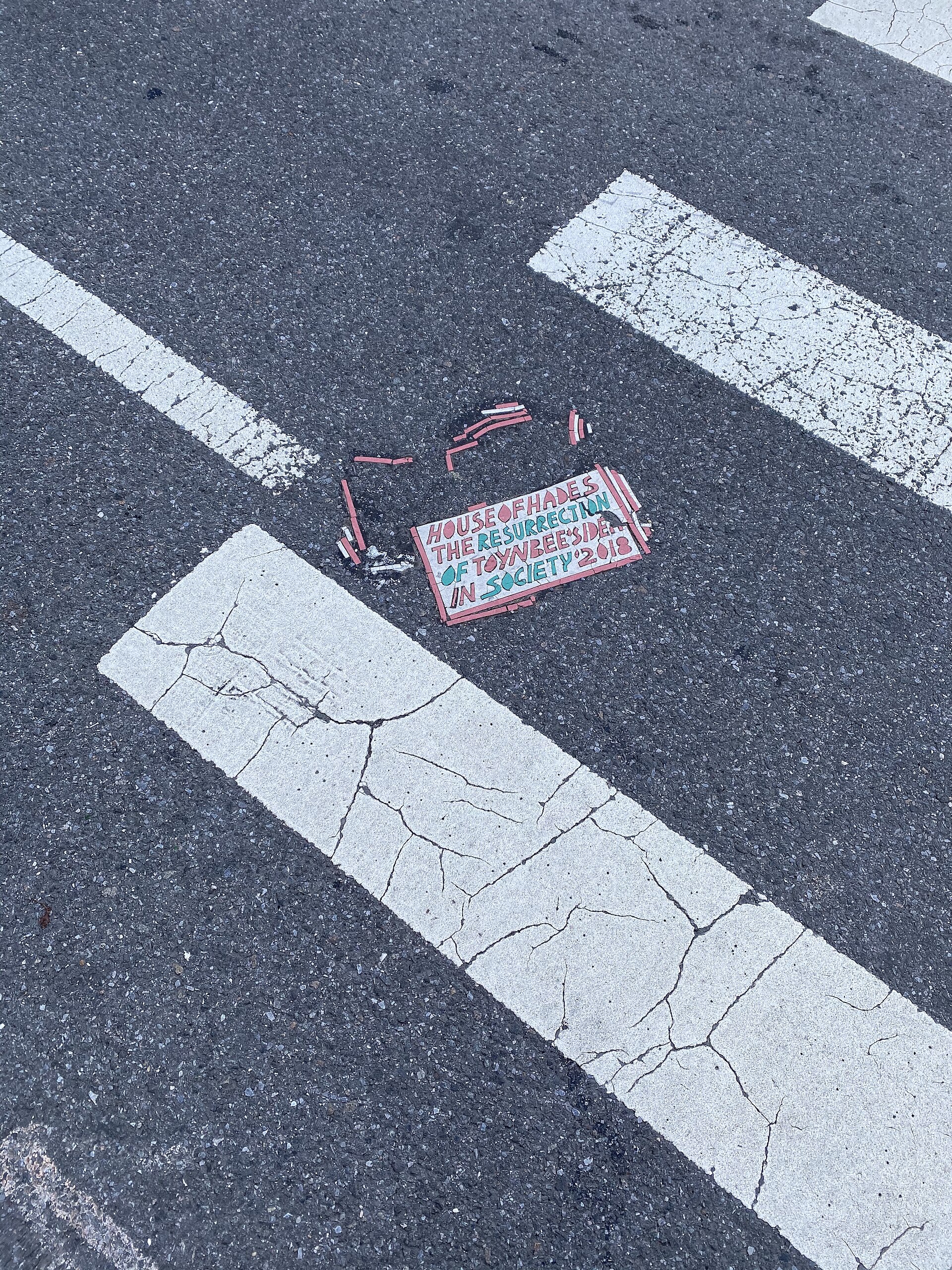
Photo: Wikimedia Commons, CC BY-SA
Philadelphia, the Epicenter
The tiles are found in greatest concentration in Philadelphia, Pennsylvania. They appeared densely across many of the city's intersections, and for that reason Philadelphia has long been regarded as the epicenter of the phenomenon. From there the tiles spread to numerous cities across the eastern and midwestern United States — New York, Pittsburgh, Baltimore, Washington D.C., Cincinnati, and more. The number of documented tiles has climbed steadily over the years, and those confirmed so far run into the hundreds.
But the phenomenon did not stay within the United States. Astonishingly, tiles of the very same type turned up in several South American cities as well — São Paulo and Rio de Janeiro in Brazil, Buenos Aires in Argentina, Santiago in Chile. Whether the person who laid the American tiles crossed to South America to plant them himself, or whether they are the work of an imitator, has never been established. But the fact that the same message is embedded in the roads of two continents separated by an ocean only made the mystery larger and stranger still.
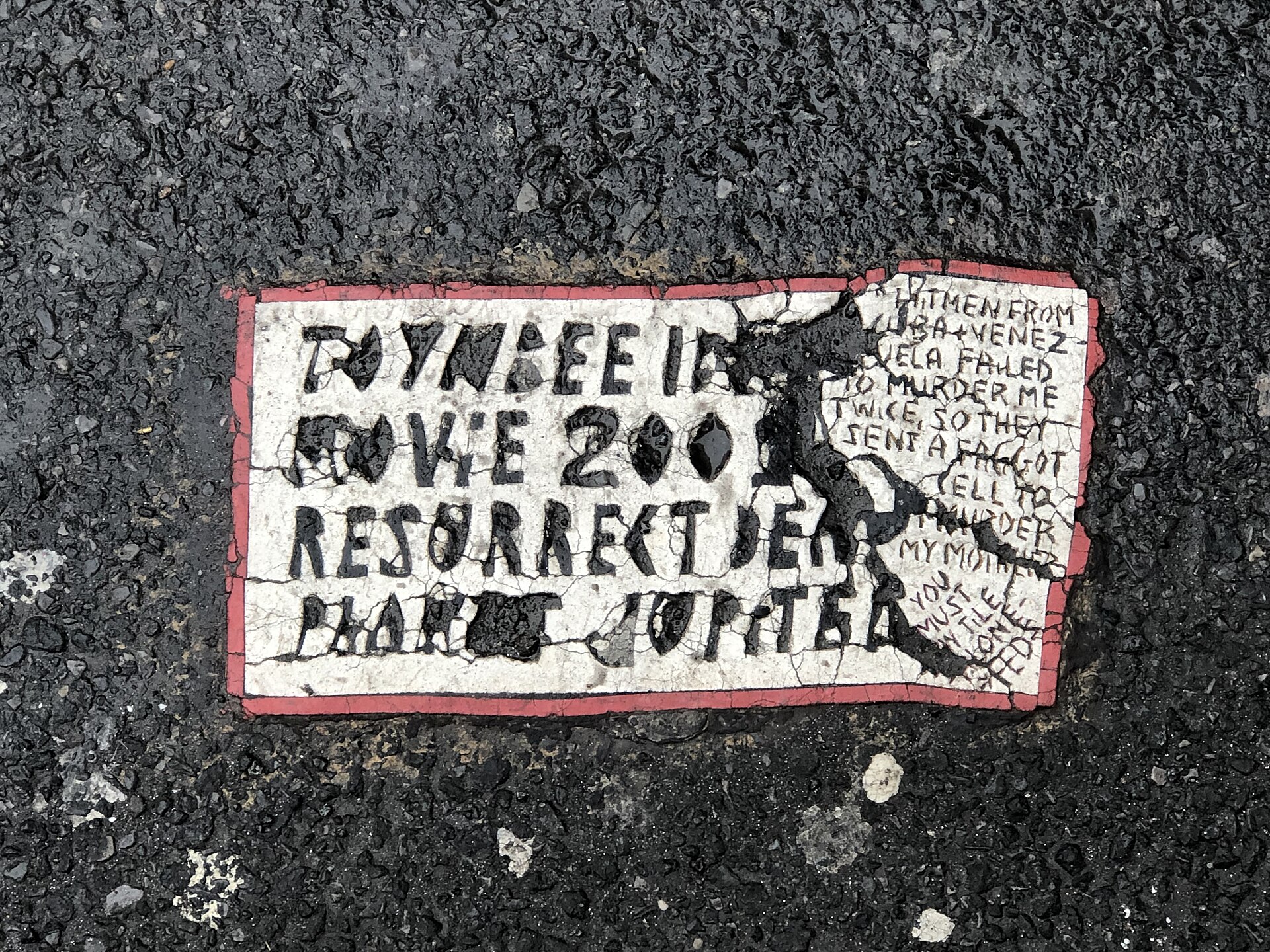
Photo: Wikimedia Commons, CC BY-SA
The 'House of Hades'
The standard text was not all there was. Some tiles carried far longer, more frantic side texts crammed into their margins, ringing the main message. These marginal texts, in a rambling and agitated tone, poured out accusations against the press, the government, and certain named individuals. Mixed in were paranoid pleas that the writer's ideas were being systematically obstructed and suppressed, along with fragmentary lines that seemed to point a finger at the forces behind it all.
One phrase that recurred especially often in these side texts was "House of Hades." In Greek myth, Hades is the god who rules the realm of the dead; the "House of Hades," then, stands for the domain of the dead. Set against the main text's theme of resurrecting the dead on Jupiter, the phrase suggests that in the tile-maker's worldview, some idea of life, death, and the crossing of the boundary between them stood at the very center. Passionate yet never quite decipherable, these marginal texts turned each tile into a window onto the mind of a single person.
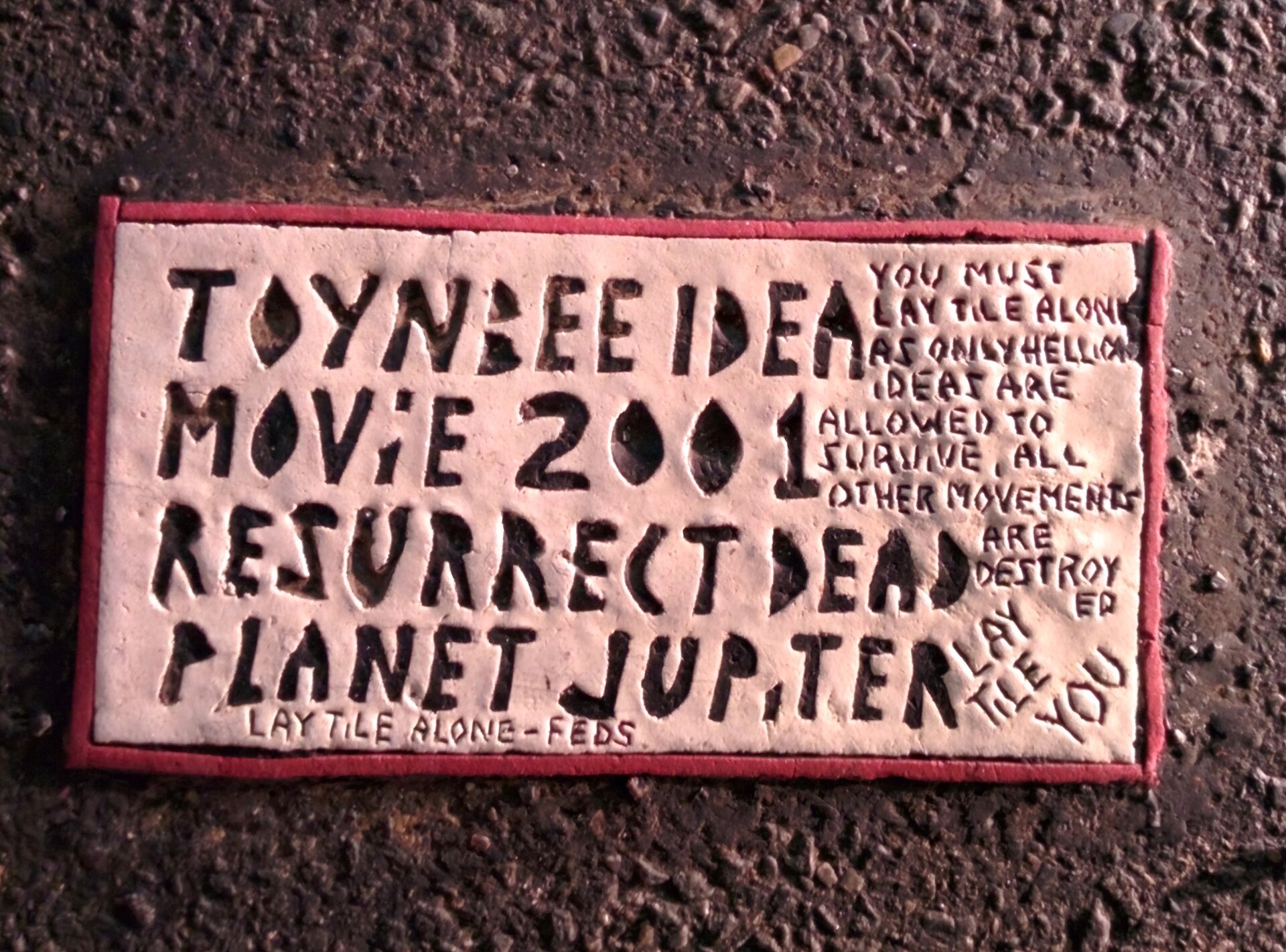
Photo: Wikimedia Commons, CC BY-SA
How Were They Embedded — The Technique of Pressing Into Asphalt
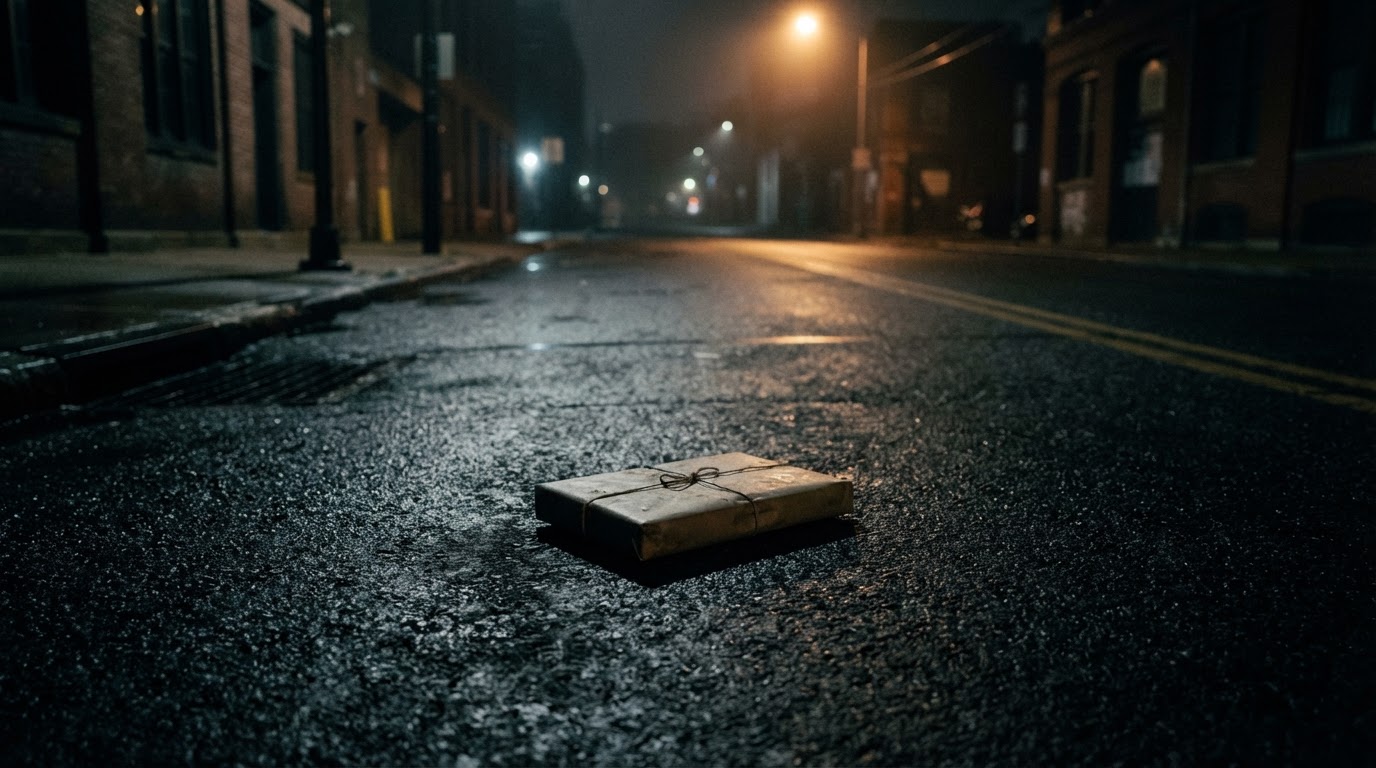
The most practical question in this mystery is this: how, in the middle of a lane where cars never stop, could anyone embed a tile so seamlessly? After long observation and reasoning, the method now most widely accepted runs as follows. First, the maker cuts the lettered plate from linoleum, lays asphalt adhesive (such as tar paper) over it, then covers the whole with paper or aluminum foil to form a single bundle. This bundle is set gently onto the road at night or during quiet hours, left for the tires of passing cars to press down with their weight.
As time passes, the summer sun, the heat of passing vehicles, and the pressure work together to soften the asphalt, and the tile slowly sinks into the road surface and bonds with it. Finally, when the paper layer on top wears away and falls off, the tile hidden beneath is revealed, fused flush with the roadway. In other words, the person who laid the tile did not even need to linger at the spot. The city's cars and its sun completed his message in the asphalt without ever knowing they had done so.
The Documentary 'Resurrect Dead' and the Severino Verna Hypothesis
There were those who set out to track down the tile-maker, anonymous for decades. Their work bore fruit in the 2011 documentary Resurrect Dead: The Mystery of the Toynbee Tiles. Following several Philadelphia enthusiasts as they gathered and chased down clues over many years, the film eventually settles on one figure as its leading candidate: a reclusive Philadelphia man named Severino Verna.
By the filmmakers' reasoning, Verna is thought to have cut a hole in the floor of his own car so that, without ever stopping, he could drop the tile bundle onto the road while seated at the wheel. That way he could plant a tile without stepping out of the vehicle and without being seen. The circumstances and the various clues seemed to point to him. But here is the decisive part: Verna himself never confirmed any of it. He remained a recluse, refusing all contact with the press and investigators, and his identity as the tile-maker survives to this day only as a hypothesis. Even the strongest name the documentary managed to surface never crossed the threshold of proof.

Tiles Still Appearing, and the Mystery That Remains
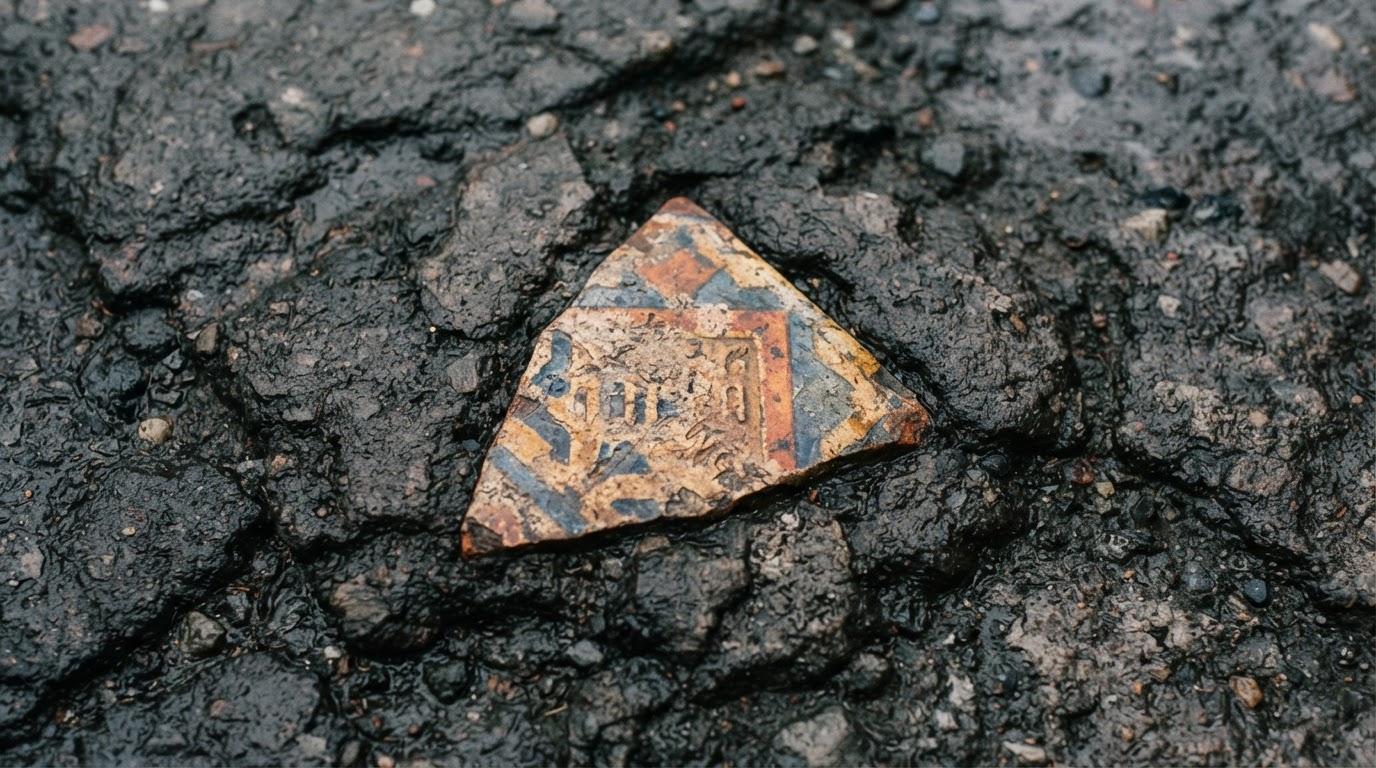
And here is the detail that makes the whole story colder still. Even after a leading candidate was named and a documentary was made, the Toynbee Tiles did not stop. As the original tiles vanished one by one to the years and to road repairs, new tiles — or "copycat tiles" imitating the originals — kept appearing on city streets. Whether the original maker is still at work, whether someone moved by his conviction took up the task, or whether the urban legend itself is simply breeding and spreading, no one can say.
A single worn tile sitting quietly in the asphalt of an empty intersection at dawn.
What we can say for certain today is only this. One day some forty years ago, someone began embedding linoleum tiles into the roads of cities across the United States and South America. The tiles bore an apocalyptic message about resurrecting the dead on Jupiter, and some came ringed with agitated side texts speaking of the House of Hades. The technique of laying them, and the name of a leading suspect, have been narrowed down to a degree — yet who that person truly was, and what he really believed, was never confirmed. Perhaps at this very moment, on the asphalt of some city intersection, a new tile is being quietly completed under the sun and the weight of passing cars. The message left by a ghost of the streets is still being pressed into the ground beneath our feet.
The entry I find hardest to leave is not the tiles but the silence around Severino Verna. The documentary named him, the reasoning was published, the hole in the car floor became the accepted method — and he answered none of it. No denial, no admission, no correspondence. I have gone looking for a statement from him more than once, always finding the same nothing. A man accused of spending decades pressing a message into the ground, who would not put a single word on the record. The side texts on those tiles rage at length about being suppressed and unheard. Whoever wrote them was not in the habit of staying quiet.
---
This article uses both real archival and on-location photographs and AI-generated images created to convey the mood of the story.


Comments
No comments yet — leave the first one.