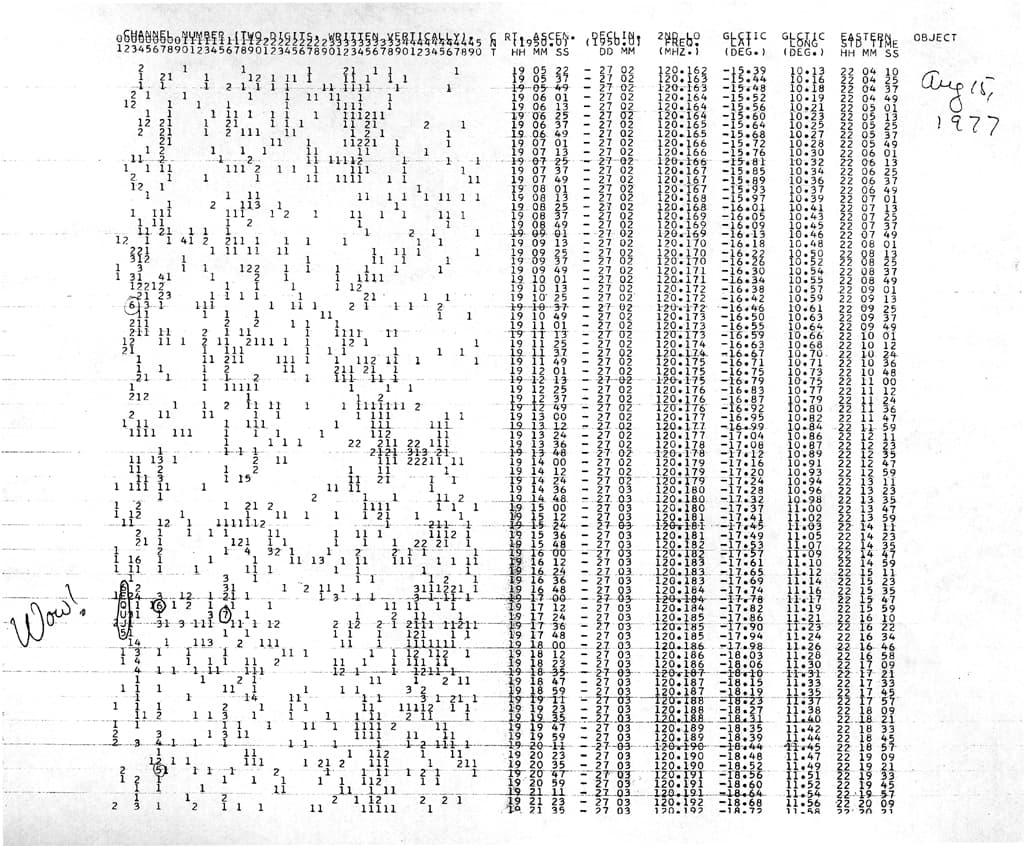
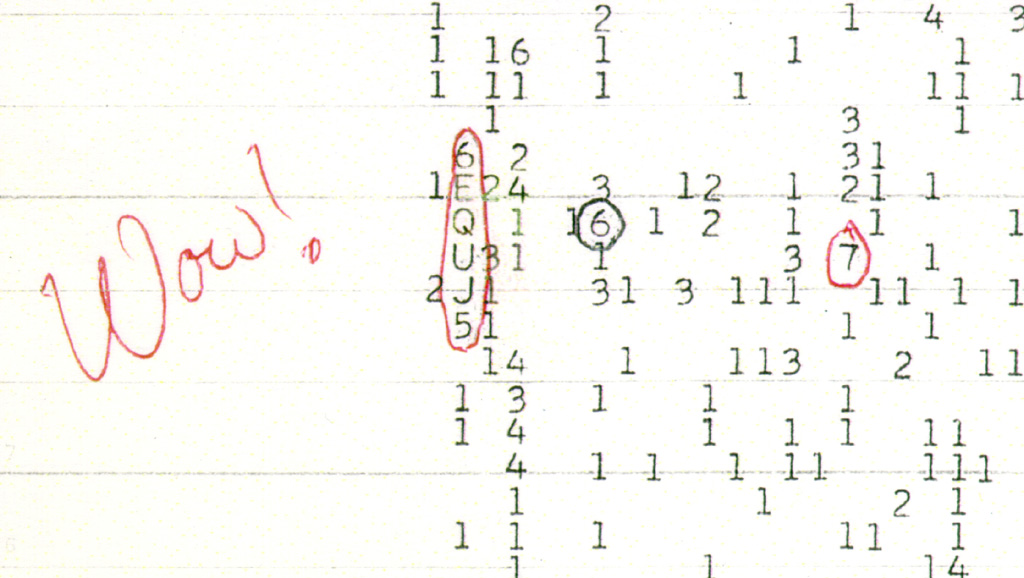
On the night of August 15, 1977, a radio telescope in Ohio was doing what it did every night — listening. It had no dish that could be pointed by hand; it simply lay open to the sky and let the turning of the Earth sweep the heavens slowly across its field of view. A few days later, an astronomer named Jerry Ehman sat down with a stack of computer printouts to check what the machine had recorded. Line after line of near-empty numbers scrolled past his eyes, the ordinary hiss of an empty universe. And then, in the middle of one column, a run of characters leapt out: 6EQUJ5. A signal so strong, so clean, and so unlike anything the telescope normally caught that Ehman took a red pen, drew a circle around it, and wrote a single word in the margin: Wow! For 72 seconds, something from the direction of the constellation Sagittarius had spoken. And in nearly half a century of listening since, it has never spoken again. This is the story of the Wow! signal — the one signal from the sky that we heard exactly once.
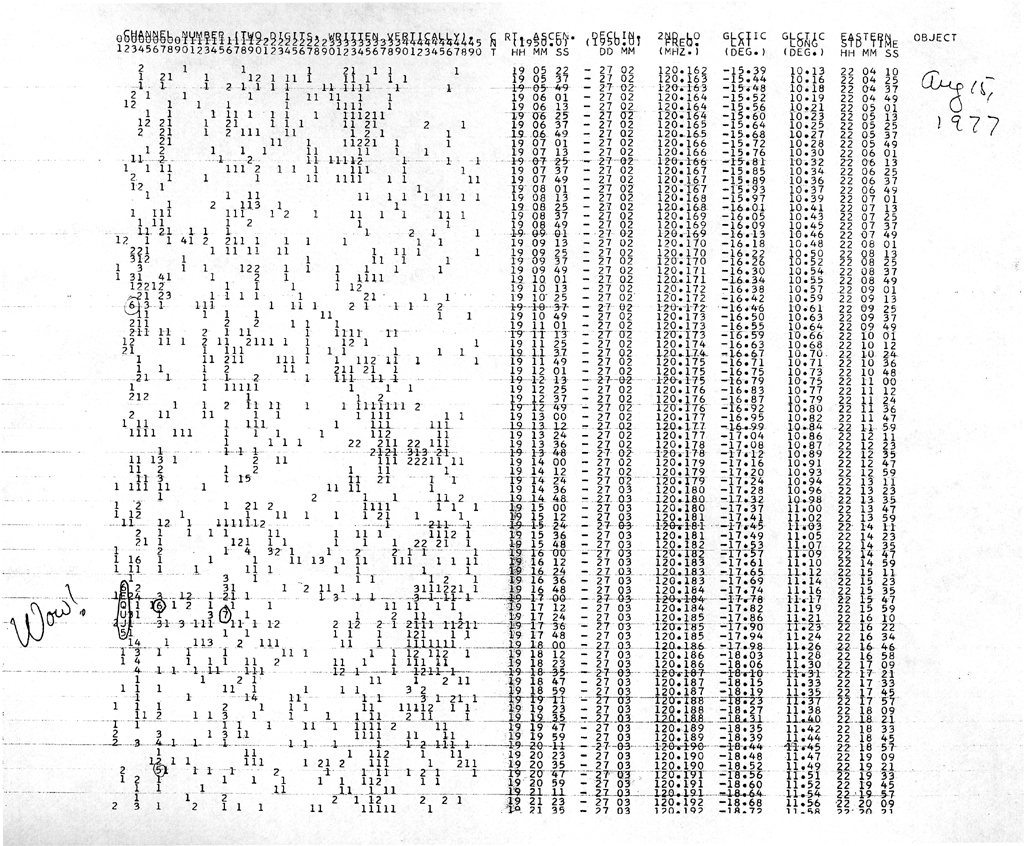
Six characters is not much to keep a file on. When I first pulled the scanned printout, I assumed I would read around it — the follow-up surveys, the rebuttals, the usual accumulation — and that the page itself would be a formality. Instead I kept enlarging it. Not the red circle, which everyone reproduces, but the columns above and below it: line after line of ordinary noise, the same flat numbers running on for pages before and after, entirely unbothered. Whatever happened that night happened inside a record that otherwise shows nothing at all.
The Telescope That Could Not Look Twice
The instrument that caught the signal was called Big Ear, a radio telescope operated by Ohio State University. It did not look like the great steerable dishes most people picture. It was an enormous flat structure the size of several football fields, lying across the ground with a pair of tilted reflectors, and it could be adjusted only for height above the horizon — not swung left or right. To scan the sky, it relied entirely on the rotation of the Earth to carry each point across its view.
This design had one crucial consequence. Because the sky drifted past at a fixed rate, any single point in space stayed inside the telescope's sensitive beam for only about 72 seconds. A source would rise gradually into the beam, reach a peak as it passed through the center, and fade out the other side over roughly a minute. That is why the Wow! signal lasted exactly as long as it did — 72 seconds is not the length of some alien broadcast, but the length of time it took the Earth's turning to sweep the source across the telescope's ear. And it is also why the moment could never simply be replayed: by the time anyone realized what had happened, the sky had already carried that patch of space away.

What 6EQUJ5 Actually Means
To anyone seeing it for the first time, 6EQUJ5 looks like a coded word — and over the years it has been mistaken for exactly that, as if the aliens had signed their message. In truth it is nothing of the sort. It is simply the way Big Ear's computer recorded how loud the signal was, moment by moment, as it drifted through the beam.
The telescope measured signal strength on a compact scale. An intensity between 1 and 9 was printed as the matching digit; anything of 10 or more was printed as a letter — A for the 10s, B for the 11s, and so on up the alphabet. So the sequence 6EQUJ5 is really a graph drawn in characters: the signal rose from 6, climbed through E, Q, and U, then fell back through 5. The letter U at the peak stands for an intensity of around 30 — roughly thirty times the normal background noise, the strongest reading Big Ear ever recorded in its years of operation. Written out, those six characters trace the perfect rise-and-fall curve you would expect from a fixed point in space being carried through the beam by the turning Earth. It behaved, in other words, exactly as a genuine signal from the cosmos should.
The Frequency That Made Scientists Hold Their Breath
What turned a strong signal into a genuinely haunting one was where on the radio dial it sat. The Wow! signal came in almost exactly at 1420 MHz — a frequency scientists call the hydrogen line, because it is the natural note emitted by hydrogen, the most abundant element in the entire universe.
That number carries a special weight in the search for alien life. As far back as 1959, two physicists had argued that if a distant civilization ever wanted to be heard across the galaxy, this is precisely the frequency they would choose — a natural landmark on the radio spectrum that any technological species, anywhere, would know about and could tune to. The hydrogen line is quiet, protected by international agreement from earthly transmitters, and universal. So when a narrow, powerful signal arrived sitting right on that cosmic beacon frequency, from the direction of the dense star fields of Sagittarius near the center of our galaxy, it was hard not to feel that the universe had done something it was not supposed to do. It had knocked on exactly the door humanity had been listening at.
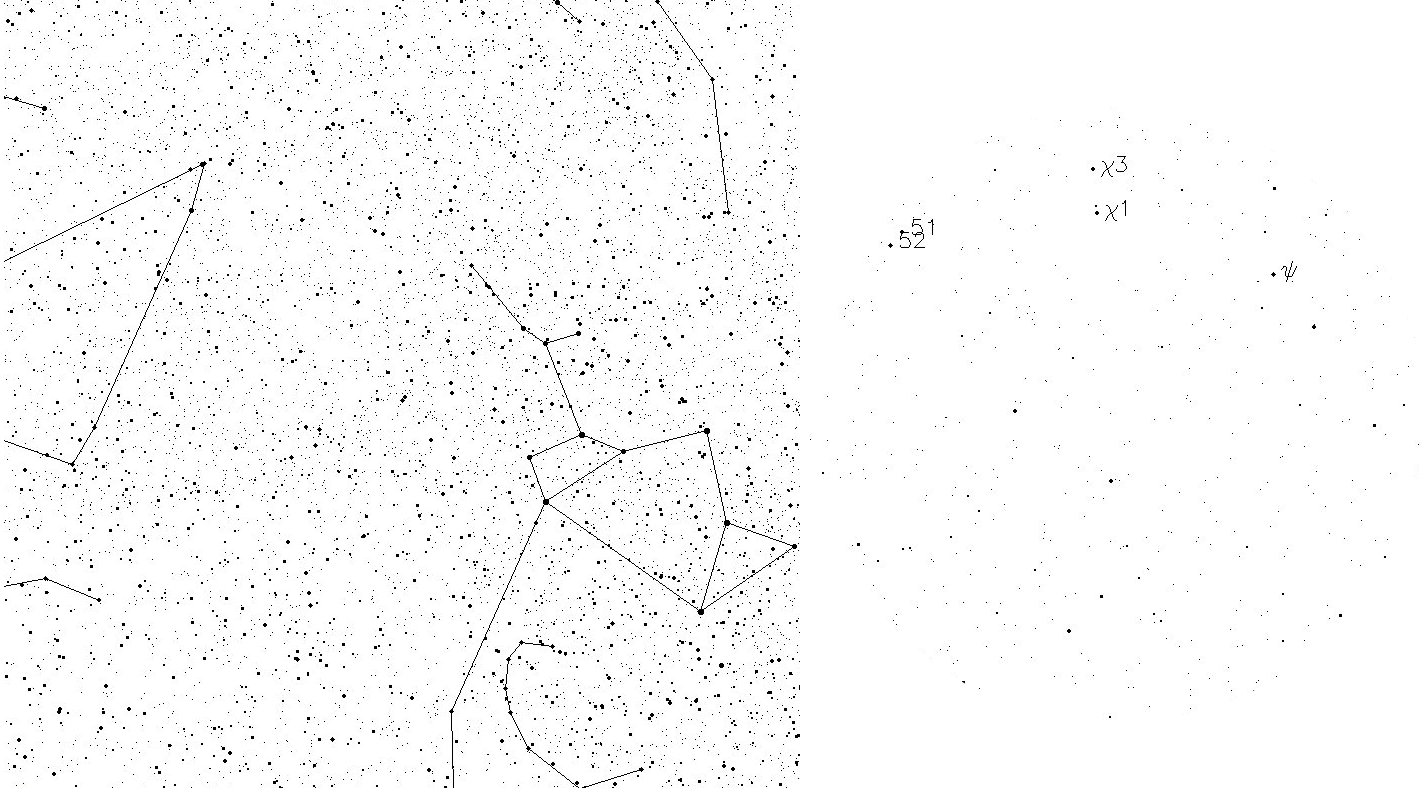
Photo: Wikimedia Commons, CC BY-SA 3.0
The Two Ears — and the Doubt They Left Behind
For all its strangeness, the Wow! signal also carried a built-in uncertainty that has frustrated researchers ever since. Big Ear listened through two feed horns, two slightly separated "ears" pointed at marginally different patches of sky. A real astronomical source, drifting past, should have passed through both horns in turn, showing up twice a few minutes apart.
The Wow! signal appeared in only one. It registered a single powerful sweep and nothing in the companion beam. Worse, the way the data was recorded made it impossible to tell afterward which of the two horns had actually caught it — which left astronomers with two slightly different possible positions in the sky and no way to choose between them. That single detection is the heart of the mystery. A source that appeared in one ear but not the other, at a precise spot that can only be narrowed to two candidates, gives us just enough to know something extraordinary happened, and never quite enough to say what.
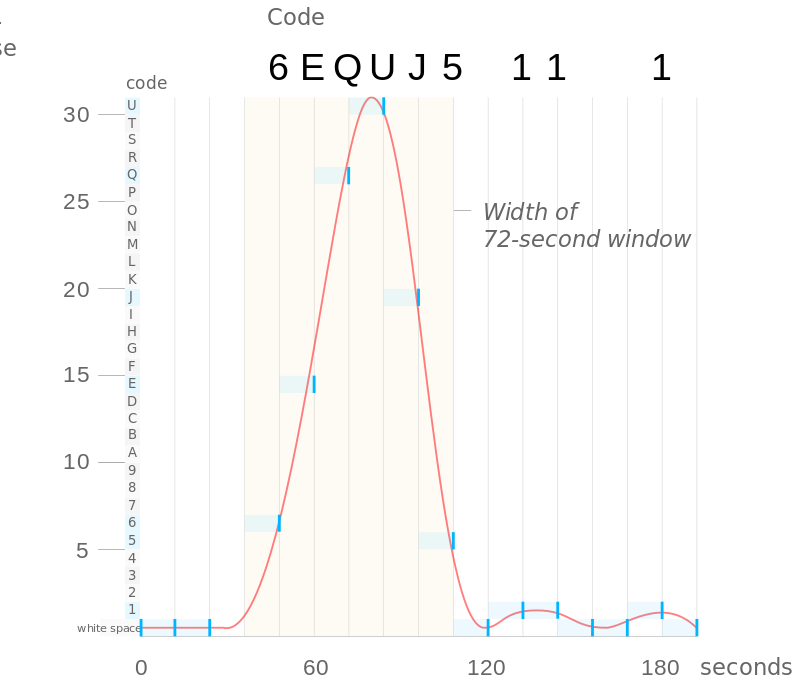
Photo: Wikimedia Commons, CC BY-SA 4.0
The Astronomer's Own Caution
It would be easy to turn Jerry Ehman into a man convinced he had found aliens. He was, in fact, the opposite — the most careful skeptic of his own discovery. Over the years he stressed that a single, unrepeated event proves nothing on its own, and at one point he leaned toward an ordinary explanation, suggesting the signal might have been an Earth-based transmission that had bounced off a piece of space debris and been caught at just the wrong angle.
But he did not stop there. When others examined that reflection idea closely, it ran into trouble of its own: to produce the clean, hydrogen-line, single-beam signal that Big Ear recorded, any orbiting reflector would have needed a nearly impossible set of properties. In light of that, Ehman softened his own skepticism, unwilling to force the data into an explanation it did not fit. His final position was the honest one, and perhaps the most unsettling — he refused to draw a grand conclusion from a single event, while admitting that the easy, down-to-earth answers did not hold up either. The signal simply sat there, resisting every box anyone tried to put it in.
Half a Century of Silence
If the signal were truly a beacon, it should have been possible to catch it again — and astronomers tried, hard. Ehman himself went back over the sky in the following months and found nothing. In the decades since, others returned to the same patch of Sagittarius with far more powerful instruments: dedicated searches with the META array in the late 1980s, long observing runs with the Very Large Array in the mid-1990s, extended watches from an observatory in Tasmania at the close of the century, and, much more recently, a coordinated modern search that combed the region for any technological signature. Every one of them came back empty. Whatever spoke that night has stayed silent through every attempt to make it speak again.
That silence is the deepest part of the puzzle. A natural, steady cosmic source — a pulsar, a galaxy, a star — should keep shining and be found again on the next pass. A one-time flash that never repeats is exactly what a natural explanation struggles most to account for. And so the very thing that makes the Wow! signal feel like a message — that it came once, sharply, and then vanished — is also the thing that makes it impossible to solve.
The Comet That Was Supposed to Explain It
In 2017, an answer finally seemed to arrive. An astronomer named Antonio Paris proposed that the culprit had been a comet — that a cloud of hydrogen gas surrounding one of two comets happening to pass through that part of the sky had produced the signal, and that its absence ever since was simply because the comet had moved on. For a moment, the story felt closed.
It did not survive scrutiny. Careful checks showed that the comets in question were not actually in the telescope's beam at the right time, undercutting the whole idea. Beyond that, comets are not known to broadcast strongly at the frequencies involved, and — perhaps most damning — a comet drifting through the sky offers no reason why the signal would appear in one of Big Ear's two horns and not the other. The comet hypothesis, tidy as it sounded, was widely rejected by other researchers. The door that had briefly seemed shut swung open again.
A Star With Our Sun's Face
The most recent thread in the story points not to an explanation but to a direction. In 2020, an amateur astronomer named Alberto Caballero went hunting through the catalogue of the Gaia space observatory for stars sitting inside the region the Wow! signal had come from. He was looking specifically for stars like our own Sun — the kind of place, he reasoned, where life might plausibly arise. Out of dozens of candidates, one stood out: a star catalogued as 2MASS 19281982-2640123, some 1,800 light-years away, and an almost exact twin of the Sun in temperature, size, and brightness.
It is important to be clear about what this is and is not. Caballero did not find a signal there, or any sign of life; he simply identified the most Sun-like star lying in the right patch of sky, a sensible place to point future telescopes. And when researchers later turned modern instruments toward that very star, they detected nothing — effectively ruling it out as the source. The Sun's distant twin, for all its poetic pull, gave back the same answer as everything else aimed at that corner of Sagittarius: silence.
The One Word That Remains
Nearly fifty years on, everything we can say for certain about the Wow! signal still fits in a few sentences. On a summer night in 1977, an Ohio radio telescope recorded a narrow, powerful signal from the direction of Sagittarius, sitting almost exactly on the frequency that scientists had long imagined an alien civilization would use. It lasted 72 seconds — the exact time it took the Earth's rotation to carry the source across the telescope's beam. It appeared in one ear and not the other. It has never been detected again, despite half a century of searching. And no natural explanation offered so far — reflected debris, a passing comet — has managed to hold together.
The detail that keeps this one open in my working files is the two horns. Every other loose end here has been chased down by someone with better instruments than the ones available in 1977 — the comet, the debris, the Sun's twin at 1,800 light-years, all of it examined and returned empty. But the recording method destroyed the one thing that would matter most, which horn heard it, and no future telescope can recover that. There are two possible places in Sagittarius, and the archive will never narrow it to one. I have learned to sit with unsolved cases. I find it harder to sit with a case where the answer existed for a few days in 1977 and was simply not written down.
We do not know what it was. It may have been some rare, fleeting natural event we simply do not yet understand. It may have been an accident of technology and reflection that lined up just once. Or it may have been exactly what it looked like on that printout — a signal, sent on purpose, to the one frequency we were listening on, arriving once and never again. The universe knocked once, at the right door, in the right way, and then fell silent. And all we have to answer it with is the single word an astronomer wrote in red ink in the margin, nearly fifty years ago. Wow!
---
This article uses both actual documentary and on-location photographs and AI-generated images and video produced to convey the mood of the story.




Comments
No comments yet — leave the first one.