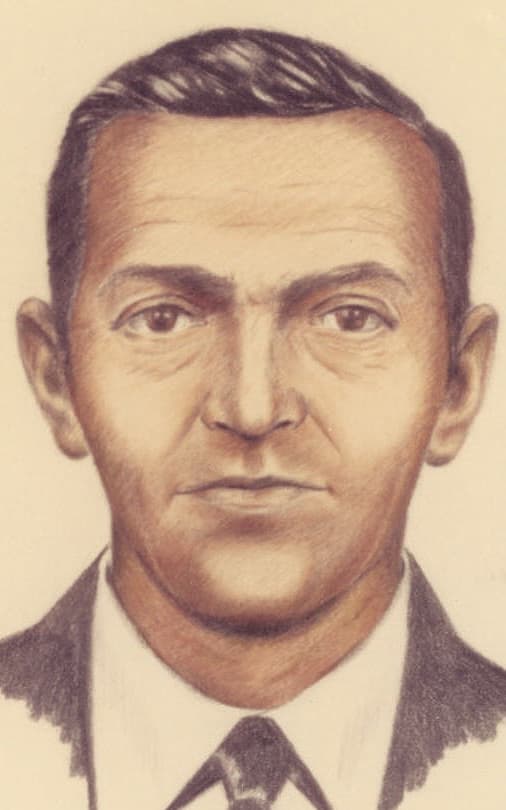
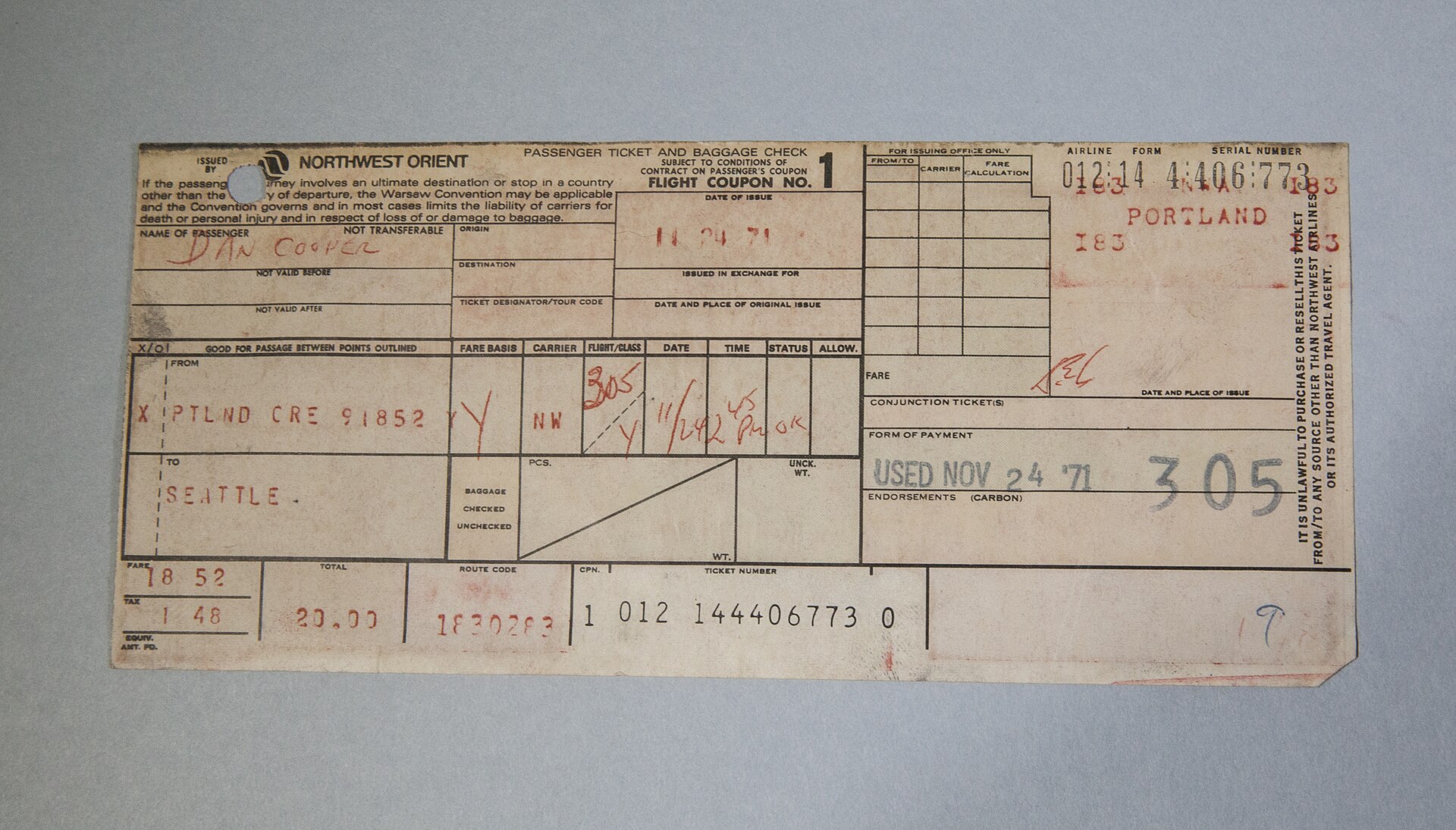
On the afternoon of November 24, 1971 — the day before Thanksgiving — Northwest Orient Airlines Flight 305 lifted off from Portland, Oregon, bound for Seattle. On the passenger list was a man who had booked his ticket under the name "Dan Cooper." He looked to be in his late thirties or early forties, an unremarkable gentleman in a dark suit and tie. Not long after takeoff, he handed a note to one of the flight attendants. It said there was a bomb in his briefcase. His demands were two: $200,000 in cash and four parachutes. After landing at Seattle and collecting what he had asked for, he released every passenger, ordered the plane back into the air, lowered its aft stairway in flight, and jumped out into the black night sky. And then he vanished for good. More than half a century later, we still do not know who this man was, or whether he even survived the fall that night. This is the story of "D.B. Cooper," the only air piracy in US history that was never solved.
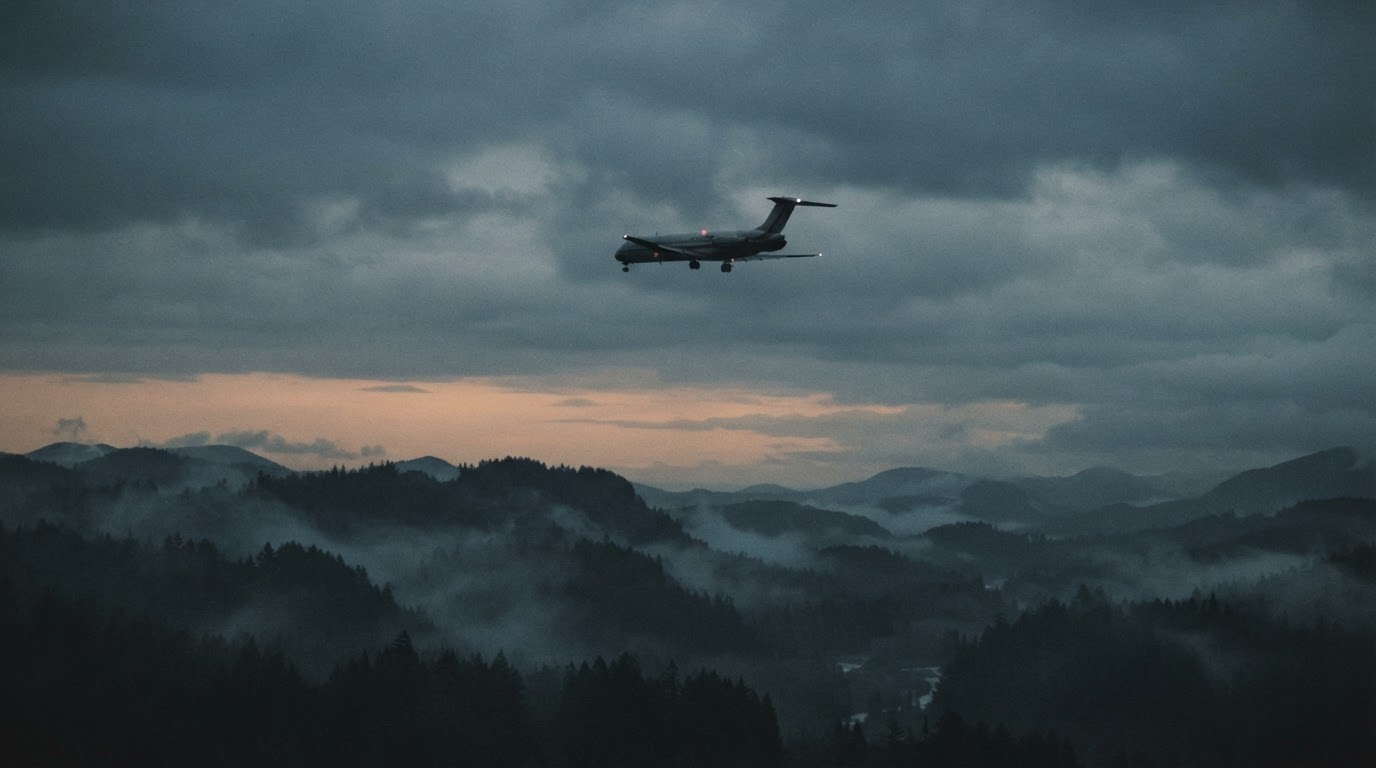
It Began with a Note
Thirty-six passengers boarded Flight 305 that day. One of them was the man who had bought his ticket under the name "Dan Cooper." He sat alone in a rear seat, wearing sunglasses, and ordered a bourbon and soda. To all appearances he was an utterly ordinary, quiet business traveler. Shortly after takeoff, he slipped a folded note to a flight attendant as she passed. At first she assumed it was the usual sort of note a lonely man hands a stewardess, and dropped it unread into her handbag.
Most of what I hold on this case is paper about paper — serial number lists, transcripts, four decades of correspondence from people certain they had solved it. What stopped me, the first time I worked through the flight attendants' statements properly, was the bourbon and soda. He paid for it. He was carrying a briefcase he intended to present as a bomb, and he settled his drink tab like a man who did not want to be remembered for anything. That is the detail I cannot get past, because it is the only one in the file that suggests he had thought about the days after.
Then the man said quietly, "Miss, you'd better look at that note. I have a bomb." The note told her he was hijacking the plane, along with his demands. He opened his briefcase just enough to reveal a red cylinder and what looked like a tangle of wires. There was no way to know whether it was truly a bomb. What he wanted was $200,000 — an enormous sum at the time — and four parachutes, two front and two back, plus a full tank of fuel the moment they landed in Seattle. Behind the face of a quiet gentleman, he held an entire airliner and everyone aboard it in his hands.
$200,000 and Four Parachutes
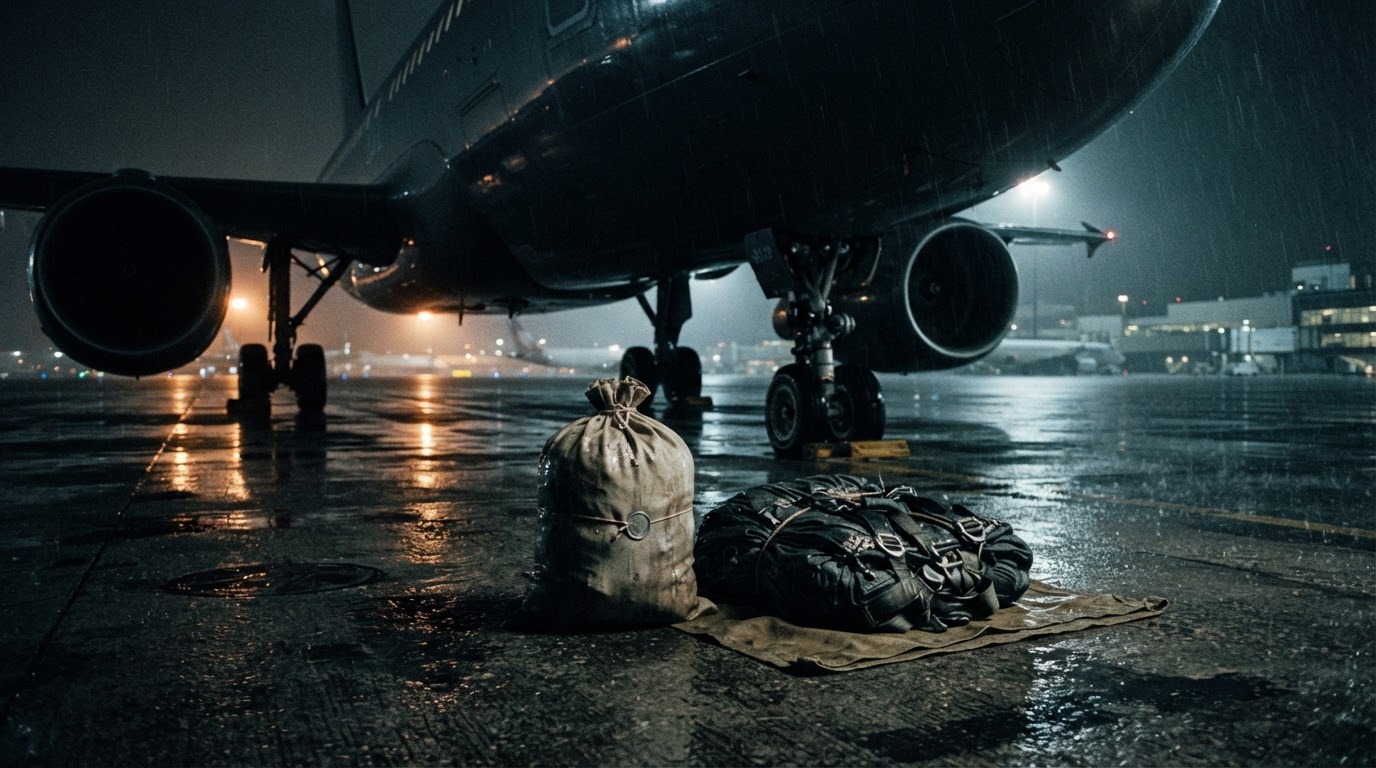
While the plane circled over Seattle, a tense negotiation unfolded on the ground. The airline decided to meet his demands. The $200,000 was assembled entirely in twenty-dollar bills — a heavy stack running to ten thousand notes. The serial numbers of every bill were recorded, and years later that record would resurface as the one thread the case had to pull.
Sometime after half past five in the afternoon, Flight 305 touched down at Seattle-Tacoma International Airport. As promised, the man released all thirty-six passengers and some of the flight attendants. A sack of cash and four parachutes were handed aboard. Analysts later reasoned that he asked for four parachutes precisely so the authorities would believe he might force a hostage to jump with him — which meant they could not risk handing him a sabotaged chute. In the end, keeping only the pilots and a few crew, he ordered the plane back into the sky. The stated destination was Mexico. But he may never have intended to go anywhere near it.
The Jump into the Night
Here the man issued strikingly specific instructions. He ordered the plane to fly low and slow, with the aft airstair lowered. The Boeing 727 he had chosen carried, at its rear, a set of built-in stairs that passengers could use to board from the ground — and that stairway could be opened in flight. Of every airliner then flying, he had singled out the one whose design offered exactly this escape. In other words, he knew the aircraft intimately.
Around eight o'clock that night, as Flight 305 crossed the black skies over southwest Washington, a warning light flashed on the cockpit panel: the aft stairway had opened. The airframe pitched upward for an instant. The pilots asked over the intercom whether he needed anything; no answer came back from the rear. The man had already strapped the cash to his body and leapt into a freezing, rain-lashed night, into a wind tearing past at hundreds of kilometers an hour, hanging beneath a parachute. When the plane landed at Reno and the crew checked the back, all that remained in the cabin was the seat he had occupied and the tie he had left knotted around nothing. The man had disappeared completely into the darkness of that night.
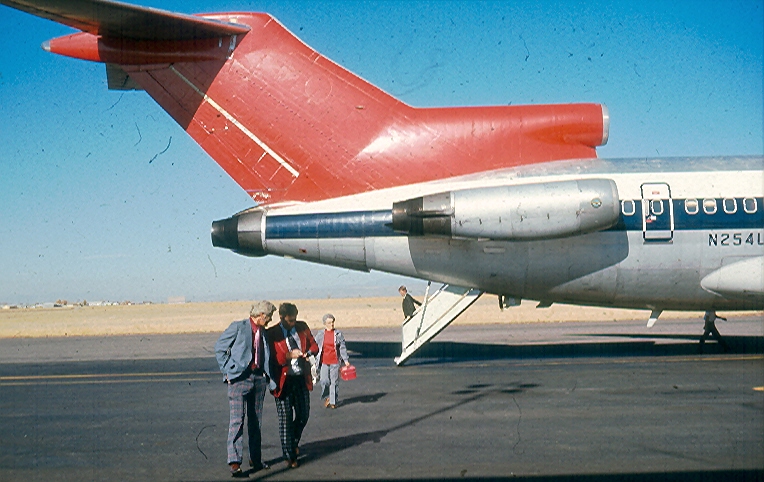
Photo: Wikimedia Commons, CC BY 2.5
From "Dan Cooper" to "D.B. Cooper"
In the immediate aftermath, as the press descended, the man was saddled with the wrong name. The name he had written on his ticket was, unmistakably, "Dan Cooper." But early in the investigation, a man with a similar name was questioned as a possible suspect, and in the reporting of that news the press garbled the names together and called him "D.B. Cooper." The man who had been questioned was quickly cleared and had nothing to do with the case — yet the name "D.B. Cooper," once attached, stuck fast. The alias the world came to know was born, in truth, from a simple mistake that had nothing to do with the man himself.
The FBI launched a sweeping investigation at once. The case was given the name "NORJAK" — short for Northwest Hijacking. From the accounts of the flight attendants and passengers, a composite sketch was drawn, and the face of a middle-aged man in a dark suit and tie was circulated across the country. The tie and tie clip he left behind, cigarette butts, and fingerprints from the seats he had touched were all collected as evidence. Yet for all these clues, the investigation never managed to pin down a single credible individual. He had left behind no real information about himself at all.
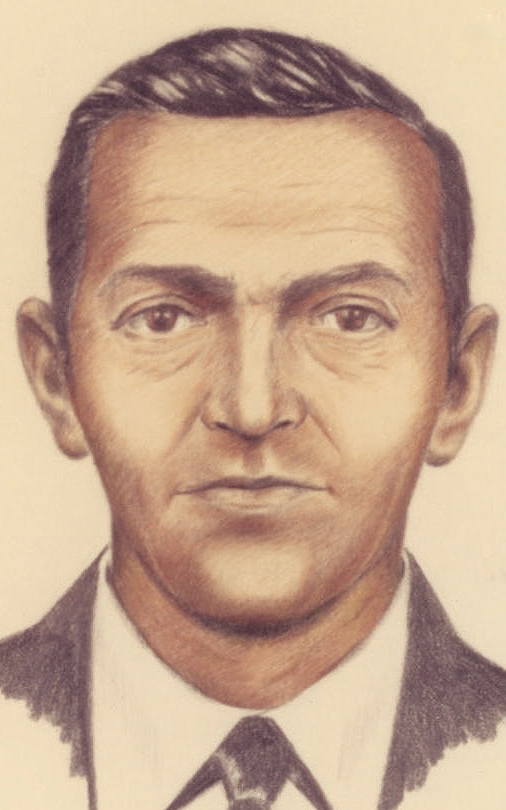
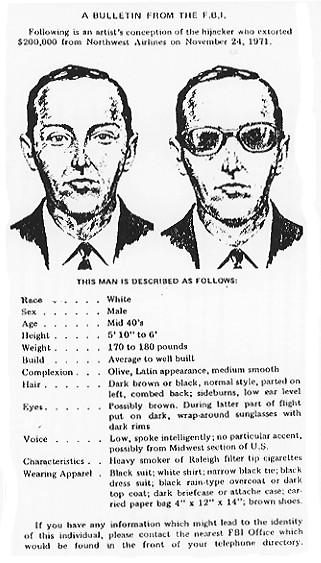
1980: The Bills Found on the Riverbank
Years passed with the investigation stalled, and then, in February 1980, an unexpected thread emerged. On a sandbar called Tena Bar along the Columbia River in Washington State, an eight-year-old boy on a family outing dug up a decaying bundle of banknotes in the sand. The mildewed, disintegrating stack of twenty-dollar bills came to about $5,800 — and when the serial numbers were checked, they matched, exactly, part of the ransom Cooper had carried away.
Nine years after the crime, it was the first piece of physical evidence proving the man had truly existed at all. But the find raised more questions than it answered. Why was only this small fraction of the ransom buried, and there of all places? The sandbar lay a considerable distance from the point where the man was thought to have jumped, and several details did not fit with the idea that the bills had simply drifted there down the river. Beyond this $5,800, not one of the remaining $194,000 or so ever surfaced again. There was no trace of it in circulation, no record of it being deposited at any bank. Along with the man, the rest of the money had vanished without a trace.

Countless Suspects, No Proof
Over more than half a century, an uncountable number of names have been floated as the true identity of D.B. Cooper. The FBI alone formally investigated more than a thousand suspects. Among them were a man said to have confessed on his deathbed that he was Cooper, a former serviceman with parachuting experience, and someone with knowledge of aircraft maintenance. More than once, families came forward to insist, "Our uncle, our father — he was the one." Yet none of it ever led to decisive proof. Attempts to analyze microscopic particles found on the tie to guess the man's occupation, attempts to match DNA — one after another they were made, but the key that might have fixed his identity never appeared.
The most fundamental question still remains. Did he actually survive that night? Many experts have judged the odds slim that anyone who jumped on a freezing, rain-soaked night, over rugged mountain terrain, in a business suit and dress shoes, could have landed unharmed. If he died that night, then why were neither his body nor his parachute ever found? And if instead he survived and slipped calmly away, how did he manage to disappear completely without spending a single one of more than $190,000 in marked bills? Whichever way you suppose it went, the ending of the story refuses to lock cleanly into place.
In July 2016, the FBI finally announced it was formally suspending the NORJAK investigation it had carried for nearly forty-five years. Every trail toward physical evidence had reached its limit, and the chance of new leads emerging had grown remote. This did not mean, however, that the case had been "solved." The longest-unsolved air piracy in FBI history had simply gone dormant, its answer still unfound. Should someone ever turn up physical evidence — a parachute, or the rest of the ransom — it could be reopened. It became, in that sense, a file closed while still left open.
The Tena Bar bills are where my own reading breaks down. I have gone back to that section of the file more often than to any other part of the case, comparing the accounts of how the bundles were lying in the sand — banded, decayed, in a rough stack rather than scattered as loose currency in moving water tends to end up. Every explanation I have read for that arrangement requires something else in the timeline to be wrong. Nine years of silence, and then five thousand eight hundred dollars surfaces on a riverbank in a shape the river should not have made.
What we can say for certain today is only this. On the night before Thanksgiving in 1971, a man in a dark suit hijacked an airliner and collected $200,000, released the passengers, and jumped from the aft stairway of a Boeing 727 in flight into the black night sky. Nine years later part of the ransom was found on a riverbank, but the man, the rest of the money, and the parachute were never recovered. Did he live, or did he die? Was he ever really "Dan Cooper" at all? This man — the only one never caught in the history of American aviation crime — has remained, for more than half a century, exactly where he leapt: in the darkness of that night.
---
This article combines genuine documentary photographs and records with AI-generated images and video produced to convey the mood of the story.

Comments
No comments yet — leave the first one.