
In the early hours of June 6, 2006, in a small studio apartment in Jeonju, North Jeolla Province, the world outside was still dark. Inside sat an old desktop computer. At 2:58 a.m., it switched on. Whoever was in front of the screen spent barely three minutes typing two terms, one after the other, into a search box. "112" — Korea's emergency police number. And "sexual assault." The searching stopped around 3:01 a.m. But the computer itself was not shut down until 4:21 a.m., an hour and twenty minutes later. What happened in that room during those 84 minutes, and whose hand pressed the power button at the end of it, we do not know. The room belonged to Lee Yoon-hui, twenty-nine, a fourth-year student at the College of Veterinary Medicine at Chonbuk National University. After that dawn, she was never seen again. For more than eighteen years.

Of all the timestamps I have transcribed into this archive, 2:58 to 3:01 is the one I have checked most often, because I kept assuming I had it wrong. Three minutes is not long enough to research anything. It is the length of time it takes to type a number you already know into the wrong box. I have gone back through the accounts looking for any indication of what was happening in the room while those two terms were entered, and the record simply stops at 3:01 and does not resume until the machine goes dark.
The End-of-Semester Gathering, and the Last Night She Was Seen
Lee Yoon-hui was a diligent student. She had come to veterinary medicine later than most and reached her fourth year at a slightly older age, but among her classmates and juniors she was known as a bright, kind presence. On the evening of June 5, 2006, she attended her department's end-of-semester gathering — the last get-together of the term, with a faculty adviser and some forty students, seniors and juniors alike. Drinks went around, conversation flowed. It was the kind of ordinary outing that happens everywhere.
Yet that night, there was something off about Yoon-hui's behavior. Several attendees remembered that she kept getting up to go to the restroom, and that each time her expression seemed uneasy. At one point she turned to a male classmate and said something to the effect of, "Why are you following me to the restroom?" Then, without a proper goodbye, she left the gathering in a hurry. One male classmate followed her out and walked with her to a point about a hundred meters from her apartment. Only after he saw the building's motion-sensor light come on, he said, did he turn back. That was the last time anyone saw Lee Yoon-hui alive.
She went into her room still wearing the clothes she had left campus in. And inside that room, at 2:58 a.m., the computer switched on.
"112" and "Sexual Assault" — an Illegible Dying Clue
What sets this case apart from countless other disappearances is precisely the record left on that computer. From 2:58 a.m. to around 3:01 a.m., for about three minutes, internet searches were made on the machine. Just two search terms: "112," the number Koreans dial for the police, and "sexual assault."
That pairing reads, in itself, like a single desperate sentence. Was someone being assaulted, or on the verge of it, trying to find out how to call the police? Laid over the events of that night — the repeated trips to the restroom, the pointed question to a classmate about being followed — the search takes on a colder, heavier weight. And yet this is exactly where everything sinks into the dark. Why she searched rather than simply dialing 112 at once, what she meant to do after the search, whether the person who typed those words was even her at all — the two short terms confirm none of it. They leave only an ominous sense that something was going wrong, and then the record breaks off.
There is another strange fact layered on top. The computer's log entries — from two days before her disappearance up to the afternoon of the day she was reported missing — had been deleted. As if someone had tried to erase a trail. The searching ended at 3:01, but the computer went dark at 4:21. That gap of one hour and twenty minutes remains the darkest hole in the entire case.

A slow push toward an old computer monitor glowing faintly in a dark room — a mood recreation, not actual footage of the case.
The Ransacked Room and What Was Left Behind
When they could not reach Lee Yoon-hui, worried classmates went to her apartment. What they found did not fit the Yoon-hui they knew. Her usually tidy room was badly disordered, and her pet dog, normally kept calm, had been let loose in the living area. It was a scene that suggested something sudden and urgent had happened inside those walls.
And the objects found in the room were, even allowing for the fact that she was a veterinary student, hard to shrug off. There were several syringes, and Rompun, an anesthetic used in animal surgery. There was also ketamine — a sedative anesthetic that, as it happened, had been designated a controlled narcotic in Korea only that February, in 2006. Animal medications in a vet student's room are not, in themselves, unusual. But when a fast-acting anesthetic and syringes are found alongside a ransacked room and a vanished person, the chill of that combination is not easily dismissed.
Stranger still was what came next. While some classmates went to the police station to file the missing-person report, others cleaned her room. The trash they gathered, however, they reportedly did not leave at the bin right outside the building, but carried some hundred meters away to a different collection point. Why move the belongings of a missing person that far to dispose of them? Later, part of her tea table and her notebook were found — a week afterward — in a rubbish heap and in the school's surgical room. It was not only the person who had gone missing. The traces she left behind were, one by one, drifting out of place and scattering.

A Name That Came Under Investigation — but Nothing Proven
As the inquiry went on, the police naturally turned their attention to the male classmate who had walked Yoon-hui to within reach of her apartment that night. The circumstances around him certainly raised questions. He was said to have kept meticulous records of Yoon-hui's daily routine and movements in a notebook, and there were accounts that he had possessed some of her belongings, even strands of her hair. The ketamine found in her room was reportedly something he had given her. Add to that the fact that he was the last person known to be beside her that night, and the suspicion trailed this case for years.
But here is what must be stated plainly. For all these circumstances, no evidence ever emerged that could identify him as the culprit. He came under investigation and was questioned intensively, but he was reported to have passed a polygraph test with a truthful result. However suspicious the circumstances, that is not the same as guilt. No account of this case — this one included — holds any grounds to declare a particular person the perpetrator. He remains someone who came under investigation but against whom nothing was ever proven. That vast distance between circumstance and proof is part of why this case has stayed unsolved for more than eighteen years.
There was another turn in 2009. A man with a record of repeated sexual offenses was arrested, and as investigators pressed him about any connection to this case, he took his own life — sending that thread, too, back into the dark. A lead would seem to come within grasp, then snap. This case has repeated that pattern again and again.

The Pieces That Won't Fit, and a Father Who Won't Disappear
This case is left with several pieces that logic cannot thread smoothly together. One concerns the volume of animal carcasses incinerated at the university's veterinary college. The claim was raised that the usual load of around 40 kilograms rose sharply just after the disappearance — at a time when, with the term over, there would have been no large animals to dissect. This is, to be clear, only a circumstance that was raised; it proves nothing on its own. Yet in a disappearance where not even a body was ever found, fragments like this stir the imagination and have been retold for a long time.
Despite the absence of a body, the case was reinvestigated an unusual number of times, and it drew renewed public attention when SBS's investigative program "Unanswered Questions" took it on directly in December 2019. But neither the broadcast nor the repeated reinvestigations reached a decisive answer. Two words on a computer, a ransacked room, an anesthetic and syringes, deleted logs, relocated trash — for all the fragments, the final piece that would resolve them into a single picture never appeared.
Through all those years, one person has refused to let go of his daughter: Lee Yoon-hui's father. Now an old man well past eighty, he still puts her name and her face before the world and pleads for the truth to be uncovered. "Do you know Lee Yoon-hui?" His question, carried across nearly two decades, still waits for an answer. What he wants is nothing grand. What happened to his daughter that dawn, and where she is now — the one thing a father has every right to know.
Cross-referencing the accounts of the days after, the detail I cannot make sit still is the rubbish. Not who moved it or why — I have no way to know that, and neither does anyone else — but the plain fact that within hours of a woman being reported missing, her room was tidied and her things were carried a hundred metres past the nearest bin. A missing-person case usually begins with a room nobody is allowed to touch. This one begins with a room already swept clean, and everything the archive holds after that point is a reconstruction of a place that no longer existed.
A computer that switched on at 2:58 a.m. and went dark at 4:21. The truth sealed inside those 84 minutes has yet to open its door to anyone. Lee Yoon-hui has still not come home, and the two words she left behind — "112" and "sexual assault" — hang there still, an unanswered question mark.
---
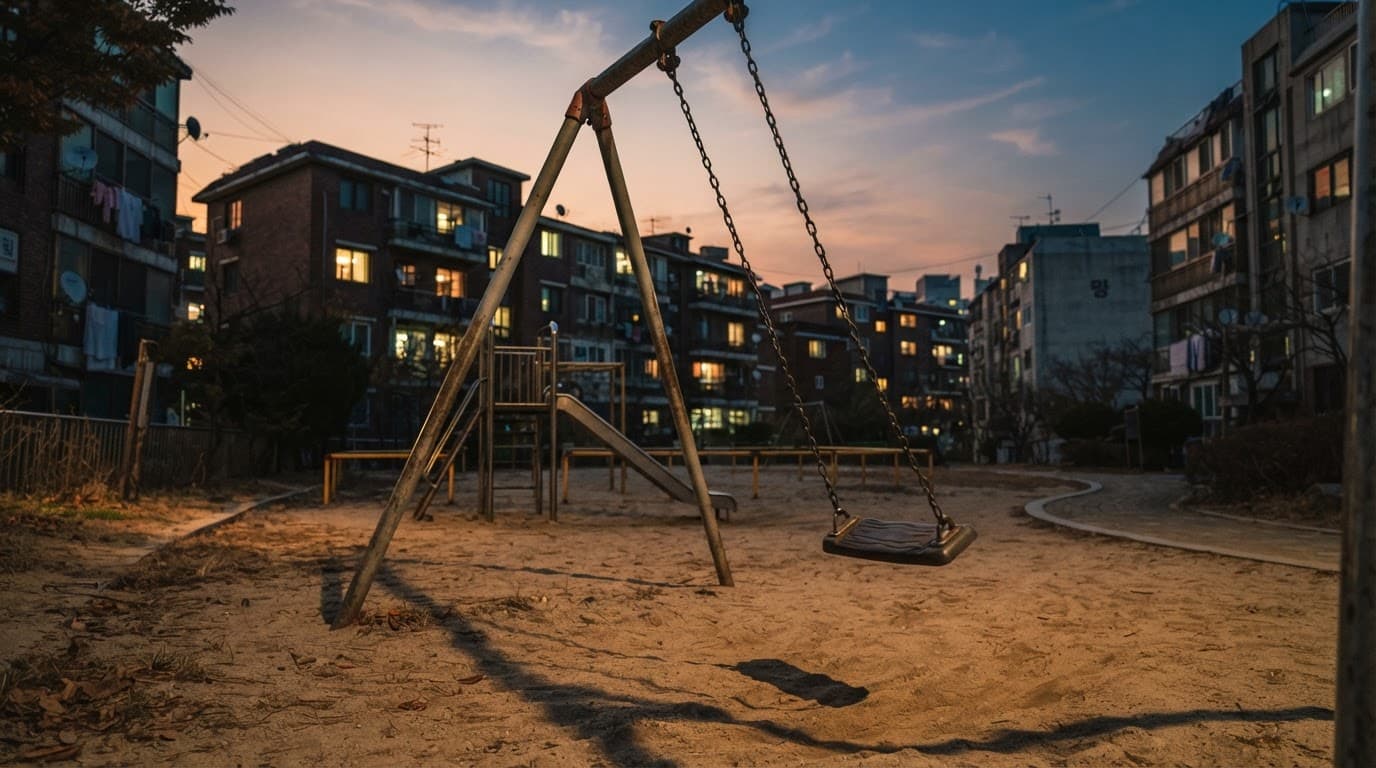
The images and video in this article are AI-generated works produced to convey the mood of the story, and are not photographs of any actual person or event.

Comments
No comments yet — leave the first one.