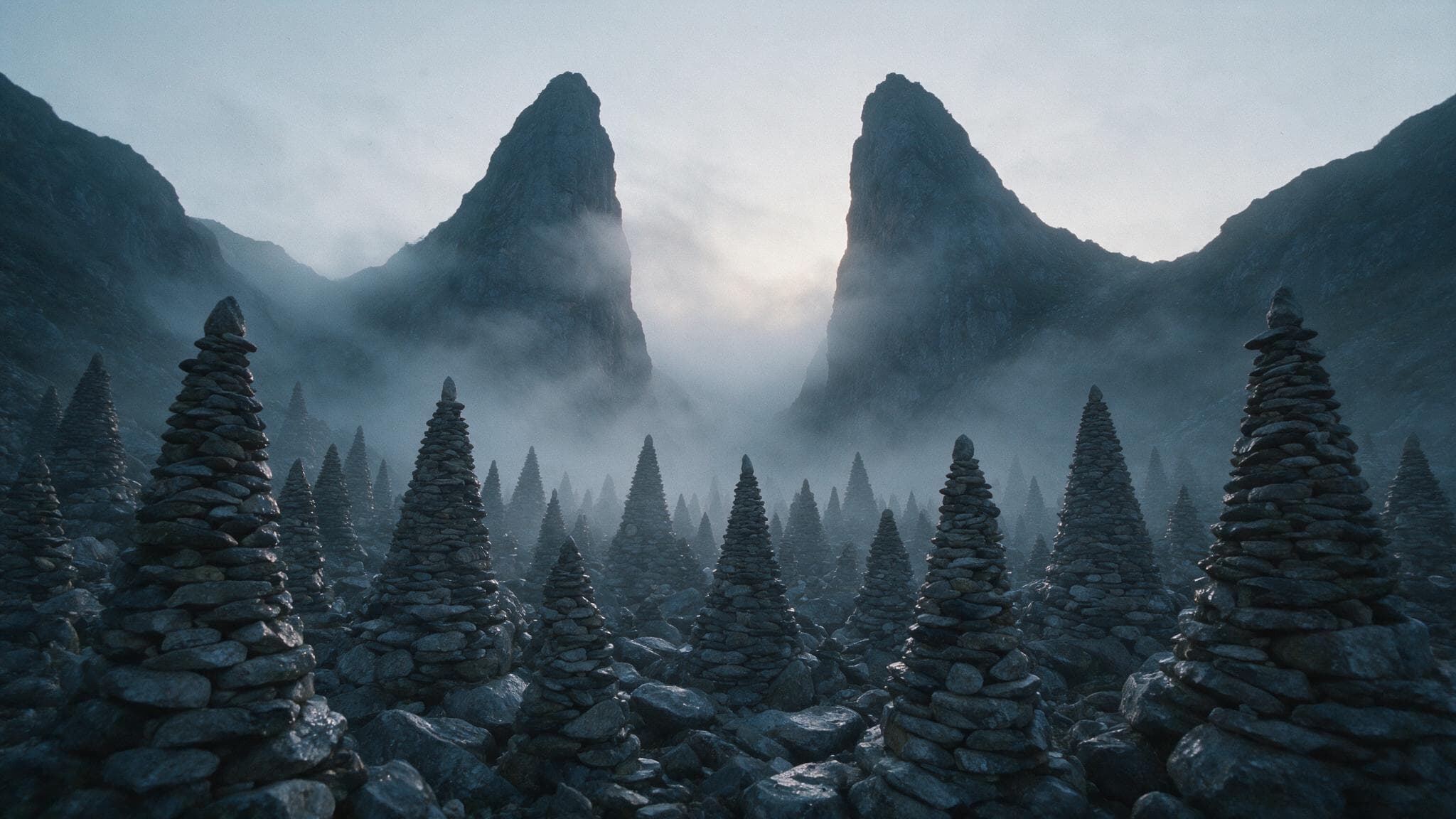
In Jinan, in the province of North Jeolla, there is a narrow valley set between two rock peaks that rise side by side like the two ears of a horse, and almost no one enters it without stopping short at least once. For along the slopes and filling the temple grounds stand more than eighty stone pagodas, each tapering up toward the sky. Some are no taller than a person; one rises 13.5 meters, the height of a five-story building. And when you step close to examine them, a chill runs down your spine. Not one of these towers was built with cement, with lime plaster, or with any adhesive at all. They are nothing but natural stones — from ones that fit in a palm to ones a man can barely lift — set one upon another with painstaking care. These heaps of rock, which look as though a single push of a finger would bring them down, have never once collapsed, not in the fierce wind that howls year-round through the gap between the two peaks, nor in the many typhoons that have clawed their way across the Korean peninsula, in more than a hundred years. And every one of these towers was built by a single man: Yi Gap-ryong.

The Mountain Shaped Like a Horse's Ears
The setting itself is like no other. Maisan means, quite literally, "Horse Ear Mountain." Two rock peaks rising side by side look for all the world like a horse pricking up its two ears, and so the mountain has been called for centuries. The slightly lower western peak is Ammaibong; the taller eastern one is Sumaibong. The two are not earthen hills but great masses of solid rock, their surfaces pocked all over with hollows, like a honeycomb. This peculiar weathering — the result of long ages of freezing and thawing that worked the pebbles loose from within the stone — forms in itself a landscape rarely seen anywhere on the Korean peninsula.
But the two peaks produce more than a strange silhouette. Their geography — two enormous walls of rock facing each other across a narrow valley — draws the wind into the gap and accelerates it, as through a funnel. And so the very place where the pagodas stand, between the two peaks, is swept by a fierce wind in every season. Of all places, it is right in the path of that wind that towers stacked without a drop of adhesive have stood their ground for more than a century.

The Man Who Stacked Stones Alone for Thirty Years
The builder of the towers was a man named Yi Gap-ryong (1860–1957). He is commonly called "Yi Gap-ryong the cheosa." A cheosa was a man who took no government post but withdrew into the countryside to cultivate the Way. According to the accounts handed down, at around the age of twenty-five, in about 1885, he came into this valley of Maisan and began a life of ascetic discipline. And from that time until just before his death, over the course of some thirty years, he filled this valley with stone pagodas.
The towers he is said to have raised numbered, at the outset, 108 — some say as many as 120. Setting aside those that have since crumbled with weather and time, about eighty remain today. What is astonishing is that he accomplished this vast labor almost entirely alone, with his bare hands. By day he carried stones and by night he stacked them with painstaking devotion, and he is said never to have stopped this work until the day he died, an old man past ninety. A single man, over a lifetime, turned an entire mountainside into a forest of stone towers. What he was praying for as he raised them, the whole of what was in his heart, we cannot now know. All that remains is the forest of stone that fills the valley and stands, even now, unfallen.

"He Carried Stones from Sacred Mountains by Folding the Earth"
The most widely told story about Yi Gap-ryong is the legend that he gathered the stones for his towers from the famous mountains across all eight provinces of old Korea. In fact, the large stones forming the lower base were brought from within a few kilometers, but the story has long circulated that the stones set at the very tops of the towers were carried from renowned mountains far away. The question is how. People say he traveled the vast distances from those distant sacred peaks to this valley "in a single breath," and that he did so using chukjibeop — the mysterious art, out of old tales, of folding the ground itself to cross a great distance in an instant.
This, of course, is legend. It is hard to believe that any such art exists, and even if it did, scholars point out, it would be a "way of traveling fast," with no direct bearing on the labor of moving heavy stones and stacking towers. In all likelihood, the superhuman toil by which one man raised this immense forest of pagodas over a lifetime was, passing through the mouths of later generations, dressed up in the mystical garb of "chukjibeop." Yet even when the legend is stripped away, the real riddle remains unsolved. How is it that these towers do not fall?

The Towers That Will Not Fall — What Does Science Say?
The tallest and most famous of the towers in this valley is called Cheonjitap — the "Heaven-and-Earth Pagoda." Stacked as a single body from below, it splits into two branches, north and south, from the middle up, and it rises 13.5 meters. That such a height was raised from natural stone alone, without a drop of adhesive, is remarkable enough; but the truly astonishing thing is that it has endured for a century in the very heart of a wind tunnel. To this mystery, people offer not supernatural marvels but several plausible explanations rooted in structural mechanics.
The first is the shape of the towers. They are broadly conical, wide at the base and narrowing toward the top. This form, which keeps the center of gravity low, is extremely stable against wind and vibration. The second is the manner of stacking. Large stones and small, angular and round, are fitted together so that their edges interlock, forming a structure in which the stones brace one another. Even without adhesive, each stone is held in place by the weight and friction of its neighbors. And third, some argue that the very fact that these towers stand in a windy place is itself part of the answer: the gaps and open, porous structure throughout the body do not meet the wind head-on but let it pass through the interstices, dispersing the force on the tower as a whole. When all of this came together in the instinct of one man, learned in the body over long years, only then did a tower rise that would not fall.

<video controls playsinline preload="metadata" poster="/media/maisan-1.jpg" style="width:100%;height:auto;border-radius:8px;"> <source src="/media/maisan-clip.mp4" type="video/mp4"> </video>
A slow pass through the stone pagodas ranged in the valley between the two peaks on a misty winter dawn — a mood recreation, not real footage.
The Ice That Grows Toward the Sky in Winter
Even as science seems to explain it away, in winter this valley sets before the visitor yet another strange phenomenon: the "reverse icicle." When we think of an icicle, we picture ice growing downward from the edge of an eaves; here, the ice does the opposite. Set a bowl of pure water before a tower, and as the water freezes from below, it rises upward, tapering toward the sky. The longest of them can exceed thirty centimeters.
This reverse icicle, too, is no supernatural marvel but a phenomenon shaped by Maisan's peculiar geography. The winter downdraft that pours fiercely down the narrow corridor between the two peaks freezes the surface of the water in the bowl abruptly, forming a thin lid of ice. As the water beneath goes on freezing and expands in volume, the trapped water is forced up through the thin gap above and freezes as it rises toward the sky. In the end, the two peaks of Maisan — with the same fierce wind that is a trial to the towers that have stood a hundred years — become, in winter, a sculptor of ice that makes water grow upside down. The same wind that tries to topple on the one hand, on the other conjures a marvel.

A Valley That Has Kept One Man's Question
Strip away the legend, set down the tale of folding the earth, explain it point by point through structural mechanics and geography — and still the Maisan stone pagodas hold a person for a long while. Their power lies not in supernatural mystery. It lies, rather, in the fact that plain truths stand side by side. That one man, almost entirely alone, over some thirty years, without a drop of adhesive, raised towers the height of a five-story building right in the path of the wind — and that they have not fallen in more than a hundred years.
We can now, to some degree, explain why the towers do not fall: the low center of gravity, the interlocked stones, the porous structure that lets the wind pass through. But even where that explanation ends, one unanswered question remains. Toward what, and with what in his heart, did one man devote a lifetime to stacking these countless stones, one by one? The weight of that heart alone can be reckoned by no structural mechanics.
Even now the wind passes between the two peaks of Maisan. In summer typhoons scour the valley; in winter the downdraft freezes water upside down. And between them the eighty-odd stone pagodas stand today, tapering toward the sky without the slightest tremor. This forest of stone, raised by one man's bare hands, remains — between the legend that would remember him as a mystical sage and the science that would explain it away with a level voice — still, quietly, unfallen.
Comments
No comments yet — leave the first one.