This is a case with a child at its center, a case that is still not closed.
There is no description here of anything cruel. Only what is known: the killer still at large, and the clues that remain.
Following Korean press convention, the victim is referred to only as "Girl A."
This is written in the hope that it might wake someone's memory.
November 5, 2003 — Six in the Evening
Songu-ri, Soheul-eup, in the city of Pocheon, Gyeonggi Province.
In late autumn, the sun sets early. By six in the evening the streets are already dark.
That day, Girl A had been out with friends. She left a friend's house around six — a little later than the hour her mother had told her to be home.
Home was not far on foot. To save a few minutes, she turned off the main road and took a shortcut through the narrow back lanes.
At about 6:20, she called her mother. She said only a few words: she was almost home. She'd be inside soon.
That was the last time her mother heard her voice.

Of everything in this file, the item I have handled most is the 6:20 phone call. It is a few seconds of an ordinary Wednesday — a girl telling her mother she is almost home — and in the record it sits directly against the moment nothing further is known. I have gone over the sequence of that evening again and again, and the gap never widens or narrows. It is always the same few minutes of a short lane. Some case files have a hole in them. This one has a doorway that was never reached.
After the call ended, Girl A never reached the door.
It was a walk of only a few minutes. Somewhere in that short lane, in the space of those few minutes, she was gone.
Ninety-Five Days of Darkness
When she did not come home, her family searched the whole neighborhood through the night. A report was filed. A search began.
But there were no cameras in that lane. A back street in a small Korean town in 2003 was not the wired place it is now. The streetlights were few and far between, and no trace remained of anyone who had passed that way that evening.
Twenty-three days after she vanished, on November 28, the first clue surfaced.
Around the Millak-dong and Nakyang-dong areas of Uijeongbu — roughly 7.4 kilometers from Girl A's home — thirteen of her belongings were found: her bag, her shoes, her socks, her school uniform necktie, a notebook, wool gloves.
That was far too distant to have walked to. It meant someone had carried her away by car.
But there were only the belongings. Of the girl herself, there was no sign.
The search stretched on through the winter. November became December, December became January, and still she did not appear.
February 8, 2004
The ninety-fifth day.
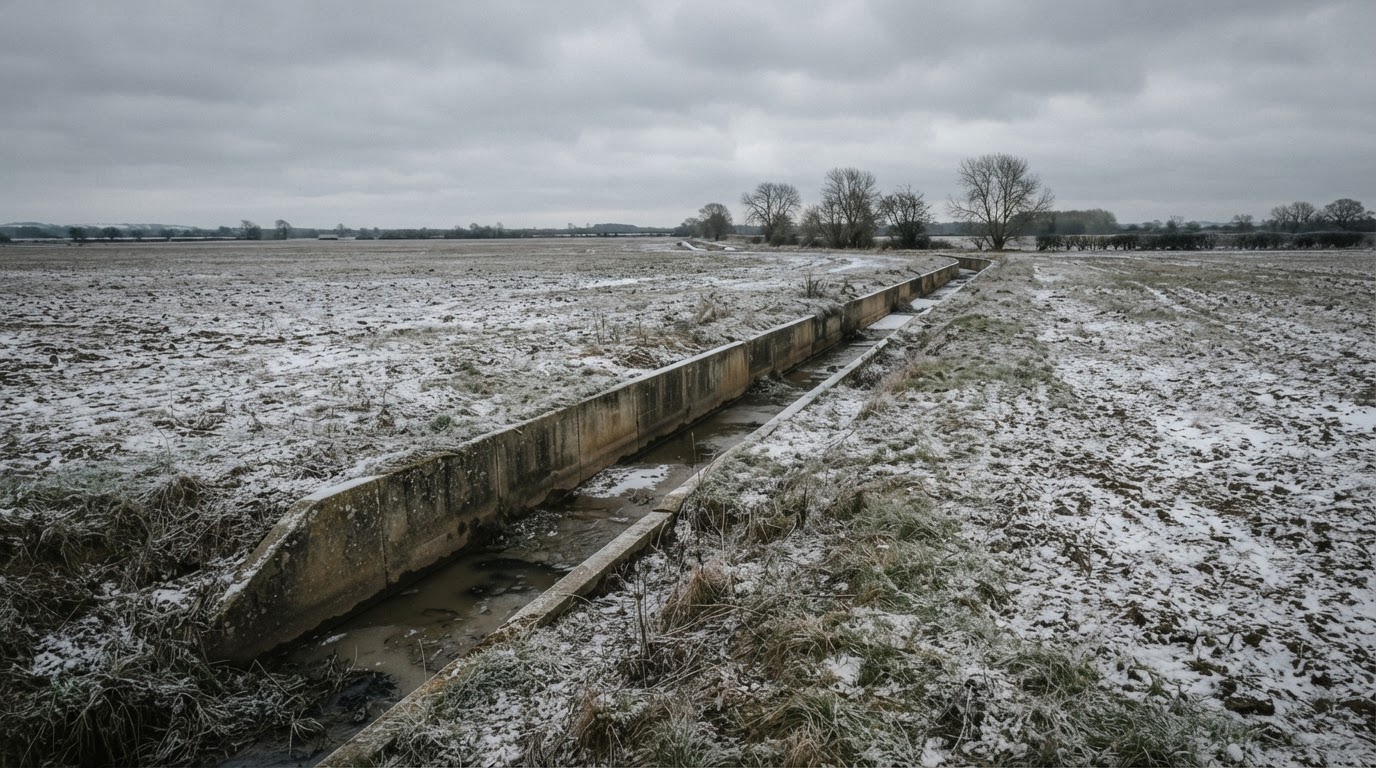
At about nine in the morning on February 8, in a drainage culvert in front of a restaurant in Idonggyo-ri, Soheul-eup, Girl A was found.
It was a narrow drainage pipe, only about sixty centimeters across.
Out of respect for the victim's dignity, the details of that discovery are not set down here. Only this is recorded: that in the cold water of a winter field, the girl was finally found.
At the end of four months of searching, what the family met was the outcome they had most feared.
And there, at that place, was one detail that seized the investigators' attention.
The Red Nail Polish
When she was found, Girl A's fingernails and toenails were painted with red nail polish.
The problem was this: Girl A never wore nail polish.
Her family was clear on the point. She simply did not paint her nails.
So then — who had painted them red?

If the girl had not applied it herself, only one answer remained.
The killer had done it.
That single fact changed the whole character of the case.
This was not simply a crime of harm and flight. The killer had done something to her. He had taken time. He had painted, one nail after another, a color onto her fingers.
There was something in that act — something hard to put into words — that ran cold in everyone who heard of it.
It is why the case came to be known by another name: the Pocheon Nail Polish Murder.
What the Polish Suggests
Profilers did not pass over this detail.
According to the profiling reported at the time, experts believed such an act might point to a person of a particular psychology — someone driven to treat a victim as an object, or as a kind of "doll" within a private world of his own. A distorted sexual fixation, the reasoning went, of which painting the nails might be the visible residue.
Some also noted that certain belongings were never recovered, and raised the possibility that the killer was the type to keep an item connected to his victim — a "trophy."
None of this is established fact. It is only the profiling that was reported. But these views all pointed, in common, to one thing: that this was not someone who acted on impulse and ran. It was someone who staged something and left its mark — a deliberate figure, and a deeply strange one.
A Week Earlier, Two Kilometers Away
There was one more clue that seemed, for a time, as though it might be decisive.
About a week before Girl A vanished — in the same area, only two kilometers from where she disappeared, a five-minute drive away — another woman had lived through something very similar.
On her way home, she was pressured to get into a white car by a man behind the wheel. The man kept asking questions, she said: How far are you going? How old are you?
When she tried to escape, he did not panic. He stayed calm and kept driving. She barely got away — and later, cooperating with the investigation, she described the man.
What she remembered was unusually vivid, and unusually strange.
His face was pale — startlingly white. There was no hair at all on his hands or arms. And on his fingernails, she said, there was a coat of clear nail polish.
He was around 175 centimeters tall, of a lean build. Inside the car were a briefcase and a khaki uniform jacket, and he had said something about having "come from a machine shop." The partial license plate she managed to recall was "Gyeonggi 735-something."
From her account, a composite sketch of the suspect was drawn.
Hairless white hands. Fingernails coated in clear polish. It was a detail that overlapped, unmistakably, with the red polish found a week later on the nails of a vanished child.

The Wall
With so many clues, why was the killer never caught?
The largest wall was the absence of CCTV. There were no cameras in that lane in 2003. Where the killer's car had gone, by what route the girl had been moved — there was not a single frame of footage to connect the path.
There was a composite. There was a partial plate. There were witness statements. But none of it amounted to the decisive proof — the physical evidence — needed to say this is the man.
The people who came under suspicion were investigated one by one. But no evidence firm enough to confirm the charge was ever secured, and one by one they were ruled out.
The Shadow of Lee Choon-jae — and the Exclusion
In 2019, a piece of news shook South Korea.
The true perpetrator of the Hwaseong serial murders — a case unsolved for more than three decades — had been identified through DNA. And that man, Lee Choon-jae, confessed to his crimes.
As his confessions unfolded, cold cases across the country were revisited. Online, some wondered whether the Pocheon case, too, might be his work. Speculation ran across the timing, the geography, the method.
But the Pocheon case was not among the crimes Lee Choon-jae confessed to.
The detective who had handled it likewise judged that the nearby attempted abduction and Girl A's case were quite possibly the work of an entirely different person.
Even a name as vast as Lee Choon-jae's could not open the door of this case. And the girl from Pocheon remained where she had been all along — alone before the question of who.
The Clock That Stopped Running
For a while, this case carried another deadline of its own.
Under the law at the time, the statute of limitations for murder was fifteen years. By that arithmetic, the case was fated to expire around 2019 — after which, even if the killer were caught, he could not be punished.
Then, in 2015, the law changed.
It is called the Tae-wan Act, named for another young victim — a child who died after an acid attack. The law abolished the statute of limitations for murder altogether. And it was applied retroactively to cases in which, as of 2015, the limitation period had not yet run out.
The Pocheon case fit that condition.
Which is to say: for this case, the clock is gone. The killer, if caught today, will be punished. Time is no longer on his side.

A File Still Open
The Pocheon case remains one that a long-term cold-case unit is still examining.
Several television programs — among them SBS's long-running Unanswered Questions — have taken up the case more than once.
In 2019, a new tipster came forward. Someone who had seen the composite testified that it was "exactly as I remember him," and for a moment there was hope that a thread might finally be pulled loose. But it never led to a decisive clue.
The case files remain. And the search for the face in that composite continues.
We carry other cases of a similar weight.
The father who searched for more than twenty years for a daughter who never came home — the disappearance of Song Hye-hui.
The children who went out to catch salamanders and never returned — the Frog Boys of Daegu.
And the man who asked children for directions at a playground, uncaught for twenty-five years — the Incheon Playground Case.
All of them, files not yet closed.

Before This File Closes
More than twenty years have passed since the evening a girl vanished from a lane in Pocheon.
With no CCTV and no decisive physical evidence, the case has stood still for a long time.
But one thing remains.
The red nail polish.
A color she never wore — one that someone left upon a child.
It has held out, even now, against twenty years of silence.
The killer would have chosen that color himself. He would have opened the bottle, taken up the brush, and painted it onto her nails, one by one.
An act like that is not easily forgotten. Perhaps someone close to that person remembers a time when he had such a color, such hands.
The clock is gone. The case is open.
A single small memory — someone who knew that color, twenty years ago — could yet light the end of the short lane the girl from Pocheon was last walking.
I have set this file down and taken it up again more times than any other Korean case I keep. What stops me is never the size of what is missing. It is the smallness of what is there: a partial plate, a sketch, and a coat of clear polish on a stranger's fingernails, noted by a woman who got away a week early and remembered a detail she had no reason to invent. Somewhere those two records — hers and the culvert — were made by the same hand. I file them next to each other and neither one moves.

---
The images and video in this article are AI-generated works produced to convey the mood of the story, and are not photographs of any actual person or event.
Comments
No comments yet — leave the first one.