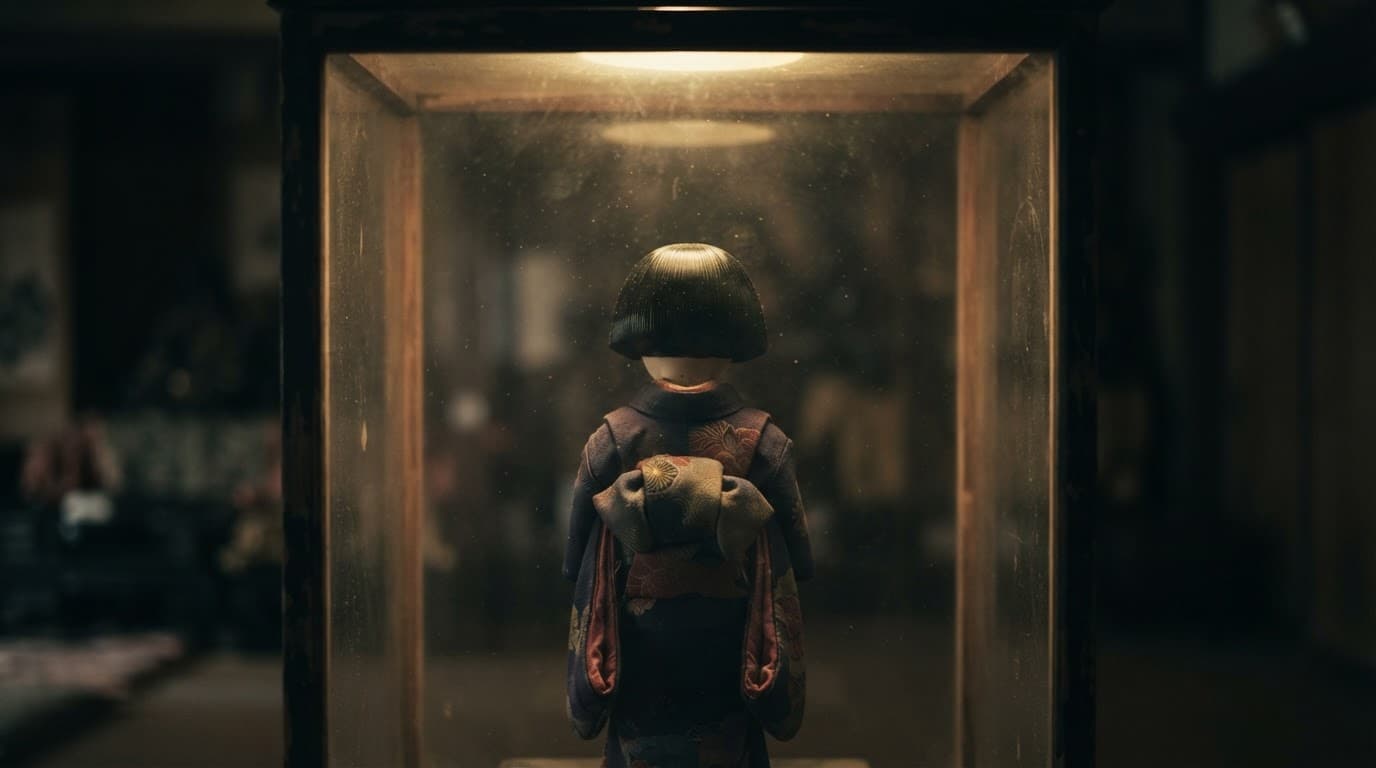
There is a doll in Hokkaido whose hair has to be cut.
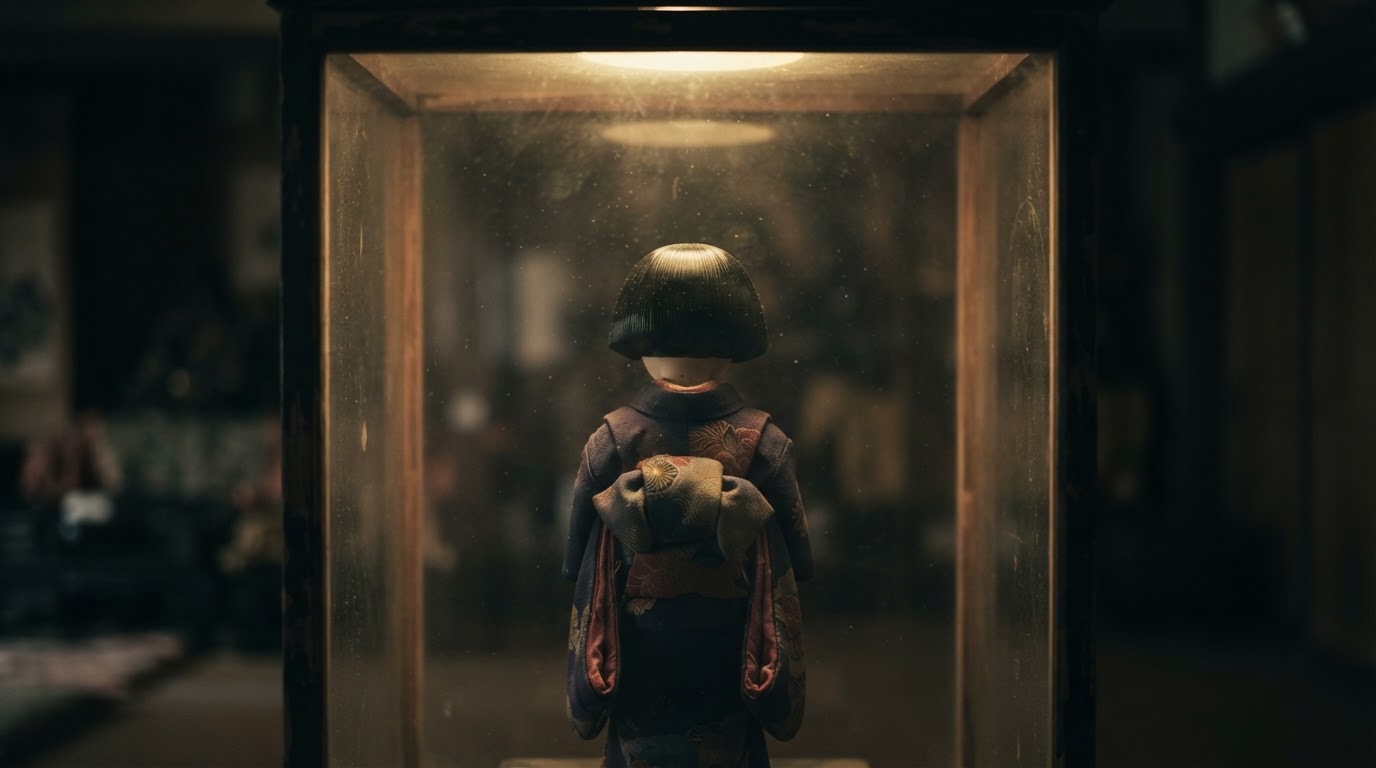
Not styled. Not brushed. Cut. Twice a year, a priest at a small temple called Mannenji slides open a glass case, lifts out a palm-and-a-half-tall girl in a kimono, and trims the black hair that has crept, once again, down past her shoulders. Then he sets her back inside the case, closes it, and waits for it to grow again.
The doll's name is Okiku. And for more than eighty years, the monks who care for her have said the same quiet, impossible sentence to everyone who asks: her hair grows.
Most of the haunted objects that reach my desk arrive with no provenance at all — no purchase, no owner, no first date. I am K. Woo, and Okiku is the exception that made me keep her. The record here begins with a receipt-shaped fact: a boy, a fair in Sapporo, a stall in the Tanukikoji arcade, summer 1918. I can put a season and a street on the moment this object entered a family. That is more documentation than nine-tenths of my archive can offer, and it is precisely what makes the rest of the story so difficult to hold at arm's length.
A Gift Bought in the Snow
The story begins not with a ghost, but with a big brother.
In the summer of 1918, a seventeen-year-old boy named Eikichi Suzuki traveled from his home to Sapporo — at the time the largest city in the wide, cold north of Japan. He was there for a fair, one of the marine exhibitions the growing city liked to hold. Walking through the shopping arcade of Tanukikoji, one of Sapporo's oldest streets, he stopped at a stall selling dolls.
He bought one for his little sister.
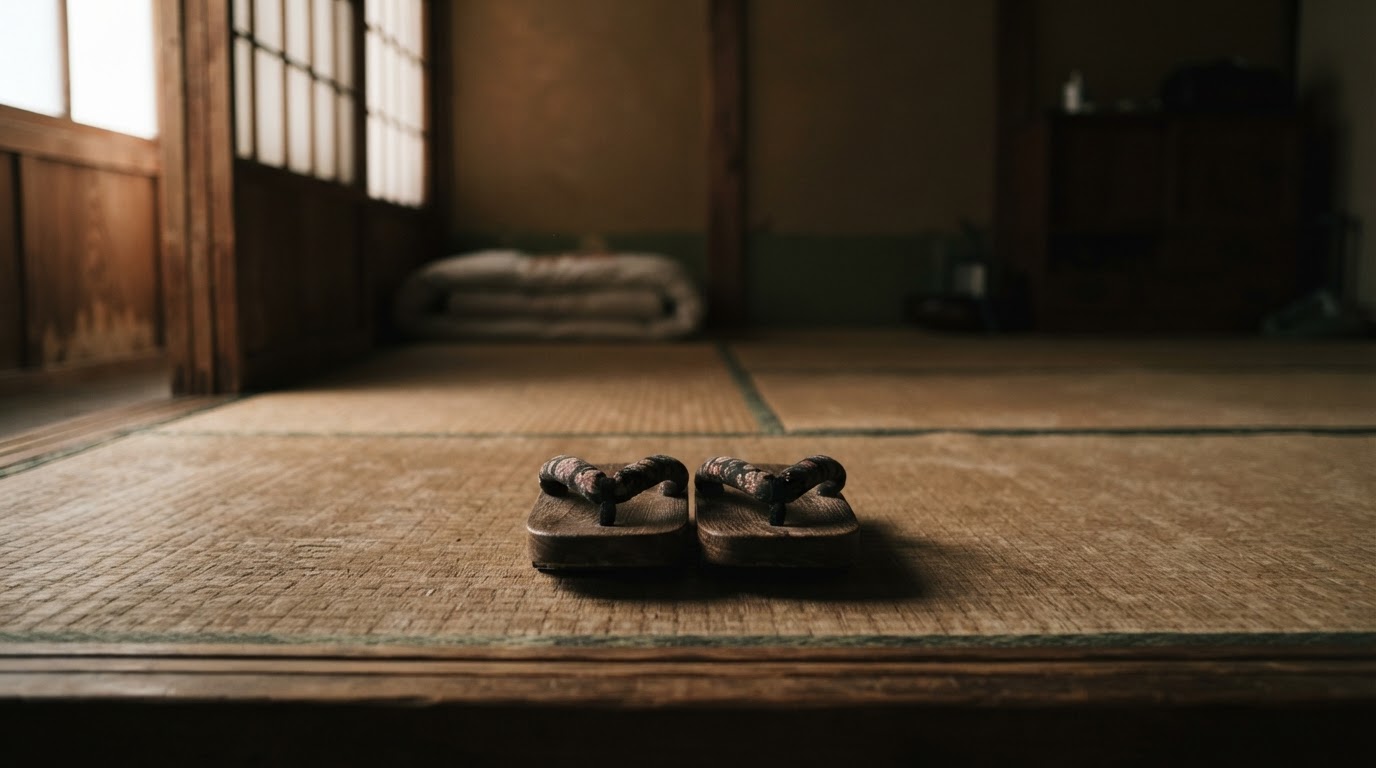
Her name was Kikuko. She was two, maybe three years old, small enough that a doll roughly the length of a forearm would have seemed like a real companion to her. The doll wore a kimono. Its hair was cut in the straight, chin-level bob called okappa — the classic hairstyle of a Japanese girl of that era, the same cut Kikuko herself wore. Perhaps that resemblance was why Eikichi chose it. A little girl and her mirror image, carried home through the northern streets.
Kikuko adored it. The way small children do, she made the doll the center of her small world — carried it, talked to it, slept beside it every night. For a while, in a family home somewhere in Hokkaido, there was nothing supernatural here at all. Just a child and the thing she loved most.
The Following Spring
Children in 1919 died of things we no longer fear.
The next year, Kikuko caught a cold. It should have been nothing. In a world before antibiotics, before the medicine we take for granted, a common cold in a small child could turn, within days, into something that took her. She developed a fever. The illness moved into her chest. And then, quietly, she was gone — barely more than three years old.
There is no way to write this part that makes it lighter than it was. A family lost its youngest. A seventeen-year-old boy, not long ago, had bought her a present in a Sapporo arcade, and now he was helping to arrange her funeral. Whatever else this story becomes, it starts here, in that grief, and it never entirely leaves it.
When the family prepared to place Kikuko's things in her small casket to be cremated with her — as was the custom — the doll was meant to go too. It was her dearest possession; it belonged with her.
But in the confusion of a household in mourning, the doll was overlooked. It was not placed in the casket. It stayed behind.
And so, almost by accident, the doll did not go into the fire with the little girl who had loved it. It remained in the house of the living.
The Altar
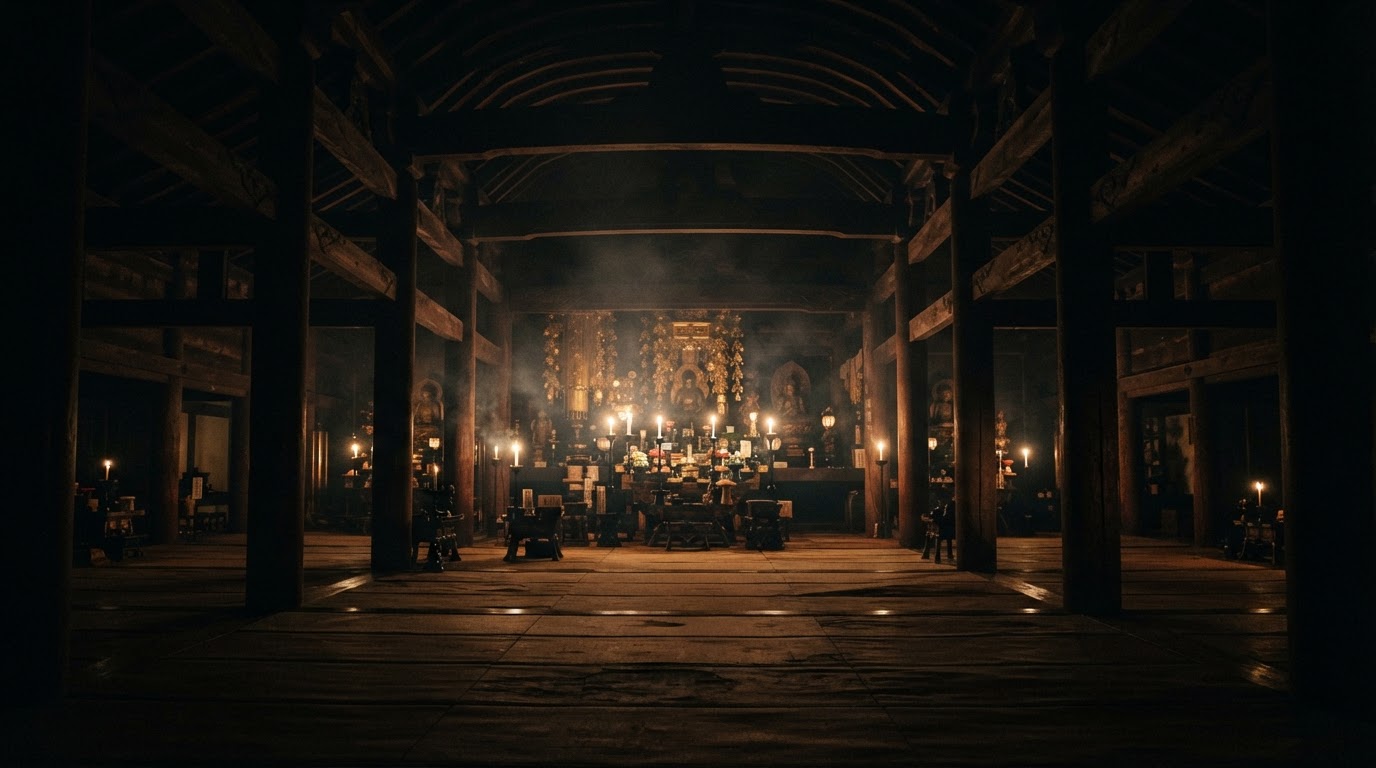
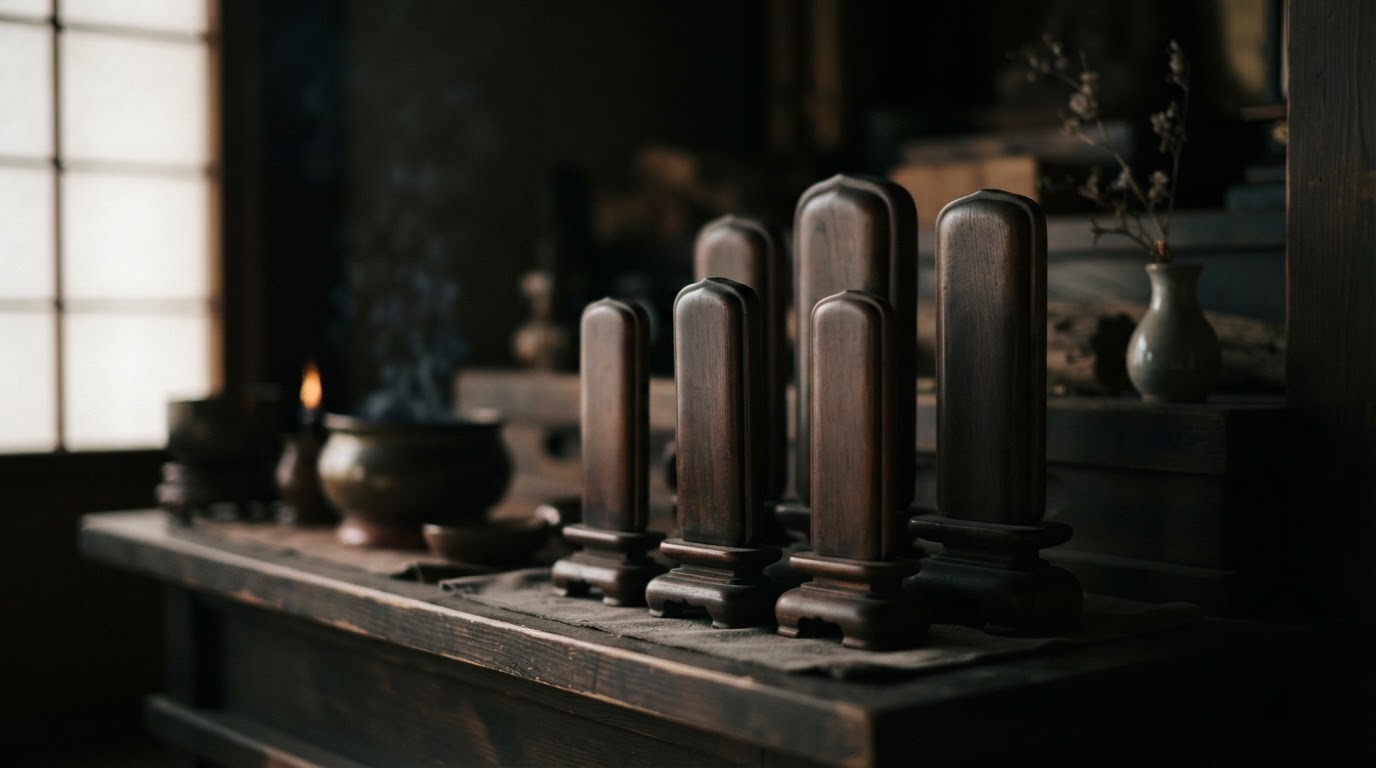
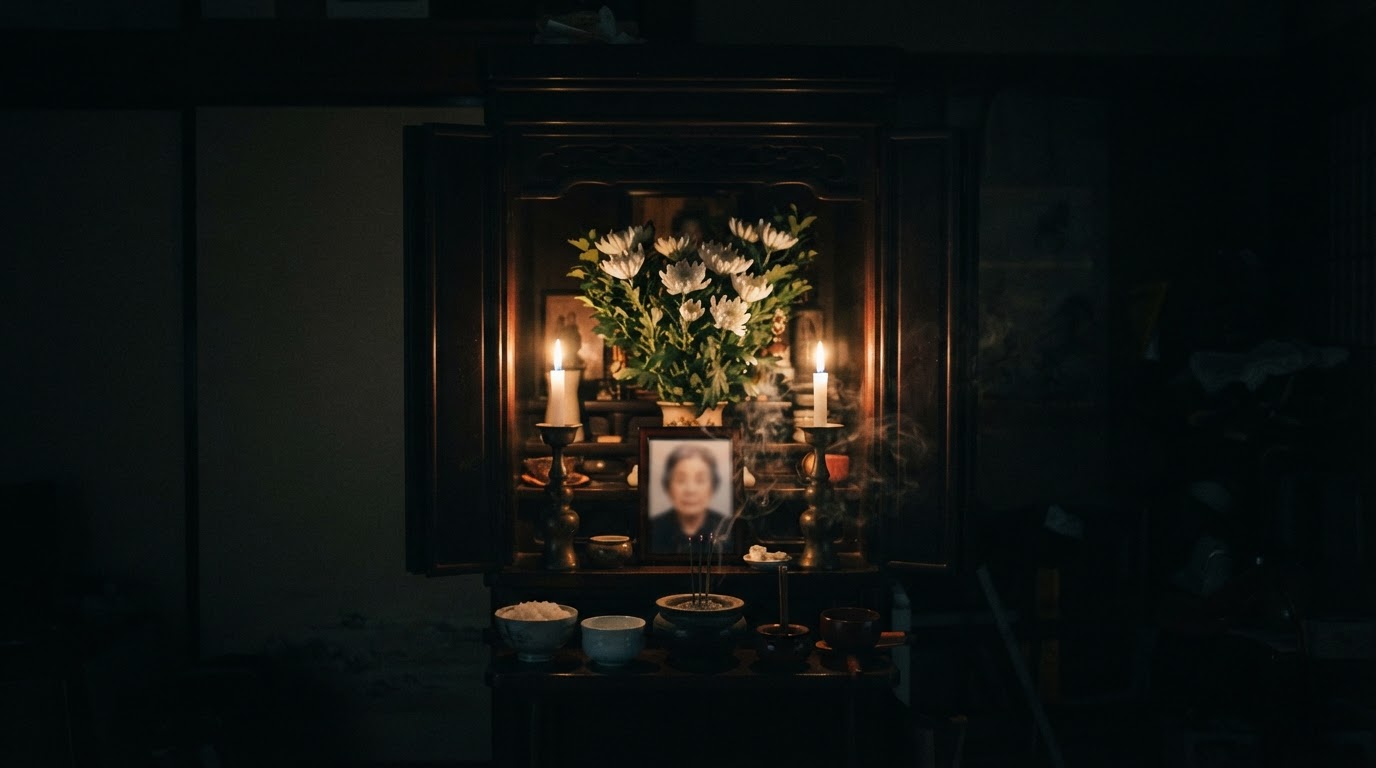
The Suzuki family did the natural thing. They placed the doll on the household Buddhist altar — the butsudan — beside a small memorial to Kikuko, and they kept her there. It was a way to keep the child close: her favorite doll, sitting where the family prayed for her every day. A small daily ritual of remembrance.
It was some time after this, the story goes, that Eikichi noticed something.
The doll's hair looked longer.
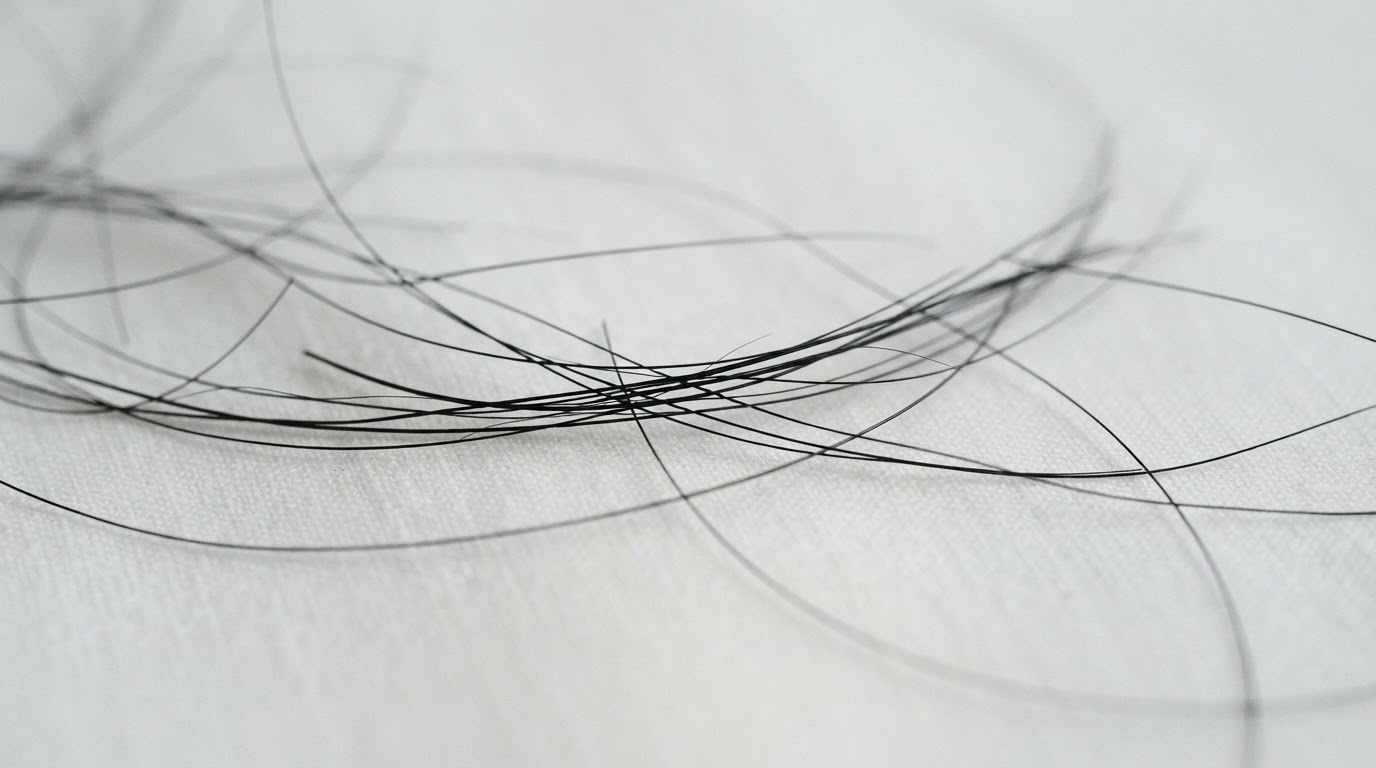
He had bought it with the neat, chin-length okappa bob — he was sure of it. That was the whole look of the thing. But now the black hair seemed to have crept downward, reaching toward the doll's shoulders. He looked again. He was not imagining it, he decided. The hair was longer than it had been.
To a grieving family who prayed at that altar every day, there was only one explanation that mattered. Kikuko's spirit had not left. It had gone into the doll she loved, the doll that — by whatever accident — had been spared the fire. She was still here. She was, in the only way left to her, still growing.
Entrusted to Mannenji
For twenty years, the doll stayed with the family, on the altar, its hair — they said — quietly lengthening.
Then, in 1938, the Suzukis had to move. The family was relocating to Karafuto — the southern half of Sakhalin island, then under Japanese control — and they could not take everything, nor everyone's memory, with them across the sea. They did not want to simply pack Kikuko's doll into a crate and carry a piece of her grief to a distant island. They wanted her cared for.
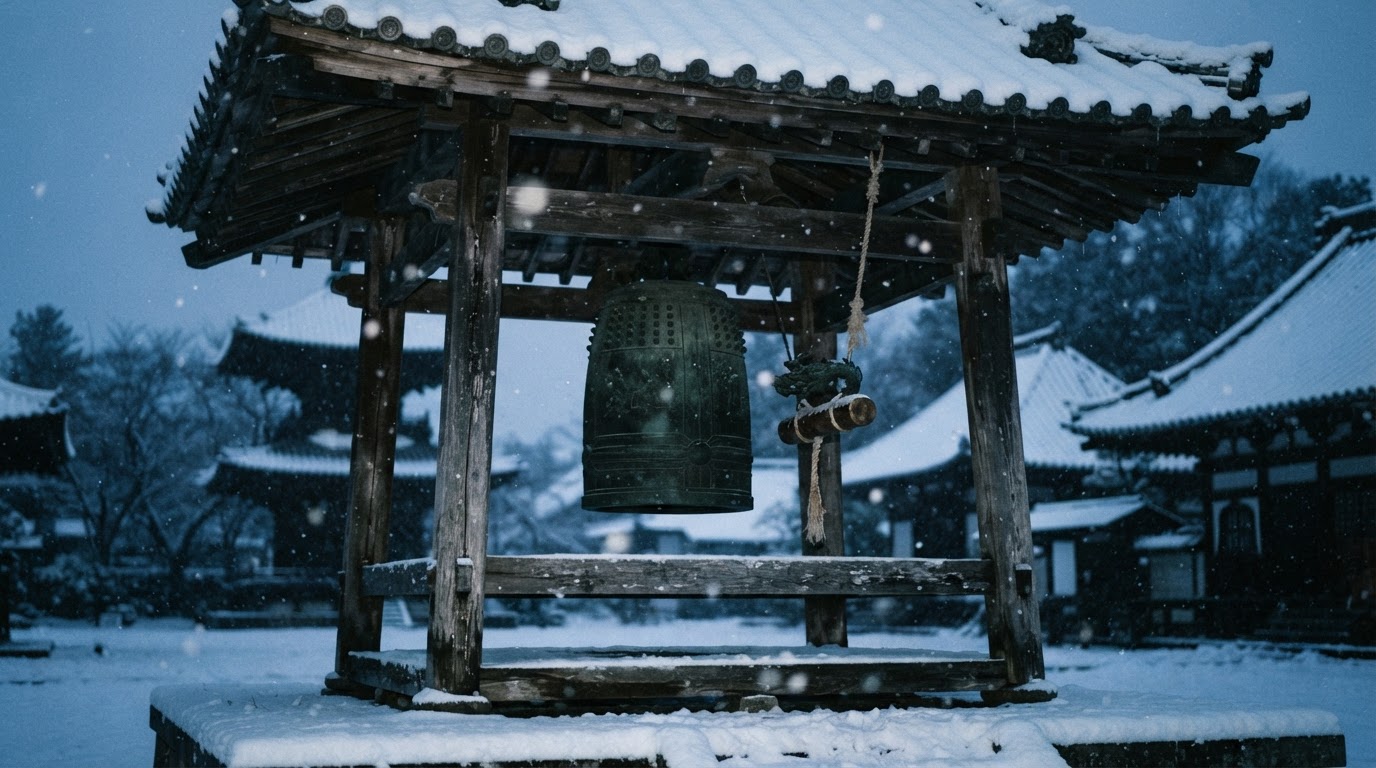
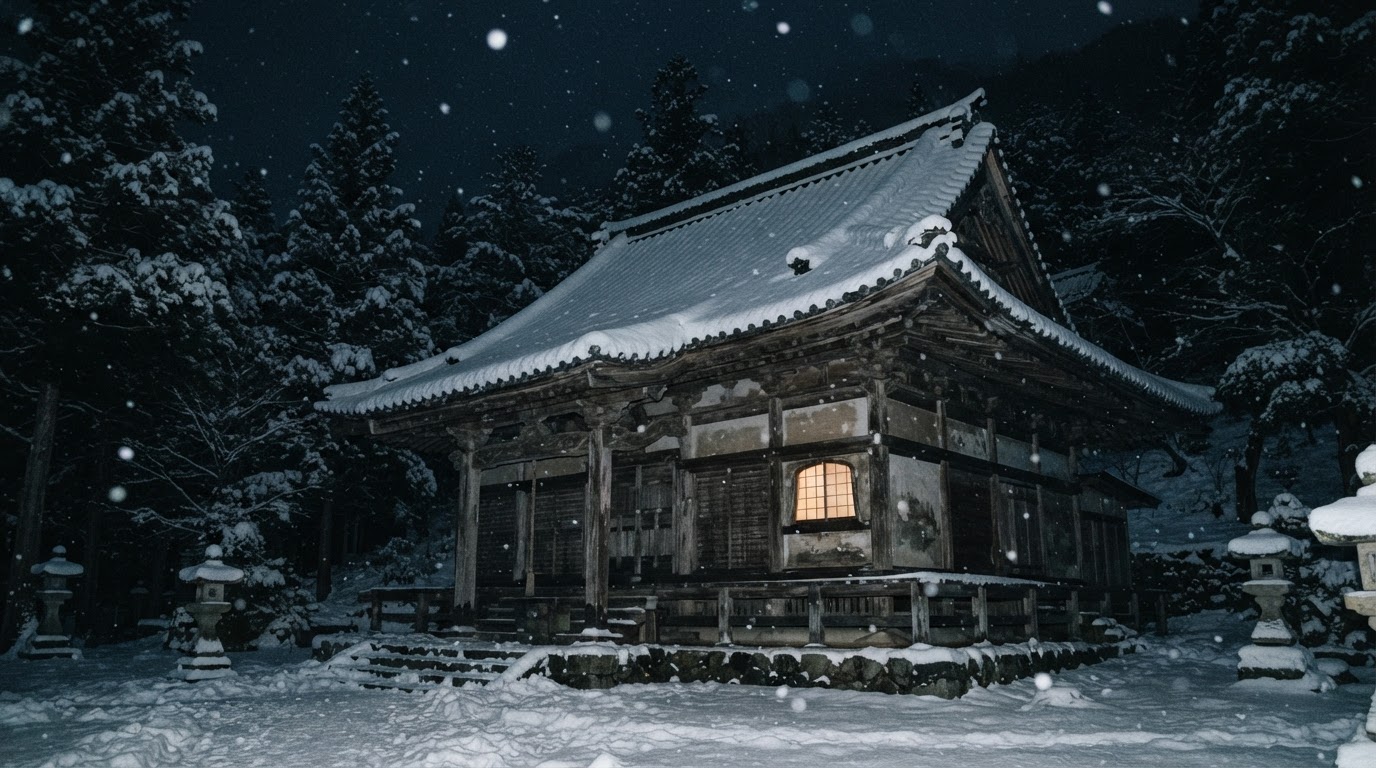
So they brought the doll to Mannenji, a temple of the Sōtō Zen school in Iwamizawa, a town in central Hokkaido, and asked the priests to keep it. They explained everything — the little sister, her death, the doll, the hair. And the temple, in the way temples in Japan have long done for objects heavy with the feelings of the dead, agreed to take her in.
Eikichi went north to Karafuto. After the war, when the family's world had been redrawn by history, he made sure the arrangement became permanent. The doll would stay at Mannenji, cared for as a memorial to his sister, for as long as the temple stood. He is said to have visited her when he could, this doll that was the last soft trace of a little girl he had loved and lost when he was barely more than a child himself.
And at the temple, the priests noticed it too. The hair kept reaching down. Every so often, they would trim it back — and in time, they said, it would grow again.
What the Temple Does
Okiku sits today in a glass case at Mannenji, dressed in her kimono, her face turned toward the visitors who come from all over Japan — and, increasingly, all over the world — to see her.
The priests do not hide her, and they do not oversell her. They tell the story plainly: this doll came to us as a memorial to a dead child; its hair grows; we trim it. Visitors who ask are told that the hair, cut to the neat bob it once had, will over months reach down again toward the shoulders. The temple cares for her the way it cares for the dead — with incense, with prayer, with the steady, unspectacular attention of people who have accepted a duty and mean to keep it.
There is something worth pausing on in that. Whatever you believe about the hair, the truest strange thing about Okiku is not the hair at all. It is that a family's private grief, more than a century old, is still being tended by strangers. A little girl who lived for three years in the 1910s is still, in a sense, being cared for — by monks who never met her, in a temple she never entered, through a doll she held in her sleep.
The Claim, Examined
Now for the part that must be said carefully, and honestly.
The lore around Okiku has long included a scientific footnote: that at some point the doll's hair was examined, and found to be human — the hair, some tellings hint, of a young child. It is the detail that turns a poignant story into a chilling one. It is also the detail that is hardest to pin down. The examination is described in the way these things always are: mentioned, hedged, never quite documented where you can hold it in your hands. Treat it, honestly, as part of the legend rather than as settled fact.
So what could actually be happening, if we set the spirit aside for a moment?
Antique Japanese dolls of this kind were often made with real human hair, rooted into the scalp of the doll's head — this much is genuinely true of the craft. Human hair was prized for its realism. So the strands on Okiku's head may well be human, simply because that is how such dolls were made. That alone accounts for the "human hair" claim without requiring anything supernatural at all.
And the growth? Material scientists and doll conservators offer several quiet, unglamorous explanations. Hair set into a doll's head can be anchored with more length hidden inside than shows on the surface; over decades, as the doll is handled, jostled, and settles, that hidden length can slip gradually outward, giving the appearance of growth. Old fibers can unwind, straighten, and stretch. Humidity — and Hokkaido's air swings hard between damp summers and bone-dry, heated winters — makes hair expand, contract, and shift its lie. A doll observed lovingly, over years, by people watching for exactly this, will have every millimeter noticed and remembered.
Then there is the oldest explanation of all, the one that lives inside the watcher rather than the doll: memorial psychology. When you place an object at the center of your grief and pray to it daily, you look at it more closely than you look at anything else on earth. You remember its "before" imperfectly and measure its "now" with unbearable attention. A family desperate for their daughter not to be entirely gone was, in the most human way possible, primed to see her still growing.
None of this is offered to sneer. It is offered because Okiku deserves the truth — and because the plain explanations do not actually make the story smaller. They just move the mystery from the doll's head to the human heart.
A Country That Holds Funerals for Dolls
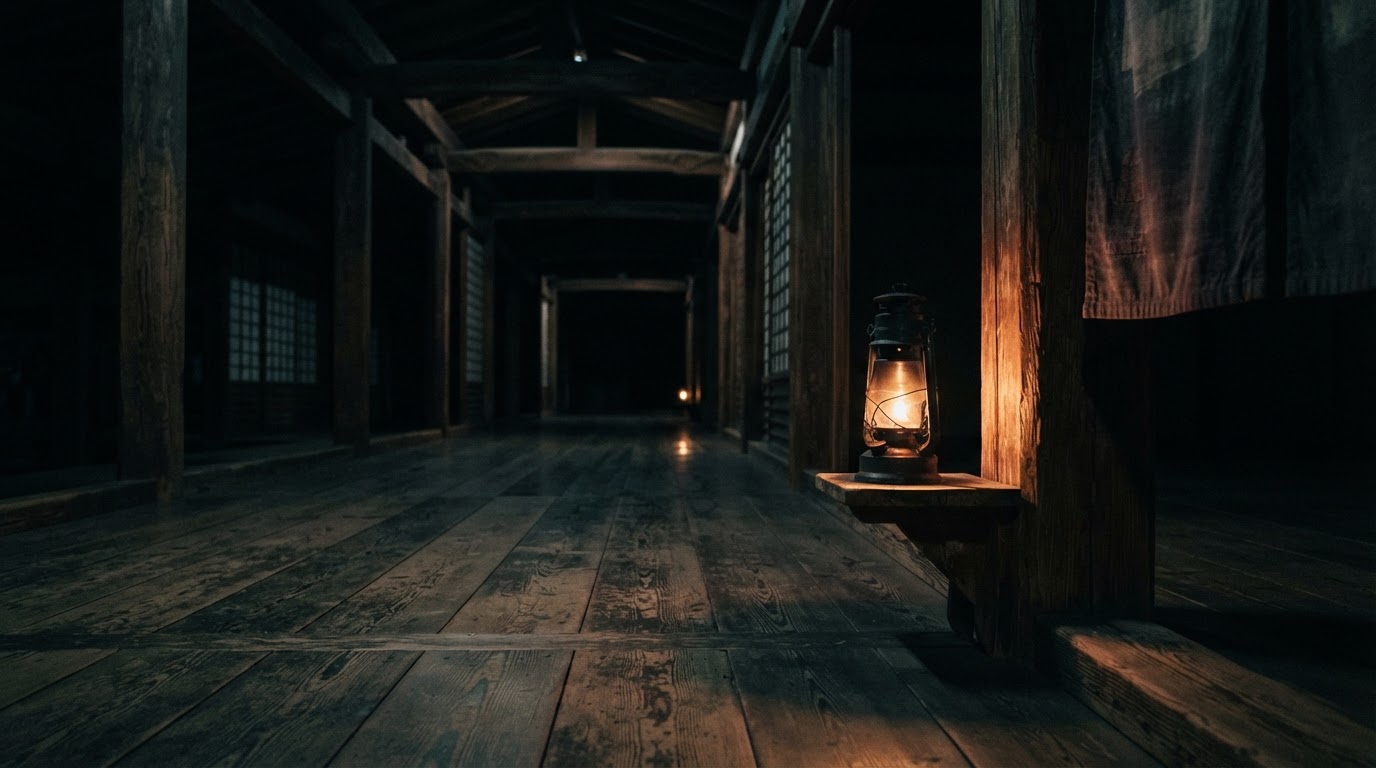
To understand why Japan, of all places, produced its most famous haunted doll — and why a temple would agree to keep one for eighty years — you have to understand something about how Japan treats objects.
In Japanese tradition, things that are loved for a long time are not simply things. There is an old, widely felt sense that a doll held and spoken to by a child for years absorbs something — call it feeling, call it spirit, the word matters less than the intuition behind it. You do not throw such an object in the trash. To do so would be cold, even dangerous.
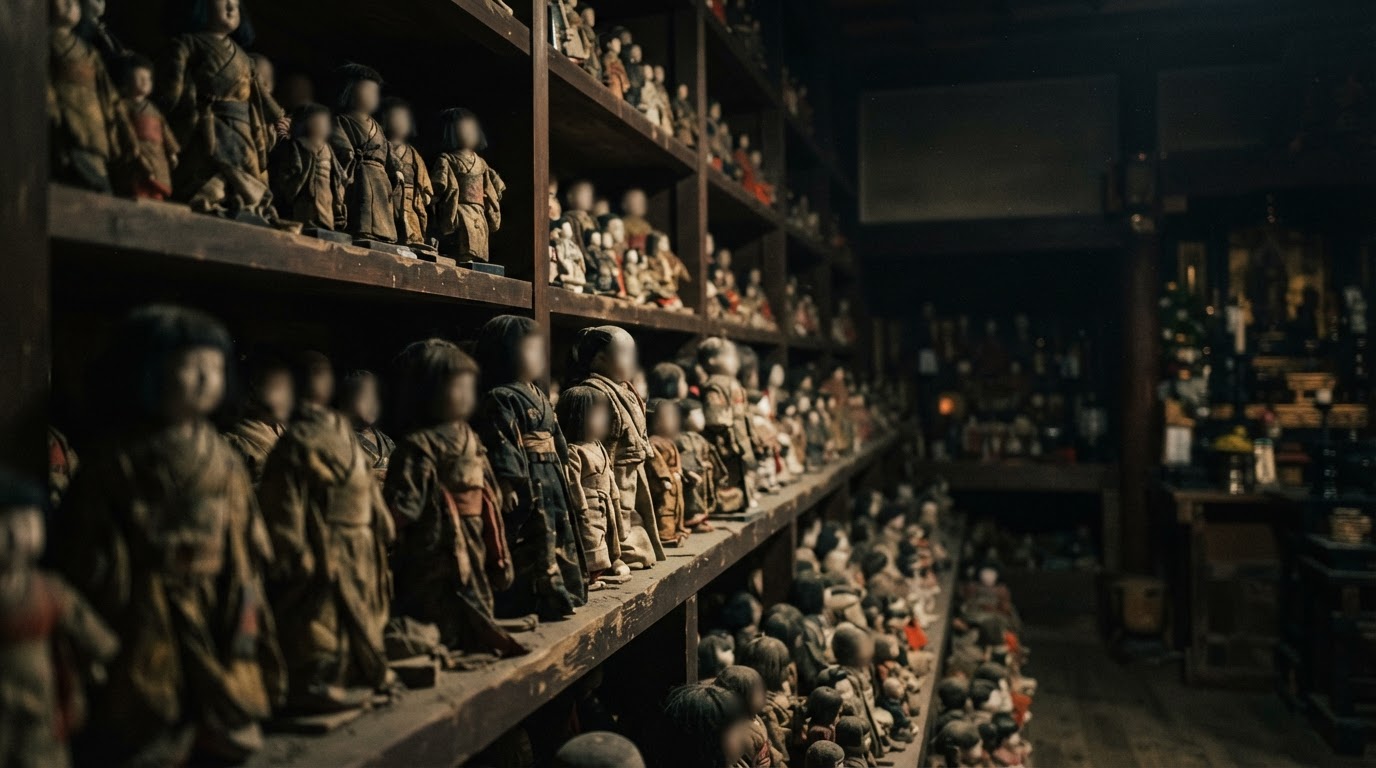
So Japan has a ritual for it: ningyō kuyō, the memorial service for dolls. At temples and shrines across the country, families bring old dolls they can no longer keep — dolls outgrown, inherited, mourned — and the priests perform a funeral for them. The dolls are blessed, thanked for their years of companionship, and released with prayer, often before being respectfully burned. It is, quite literally, a funeral for an object, born from the belief that an object long loved has earned one.
Seen against that backdrop, Okiku is not an aberration. She is ningyō kuyō frozen at its most tender and most unresolved. A doll that was loved, that stood in for a dead child, that a family could not bring themselves to burn — and so, instead of a funeral, she got a home. The temple did not enshrine a monster. It took in a mourner's proxy and never stopped grieving on the family's behalf.
Okiku and Annabelle
Western readers meeting Okiku will reach, almost reflexively, for a comparison — and there is an obvious one. In the West, the most famous haunted doll is Annabelle: a Raggedy Ann doll locked in a glass case at a paranormal museum in Connecticut, wrapped in stories of moving on its own and menacing the living, made a horror-movie villain and a global brand. (We've told her story elsewhere on this site.) The parallel is easy: two dolls, two glass cases, two objects that the living decided were not quite inert.
But hold the two up side by side and the difference is the whole point.
Annabelle's legend is a legend of threat. She is dangerous, malicious, a thing to be contained; the case that holds her is described almost as a cage, and the warning is not to touch her. The story is built to frighten, and it works.
Okiku's legend is a legend of love. There is nothing in it that wants to hurt you. The doll does not move, does not menace, does not need to be caged. The uncanny fact at its center — the growing hair — is read not as a threat but as a sign of a little girl who could not bear to leave. Where Annabelle is a story about evil pressing in from outside, Okiku is a story about grief refusing to let go from within.
Two cultures, two glass cases, and two utterly different ideas about what a haunted object even is. In one, the doll is what you're afraid of. In the other, the doll is what someone loved.
Why We Pour Ourselves Into Objects
Strip away the hair, the temple, the century of retelling, and Okiku asks a question that has nothing to do with the supernatural at all: why do the objects of the dead hold so much of them?
We all know the feeling, even those of us who believe in nothing. A parent's reading glasses. A lost child's shoe. A worn coat on a hook that no one can bring themselves to move. These things have no power, and yet we behave as though they do — we keep them, guard them, cannot throw them away. Grief needs somewhere to live, and the objects the dead touched become its vessels. Not because a spirit is inside them, but because our love has nowhere else to go, and so it goes there.
The Suzuki family had a three-year-old daughter for the length of a single, ordinary childhood, and then they did not. What they had left was a doll cut to look like her, in a bob that matched her own. Of course they watched it. Of course, watching it that hard, that hopefully, they saw it changing. Of course they could not put it in the fire. The hair growing was, in the end, the most human thing imaginable dressed up as the strangest: a family's refusal to accept that a little girl was entirely, finally gone.
That refusal did not fade with them. It was handed to a temple, and the temple kept it, and eighty years of monks have trimmed a doll's hair rather than let a stranger's grief go untended. Whatever the fibers are actually doing inside that head, that is the true haunting — love that outlived everyone who first felt it, still being honored by people who inherited it without ever knowing its source.

The Little Sister
So the priest opens the case, and takes out the small girl in the kimono, and trims her hair, and puts her back. He will do it again in a few months. Someone will do it after him. This is what devotion looks like when it has been passed down long enough to become simply a duty.
We can decide, calmly, that the hair is doll's hair behaving as old doll's hair behaves — human strands slipping and settling and swelling in the damp — and that a family in mourning saw in it what they needed to see. We can decide all of that and be right, and lose nothing of what matters.
Because the thing at the center of Okiku was never really the hair. It was a two-year-old who slept with a doll, and a seventeen-year-old brother who bought it for her in the snow, and a spring cold that should not have been able to take her but did. It was a family that could not let her go, and a temple that agreed to hold on in their place.
Kikuko lived for about three years, more than a hundred years ago, in the cold north of Japan. Almost nothing of her should have survived — no photograph most of us will ever see, no words, no grave that draws crowds. And yet, because of a doll her brother forgot to place in her casket, her name is spoken today by strangers on the other side of the world.
Perhaps that is the only ghost in this story worth believing in. Not a spirit in the hair, but a little girl who was loved so much that, a century on, people are still, gently, taking care of her.
I want to end on the tidy version too, and I cannot quite. The material explanations satisfy me right up to the point where I try to make them account for duration. Slippage from the doll's head is a finite supply; anchored hair can only surrender the length that was hidden inside it, and that length runs out. Mannenji has been cutting since 1938. Somewhere in my notes I worked out roughly how many trimmings that is, and then stopped, because the arithmetic asks a question I have no way to answer: what, exactly, is still down there to be paid out. The priest opens the case on schedule. He has never yet opened it to find nothing left to cut.
---
The images and video in this article are AI-generated works produced to convey the mood of the story, and are not photographs of any actual person or event.

Comments
No comments yet — leave the first one.