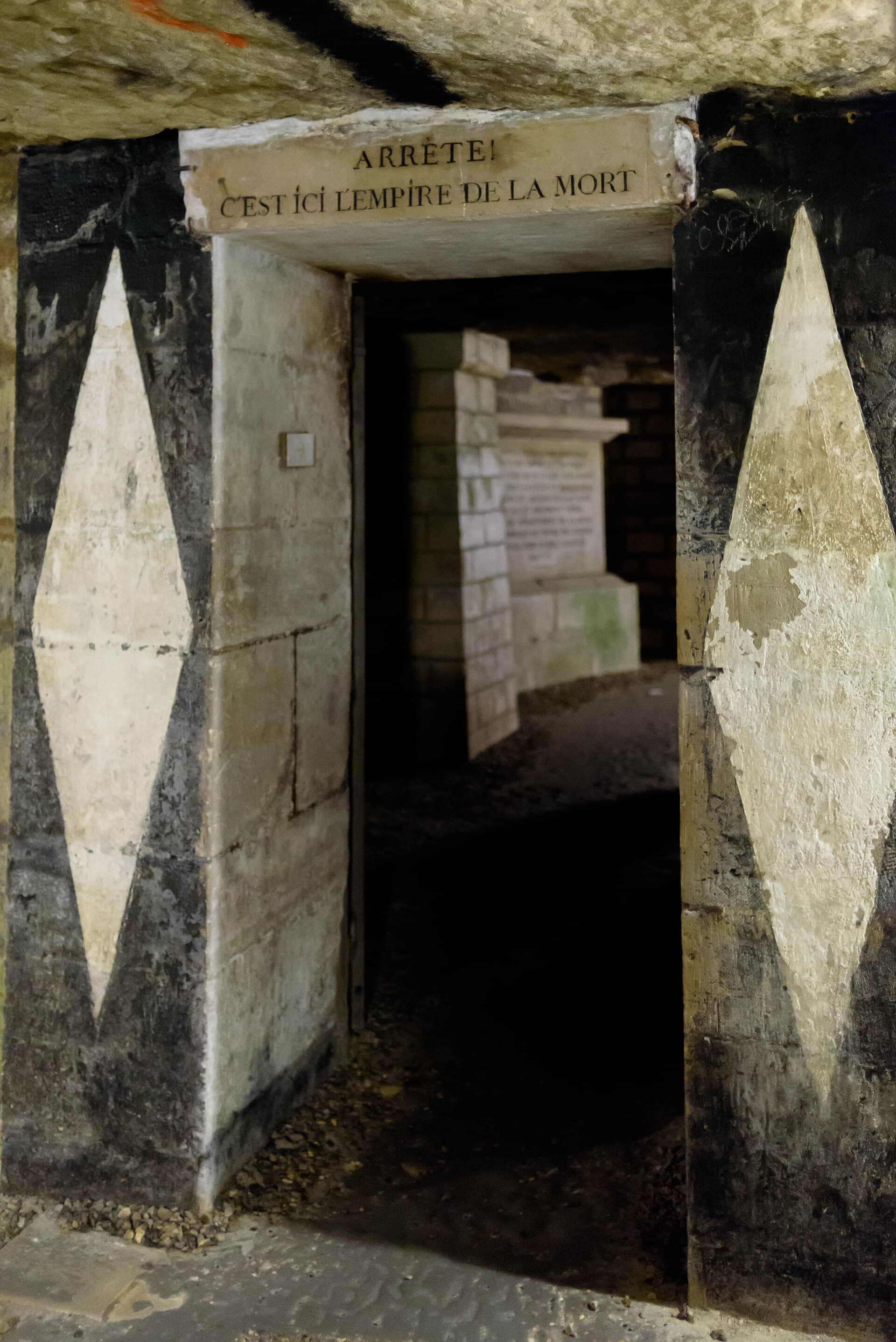
Imagine walking down a narrow spiral staircase off an ordinary Paris street, deeper and deeper, until the noise of the city above fades to nothing. The air turns cold and damp. Your footsteps echo. And then the tunnel walls stop being stone — and become bone. Skulls set in neat rows. Long bones stacked like firewood, wall after wall of them, for hundreds of metres. You are standing inside the remains of more than six million human beings. This is the ossuary of the Paris Catacombs, and it is only a tiny lit corner of something far larger and far darker: a labyrinth of roughly 280 kilometres of tunnels that runs beneath the city, most of it forbidden, unmapped in daily life, and known intimately only to the people who slip down into it in the dark. Some of those people do not come back.
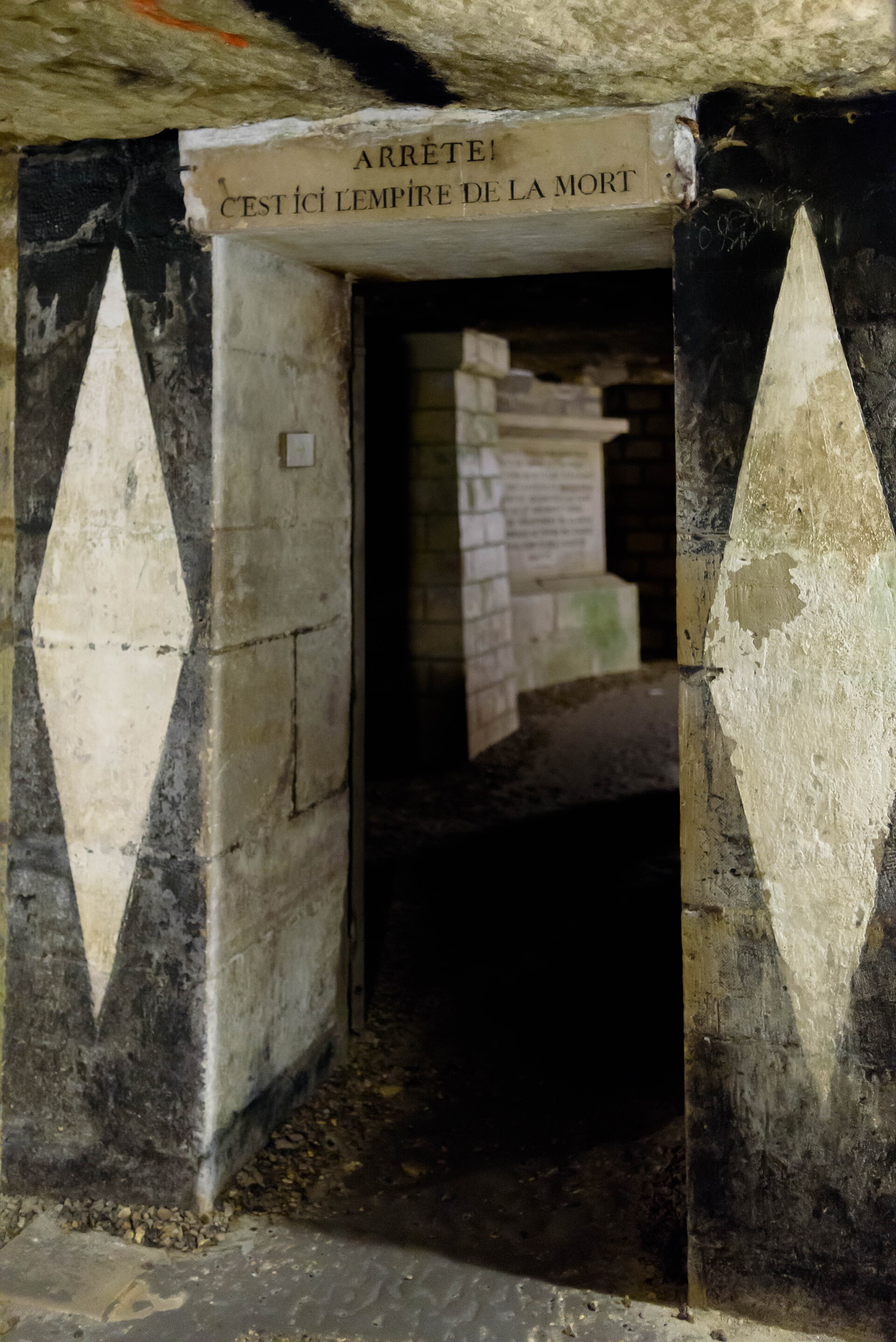
Every archive is a filing problem before it is anything else, and that is what drew me here. I am K. Woo, and the Paris catacombs are the largest filing problem I know of: six million people reduced to skulls and femurs, sorted by bone type instead of by name, stacked into walls by workmen who were solving a public-health crisis and inventing an ossuary by accident. I have spent a long time with the transfer accounts from the 1780s. Not one of those six million is retrievable as an individual. The organizing principle down there is the opposite of an archive — it keeps everything and identifies nothing.
The City of the Dead
The bones did not begin underground. For centuries, Paris buried its dead in city cemeteries, and by the eighteenth century the largest of them — the Saints-Innocents cemetery, which had taken in roughly two million burials over some six hundred years — was catastrophically overfull. The ground itself was saturated with the dead; walls collapsed under the weight of corpses, and the stench and disease seeped into the neighbourhood around it. The solution the authorities settled on was grim in its simplicity. Beneath the city lay a vast web of abandoned limestone quarries — the same quarries whose stone had built Notre-Dame, the Louvre and much of old Paris. So the dead were moved into them.
Starting in the late 1780s, night after night, covered wagons carried bones down into the old quarries in solemn processions. The transfers went on for decades, emptying cemetery after cemetery, until the underground held the remains of more than six million people. Workers did not simply dump them. In the ossuary, the bones were arranged — skulls and femurs stacked into deliberate, almost decorative walls, with plaques bearing verses about death set among them. What began as a sanitation crisis became something stranger: an underground kingdom built entirely out of the anonymous dead of Paris.
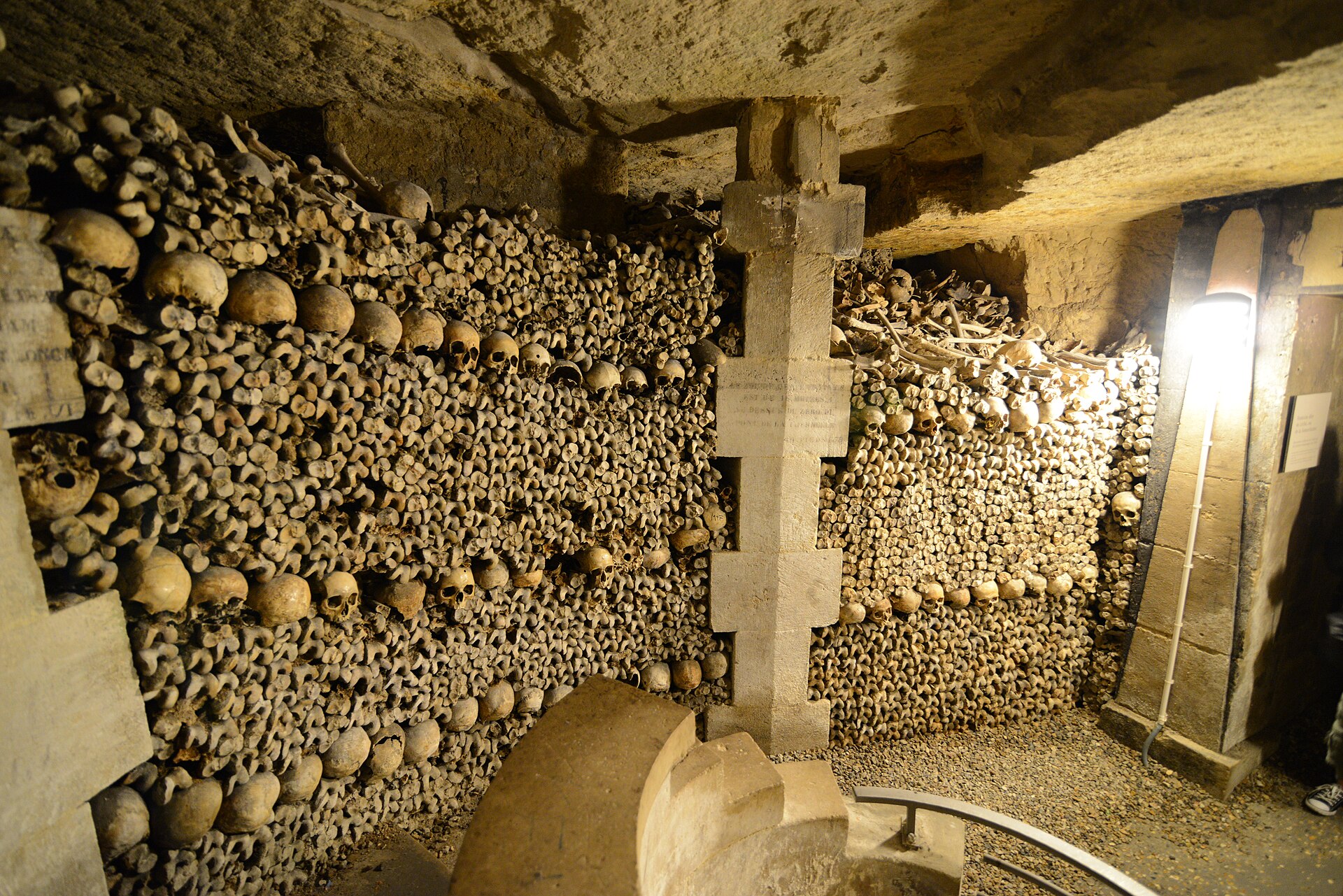
Photo: Wikimedia Commons, CC BY 2.0
The Doorkeeper Who Never Found the Stairs
Long before the tunnels held any bones, they were already dangerous. The oldest of the catacombs' ghost stories is not a legend at all but a documented death — the man whose name still marks the underground more than two centuries later.
In 1793, a man named Philibert Aspairt is said to have descended into the quarries through an entrance beneath the Val-de-Grâce hospital, where he worked as a doorkeeper. Why he went down is not known for certain; one common account holds that he was searching for a cellar of liquor. Whatever the reason, he never came back up. His body was not found until 1804 — eleven years later — and when it was, it lay only a few metres from a staircase that would have led him out. He had been identified, the story goes, by the ring of keys still on him and the buttons of his coat. He is remembered as, in effect, the first of the catacombs' lost, and a tombstone was placed underground to mark where he fell. Eleven years in the dark, a few steps from the way out, never knowing the exit was there. It is the fear the whole labyrinth is built on.
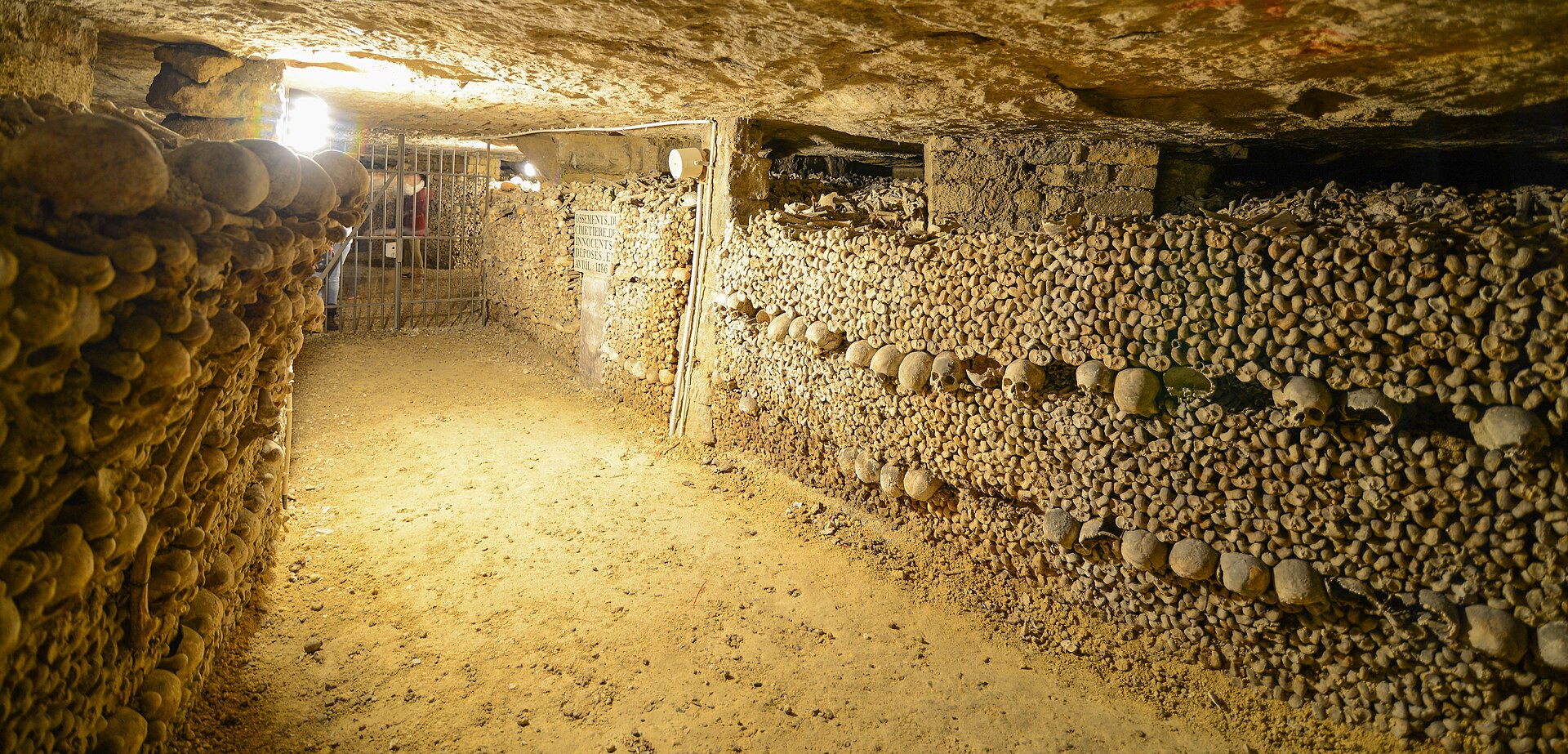
Photo: Wikimedia Commons, CC BY 2.0
The Forbidden Network and the Cataphiles
The stretch of ossuary that tourists visit is barely more than a kilometre and a half of the whole. Beyond the lit and ticketed path lies the rest of it — around 280 kilometres of dark galleries, and entering them without permission has been illegal since 1955. There are said to be fewer than a handful of full-time officers patrolling more than 200 kilometres of tunnel, so once you are down there, in practice, there is almost no authority at all.
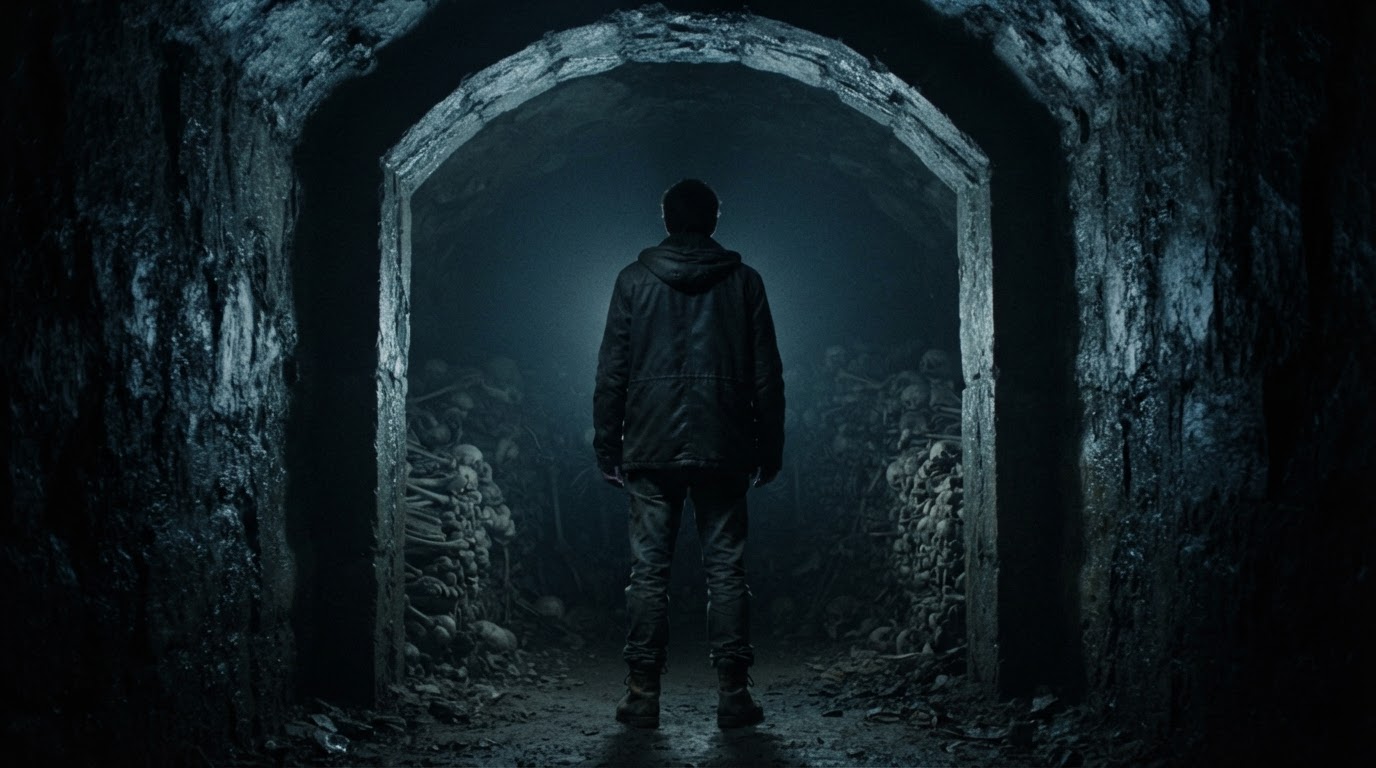
The people who go down anyway call themselves cataphiles. They descend for a night, sometimes for days at a time, through hidden entrances they guard jealously and never publish. Down in the dark they map the passages, paint murals, carve out rooms, and squeeze through chatières — tunnels so narrow you can only crawl. There is a code among them: don't break anything, don't tag over another's work, don't reveal the entrances. But the underground is not forgiving. Some passages are low; some are flooded to the waist or higher; wires and pipes snag at you, and the darkness is total. Without a reliable map and light, the network of identical stone corridors becomes a trap. People do get lost down there. And at least one of them, if the story is to be believed, left behind a record of it.
The Camera in the Dark
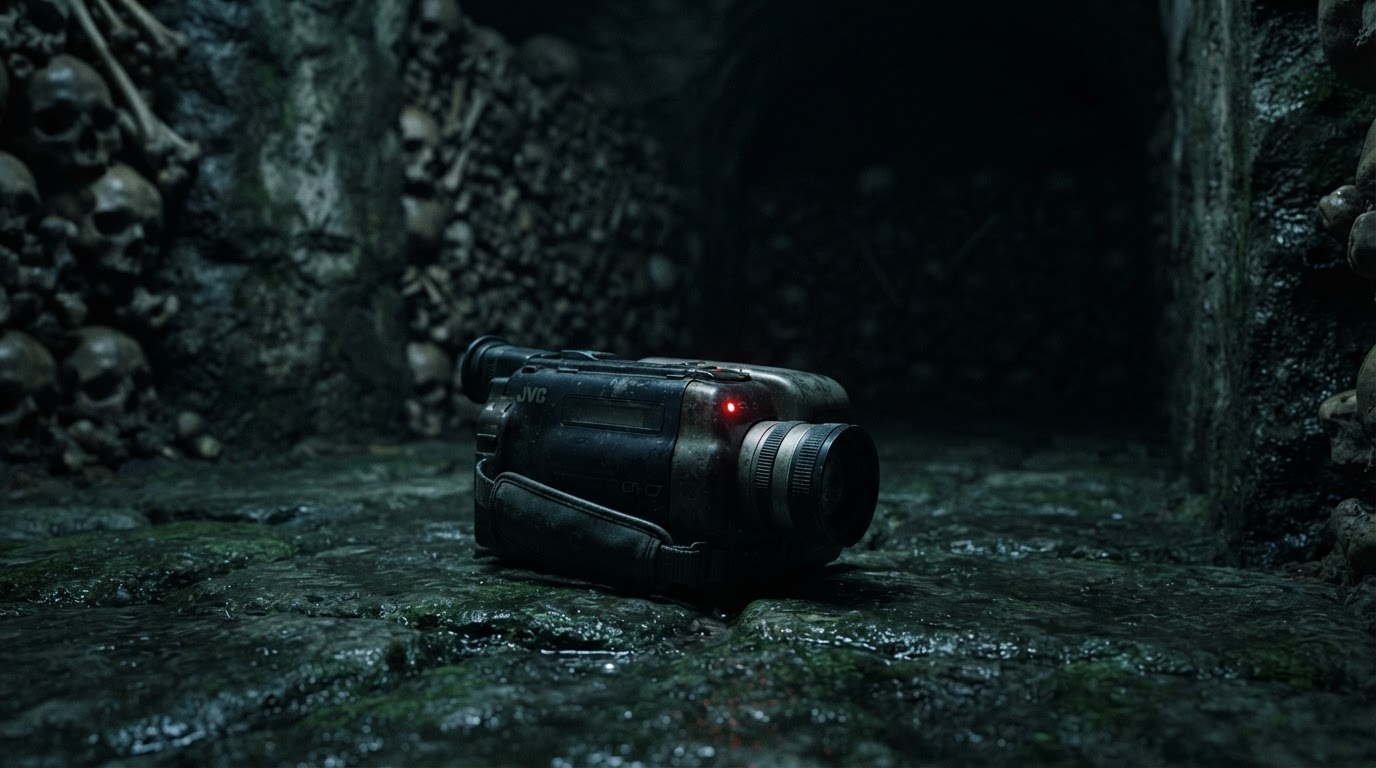
Some time in the early 1990s, according to the account that has circulated ever since, a group of explorers deep in the forbidden tunnels found a video camera abandoned on the ground. When the footage was played back, it showed a man alone in the catacombs. At first he moves calmly through the bone-lined corridors, filming as he goes, apparently sure of where he is. But as the minutes pass, something changes. He grows disoriented. He begins to walk faster, then to run, the camera swinging wildly, the light jerking across the stone as he turns toward shadows. And then, abruptly, the footage ends — the camera falls to the ground and keeps filming the dark. No one who watched it could say what had frightened him, and nothing is ever shown chasing him.
Here honesty matters, because this is where fact ends and legend takes over. The man in the footage was never identified. No body was ever recovered. The clip reached a wide audience through the American television programme Scariest Places on Earth around 2000, and much of what is "known" about it comes from that broadcast rather than any police file. Many who have studied it believe it may well be a hoax — a staged clip that lost its context and grew into a myth. There is no confirmed missing person, no confirmed recovery, no proof at all beyond the tape itself. And yet it endures, because it distils the exact terror of the place: a person alone in a maze of the dead, the light failing, the way out forgotten, and no one who will ever know what happened.
A Cinema Beneath the City
Not everything found in the forbidden tunnels is a mystery of terror. Some of it is simply astonishing. In 2004, police on a training exercise in the tunnels beneath the 16th arrondissement pushed past a sign reading "no public entry" and found, sixty feet under the city, something no one expected: a fully equipped cinema.
Carved into the stone was an auditorium of around 400 square metres. There was a large screen and seats hewn out of the rock, a projection setup with film reels — thrillers and film-noir classics, by the accounts — a bar, a small restaurant, and even a working telephone line, all running on electricity tapped illegally from the grid. As the officers explored, a recording of dogs barking played over a hidden sound system, apparently rigged to scare intruders off. When the police returned three days later, with the electricity board, to trace the wiring, they found the entire cinema stripped bare — the equipment gone, the power cut, the phone lines pulled out. In the middle of the empty floor lay a single note. It read, in effect: do not try to find us. The group behind it, an underground collective devoted to occupying the city's hidden spaces, was never caught. The cinema simply vanished back into the dark, as if it had never been there at all.
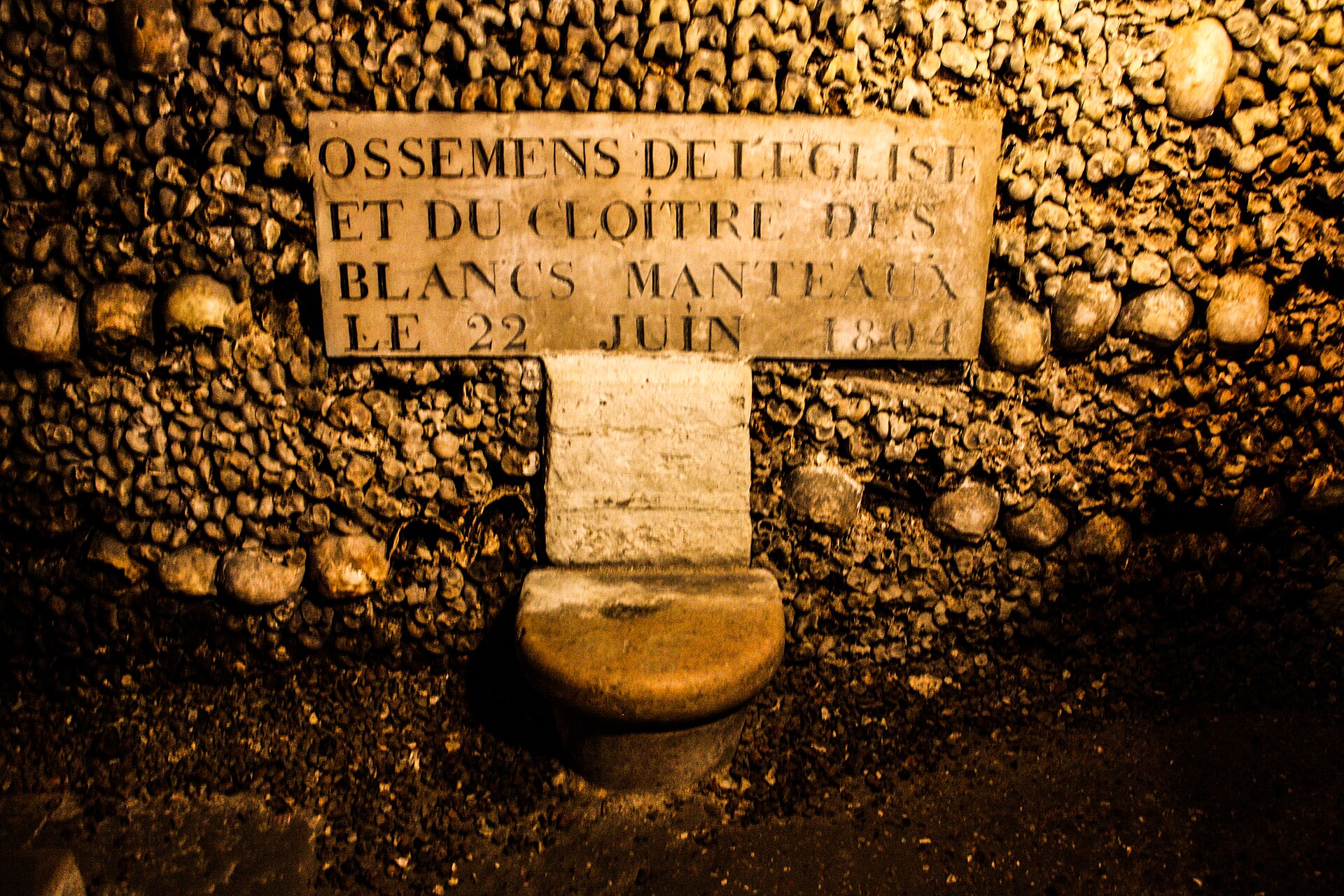
Photo: Wikimedia Commons, CC BY 2.0
What the Dark Keeps
Stand at the edge of the lit path today and you can feel it — the pull of everything past the rope. The tourist route ends; the tunnels do not. They run on for hundreds of kilometres in every direction, black and identical and full of the dead, threaded with the murals and carved rooms and hidden entrances of people the city above will never see. Every so often the news carries a story of someone pulled out after days lost below, or of a rescue that came too late, or of remains found in a passage no one had walked in years.
I have gone back and forth on the camera tape for years, and I no longer think the question of whether it is staged is the interesting one. Set it aside as a hoax if you like. Philibert Aspairt is not a hoax. He is a name, a job, a hospital entrance, a ring of keys, a date of recovery in 1804, and a distance from the staircase measured in metres. That case is fully documented and it is worse than the tape, because it tells you exactly how the labyrinth kills: not with anything following you, but with the exit sitting a few paces away in the dark for eleven years while you fail to find it.
What makes the Paris Catacombs so unshakeable is not a single ghost or a single unsolved crime. It is the scale of the silence. Six million people are stacked into the walls of one lit corner, and around them stretches a labyrinth so vast and so lightly watched that a whole cinema could be built in it unnoticed, that a doorkeeper could die eleven years' walk from the surface, that a camera could film a man's last frightened minutes and no one on earth could ever say who he was. The dark beneath Paris keeps its dead, and it keeps its secrets. And every year, people who know all of this still go down the stairs, into the cold and the bone and the black — and trust that they will find their way back to the light.
---
This article combines real photographs taken inside the Paris catacombs with AI-generated images and video produced to convey the mood of the story.

Comments
No comments yet — leave the first one.