
There is, they say, a poem that must never be read aloud. While it sits on the page in ink, nothing happens. But the moment it takes on a human voice and slips out into the air, something begins. Those who finish reciting it are said to lose their voices, to fall down a flight of stairs within days, to take to their beds with an illness no one can name — and, in the worst tellings, to die. The poem is called "Tomino's Hell." It came into the world in Japan in 1919, a short poem about a boy descending into hell. What we mean to tell today is not the story of the poem itself, but the story of the taboo that has grown around it for close to a century. Let us say it plainly from the start: the curse has no basis. And yet the question of why this "thing you must not read" has kept a chill running down people's spines for so long, and so stubbornly — that is the real story of the day.
Nothing in this archive has made me as self-conscious about my own working habits as this one. I handle the text constantly — checking the 1919 publication of Sakin, comparing translations, verifying the dates — and I have read every line of it with my eyes many times over. Not once, in all of that, have I read it out. There was never a decision involved. I simply noticed, some way into the work, that I had been silently observing a rule I do not believe in, and I have not been able to explain to myself when I started.

A Poem Asleep in a Collection
Tomino's Hell was not a ghost story that sprang up on its own in some dark corner of the internet. It is a real poem, written by a real poet, set down in a real book. The man who wrote it was Saijō Yaso (1892–1970). He was a symbolist poet trained in French literature, a lyricist who would go on to write the words for countless popular songs, and — above all — one of the great children's-song poets of the Taishō era. That the very hand which crafted clear, tender songs for children also wrote a poem about a boy falling into hell is, in itself, something faintly unsettling.
The collection in which "Tomino's Hell" appears is titled Sakin (砂金), meaning "Sand Gold" — the gold that lies mixed among grains of sand. It was Saijō Yaso's first collection of poetry, published in 1919. Beneath that title, a number of lyric poems stood side by side, and quietly wedged among them was this bleak little work. When it first entered the world, the poem carried no rumor of any curse. It was simply a somewhat dark, somewhat sorrowful poem by a young poet. No one feared to read it aloud, and there was no tale of anyone harmed by it. The curse was born long after the poem, in an entirely different age.
Let one thing be made clear here. In this piece we do not reproduce the poem in full. Not because it is genuinely dangerous — that it is not, as we will explain later — but because what this piece means to examine is not the reciting of the poem, but the story that it "must not be read" itself. We need only glance for a moment at the shadow the poem casts, at the outline of its atmosphere.
The Darkness the Poem Draws
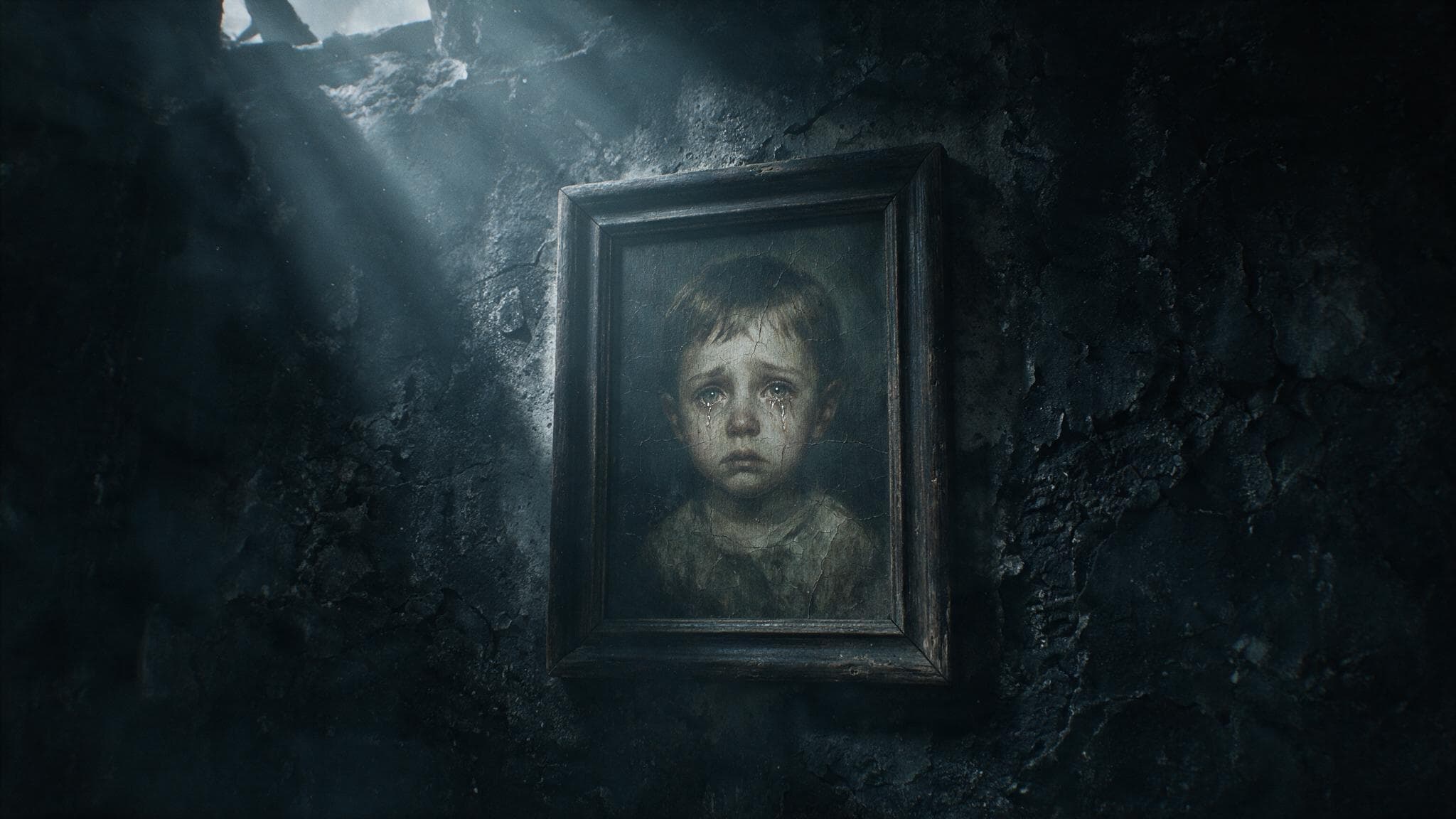
"Tomino's Hell" traces the journey of a boy named Tomino as he descends into hell. The poem's speaker calls out — in a rhythm at once like a lullaby and like an incantation — to a boy who has already vanished into the dark of the underworld. A sister coughing blood, a boy left alone, sliding down into the blackness, lower and still lower: such images run through the whole of the poem. Nothing bright appears anywhere. No saving hand, no road back into view. There is only the endless downward fall, and the voice that watches that fall and keeps repeating the boy's name.
There are several reasons this poem strikes people as so chilling. One is its subject: a child. Coming from the hand of a children's-song poet, the poem wears, in form, the garment of a song for the young, while concealing within it a darkness no child could ever be allowed to hear. That dissonance between the gentle meter and the cruel content scrapes uncomfortably at the mind. Another is repetition. The poem returns again and again to a certain refrain, rolling the same sounds over and over as if chanting a spell. Read aloud, that repetition naturally becomes rhythm, and rhythm, before you know it, sets the reciter's mouth moving as though under a spell. It may be that in exactly this feature the soil was prepared in which the later curse would grow.
But once more, let us stress: all of this is only "the poem's content and atmosphere." That a poem is bleak, and that reading the poem actually brings misfortune, are two entirely different matters. The world holds no end of bleak and sorrowful poems, and not one of them rains physical catastrophe down on its reader. So why was this poem, and this poem alone, branded with the mark of "you must not read it"?
When Was the Curse Born?
The poem took on its garment as a "cursed poem" fully eighty-odd years after its publication in 1919. Saijō Yaso died in 1970 — so the poet who actually wrote it never dreamed his poem would one day trail such a rumor behind it. The story of the curse began to spread in earnest in the early 2000s, around the time the internet had settled deep into people's daily lives. Centered on Japan's vast anonymous message boards, someone pulled this old poem back out and attached to it a single frightening rule. Do not read this poem aloud. Read it, and something bad will happen.
A short clip drifting slowly toward an old poetry book set alone beside a candle — a mood recreation, not real footage.
Carried by the nature of anonymous boards, the story swelled in size almost overnight. One person wrote that "a friend read it aloud for fun, and a few days later took a bad fall down the stairs." Another added that "the person who finished reciting it suddenly went hoarse and could no longer speak." As tales of an unexplained fever after the reading, and even of someone who died within days, were pinned on, the poem grew into a more and more dangerous object. The frightening thing about such stories is that no one can ever confirm the reality of the "friend" or the "someone I know." The catastrophe always befalls not the writer himself but someone one degree removed, and so, impossible either to refute or to verify, the story keeps rolling on.
What is worth noticing is that once the curse was attached, even the poem's original content began to be read anew. The boy falling into hell, the spell-like refrain repeated over and over, the darkness wearing the form of a children's song — these bleak elements the poem had possessed from the start were now read as "proof of the curse." In truth the order was exactly reversed. It was because the poem was bleak that the curse story found it easy to attach; the poem did not become bleak because the curse was there. Yet once you put on the lens of a curse, every line of the poem begins to look like an omen. This is the way a taboo narrative bewitches the eye.
That the Curse Has No Basis
Now we come to the most important part. The curse woven around Tomino's Hell is an urban legend. There is nowhere any evidence to support the claim that reading this poem aloud brings misfortune. For over a hundred years the poem has stood on the shelves of countless libraries and bookshops, and countless people have read it, studied it, quoted it. Had the curse truly worked, catastrophe should have marched in a line through the literary scholars and editors and reciters who handled it. Nothing of the kind occurred.
Above all, the poem is today translated into many languages and widely introduced, and the internet holds an endless supply of videos and recordings in which people actually recite it aloud. Drawn by curiosity, great numbers of people have read this poem from beginning to end, clearly and deliberately, before a camera, before a microphone. If the curse had held even a shred of reality, a statistically visible trail of misfortune should have been left among all those reciters. There should have been far more than the usual number of people who fell down stairs, who lost their voices, who died suddenly. But no such pattern exists anywhere. The catastrophe befalls only "someone within the story," and not once has it ever shown itself in a form that can actually be verified.
A fall on the stairs, a sudden loss of voice, an illness no one can name — these are, in fact, things that happen everywhere in the world, whether or not one reads this poem. People slip on stairs; a cold leaves them hoarse; illness comes upon them out of nowhere. When such ordinary misfortune happens to arrive after one has by chance read this poem, a person who already knows the story of the curse links the two together as a matter of course. "Could it be because I read that poem?" This is precisely the way human beings manufacture cause where there is none, out of random coincidence — and it is the old secret by which every curse story survives.
And Yet, Why It Still Chills
Once you know the curse has no basis, the story ought to lose its power. Strangely, it does not. Even after its true nature has been laid bare, Tomino's Hell still sends a chill down the spine. Why? Its power comes not from any supernatural force in the poem, but from the very structure of the taboo — the "thing you must not read." Tell a person not to do something, and the mind leans, instead, toward it. The box you must not open, the room you must not look into, the poem you must not read aloud — what is forbidden is always alluring, and the tension of the moment you stand hesitating before that temptation is the true fear this story offers.
And this taboo is participatory. Most ghost stories are someone else's distant affair, but Tomino's Hell presses a single choice directly upon you, the one reading these very words. Will you seek out this poem and read it aloud? In the instant of that choice, you become no longer a bystander standing outside the story but a party to it, standing at its very center. To know with your head that the curse is not real, and yet, when you actually try to read the poem aloud alone in the dark of night, to feel your throat catch just slightly — that faint hesitation is itself the proof that this hundred-year-old story is alive even now.
So let us close the tale this way. Tomino's Hell is not a cursed poem. It is only a dark and sorrowful poem in which, in 1919, a poet drew a boy falling into hell. Read it aloud, and nothing at all will happen to you. The stairs will remain safe; your voice will remain your own. But if tonight, having lit a single candle and opened an old collection of verse, you feel your throat catch just slightly at the moment you try to read that first line aloud — that is not a curse. It is only the voices of those who, for a hundred years, have kept this story alive, briefly stirring again within you. That voice, whispering low, that this poem must be read with the eyes alone.
The detail I have never been able to file cleanly is the author. Saijō Yaso spent his career writing songs for children, and he died in 1970, thirty years before anyone thought to call his poem dangerous. He never knew. Whatever he was doing when he wrote a boy sliding down into the dark and gave the poem a refrain that moves a mouth like a chant, he was doing it for his own reasons, in 1919, with no rumor to lean on. I have the collection catalogued and the curse debunked and the dates verified, and I still cannot say what he thought he was making.

---
The images and video in this article are AI-generated works produced to convey the mood of the story, and are not photographs of any actual person or event.

Comments
No comments yet — leave the first one.