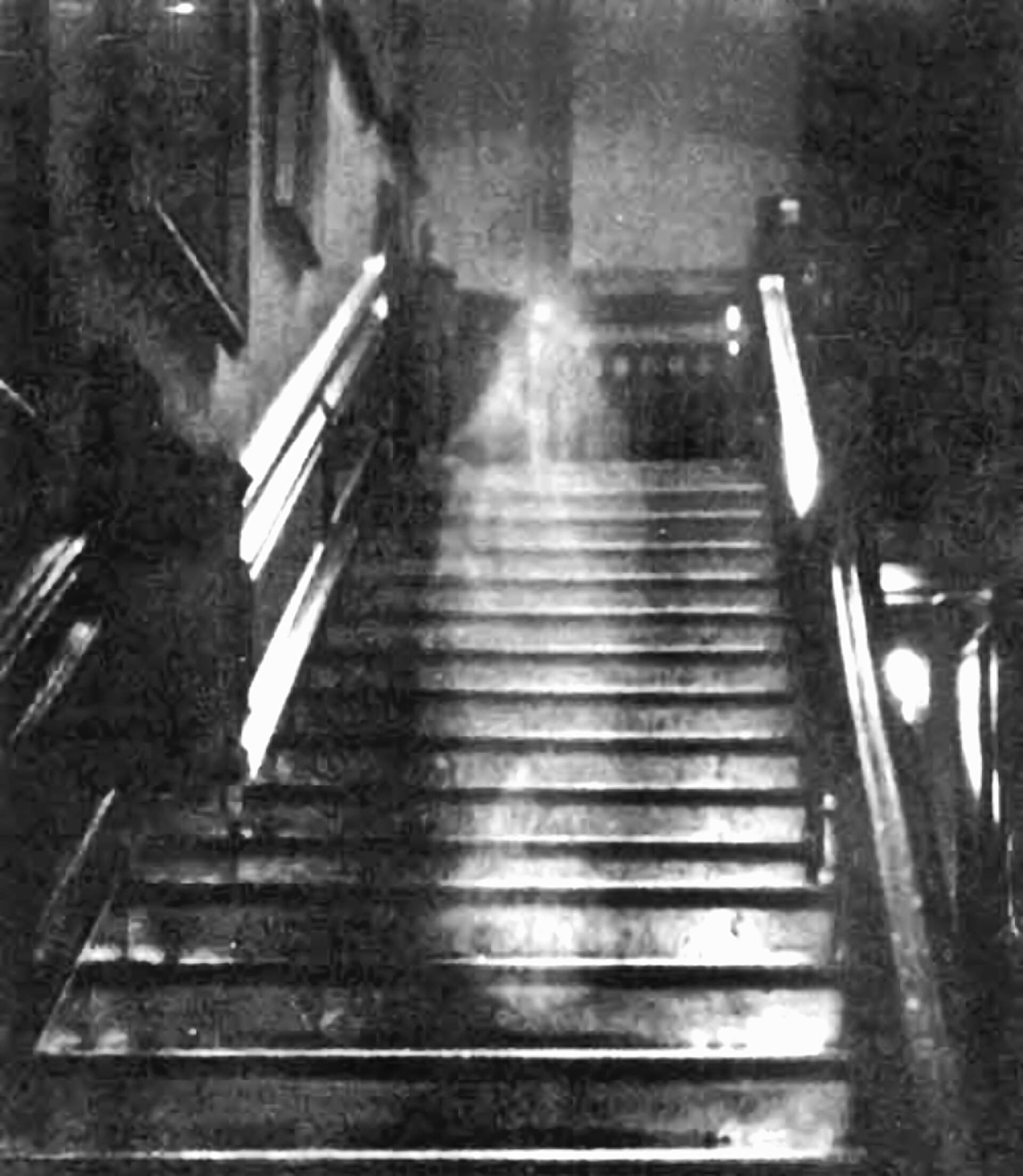
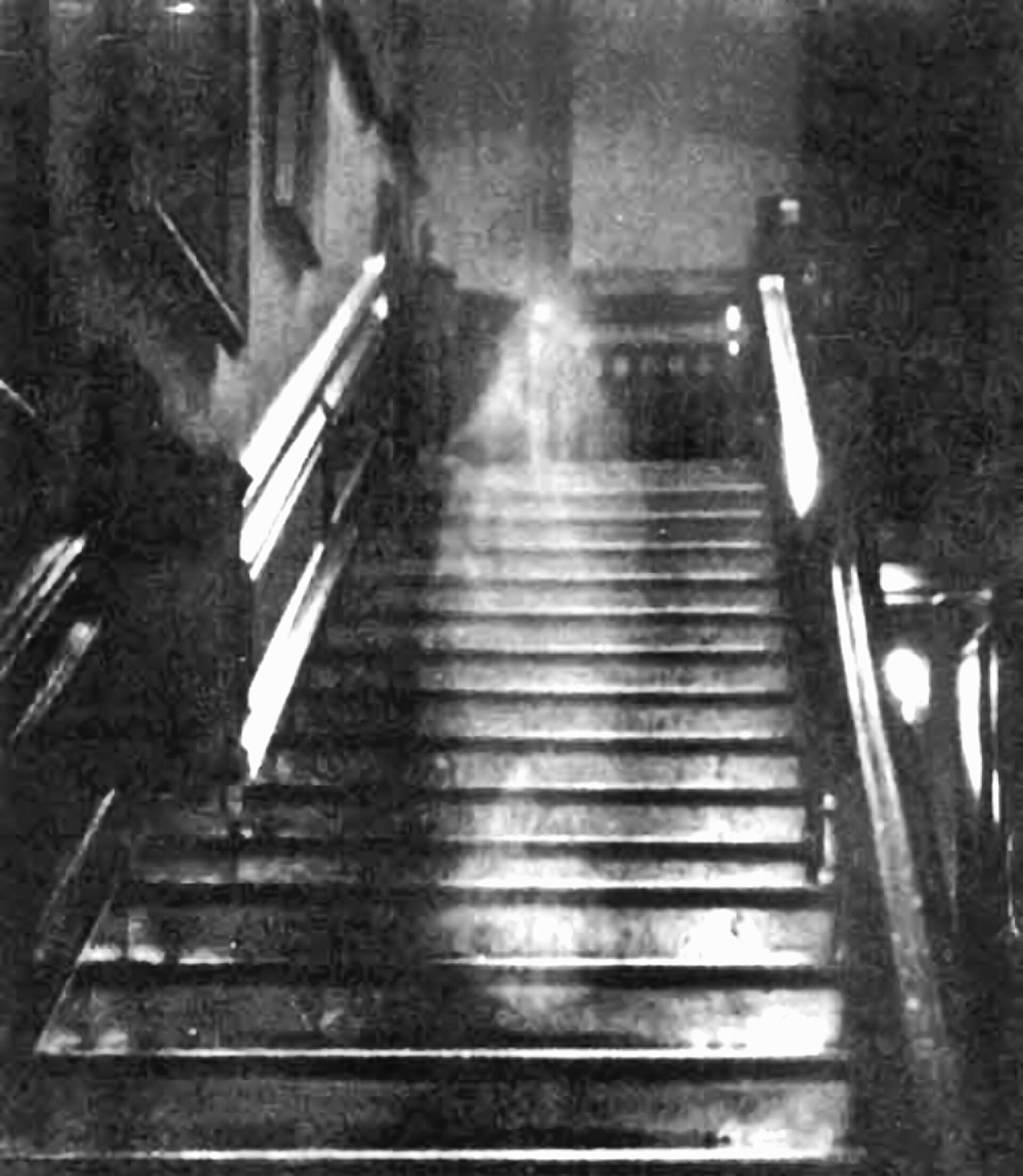
There is one photograph that almost everyone has seen, even if they have never known its name. A grand old staircase, wide and dark, its wooden banister curving down out of the shadows. And on the stairs, halfway down, a shape — a woman, or the suggestion of a woman, made of nothing but pale light. She has no face you could describe. She seems to be walking toward the camera, one veiled form flowing down toward the person who pressed the shutter. It was taken in September 1936, in an English country house called Raynham Hall, and for close to ninety years it has been called the most famous ghost photograph in the world. In all that time, no one has proven it a fake. And no one has proven it real. This is the story of the Brown Lady of Raynham Hall.
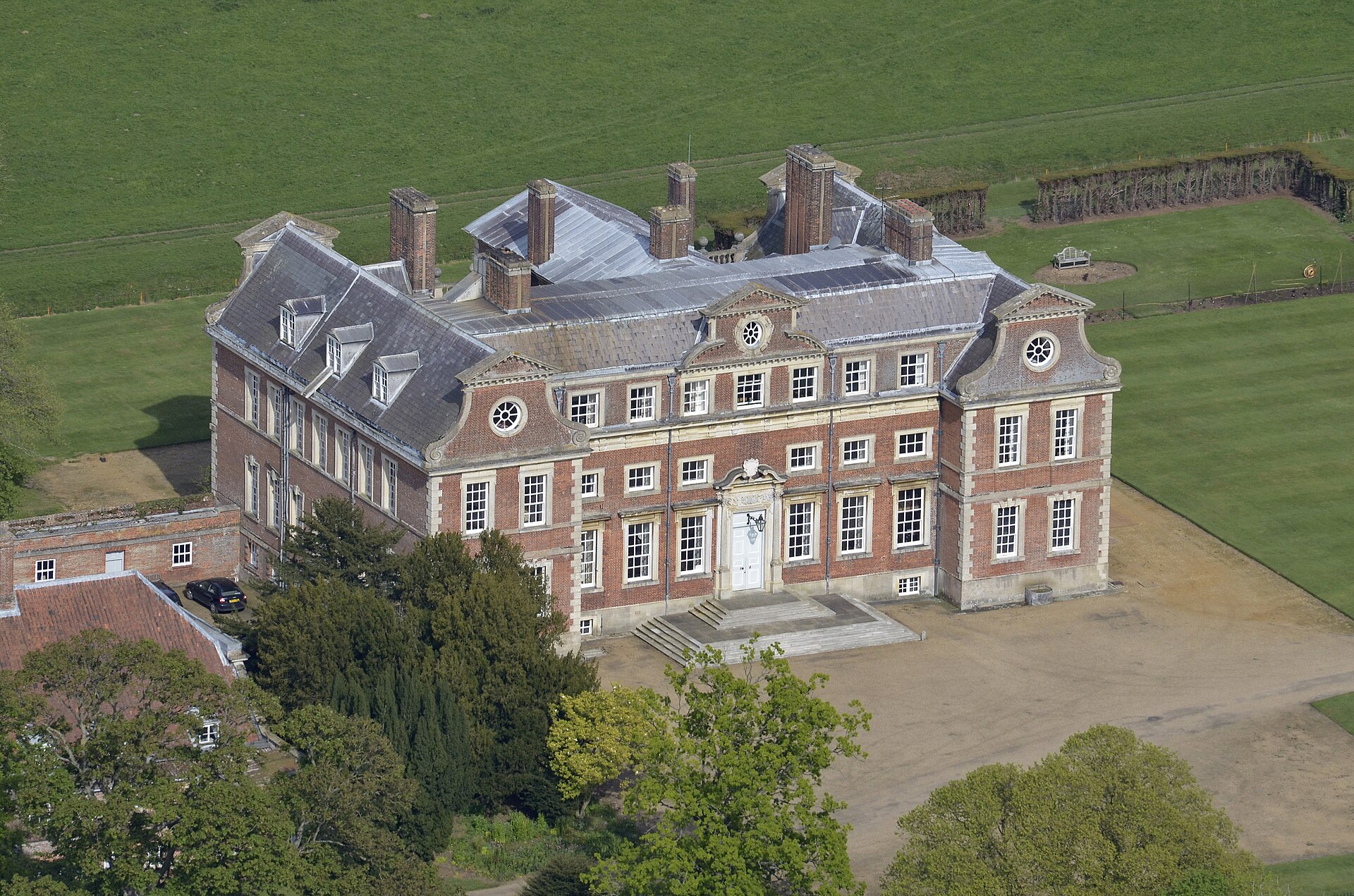
Photo: Wikimedia Commons, CC BY 2.0
I am K. Woo, and I keep this archive. This particular file has been open on my desk longer than most, because of a detail that has nothing to do with the ghost: Provand, the man operating the camera, saw nothing at all. He pulled the cap off the lens on someone else's word. I have collected a great many accounts of apparitions, and almost all of them come to me from the person who looked. This one comes from the person who didn't — and it is his plate, not his eyes, that has been argued over for ninety years.
The Woman in the Brown Dress
Long before there was a camera anywhere near Raynham Hall, there was a story about a woman who walked its corridors in a brown dress.
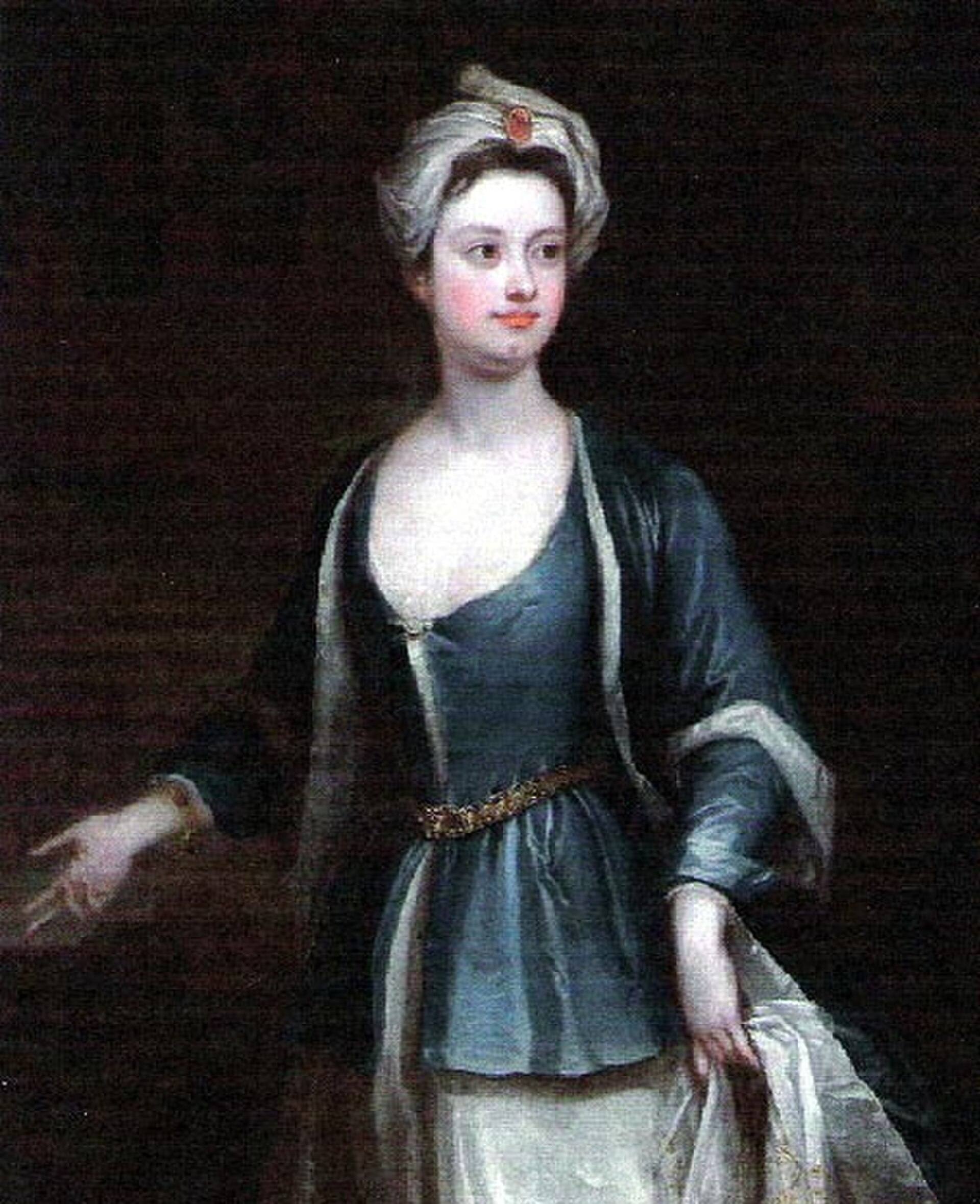
The house sits in the county of Norfolk, in the east of England — a large, handsome manor built in the early seventeenth century, the seat of the Townshend family for generations. And the ghost that is said to walk there has a name and a history, which is itself unusual. She is believed to be Lady Dorothy Walpole, born in 1686, the sister of Sir Robert Walpole, the man often called Britain's first prime minister. In 1713 she married Charles Townshend, the 2nd Viscount Townshend, and came to live at Raynham Hall as its mistress.
The legend that grew up around her is a bitter one. Her husband, the story goes, was a proud and violent-tempered man. When he came to believe that Dorothy had been unfaithful — that she had carried on an affair — he did not divorce her or send her away in disgrace. Instead, so the tale runs, he had her confined to her own rooms in the house, forbidding her ever to leave, keeping her a prisoner in her own home until she died there of smallpox. Whether every detail of this is true is impossible to say now; it comes down to us through generations of retelling. But it is the story people believed, and it is the story that gave the figure on the stairs her sorrow. A woman shut away from the world, dead within walls she was never allowed to leave.
She is remembered, above all, for the colour of her dress — a brown brocade gown, old-fashioned even by the standards of those who claimed to see her. From it comes the only name history has kept for her: the Brown Lady.
The First Sightings
The first accounts of the Brown Lady long predate any photograph. They reach back to the winter of 1835.
That Christmas, according to the story handed down, Raynham Hall was full of guests. Among them was a man named Colonel Loftus. Late one night, as he and another guest were making their way to their bedrooms, they saw a woman ahead of them in the corridor — a lady in an old brown dress. There was nothing at first to mark her as anything but another guest, until they drew closer and she was simply, impossibly, gone. The following night Loftus saw her again. This time he was near enough to look at her face, and what he described has followed the Brown Lady ever since: where her eyes should have been, there were only dark, empty sockets — hollows in a faintly glowing face.
Word of the haunting spread, and in time it drew a determined skeptic. In 1836 the novelist Captain Frederick Marryat, a famous author of seafaring tales and a man with no patience for ghost stories, came to Raynham Hall convinced the whole business was a hoax — perhaps a trick got up by local smugglers to frighten people away from the house. He arranged to spend the night in the haunted room, and he brought a pistol.
What Marryat later claimed to have experienced did nothing to reassure him. In the corridor, by the light of a lamp, he came face to face with a woman in a brown dress — and, he said, she turned toward him and grinned at him in a horrible, knowing way. Marryat raised his pistol and fired straight at her. The bullet, he insisted, passed clean through the figure and struck the door behind, where it lodged in the wood. The woman was simply not there for it to hit. A man who had come to disprove a ghost left having fired a real bullet at one.
September 1936 — The Photograph
For a century the Brown Lady lived only in stories. Then, on the 19th of September 1936, she was — so two men swore for the rest of their lives — caught on a photographic plate.
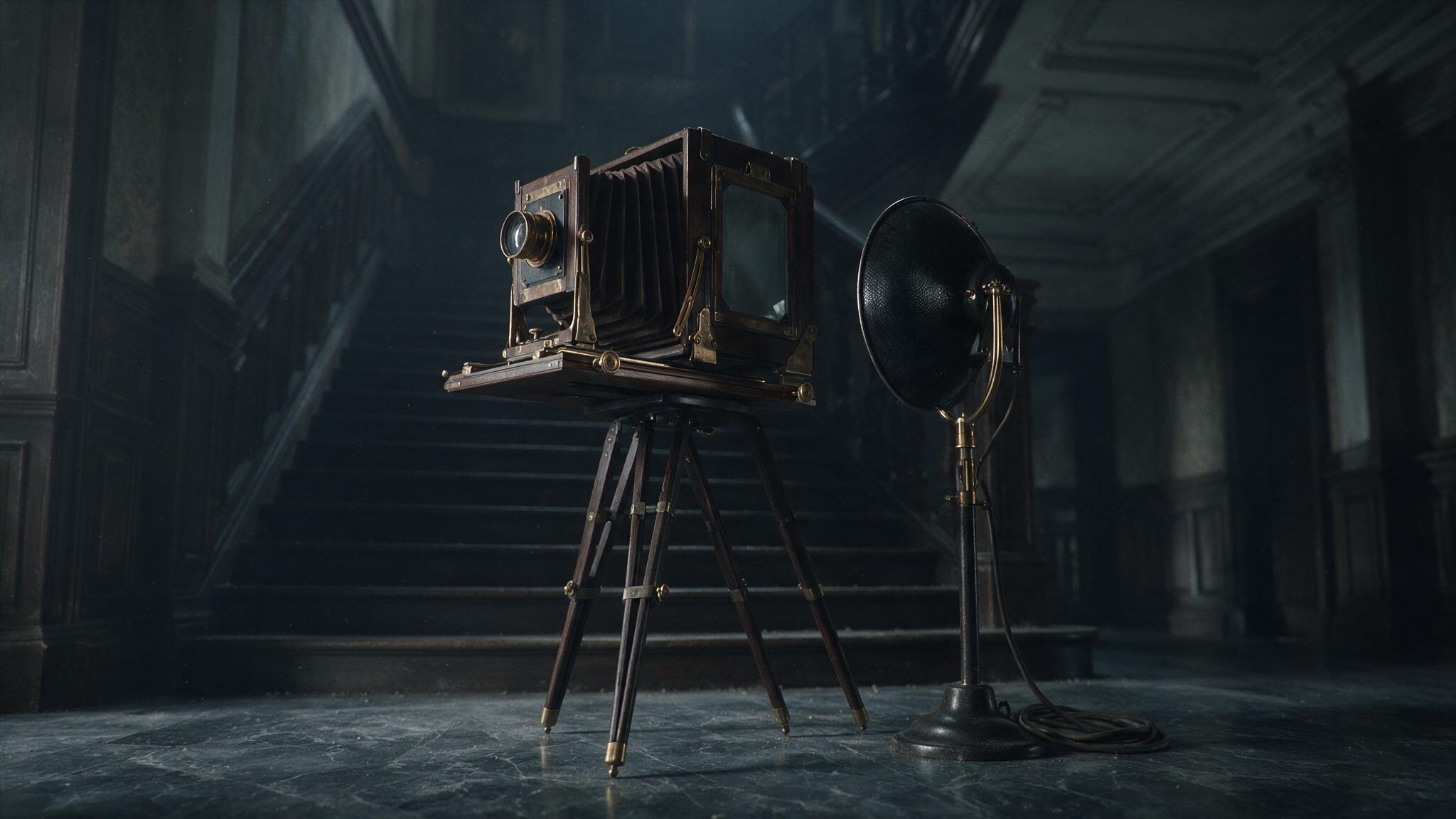
That day, Raynham Hall was being photographed for the magazine Country Life, which was preparing a feature on the house. The work had been given to a London photographer, Captain Hubert C. Provand, and his assistant, a man named Indre Shira. The two were experienced professionals, moving through the great rooms of the hall with their heavy camera and flash equipment, photographing the interiors one by one.
They came at last to the grand oak staircase. Provand set up the camera at the foot of the stairs, framed his shot, and took one exposure. He was bent over the camera preparing a second when his assistant, Shira, standing beside him and looking up the staircase, suddenly saw something. Later he would describe it as a vapoury form — a faint, misty shape gathering at the top of the stairs and beginning, slowly, to move down toward them, gradually taking on the outline of a woman draped in veils.
Shira shouted for Provand to be quick. Provand, who could see nothing on the stairs himself, snatched the cap off the lens on his assistant's word, and Shira pressed the trigger to fire the flash. There was a burst of light. The two men argued about it at once — Provand insisting there had been nothing there, Shira insisting there had. There was only one way to settle it, and that was to develop the plate.
What Came Back on the Plate
When the negative was developed, the argument ended.
There on the staircase, exactly where Shira had said he saw her, was a figure. A translucent form of pale light, roughly the shape of a woman in a long draped gown, appeared to be descending the stairs — one arm at the banister, the veil of light flowing down toward the camera. Through her body the steps of the staircase could still be faintly seen. She had no clear face. She was simply there, on the stairs, in a photograph of an empty house.
Country Life published the image that December of 1936, and the reaction was immediate and enormous. Here at last, it seemed, was a photograph — not a painting, not a tale told by a nervous guest, but a genuine photographic negative — that showed a ghost on the very staircase where a ghost had been reported for a hundred years. In January 1937 the American magazine Life reprinted it, and the picture travelled around the world. It has never really stopped travelling since. Reproduced in book after book, article after article, it became the single image that, for millions of people, made the idea of a ghost photograph seem possible.
The two photographers signed statements swearing to the truth of what had happened — that they had not tampered with the plate, that they had photographed exactly what was before them. And here the story might have ended, as a simple wonder, were it not for the skeptics. Because from the very first, there were people who looked at that beautiful, impossible image and asked a hard question: what if the camera had made the ghost?
The Case for a Trick of the Camera
To believe the photograph is genuine is to believe something enormous. And so, for nearly ninety years, careful people have tried to find the ordinary explanation hiding inside the extraordinary one.
The most common is the double exposure. In the cameras of 1936, it was entirely possible to expose the same plate twice — to lay one image on top of another. If, by accident or by design, an earlier faint image of some pale, roughly human shape had already been captured on that plate, then the second exposure of the empty staircase would have laid the staircase over the ghost, producing precisely the transparent, drifting figure we see. Some skeptics have gone further and suggested a specific culprit: that the "ghost" is a doubled image of a statue — a pale figure of the Virgin Mary, perhaps — accidentally superimposed on the stairs.
Others have pointed to simpler accidents of the equipment. A smear of grease on the lens; a stray flash of light leaking onto the plate; a reflection; a fault in the developing. Any of these, the argument runs, could produce a soft luminous smudge on the finished image that the eye, primed by a century of ghost stories, readily reads as a woman coming down the stairs. And there is the human factor, which no chemistry can rule out: Shira, the assistant, was the only one who claimed to see the figure with his own eyes; Provand saw nothing. A story told by one excited man, in a house famous for its ghost, is not the strongest of evidence.
These are serious objections, and an honest telling has to give them their full weight. The photograph could be a double exposure. It could be a smear of light. Many who have studied it are convinced it is nothing more.
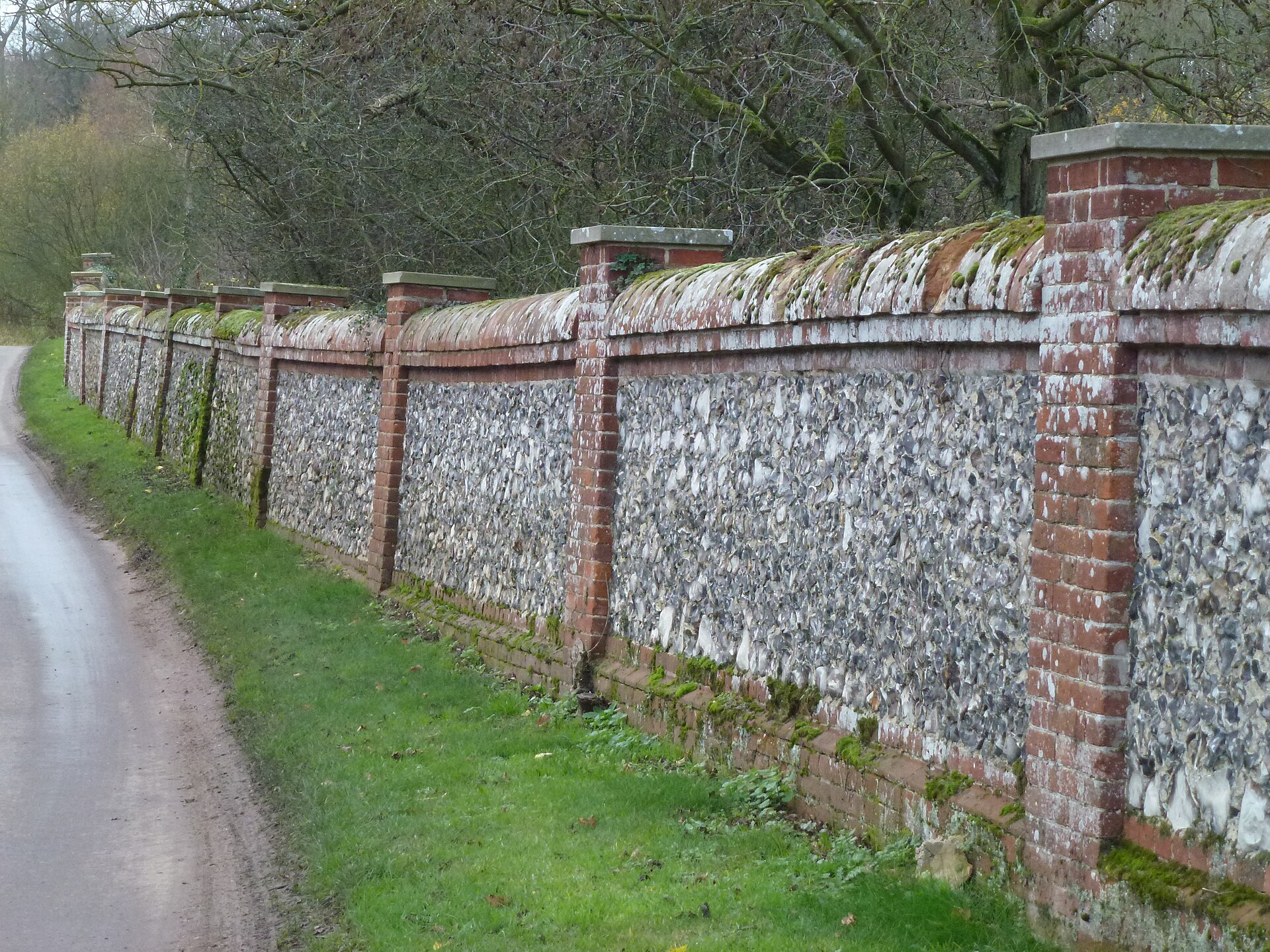
Photo: Wikimedia Commons, CC BY-SA 2.0
The Thing That Won't Quite Be Explained
And yet.
For all the strength of the skeptical case, something strange has happened over the decades. The photograph has been examined again and again — by photographic experts in the 1930s, by later analysts with better tools, by visual-effects specialists who understand exactly how images can be faked, by digital forensics examiners of our own century. It has been picked over about as thoroughly as any single photograph in history. And the odd, stubborn result of all that scrutiny is this: no one has ever definitively proven how it was done.
If it is a double exposure, no one has been able to show conclusively that it is one, or to reproduce the exact effect and say there, that is how it happened. If it is a smear or a light leak, the smear has never quite been pinned down. Each explanation is plausible; none has ever closed the case. The Brown Lady photograph occupies a peculiar and rare position — too suspicious to be simply accepted as a real ghost, too resistant to analysis to be simply dismissed as a proven fake. It has, in a phrase that has followed it for decades, never been debunked. But neither has it ever been believed by the people whose job is to doubt.
What keeps me returning to this folder is not the figure on the stairs. It is the shape of the record itself. Every other case I hold either collapses under enough scrutiny or was never scrutinised at all; this one has been taken apart by ninety years of specialists who each announced a mechanism and then failed to reproduce it. I have re-read the 1936 statements and the later analyses until the sentences have gone flat in my mouth, and the residue is always the same: a bullet lodged in a door in 1836, a plate developed in 1936, and a gap between them that no one has closed.
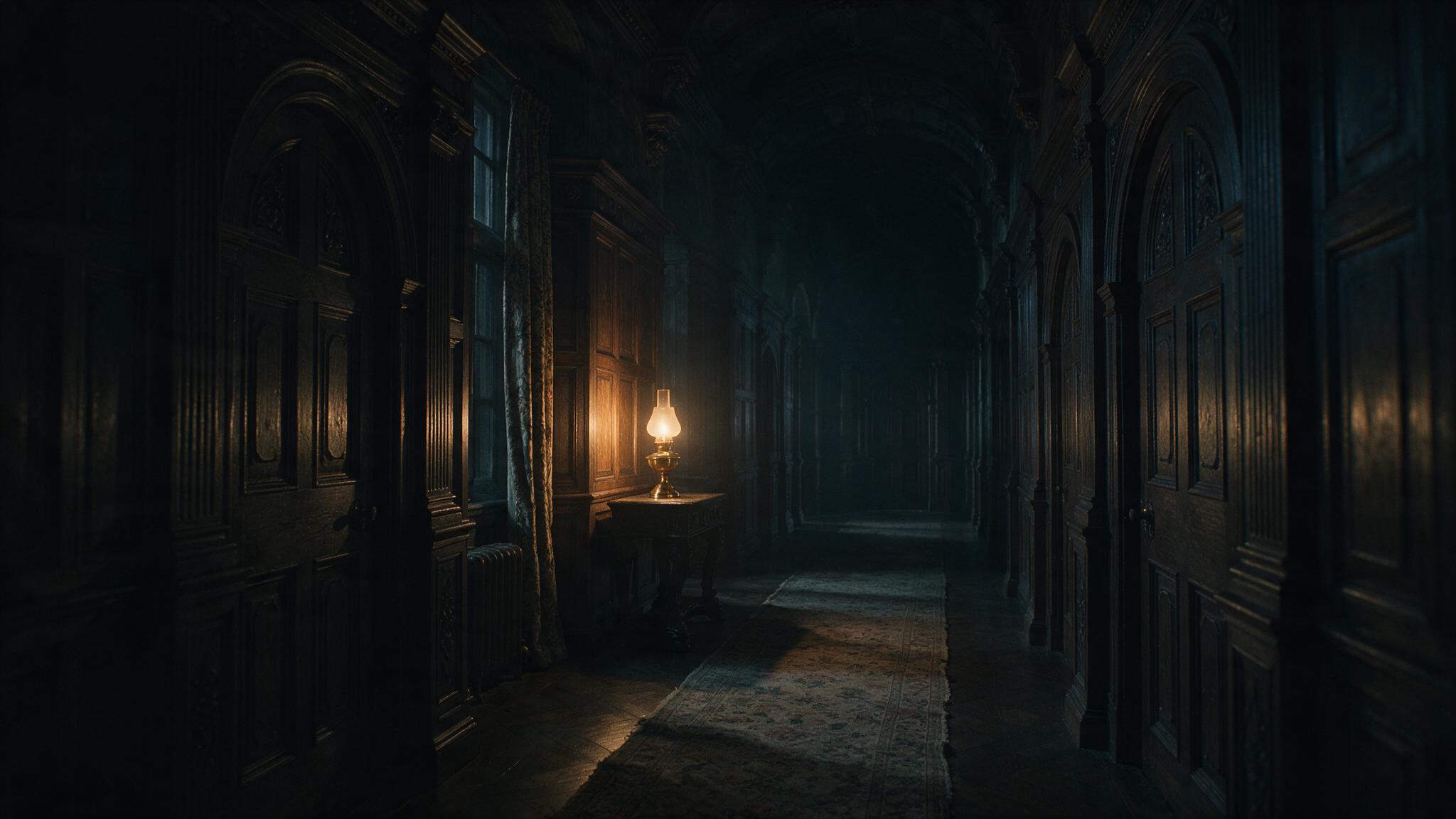
Watch the short mood clip below — a slow drift down a dark manor staircase toward a shape that never quite forms. It is a recreation of atmosphere, not real footage of anything.
What we can say for certain is small, and all the stranger for it. In September 1936, two professional photographers stood at the bottom of a great staircase in an old English house that had been telling a ghost story for a hundred years. One of them said a woman of mist was coming down the stairs. They fired the flash. And when they developed the plate, there she was — a veiled figure of light, descending, faceless, exactly where the stories had always put her. Perhaps the camera simply invented her out of grease and accident and a nervous man's imagination. Or perhaps, for a single burst of magnesium flash, the Brown Lady of Raynham Hall walked down her stairs one more time, and let herself be seen. After ninety years, the photograph still refuses to tell us which.
---
This article combines genuine archival and on-site photographs with AI-generated images and video produced to convey the mood of the story.

Comments
No comments yet — leave the first one.