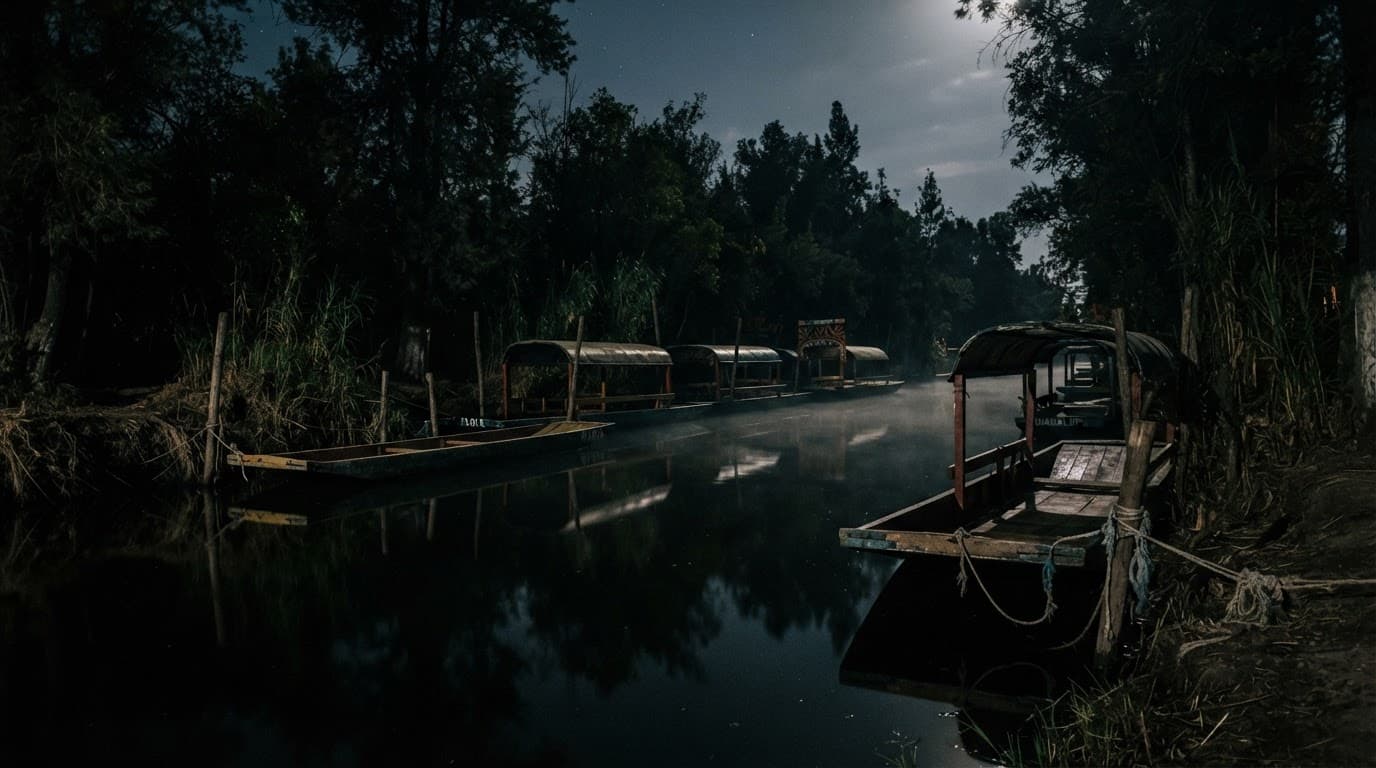
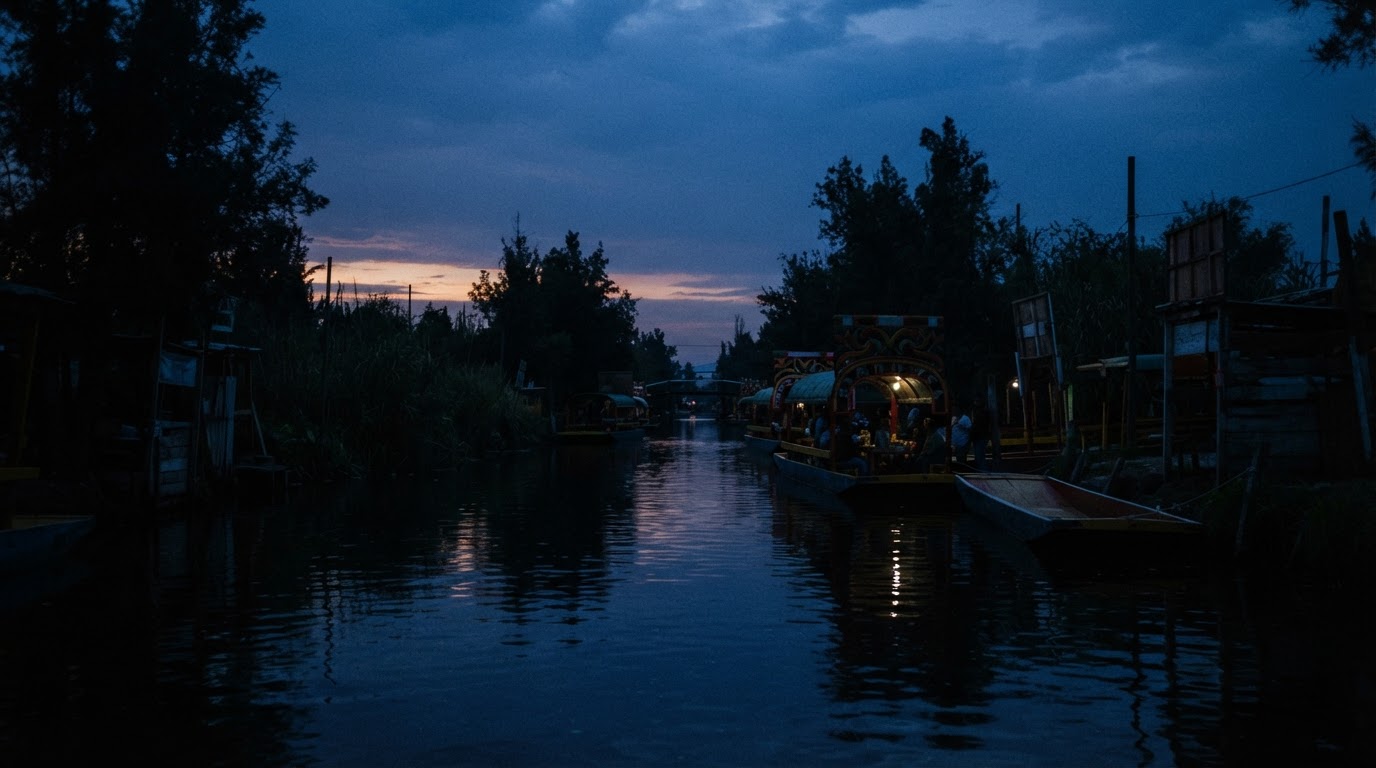
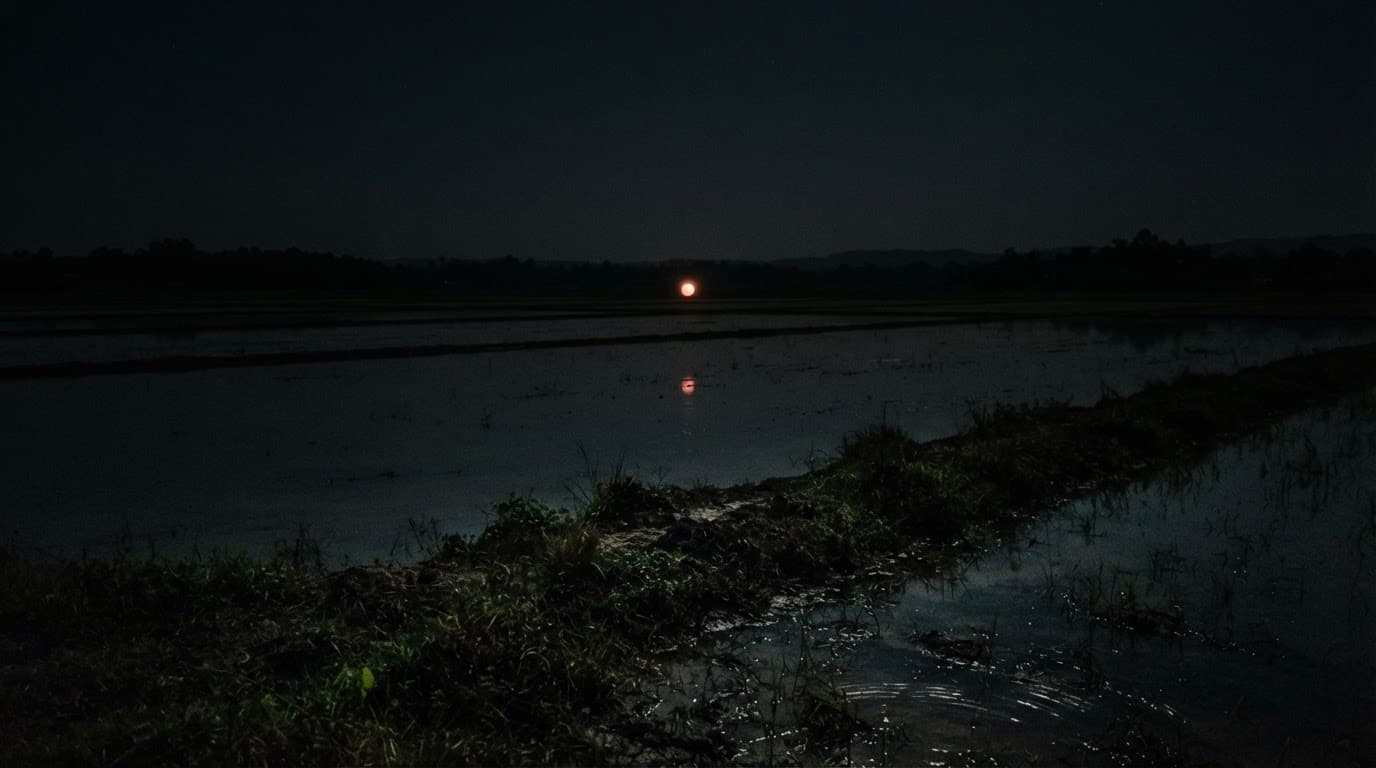
The water is black and it is holding still.
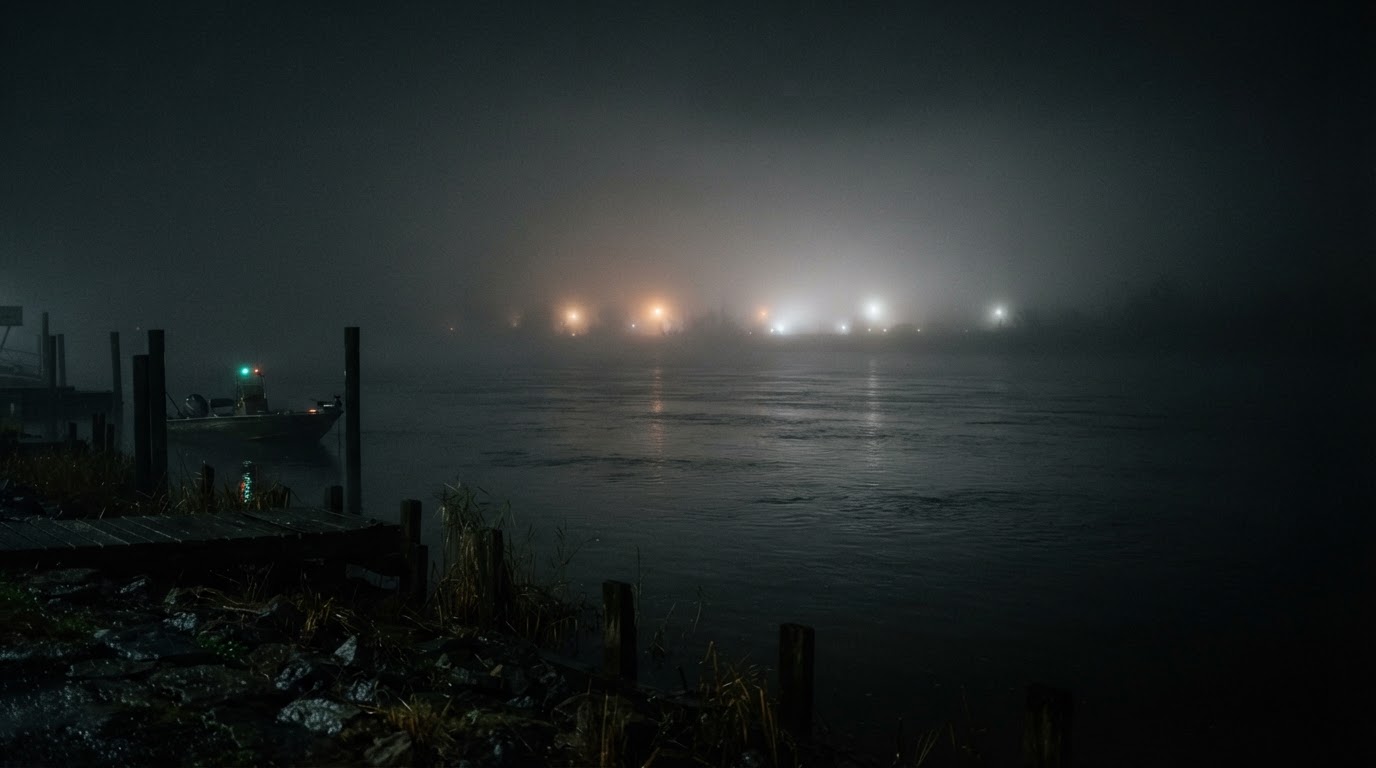
It is late on a canal path in Xochimilco, the old lake-city grid of channels and floating gardens at the southern edge of Mexico City, and the trajineras — the long flat-bottomed boats, painted in daytime colors nobody can see now — have been tied up and left. The music is gone. The vendors are gone. What is left is the smell of wet earth and the small sounds a canal makes to itself in the dark: a reed shifting, a drop, the give of water against a hull. And then, out over the surface, thin and unmistakable, a cry.
A woman weeping. Not close — or so it seems. It comes from somewhere across the water, a high broken sound rising and falling, and inside it, if you listen, a word. Mis hijos. My children. Then again, further off, thinner: Ay, mis hijos. You stand very still on the path. The rule your grandmother taught you, if you grew up here, arrives before the fear does — and it is the wrong way around, and that is what frightens you. When she sounds far, she is near. When she sounds near, she is far. The cry is far.
Which means she is not.
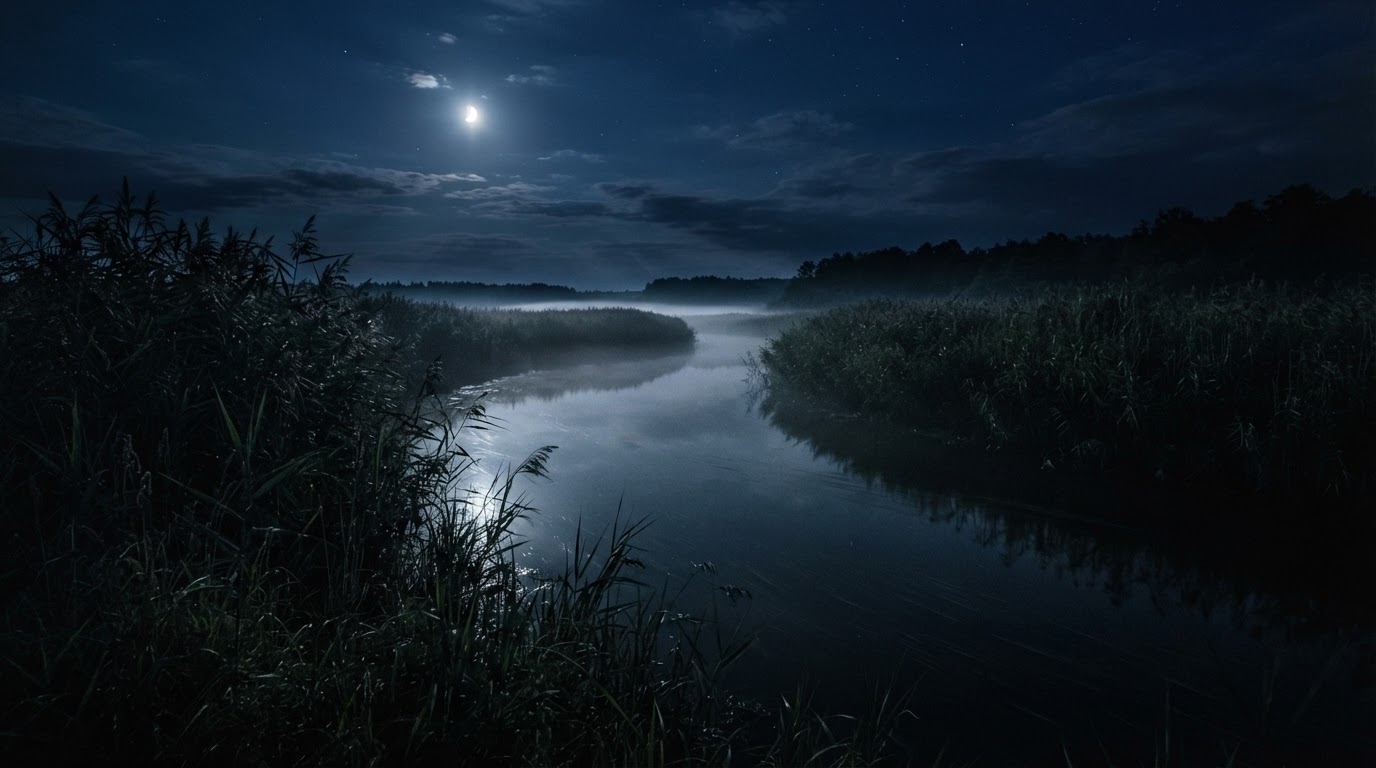
Sahagún's sixth omen is what pulled this file open, and it opened in the wrong direction. I had expected to trace a colonial ghost story backward until it thinned out into nothing; instead the trail ran straight into a compilation made by a Spanish friar out of Mexica testimony, and there she already was, weeping in the streets of a city that had a year left. What unsettles me is the tense of it. She is not mourning children who drowned. She is asking where she can take them — grief filed in advance, before there was anything to grieve.
The Story, As It Is Told
She had a name once, before she was only a sound. In most tellings it is María, and the story goes that she was poor and uncommonly beautiful, in a village beside a river, in a time no one fixes exactly. A man came — richer than her, higher than her, the kind of man a village girl is warned about and loves anyway. He married her, or he did not; the tellings differ, and the difference matters less than what follows. She bore him children. Two, in most versions, or three. And for a while there was a life.
Then the man's love thinned and cooled, the way the legend always says it did. Perhaps he left for a woman of his own class. Perhaps he stayed but looked through María as though she were window glass, and doted only on the children, and let her feel each day how little of him was left for her. The story is careful here, and so are we. What it says is that something broke in her — a grief and a jealousy and a rage that had nowhere to go — and that on one terrible evening, beside the river, in a moment the legend never lingers on and never forgives, the children went into the water and did not come out.
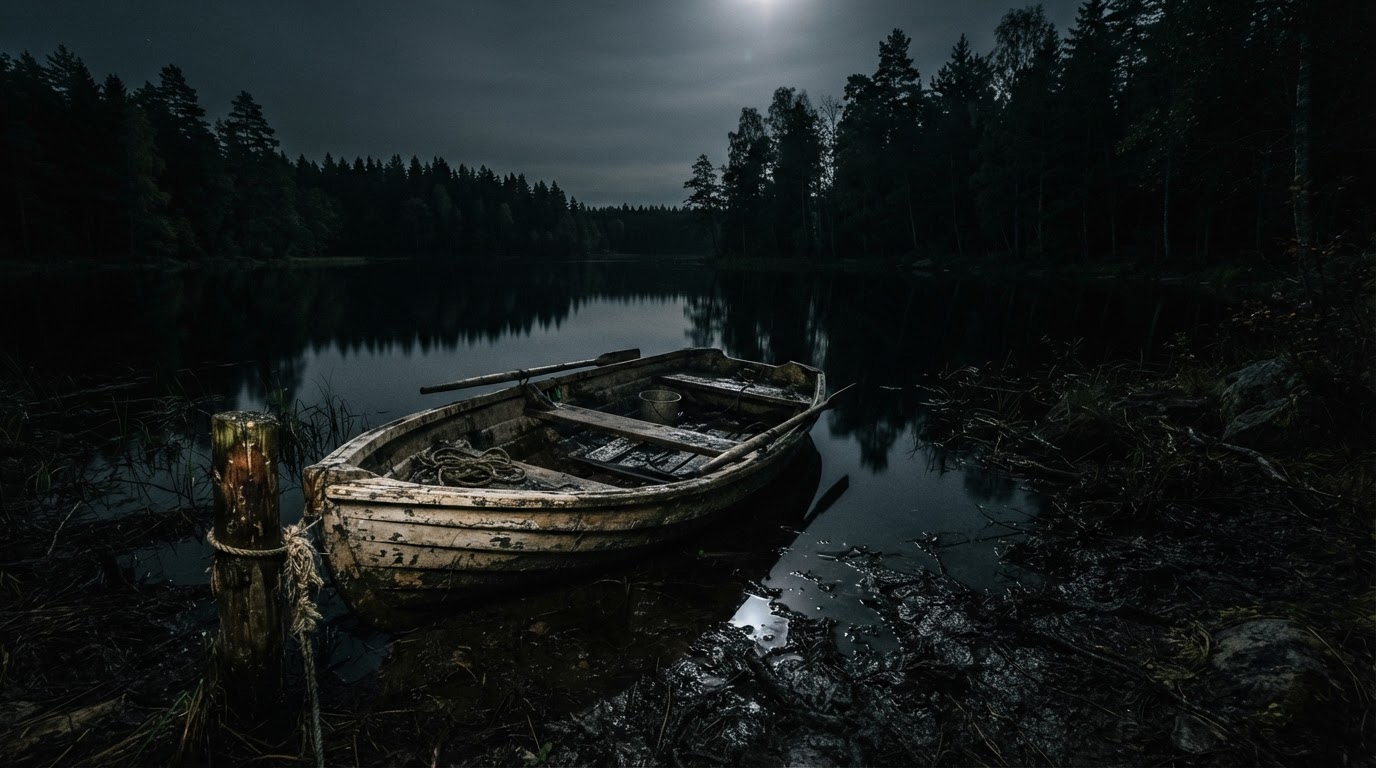
The story does not dwell on how. It turns its face away, the way the tellers always have, and speaks only of what came after: that when the madness lifted and she understood what the river now held, María went in after them. Or she wandered the bank until grief or exposure took her. Or she simply stood at the water's edge and wept until she died there, calling their names into a current that would not give them back. However her mortal life ends — and it always ends by the water — her weeping does not end with it.
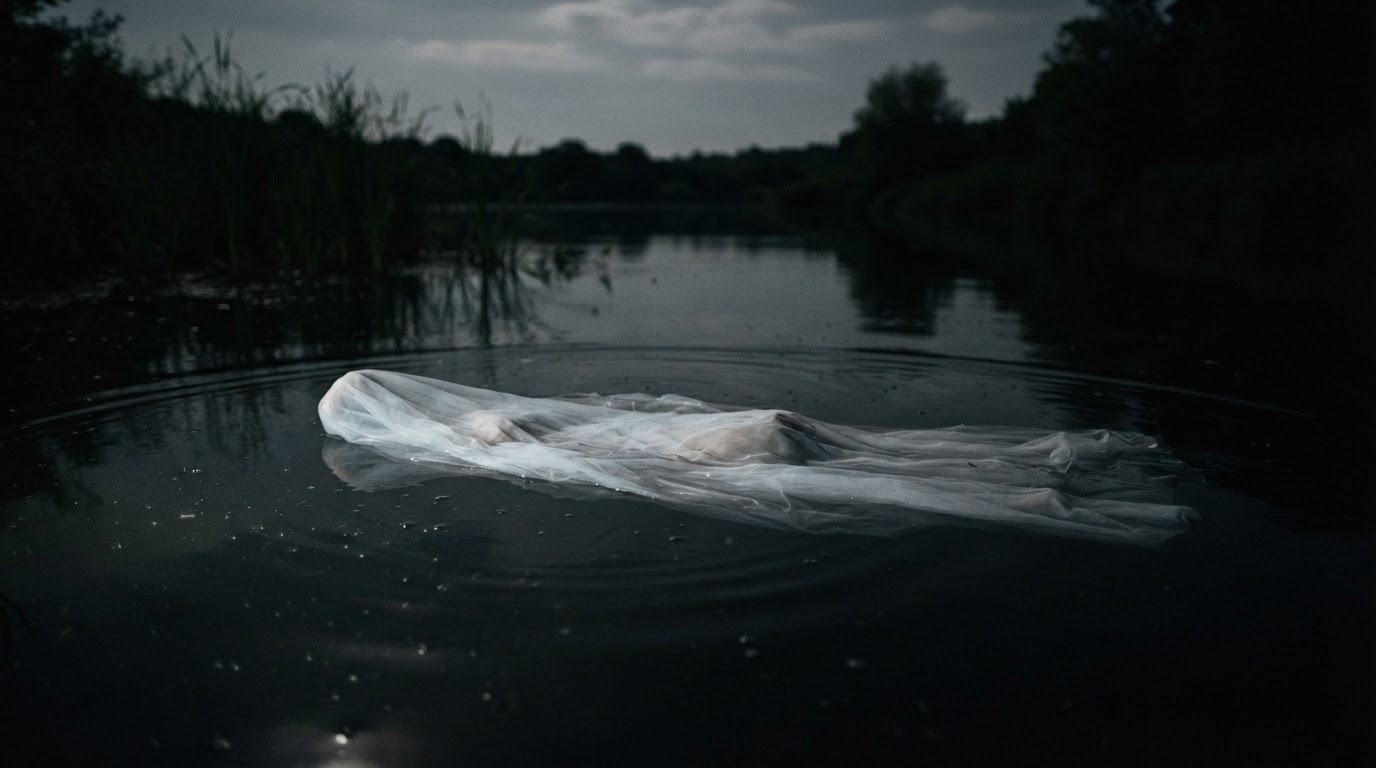
At the gate of the next world, the story goes, she is turned back. She cannot enter without her children, and her children are lost, and so she is sent to look for them. And she looks. She has been looking ever since — a pale figure in a long white dress or veil, walking the edges of rivers and lakes and canals in the dark, weeping, asking the water and the reeds and anyone she meets the same unanswerable question. Have you seen my children? Where are my children? She is not searching a place. She is searching everywhere there is water, forever, and she has not found them, and she never will.
The Rule of the Cry
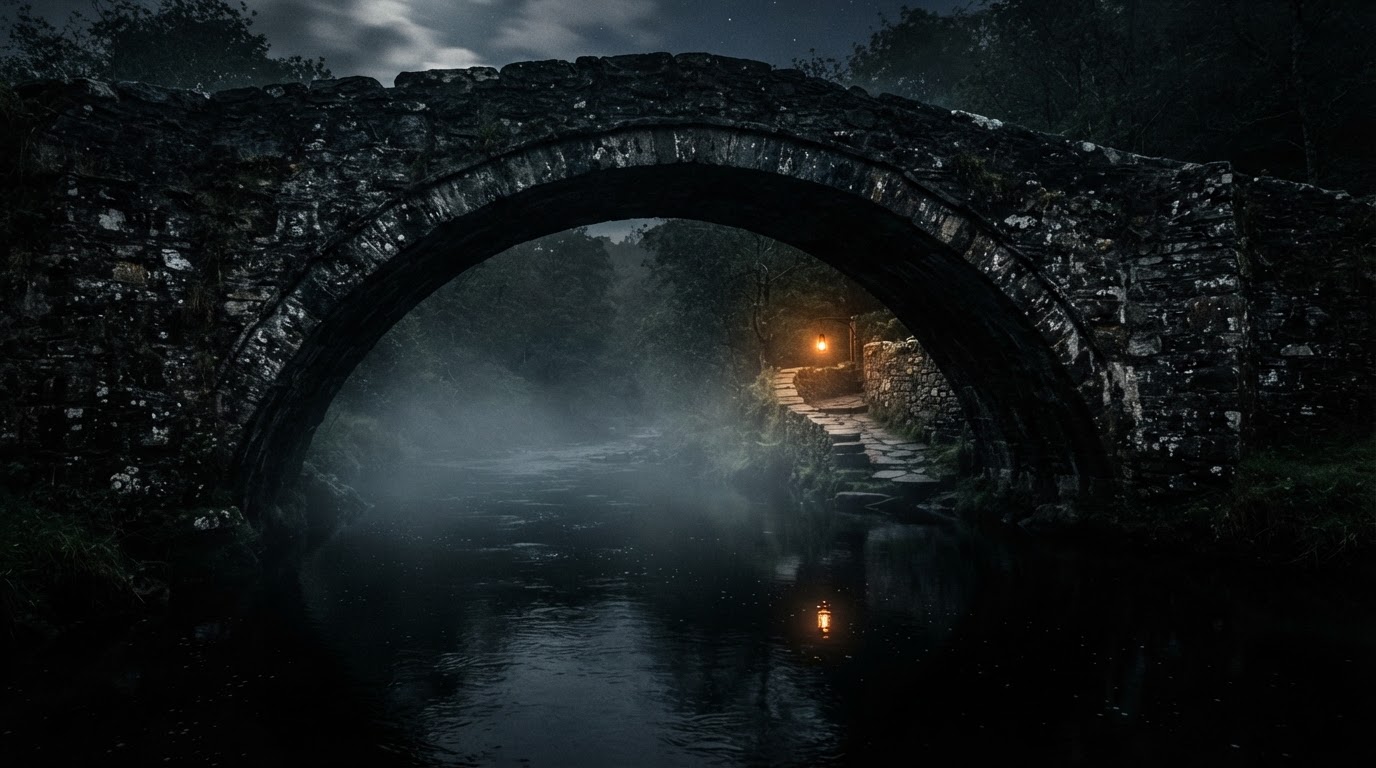
Every real ghost story has a rule, and La Llorona's is one of the strangest and most quietly perfect in all of folklore. It is about her cry, and about distance, and it runs exactly backward to how the world is supposed to work.
When you hear her weeping loud and near — the sound seeming to come from just there, at the next bend, close enough to reach — she is in truth far away. And when the cry is faint and thin and far off, a small sad sound at the very edge of hearing, she is close. She is, perhaps, right behind you.
Sit with why this works, because it is a piece of genuine craft, invented by no one and improved by everyone who ever repeated it. It inverts the one instinct you most rely on in the dark: that loud means close and quiet means safe. It takes the ear, the sense you fall back on when your eyes fail at night by the water, and turns it into a liar. It means you can never use the cry to find her or to flee her, because the cry tells you the opposite of the truth. And it means the most dangerous moment is the one that feels safest — the moment the weeping goes soft and distant and you let your shoulders down, thinking she has passed on down the canal. That is the moment to be afraid. In the logic of the legend, the softest cry is the coldest one. It is the sound of her having arrived.
Five Hundred Years: The Weeping Before the Fall
To understand how deep this legend runs, you have to go back past the colony, past the conquest, to the last years of an empire that did not yet know it was ending.
In the Aztec, or Mexica, accounts gathered after the conquest — most famously in the great compilation of the friar Bernardino de Sahagún — there is a list of omens said to have appeared in the years before the Spanish came, portents that troubled the last independent rulers of Tenochtitlan. A comet standing in the daytime sky. A temple bursting into flame that no water could quench. The lake itself boiling up without wind. A strange bird brought to the emperor Moctezuma with a mirror in its head. And among them, the sixth omen, the one that reaches straight down the centuries into the story we are telling.
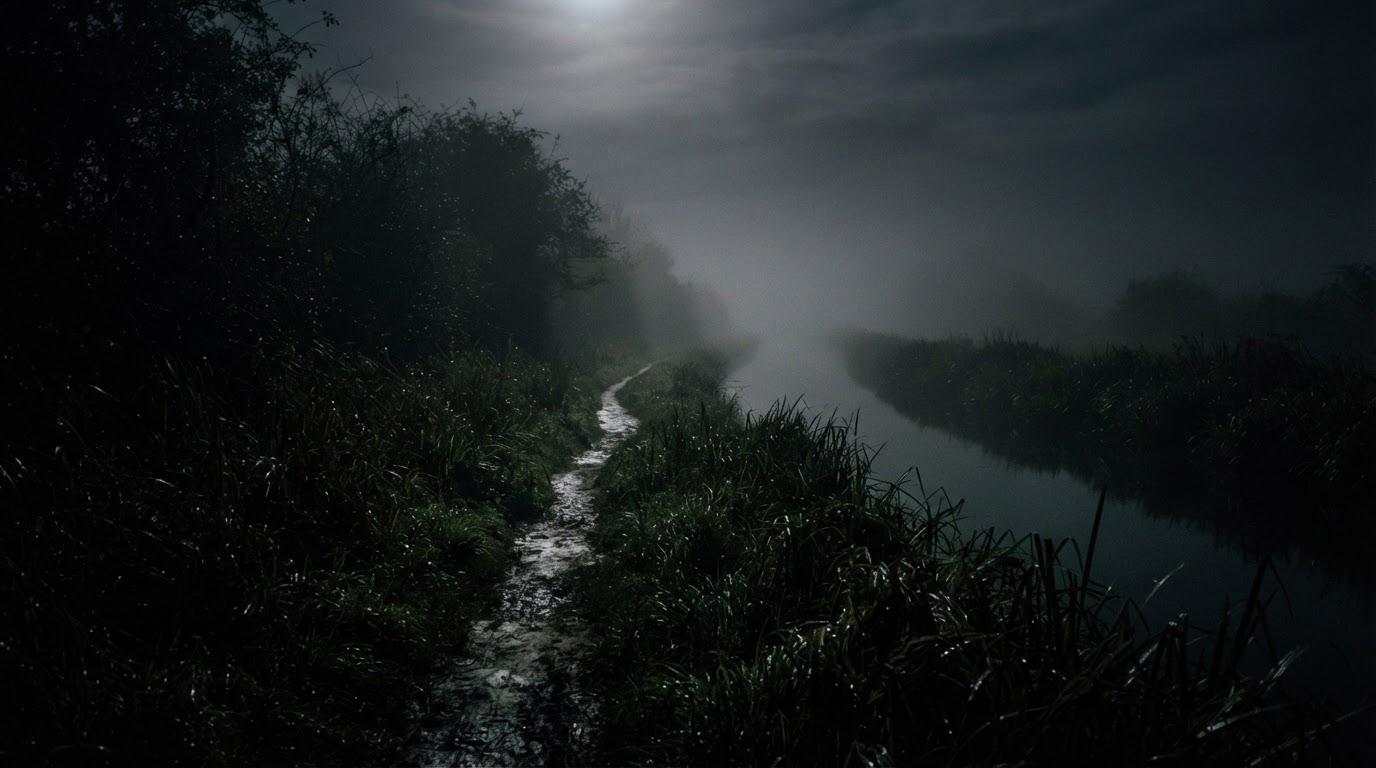
In the nights before the fall, the accounts say, a woman was heard weeping in the dark streets of the island city. Night after night her voice carried over the canals and the causeways, and the words she cried were these, or close to these: "My children, we must go far from here." And again: "My children, where shall I take you?" A woman no one could find, mourning in advance for children not yet lost, walking the water of a city that had perhaps a year of life left in it. The people who heard her did not know what she was. We, looking back, cannot help but feel we do. The Weeping Woman was already walking the canals of Mexico before Cortés ever saw them — and what she wept was not a private grief but the death of a world.
The Goddess Behind the Ghost
That sixth omen was not, most likely, a first appearance. It was a recognition — the people of Tenochtitlan hearing something they already had a name for.
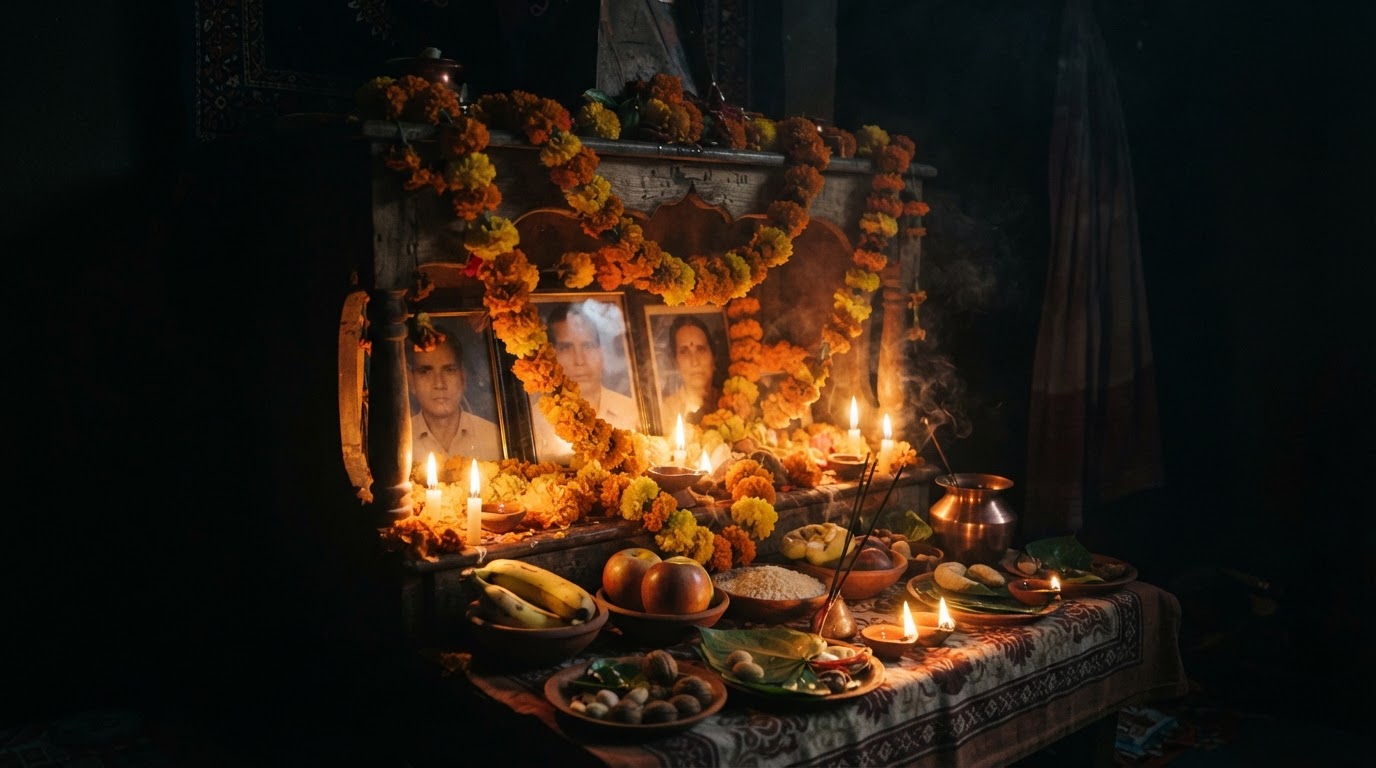
Woven through Mexica belief is the figure of Cihuacóatl, "Woman Serpent," a mother goddess of terrible aspect associated with childbirth and with the women who died bearing children, a deity who wept and cried out in the night. She was said to appear in white, to walk among the people carrying an empty cradle, to leave it in the marketplace and vanish — and when the cradle was looked into, it held not a child but a stone, or the blade of a sacrificial knife. Her weeping was an omen in itself, a sound the city knew to dread. In her, and in related figures of the divine feminine — the mothers who died in childbirth, the cihuateteo, who returned at night to the crossroads — you can already see the shape La Llorona would take: a woman in white, mourning by night, bound to children and to loss, moving through the streets and the water of the valley of Mexico.
So when the friars arrived with their own long European tradition of restless female ghosts by water, the two streams met and did not so much combine as recognize each other. The Weeping Woman who walks the canals of Mexico City is not simply a colonial invention laid over the native imagination, nor simply an Aztec goddess in a Christian dress. She is the seam itself — the place where an empire's memory of its own mother-goddess and a conquering religion's fear of the unquiet dead were welded into a single figure who has haunted the water ever since.
The Colonial City and the Woman in White
By the colonial centuries, La Llorona had settled fully into her most familiar form, and the sightings gathered in the streets of Mexico City itself.
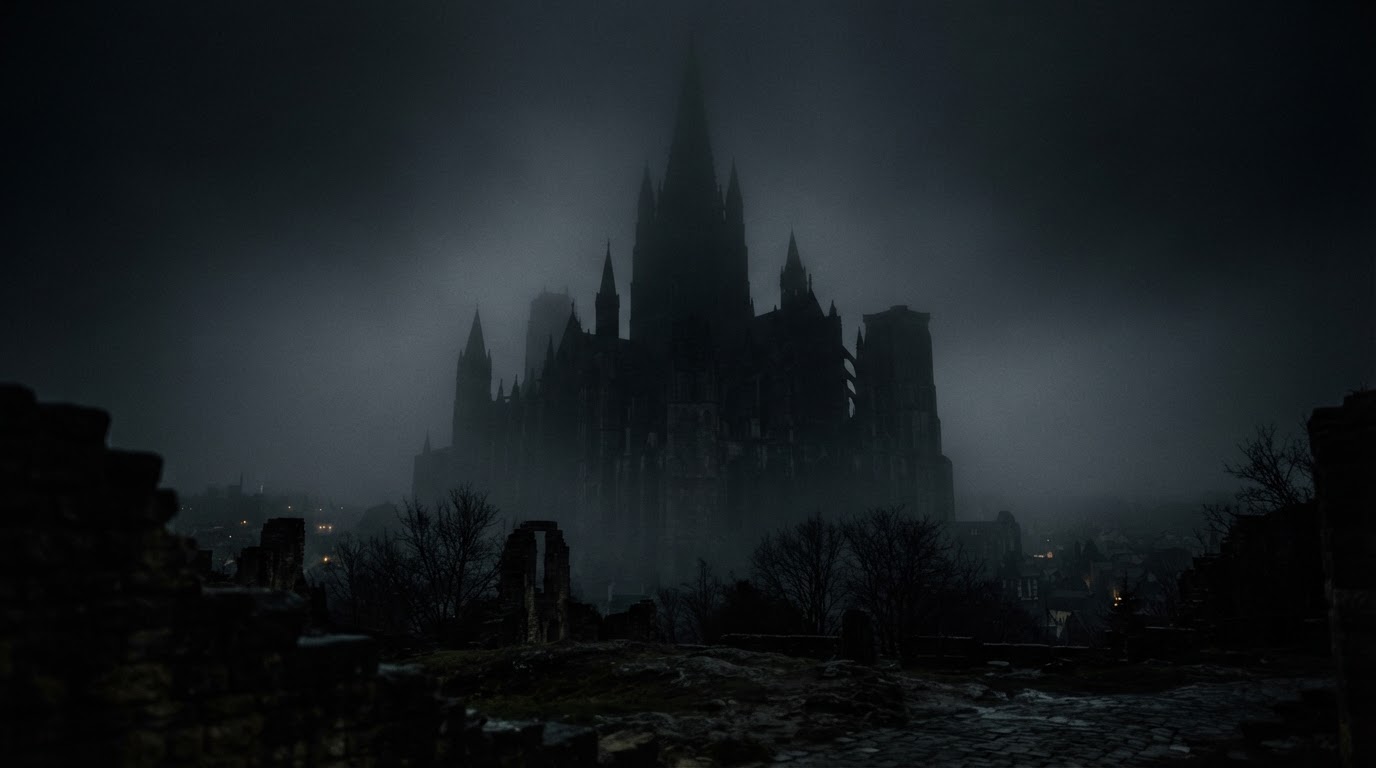
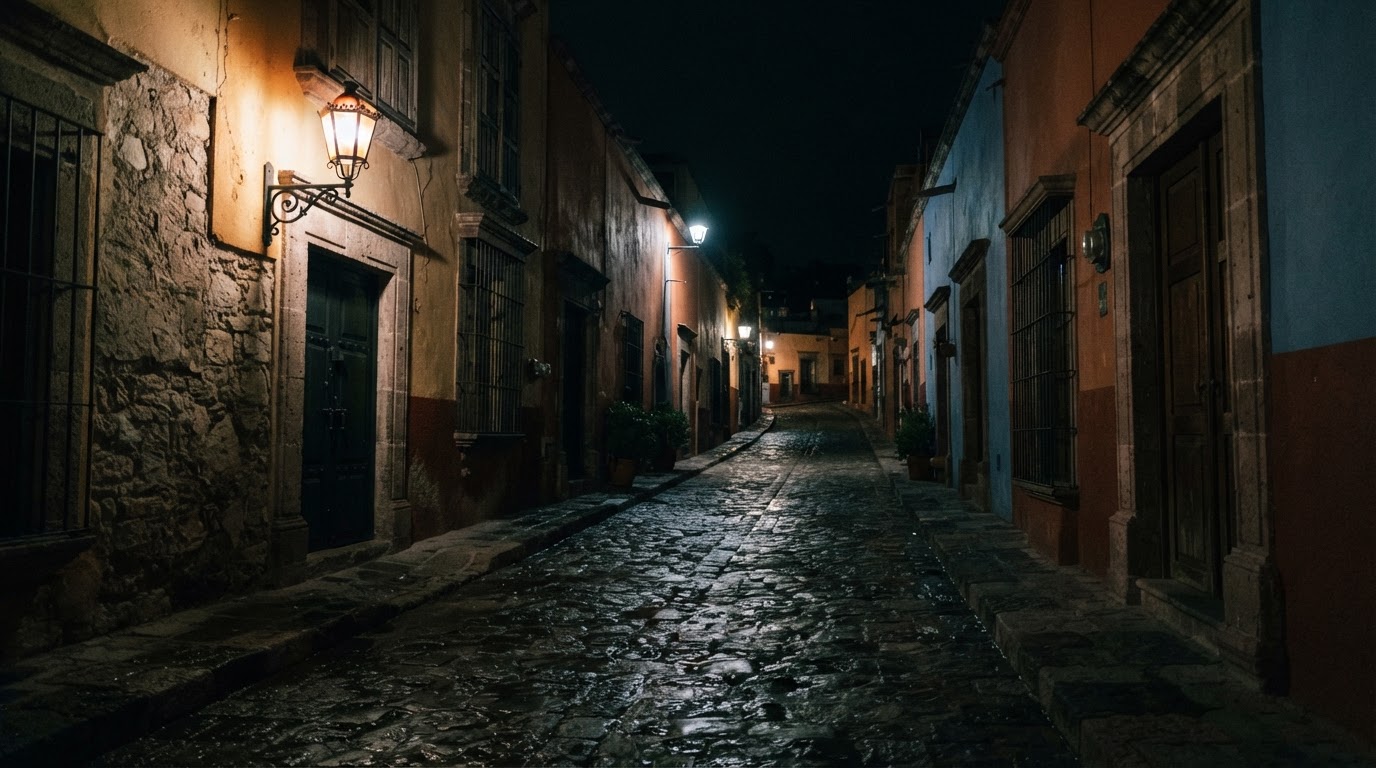
The chronicles and the oral accounts of the seventeenth and eighteenth centuries describe her walking the plazas and cobbled lanes of the capital at the dead hours of night — a tall woman in white, her face veiled or turned away, moving with an unnatural grace toward the canals and the causeways and the lake that then still ringed the city. Night watchmen and late travelers told of hearing her long wail rise over the rooftops, of following the sound and finding no one, of a figure who reached the water's edge and dissolved into it or into the mist. She kept to the hours when the city belonged to no one, and she kept to the water, always to the water, as though the lakes and canals of the drowned Aztec capital were the map of her endless search.
It is worth remembering what that city was built on. Tenochtitlan had been an island metropolis laced with canals; the Spanish drained and filled and paved, but the water kept returning, kept flooding the low streets, and the memory of the lake never fully left the ground the colonial city stood on. A ghost bound to that water was a ghost bound to the buried city underneath — and every generation that heard her wail was hearing, without knowing it, the voice the sixth omen had described.
The Malinche Question
There is one more thread the scholars argue over, and it is the one that turns La Llorona from a ghost into a wound.
La Malinche was the indigenous woman — Malintzin, later baptized Marina — who served Hernán Cortés as interpreter, guide, and mistress, and who bore him a son said to be among the first mestizo children, the first of the mixed people who would become modern Mexico. For centuries she has been a contested figure: traitor to some, survivor to others, mother of a nation to others still. And some readers of the legend, and some scholars of it, have heard in La Llorona an echo of her — a native woman who loved and served a Spanish man, who gave him children, and who was, in the end, set aside. In this reading, the Weeping Woman drowning her children and mourning them forever becomes something larger and more terrible than a village tragedy: she becomes an image of the conquest itself, of a people whose old world was taken and whose children were born into the world that replaced it, weeping for what could not be kept.
Not every folklorist accepts the connection, and it is right to be careful with it — the identification of La Llorona with La Malinche is as much a modern interpretation as an old tradition, and the legend is far older and far more various than any single reading. But that the connection can be made at all, that it feels true even where it cannot be proved, tells you what kind of legend this is. La Llorona is never only a ghost. She is a country's grief given a woman's shape, walking the water where its first world went down.
The Weeping Woman Across a Continent
She did not stay in the valley of Mexico. Wherever the language and the memory traveled, she traveled, and everywhere she went she took on the color of the local water.
Across Mexico the details shift from region to region — the river changes, the man changes, the number of children changes — but the shape holds. In Guatemala and further into Central America she walks alongside cousins of her own kind, the wailing spirits and the whistling men of those countries' nights, so that a traveler on a dark road might not know at first whether the cry ahead is hers or another's. Southward through the continent she appears under her own name and under others, a woman weeping by rivers and lakes wherever Spanish is spoken.
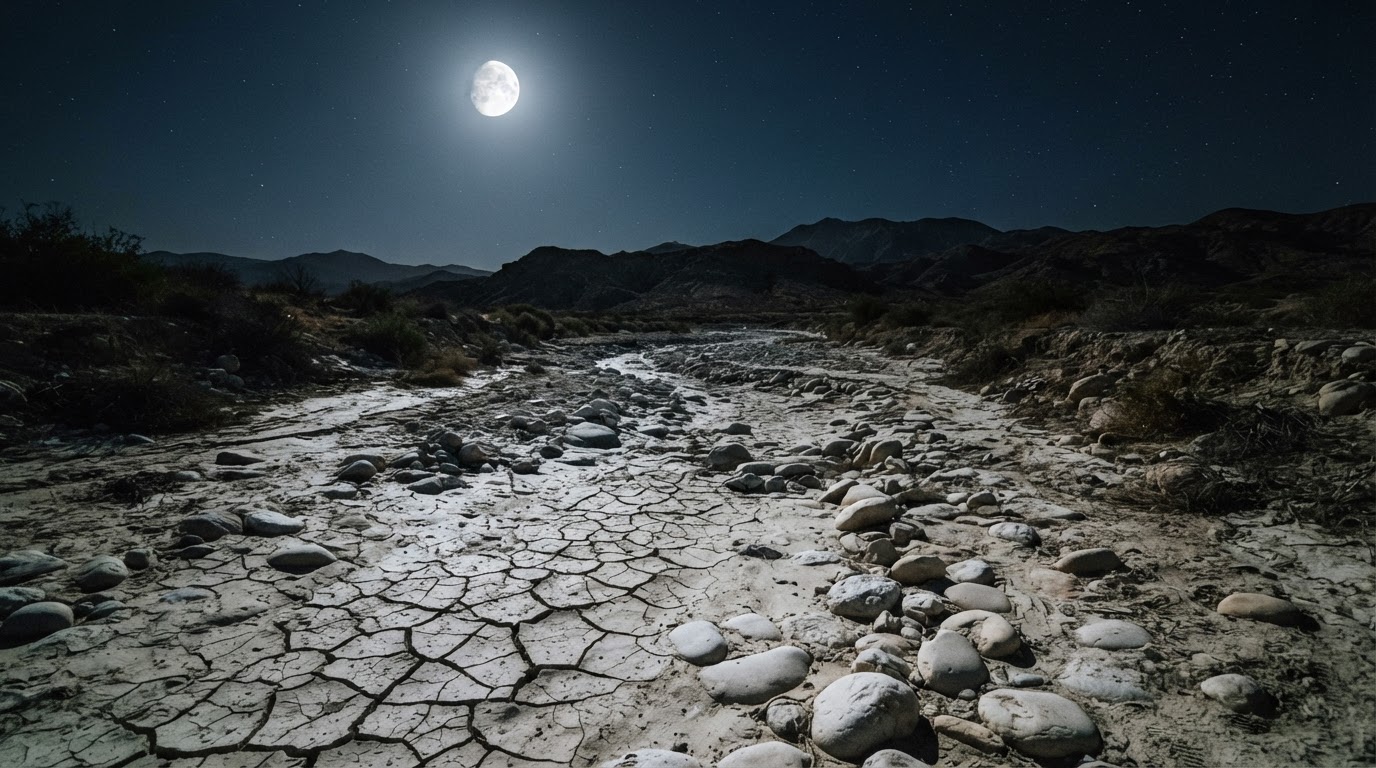
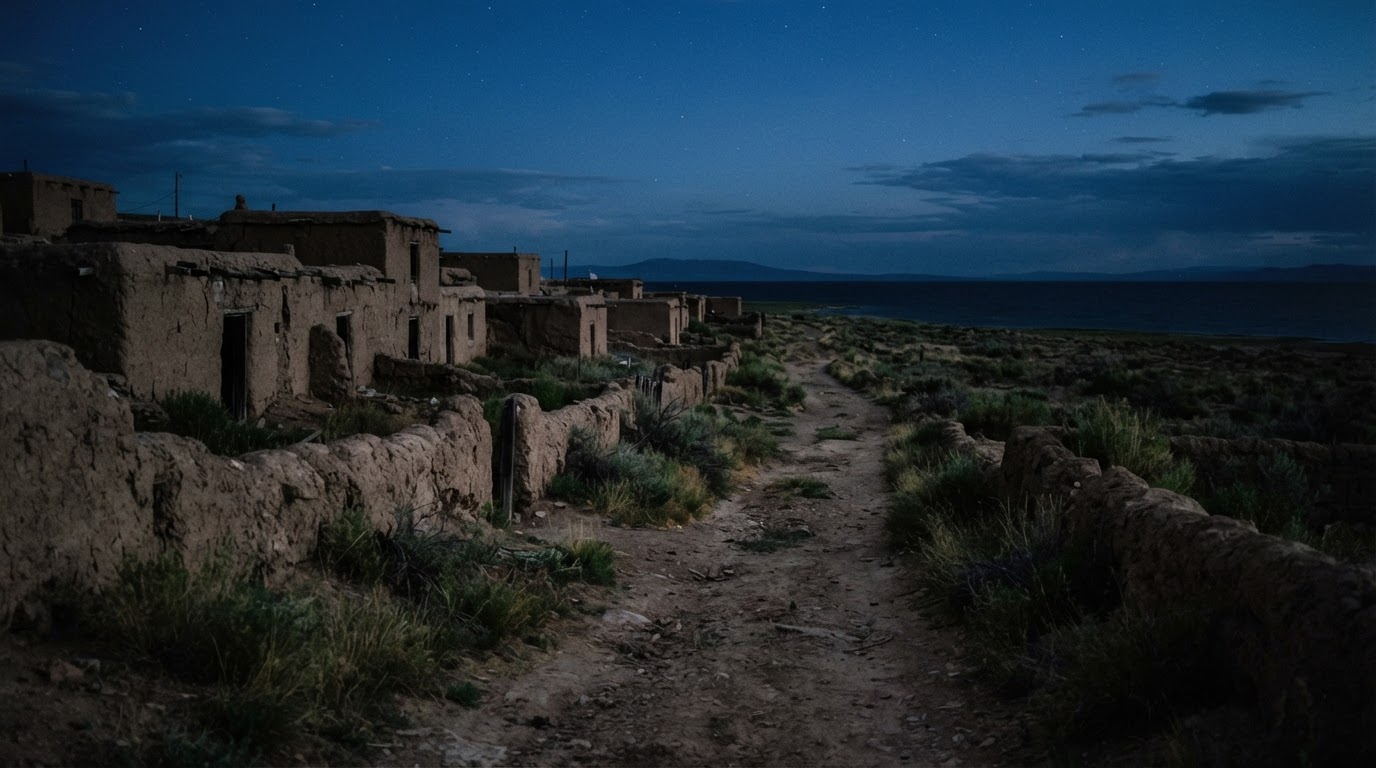
And she went north. In the borderlands and the American Southwest — Texas, New Mexico, Arizona, California, wherever the rivers run and the Mexican and Mexican-American communities carried their stories — La Llorona is as alive today as anywhere. Along the Rio Grande and the irrigation ditches and the arroyos that flood and empty with the season, she is the woman children are warned about, the reason not to play near the water after dark. Riverbank or canal, crossroads or dry wash, the legend adapts to whatever water it finds, because water is the one thing it cannot do without. She is the continent's most widely shared ghost, and she belongs to every river that ever took a child, and to every mother who ever feared one would.
The Boogeyman and the Tragedy
There are two ways to hold La Llorona, and most people who grow up with her hold both at once, at different ages.
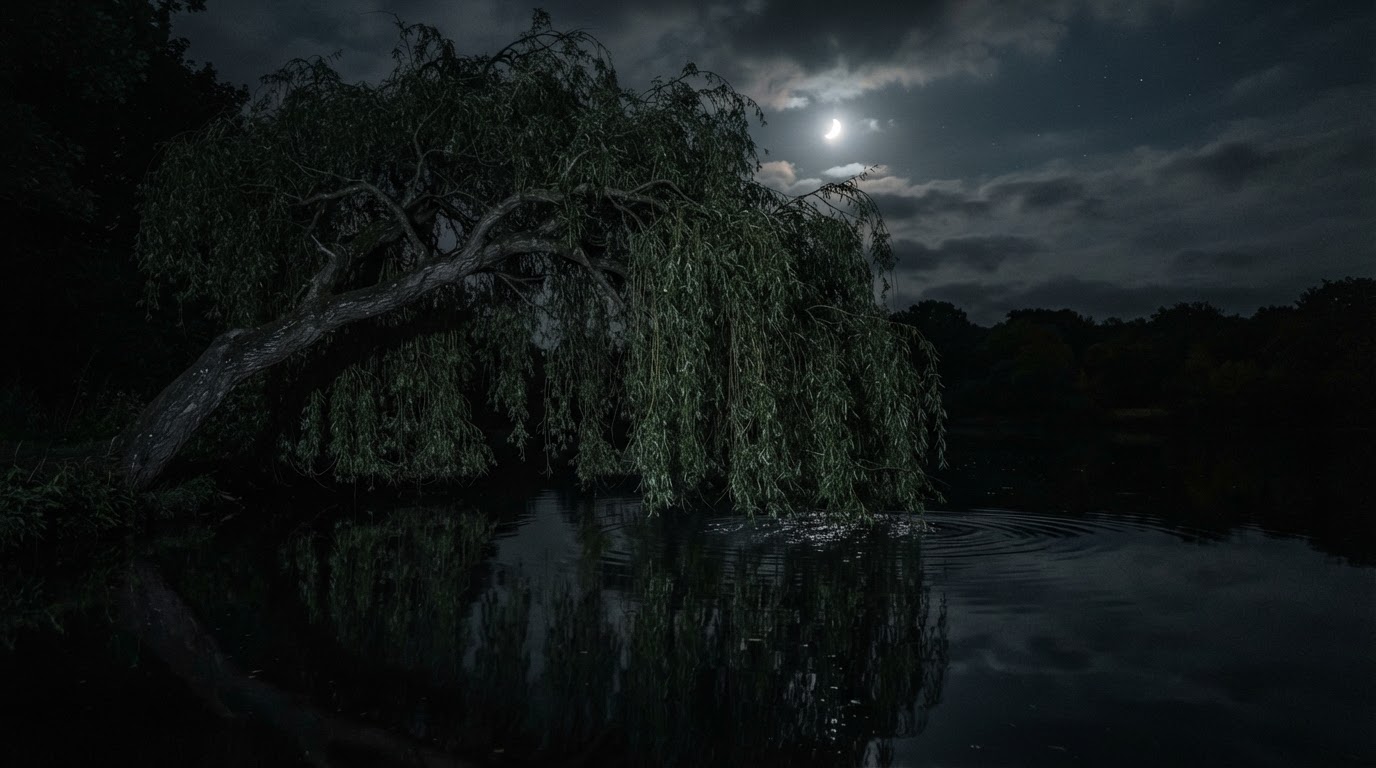
To a child she is a boogeyman, and a useful one. Don't go near the canal after dark or La Llorona will take you. In a landscape threaded with rivers, ditches, and canals that drown the careless every year, she is a warning wearing a ghost's face — a way for a culture to keep its children back from the water without having to explain, each time, exactly why the water is dangerous. The mother who lost her own children now takes the children of the living, the story says, mistaking them for hers or reaching for them out of a grief that cannot tell the difference. Stay away from the water. She is listening for you.
But grow up, and the same legend turns over in your hands and shows its other face, and the other face is not a monster at all. It is a tragedy — the oldest and most human tragedy there is. A woman destroyed by love and loss, driven to the one unforgivable thing, and then condemned not to oblivion but to consciousness, to search forever for what she herself put beyond finding. The horror of La Llorona, read as an adult, is not that she might take you. It is that she cannot stop looking. She is grief that has been denied even the mercy of an ending — a mother walking the water five hundred years into a search she already knows is hopeless, and unable, for all that, to stop calling their names.
Reading Her Again: Grief, Water, and the Woman's Voice
Modern readers have returned to La Llorona and found her larger than the warning she was reduced to, and some of what they have found is worth sitting with.
Feminist retellings, especially from Chicana writers and scholars, have taken the Weeping Woman out of the role of monster and asked what the legend does not say — asked about the man who left, about a world that gave a poor and beautiful woman almost no power over her own life and then blamed her alone for the catastrophe that followed. In these re-readings La Llorona is not simply a mother who did a terrible thing, but a woman failed by everyone and everything around her, and her endless weeping becomes not only penance but protest, the sound of a grief that refuses to be quiet, that will not let the water close smoothly over what was done. She has been reclaimed, in this century, as a figure of resistance as much as of horror — a woman whose voice, at least, could not be taken from her.
And there is the quieter reading, the one that needs no ghost at all. Grief does strange things to perception, and it has always done them near water. The mind that has lost a child does not simply stop; it goes looking, it hears the lost voice in ordinary sounds, it sees the lost shape at the edge of the eye. And moving water is the great engine of that trick — a river or a canal at night generates a constant shifting wash of sound, low and complex and half-human, and the ear, straining in the dark, finds words in it. Wind over reeds, water folding against a bank, a night bird far off: run them through a frightened or a grieving mind and they resolve, again and again, into a woman weeping. La Llorona may be, in part, the sound water makes when a person who is afraid, or bereaved, listens to it too hard in the dark. That does not make her less real. It makes her a legend built precisely, and cruelly, out of the two things human beings least master — grief, and the dark by the water.
The Living Legend: Screen, Song, and the Cry That Won't Fade
For a ghost five centuries old, La Llorona has never been more present than she is now.
She reached the screen early — a Mexican film of 1933 was among the country's first sound horror pictures, and a celebrated 1961 Mexican film, La Llorona, fixed her image for a generation of filmgoers. She has recurred in Mexican and Latin American cinema ever since, and crossed into Hollywood with a 2019 studio film that set her loose in modern Los Angeles — proof that the Weeping Woman can walk any water, even a city's swimming pools and storm drains. She moves through music, too: her name and her lament run through the great Mexican song La Llorona, that aching standard covered by voice after voice, so that the same syllables that frighten children by the canal are sung, elsewhere, as one of the most beautiful expressions of love and sorrow the culture owns.
And she has slipped, gently, into the tenderest corners of the tradition. The culture of the mothers' and grandmothers' lullaby — the songs sung to keep children close and safe through the night, the world so lovingly drawn in a film like Coco — carries her shadow at its edge, because every lullaby that soothes a child is quietly answering the fear the legend names: the dread of the child lost, the mother's voice against the dark. In the age of the phone camera she has gone viral too — grainy clips of a pale figure by a canal, a wail caught on a night recording, the old legend refreshing itself in a new medium exactly as it always has. She does not age. She only finds new water.
The White Woman by the Water, Everywhere
Step back far enough and La Llorona stops looking singular and starts looking like something the whole human species keeps arriving at independently: the woman in white who died by water, or died bearing a child, or lost a child, and who walks the edges of rivers and lakes forever, weeping.
Korea has her. The 처녀귀신 (cheonyeo gwishin), the maiden ghost in a long white sobok with wet black hair over her face, is the shape a young woman's unresolved grief and unfinished life take in the Korean imagination — a sorrow that will not settle, lingering at the threshold between worlds. Japan has her too, and closer to the bone: the ubume, the ghost of a woman who died in childbirth, who returns weeping, sometimes carrying an infant she asks a stranger to hold, bound forever to the child and the loss that killed her. Ireland has the banshee, the woman whose keening wail carries over the countryside as an omen of a death to come — a female voice, a cry heard before you understand what it means, grief arriving from the dark ahead of you. Across cultures that never touched, the same figure keeps forming: female, in white or in mourning, near water or crossing between worlds, and known above all by her voice, her weeping, the sound of a loss that outlasts the one who suffered it.
And on this site you have already met her sisters. In Southeast Asia she wears the face of the pontianak — the vengeful spirit of a woman who died in pregnancy or childbirth, a wailing figure in white whose cry, like La Llorona's, plays its own cruel trick of distance. In Thailand she is Mae Nak, the woman who died in childbirth and would not leave, whose love and grief outlasted her body and bound her to the water's edge and the family she could not release. Weeping women of water and motherhood, all of them — the same ancient wound opened in three languages and three rivers. La Llorona is the one who walks the canals of Mexico. But the cry is older than any single country, and it has been carrying over dark water, in every language there is, for as long as mothers have feared the loss of what they love.
Grief That Outlives Empires
An empire heard her before it fell. That is the detail that stays.
Whatever La Llorona is — a colonial ghost, an Aztec goddess in mourning white, the drowned grief of the conquest, the sound moving water makes to a frightened ear, or a mother's tragedy told so many times it wore a groove into a whole hemisphere's imagination — she began, in the oldest account we have, as a voice weeping over a doomed city, mourning children not yet lost, a year before the world she walked in came to its end. Tenochtitlan fell. The lake was drained. The empire became a colony and the colony became a country and the country grew into the modern nations that now share her. And through all of it, across five hundred years and the fall of everything that stood when she began, she has never stopped. The cry still carries over the water. The search has never ended. The children have never been found.
Cihuacóatl left a cradle in the marketplace and the people who looked inside found a stone, or a knife. I have set that account beside the modern ones — the canal, the veil, the voice over the water — perhaps a dozen times now, and each pass I catch myself doing the same useless thing: checking whether any teller, in five centuries, ever describes the children. They are named in no version. No ages, no faces, not even a count that holds steady. The whole enormous grief of this continent is organized around two people who exist only as an absence somebody is shouting into.
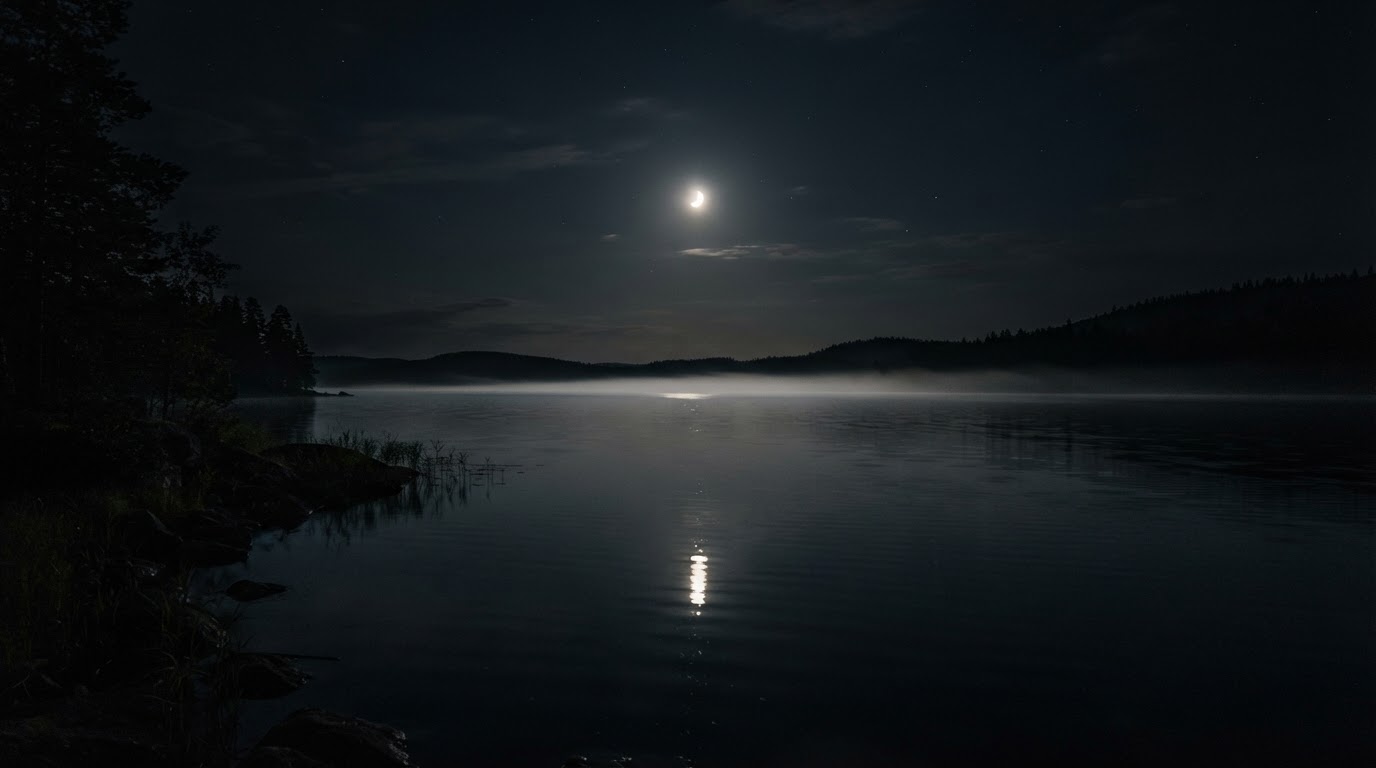
That is finally why she will not fade, long after the fright of her has worn thin. La Llorona is grief that outlived the empire that first heard it — proof, walking the water's edge, that some losses are larger than the worlds they happen in, that a mother's mourning can outlast a civilization, that the water keeps the memory even after the city on it is gone. So the story leaves you where it began: on a dark canal path, the boats tied and silent, the water black and holding still. And out across it, thin and far — which means, if the old rule holds, that she is not far at all — the sound of a woman weeping, calling into the dark for children the river took five hundred years ago, and has not given back, and never will.
---
The images and video in this article are AI-generated works produced to convey the mood of the story, and are not photographs of any actual person or event.
Comments
No comments yet — leave the first one.